Why AI Isn't the End of Human Writing
Has AI killed writing? Rather than an apocalyptic threat, writing machines are the final link in a chain that began with the alphabet. The only things that cannot be replaced are human intent and human error.

Has AI killed writing? Rather than an apocalyptic threat, writing machines are the final link in a chain that began with the alphabet. The only things that cannot be replaced are human intent and human error.
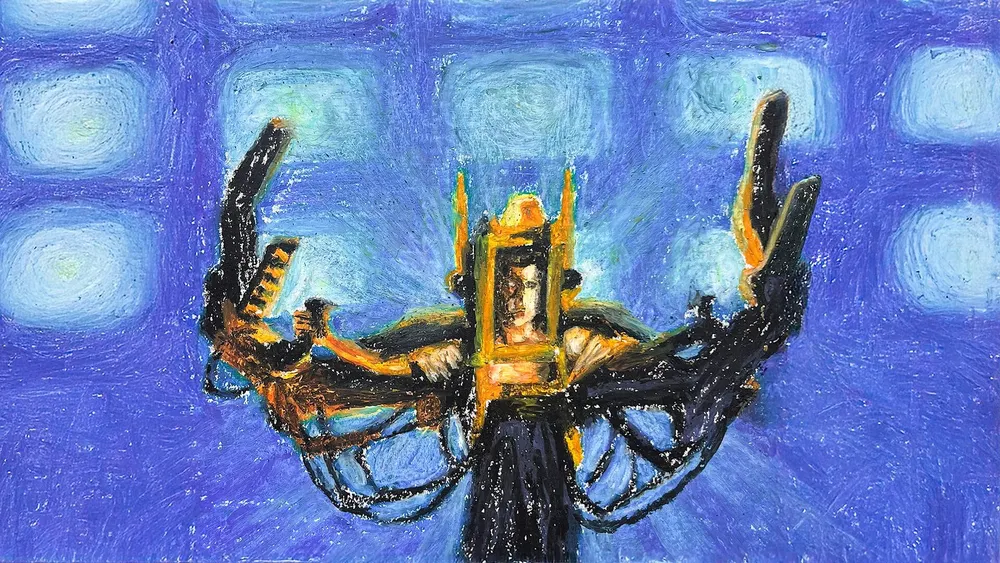
The scene is set: there are scattered blue lights reflecting off the floor of the ship, occasionally interrupted by a flickering white light. Then the hatch opens, and we see Ripley clad in a metallic exoskeleton with arms like giant pincers. She moves through the fog that gathers in the corners. The xenomorph queen approaches, a massive black creature that has a girl cornered. The entire crew has been killed, and until this moment, it seemed impossible to confront it. But now our heroine fights with technical assistance, an industrial device (originally designed for production) repurposed as a weapon to defeat the alien threat.
The xenomorph is a term coined for the first Alien movie, derived from the Greek xénos (strange, foreign, someone who doesn't belong) and morphé (form). It is a thing alien to the human world, irreducible to its codes. And the exoskeleton that Ripley dons to face it also embodies this: it is a strange, even inorganic form that envelops and projects her body. Yet, as she fights, it acts in accordance with her intentions, moving when she wants to move and helping her defeat the alien queen.
We live surrounded by hybrids: languages infused with technology, texts produced between screens, algorithms, autocorrects, and now language generation models. So we ask ourselves: does AI write? Does it replace the writer? Is this the end of human writing?
I like to think that this is what writing is. That when we sit down to process ideas, to say something, anything, in this system of codes we invented thousands of years ago, we are like Ripley facing the strange, even the very form itself. But writing is not just body; it is also that external and inorganic element, the tool that allows us to record, carve, print, or encode; it is, nothing more and nothing less, a way, mediated by technique, of socially producing meaning.
We live surrounded by hybrids: languages infused with technology, texts produced between screens, algorithms, autocorrects, and now language generation models. So we ask ourselves: does AI write? Does it replace the writer? Is this the end of human writing? These questions focus on whether the exoskeleton fights on its own, and that leads to thinking more about Skynet and the rebellion of machines, rather than placing the problem on the owner of the factory.
Writing is undergoing a traumatic experience. Understanding it as such, without veering into exaggeration or apocalypse, requires stepping away from some oppositions that are neither real nor productive.
The question today is what happens when the exoskeleton replaces the body. Or, at least, in its basic motor functions, in its ability to produce and technically resolve. So now that machines can form sentences, what remains of our writing? Is that artificial writing a sinister replacement for my natural writing? The temptation, I believe, is to stay there.
 Mariano Vilar
So let’s dive right into the nature-artificiality dichotomy, and while we’re at it, we can pose this question: is orality more natural than alphabetic writing? Articulated orality is already language, that is, a system, a learned code, and a technique that performs the body. Speaking a language is not about unleashing an instinct; it’s about operating within a convention that preexists us, one we had to internalize and to which we never fully belong. Even before that, there were growls and guttural sounds, but those also functioned as signs shaped by evolution, by the group, and by history. There’s no pure outside there either. And what about the intention to say—would that be what’s natural? Intention forms within language; we don’t translate our desires. When someone wants to say something, that "something" already takes the form of something sayable: it has categories, syntax, vocabulary, and the discursive genres in which we learned to think.
Mariano Vilar, analyzing McLuhan in a recent article for this outlet, states that thought is not something that happens inside and then spills out into words; a significant part of it occurs in the very act of writing or speaking. If this is the case, technique is not an afterthought to humanity: it is a constitutive part. There is no pre-technical homo sapiens that later complemented itself with tools. There is a single process that produces both species and tools, body and prosthesis.
Donna Haraway's formula in the 1985 Cyborg Manifesto remains, in this sense, a key framework for today: there is no fundamental ontological separation between the technical and the organic, nor between the machine and the organism. And it’s easy to verify: I, who write these lines, and you, who read them, are bodies traversed by antibiotics, vaccines, corrective lenses, digital platforms, and even languages learned on Duolingo. We are already cyborgs, perhaps not in the cyberpunk sense of Robocop or Neuromancer, but certainly in the literal sense of the manifesto: creatures in which the division has never truly ruled.
There is no pre-technical homo sapiens that later complemented itself with tools. There is a single process that produces both species and tools, body and prosthesis.
Bruno Latour formulates something similar as a historical diagnosis: we have never been modern, he states in his eponymous 1991 book, because we have never fully separated nature from artifice. It’s not that we failed in the separation; it’s that the separation never had a real referent. Purity was the project (to have clear categories that show clear oppositions) but not the starting point. What has always existed are hybrids. The natural/artificial opposition is a very useful retrospective fiction for some political and conceptual operations (as it was for legitimizing sciences or fascism at its time), but it does not name any real boundary in the world.
If we had to look for something closest to the "natural," we might think of the conversation between two close individuals with full oral and auditory capacity: one body using its organicity to emit a sound and another body that perceives it. In that case, there is no non-biological physical artifact between the bodies. But the alphabet is indeed an artifact, albeit of a different kind. It is the arbitrary conversion of phonemes into visual signs, a technology that had to be invented, propagated, and normalized. When the first civilizations adopted it, they didn’t simply start "writing what they said"; they opened a new device that reordered memory, law, abstract thought, and eventually, philosophy. A technologization of the word that changed an entire way of relating to thought and time.
The printing press, sixteen hundred years later, did the same on another scale, as it standardized typefaces, created the modern idea of author, made text replicable, and sparked an editorial economy. Cervantes could not have written Don Quixote without the printing press because the novel itself (as a genre that thrives on mass circulation, paying readers, and the dialogue it generates with itself) is a creature of the press. The printing press is not just the
 Jazmin Cueto Hermite
Hundreds of years later, in the 1980s, at the La Ópera bar in Buenos Aires, the topic of conversation was the computer. Osvaldo Soriano, as Ricardo Piglia recounts in his diaries, said he had lost five entire pages due to a power outage. "They just disappeared, bam, in an instant." His solution was to make backups every half hour. He even thought of it as a survival technique, and it became a core part of his last novel (in which a writer buries the disk with the backup of the novel he's writing, but later, when he needs it, forgets where it is). Piglia, who was already writing with WordPerfect on a Macintosh, noted that for the first time it was possible to edit while writing, without having to retype the entire page. The eraser as a separate instance was beginning to disappear, along with a way of thinking about writing. "Any young writer can be their own editor at the same time," he said, frustrated.
What was a novelty in the 1980s with word processors later expanded on a larger scale. Spell checkers began correcting us without being asked; the autocomplete feature on the cell phone modifies or guides our lexical choices; search engines alter and direct our inquiries. Each new function mediates between us and the world. All of this reaches its pinnacle with language generation models (LLM).
Generative artificial intelligence, as seen in that series, does not imply the intrusion of technology into a previously pure and immaculate realm, but rather is the last step in a history that began three thousand years ago when someone decided that a sound could be represented by a sign. However, there is a difference between these new typewriters and everything that preceded them: until now, each of those machines (from the alphabet to the word processor) was a mediation between a body that wanted to say something and a text that was said. The body was always in the middle, typing or drawing, choosing each word. AI is the first technology capable of skipping that typing. Not the first mediation, not by a long shot. But it is the first that produces text without the body requesting it having to think about its form. That is indeed new, and it gives us the most vertigo because it proposes a profound change in the notion of writing.
At this point, a bit of philosophy of language is needed, and a good way to explore it is through a note by Juan Ruocco in this medium, who did the work of mapping it out. The center of gravity of the discussion is a phrase by Hilary Putnam, an American philosopher: meaning is not in the head. Putnam proposes a thought experiment he calls “Twin Earth.” Let’s imagine two identical planets in every way. On Earth, the word "water" refers to H₂O. On Twin Earth, it refers to a substance indistinguishable in practice, but whose chemical composition is XYZ. Although speakers of both worlds have the same mental states when thinking of "water," the word refers to different things. What does this mean? That what makes a word mean something is not only related to what happens inside the speaker's head. An environment is needed, a causal history that connects the word to the thing, and a linguistic community that sustains that connection over time.
AI is the first technology that produces text without the body requesting it having to think about its form. That is indeed new, and it gives us the most vertigo because it proposes a profound change in the notion of writing.
Applied to an LLM, this has strong consequences at first glance. An LLM never felt thirsty when it said "water." There is no causal chain between its parameters and the world where water moistens, calms, or drowns. It uses the term because it found it millions of times in its training data, not because it participates in the world that those words name. Its use of the term is, as Ruocco says, a parasite of ours. Up to this point, the argument might seem to lead to the idea that AI produces text without a speaker. Sentences without anyone behind them, messages without a sender. A Skynet without consciousness.
But there is someone behind it: for the text to exist, someone had to open the chat and request it. There is a finger on the button. There is a desire (it may be vague or strong, artistic or commercial, but it is desire nonetheless) for something to appear on the screen. And that someone is indeed in the world, has felt thirsty at some point, and participates in the causal chain and the linguistic community that Putnam describes. The question then is where that body has gone, and how much it affects the text it requests to produce (that is, it externalizes).
That is the mutation that changes the paradigm. The speaker did not disappear; rather, they shifted. They used to type word by word; now they request, prompt, and in that act, they also choose, discard, recombine, and rewrite. The function is not the same (and this opens a way out of this mess that will continue to exist: choosing to maintain the classic function of writing without this new mediation) but the body hasn’t completely evaporated. I call it the last bastion: the stronghold where intention still lives, sometimes compressed to the minimum, but still there.
But the issue, again, is that we have no way of measuring how much body is in what we read, and that raises alarms. We cannot separate the artificial from the natural. Because it is not the same to say, "write me a poem about love," thrown out by someone who has no idea what they mean but wants text on the screen, than for someone who just asks something and incorporates fragments that they then editorialize. In the first case, the causal chain with the world is technically there, but it is weak: no one thought anything, no one chose anything, nor took responsibility for anything. In contrast, a request loaded with years of thought about a concrete problem, with discarding and rewriting, with criteria to choose between twenty variants and then ask for the twenty-first, has a body even if the mechanical execution is by the machine. The problem is that, as it is an individual and inaccessible act, it becomes an unprovable ethical act. And as readers, that terrifies us.
So, if before typing everything was the default, now enunciation has become a variable parameter that we decide individually.
From this arises something more: if, as Vilar says, thought is not something that happens inside and then spills out into words but occurs in the very act of writing, then writing was (in any previous era) the prosthesis of thought. The place where thinking ceased to be intimate and materialized in reality, allowing it to be observed outside of its time. Something vital happened there, in every word placed on the page, which shifts with the prompt. Thought materializes within the instruction, in a text box that the reader will never see. What is visible, that is, the text that appears on the screen, becomes a secondary result, an output. Between the creative act and the contemplation of that act, a new distance emerges. Paranoia, aversion, and fetishization When Marcel Duchamp placed an industrial urinal signed "R. Mutt" in an art exhibition in 1917, what he did was remove an object from its natural environment and place it in an interpretive frame that denaturalized it. Despite not involving technical skill or craftsmanship, that “thing” is considered art because someone (the artist) proposes it as such. Because, as we saw earlier, there is an intention that can be sensed behind the visible. What defines the work is not the manual labor or technical skill, but the decision.
The enunciator didn't disappear; rather, it shifted. It used to type word by word; now it asks, prompts, and in that act, it also chooses, discards, recombines, and rewrites. The function isn't the same, but the body hasn't completely evaporated. I call it the last stronghold: the fortress where intention still lives, sometimes compressed to the bare minimum, but still there.
With the generated text, this could continue happening because the same genesis is fulfilled: someone wanted that which didn't exist before to now exist. Now the mechanical execution is by the machine; before, it might have been by a museum employee (and there's another, much more terrible debate about labor). In other words, there's no body writing word by word, but there is someone choosing to let a text enter the world. The authorship, from this perspective, shifts to a curatorial stance, where the artistic act is defined not by constructing but by deciding.
A Barthesian perspective would say that the author doesn't matter; what matters is the urinal itself within a framework that allows it to be seen as art. Roland Barthes announced the death of the author in 1968, and since then, it has been assumed in much of literary theory that meaning doesn't originate from a biographical intention but is produced in the reading. If the author was already dead before, the shift to prompt doesn't add as much as it might seem. The text has always been, in some sense, a surface that the reader activates.
Everything is already producing new effects and generating new questions. The first would be reader paranoia. Every text becomes suspicious: Did someone write it? Was it a machine? Is it genuine or is it output? Reading now begins with a question that didn't exist before, a presumption of fraud. And that unleashes what follows, which is the aversion to deception. There’s something that feels like betrayal when one discovers that a text could have been written by a machine. It's like a wound in the implicit pact of reading. The third, paradoxically, is a fetishized consumption of handmade work. The human becomes a value label due to its authenticity and premium consumption. A new job even emerges: humanizing texts made by AI.
These three effects (paranoia, aversion, fetishization) seem to be the first symptoms of a new reading scene produced by the machine.
Beyond the philosophical and formal consequences that are important for thinking about writing, it's crucial not to overlook the core problems of these tools. They are, moreover, the same ones we've been dragging since the dawn of the millennium: the progressive feudalization of the virtual environment and the increasingly total mediation between the user and the world. In other words, we mustn't forget that they are machines trained by Silicon Valley, with still very clear limitations, and that also propose a rather standardized aesthetic.
Thus, form begins to be contaminated or resisted. Clarifying scripts, three-part sentences, hook phrases, and colons become suspicious marks, triggers of paranoia. Words like "precise," "vibrate," "accurate," or "powerful" are hijacked and emptied by machines, which also train in an Anglo-Saxon grammar to later translate it into Spanish, generating a weird cadence, slightly out of phase. They are, basically, a reflection of how power thinks language: just another technical instrument, aligned with the most standardized forms of the center and exported to the rest. What do we do with that?
Machines train in an Anglo-Saxon grammar to later translate it into Spanish, generating a weird cadence, slightly out of phase. They are, basically, a reflection of how power thinks language: just another technical instrument, aligned with the most standardized forms of the center and exported to the rest.
I don't think I'm the only one struggling to be optimistic these days. But there's a bet I make, and that is that despite everything, society has historically known how to re-signify the cultural products of power and has proposed its own resistances. In the cracks of the everyday (in inappropriate use, errant reading, fanfiction, debates in forums, or the poorly translated phrase that becomes a joke, the prompt used for something its designers didn't foresee), new ways of the future are generated.
There's an unexpected formulation of all this in the recent encyclical Magnifica Humanitas by Leo XIV. It states that "for an algorithm, an error is a defect that must be corrected; for a person, however, an error can be the catalyst for a profound transformation." The machine has a goal; its mechanisms aim to optimize, push toward the correct answer, toward the expected form, toward the average of what already exists. The body, on the other hand, makes mistakes, fails, contradicts itself, or desires something that isn't what the machine was created for (and this could also be, by mistake). In other words, the user, the Ripley inside the suit, can consciously or unconsciously provoke a shift from the expected. Deviation, rupture, and misuse become, in some way, increasingly profound signs of humanity. If the tool is calibrated for one use, the last stronghold could also appear in what was once undesirable: misuse and error.
Cyborg writing, in that sense, also includes stubbornness. People who continue to make pottery in the midst of the industrial age, or who paint when images can be generated in 4K with a click; individuals who write by hand when there are word processors, and who type word by word when there are models that can write the paragraph for them if asked. Beyond nostalgia, there's another phenomenon that seems to occur every time a new technology appears, which is that previous ones become elective. Pottery before industry was the only way to make a cup; after industry, it's a decision that implies, at least as a consumer, meaning. Typing each word before the LLM was simply writing; now it's a stance.
Situated position, Let's return to Ripley one last time. The difference between her and the exoskeleton doesn't relate to the natural/artificial: Ripley is cyborg even without the apparatus. She is a trained body, intervened by years of hibernation and material and social technologies. The difference is that Ripley has a situated position in the world, a history, and something to lose, while the exoskeleton does not. The typewriter needs a body because saying means nothing to it. The issue, I believe, will be how much of that industrialized language is original and human and what it allows us to think in terms of new aesthetics. A new distance appears between thinking and what is read, a new mediation to a performance already mediated. And yet, on the other side, someone still decides. Like Duchamp with the urinal or Ripley inside the exoskeleton, the density of that decision, the consistency of that position, the intention to say even while using, rewriting, or deforming what machines from Silicon Valley (which, like that exoskeleton, were designed for exploitation or replacement) give us, is what will now distinguish human writing from a text that is merely output.
Y a cada colaborador se le paga por su trabajo. Las dos cosas dependen de los suscriptores.