We dive into role-playing games and the magic of creating shared worlds. We also explore “Powered by the Apocalypse,” a gaming philosophy that prioritizes storytelling and conflict over rules, turning every session into a milestone.
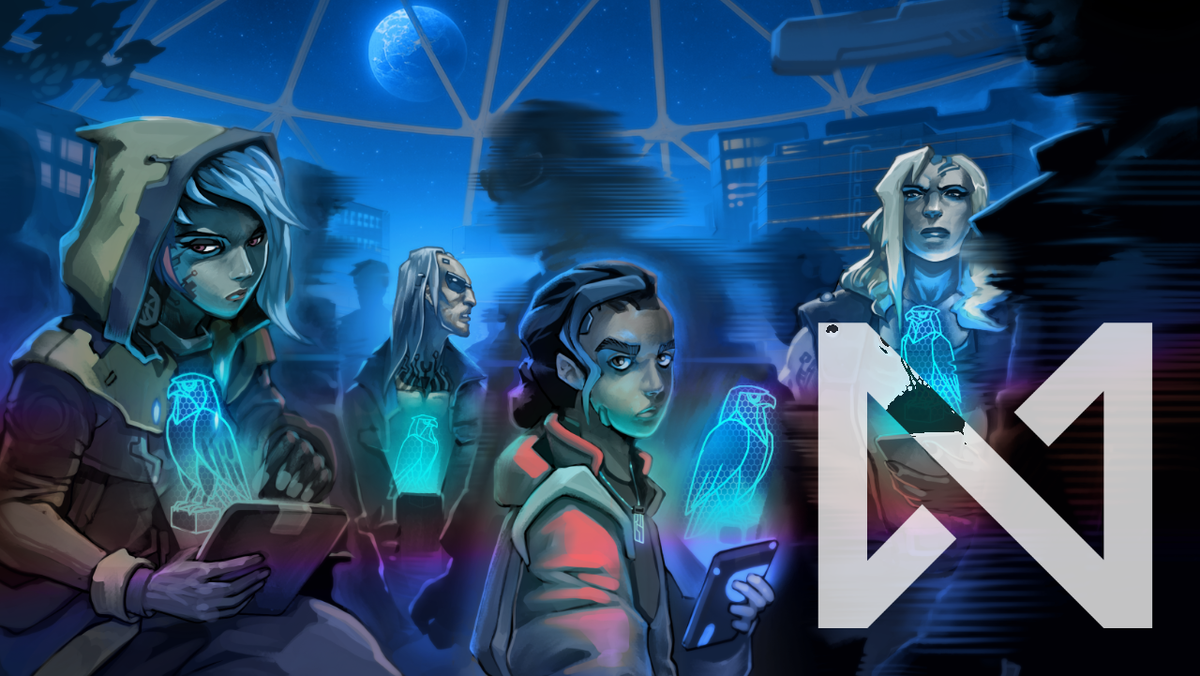
It's Friday at 2 AM, and a long-forgotten sitcom from the 2000s used to say that nothing good happens at this hour. But I can't go to sleep just yet. I have an impossible dilemma to solve. I need to choose which character archetype I'm going to play in my new role-playing campaign. On one hand, there's Harrier, a leader of a death cult with the ability to slip into a blissful coma to predict the future. Oh, and I get to decide what kind of motorcycle his flock rides and what they believe comes after death. But the Vigilant is also whispering to me. He tells me that not everyone can be trusted. That some aren't even human, but entities from the Maelstrom disguised to deceive us. But if I choose him, I'll recognize them and see their true form. For that, I would have to check two boxes on my character sheet. Do I want them to be wolves, angels, or insects? What's worse, that they're made of plastic, have holes instead of eyes, or make unbearable screeches that blast my mind? “The maelstrom, vast and screaming in fear and hate, it spawns terrors. Be on guard.”, warns the Vigilant. “We are the fire in the ashes of the world. We are the screaming machines that tear the roads to ruts and shake the ruined buildings”, shouts Harrier and his cultists. And I can't decide.
What makes Apocalypse World special? Is it its Mad Max-esque premise where the world we knew no longer exists and now we’re all survivors, stranger than ever? Is it its sharp, gritty, and irreverent language? No, it’s not any of that.
What I'm about to try is called Apocalypse World, and I feel the nerves of someone waiting for an initiation rite. Why? Well, I could say that for me playing role-playing games is always a magical event, a fragile and dangerous trip with an unparalleled high. Also, I never stop thinking about how games are designed, about the mind that decided to place this gear here and that lever there to push my imagination, emotion, and cognition into the deeply human Rube Goldberg machine that is the gaming experience. But all that would apply to any system. What makes Apocalypse World special? Is it its Mad Max-esque premise where the world we knew no longer exists and now we’re all survivors, stranger than ever? Is it its sharp, gritty, and irreverent language? Is it because it includes a mechanic called Sex Moves that seems pulled from the worst nerd cliché? No, it’s not any of that. And this isn’t a review. This is an inquiry into what makes role-playing games unique and how my personal journey with them has brought me here, to this event that I will attempt to explain why it is canonical.
What is a role-playing game about? We could start with the idea that it involves embodying fictional characters in various situations and playing to see how they fare in them. That would be a generic approach to the concept, in the sense that it connects it with other meanings of the term “role-playing,” from pedagogy to sex. But it’s still restrictive. We would be missing many games in which we don’t represent characters but something else (like “The Quiet Year,” where we all role-play the fate of a dying community) or games where character control is shared or alternated, like the Coen movie simulator that is “Fiasco.”
I prefer to take a step back and encapsulate role-playing games in the act of collaboratively inventing a story. This allows me to focus on what, for me, is the most magical and tangible event that arises from role-playing: together we just invented a world that didn’t exist just moments ago, and now we can perceive it and be moved by what happens there. And the strangest and most difficult part: that world exists in our minds, and yet we all inhabit it equally. If we reflect on this for a second, it’s madness, especially in light of the fact that the consciousness of others (and, to no lesser extent, our own) exists at a distance that is immeasurable to us. We can’t truly access what others think and how they think. But for a while, we can explore the same universe. A universe that, again, we just birthed. Let’s be gods for a moment.
What is the condition of existence of that imagined common space, as Ron Edwards calls it (remember that name)? To agree on how it looks and what happens there. Even though each player forms their own mental image, we have to agree that your character is hurt because mine just shot him. “If I say I shoot you and you say the bullet jammed in my gun, who do we believe?” This is how Vincent Baker (remember this name too) frames the fundamental arbitration problem that runs through all role-playing games. What’s at stake is the credibility, the power to establish facts and have the other players give them substance. How does that assignment of credibility work? It can be resolved in many ways. But however it is done, that is the system of our game.
Together we just invented a world that didn’t exist just moments ago, and now we can perceive it and be moved by what happens there. And the strangest and most difficult part: that world exists in our minds, and yet we all inhabit it equally.
Let’s take a concrete example. In a classic role-playing game like D&D, credibility emanates from different sources depending on the event in question. Players are considered to have the authority to say what their characters think and do, while the Dungeon Master (DM) decides for the NPCs (Non-Player Characters) and the world as a whole. If a D&D player shouts “and then a red dragon appears” or if the Master tells Juancito, the barbarian, “and you grab your axe and jump to tackle the beast,” in both cases it would be considered that the person is overstepping their limits and that, therefore, what they said lacks support. A player also can’t invent a level 100 katana that shoots electricity and reveals invisible monsters. The credibility of having a particular piece of equipment with certain mechanical effects relies, first, on the existence and availability of that object, either by the DM’s determination (they find it in a chest) or by being listed in a sourcebook; and, second, on the investment of certain resources by the player to obtain it (coins, experience points, starting equipment). And to actually reveal the creature lurking and electrocute it with my shiny new katana, I’ll have to roll a die and pray that luck is on my side. DM, players, resources, class attributes, stats, and chance are all sources of credibility that we agree to respect as the maximum foundation of this common space we are imagining. That’s how D&D works. In other games, it’s totally different. And if we could resolve everything by discussing case by case, without any rules or external input, that would be our system. In Baker’s words, “a role-playing system is any way a group of players defines what happens in the game.”
Between 1999 and 2005, the theorization and design of indie role-playing games experienced a golden age. It happened, like all the good things from the old Internet, in a forum. That forum was called 'The Forge' and was moderated by Ron Edwards, a Doctor of Biology from the University of Florida who had just released a game called Sorcerer, where we play as sorcerers seeking to make contracts with demons to gain unlimited power and, of course, pay a high price for it.
Sorcerer is considered an extremely influential game in the indie scene, a precursor to many 'technologies' of role-playing design, such as considering the emotional impact of playing and including safety tools (like Lines and Veils) to protect it, or the concept of kickers, basically trigger conflicts embedded in the characters' backstories that serve as the main engine of the game. And all of this without being a big title, self-published, and with a niche proposal. In fact, this is also an element that would later become a widely accepted guiding principle of indie design. Leaving behind generalist pretensions (like the 'fantasy' of D&D) or ultra-complex settings (like White Wolf's World of Darkness) to focus on bringing to life a very specific experience, with mechanics entirely at the service of the narrative and with an emerging setting that seeps from the cracks that players dig into their characters.
Now, my intention is not to tear down traditional role-playing or the games from 'big publishers' nor to gatekeep what true role-playing is. My issue with D&D isn't the system itself, but rather the confusion between Hasbro's commercial power to popularize and sustain it as the main way to play role-playing games, and the mistaken idea that a game can be 'for everyone and for everything.' It doesn't matter if they release hacks of Avatar and Adventure Time, D&D remains a system focused on combat, the power trip of leveling up your character to find a broken combo of skills, and the difficulty expressed in resource management caused by a succession of encounters in a dungeon. Of course, players can role-play whatever they want and navigate conversations and tender scenes or solve mysteries with Sherlockian deduction, but it’s not a system that provides tools for that. In other words, all the credibility of those dramatic developments rests on an extra effort from the players combined with the DM fiat, because those aspects of the experience are not what D&D cares about. And that's perfectly fine! But we need to identify that proposal (or lack thereof), question whether it aligns with what we are looking for when playing role-playing games, and open our minds to all the other systems that have been designed for the infinite spaces we can imagine together.
The greatest contribution attributed to Ron Edwards is his 'Big Model', a theoretical framework that aimed precisely at this: classifying players according to their creative agenda, that is, what goals they pursued when playing role-playing games, what they considered satisfying or fun. And through Byzantine forum discussions (Edwards always left a section of The Forge explicitly related to his categorization project), they arrived at the panacea of every good American researcher: a triad of approaches, immortalized in some rich initials.
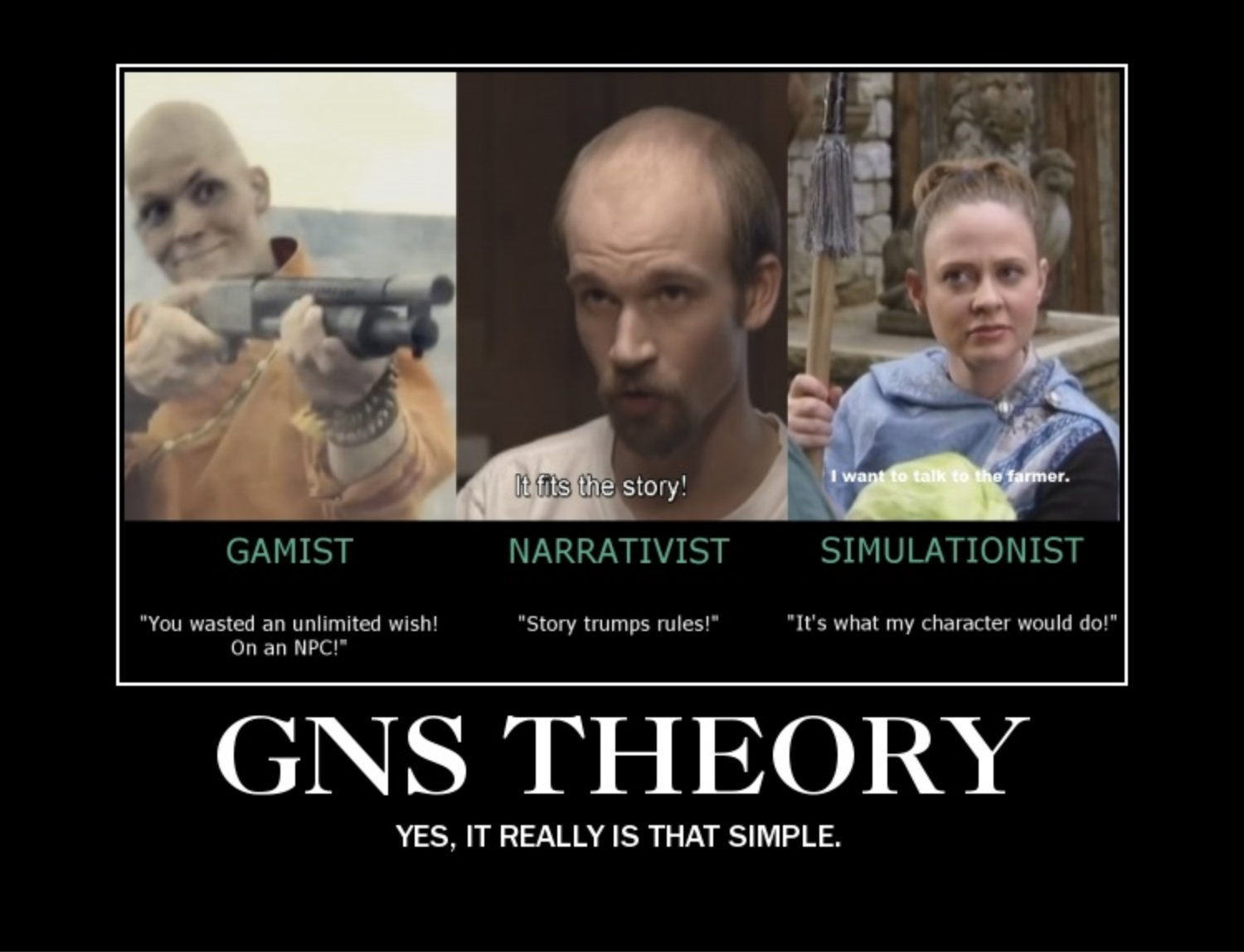
Thus, the GNS theory was born, which divides the role-playing world into three realms. The Gamists, attracted by strategy, overcoming obstacles, and manipulating rules to gain maximum power. The Narrativists, interested in developing dramatic conflicts, exploring themes, and resolving plots in a cathartic and transformative way for their characters. And the Simulationists, in search of the ultimate immersion, the discovery and internal coherence of characters, and the deepening of the imagined common spaces.
The GNS theory provokes that ambiguity characteristic of all totalizing theories: first, the pleasure and peace of clarifying something that previously seemed amorphous and chaotic. Finding a new identity, naming what I experience. Of course, it’s not that I don’t like role-playing or that D&D is poorly made, it’s just that I was looking for something else and I have to switch to the Narrativists' side. Then comes the rebellion, the epistemic itch against that which, by explaining, flattens; by dividing, imprisons. Are there three realms or rather twenty tribes in constant migration? Can we really dissect a design based on three ideal types and, worse still, declare that it should only focus on one of them? Does it seem to me or is there a whiff that Narrativism is the 'real deal' of role-playing, because that was Edwards' inclination? From its inception to the present, the GNS theory has received countless criticisms and we can consider it obsolete. However, it continues to illuminate a prevailing truth: you can't make a game for everyone because not everyone seeks the same thing when playing role-playing games.
Conflict resolution
Of course, I didn't know exactly what I was looking for at first. I started playing role-playing games during the pandemic. I began, like many today, with D&D 5th edition, because it was what I knew and what my friends played. I quickly became interested in running games and creating my own scenarios and monsters. D&D places a lot of creative responsibility on the DM, and that intimidated me but also excited me. I wanted to be the architect of my own setting, to dazzle with my puzzles and challenge my players with the monsters I invented. One of my first projects was a one-shot scenario in the haunted house style, where the party got trapped in different rooms and had to escape using a mix of ingenuity and the rudimentary combat of a couple of level 1s. It was called the Fleisch Mansion and its highlight was a poop golem that emerged from the ivory toilet. It took me several hours with the Statblock Generator to design that creature, but it almost resulted in a TPK. Totally worth it.
However, after a couple of attempts, I started to notice that I wasn't comfortable with the system, especially when it came to designing investigation and political intrigue scenarios. After the twentieth time rolling Persuasion or Investigation and seeing how I turned a failure into a no, but..., I concluded that maybe role-playing wasn't for me.
A few months later, a friend offered to run a campaign with another system called The Sprawl, set, as you might have guessed, in a cyberpunk world. The change of setting already had me excited, and Guille, the MC, assured us that we didn't need to read much because the system was simple. What blew my mind first was that, in the first session, we didn't play any actual scenes but instead created our characters and, in addition, co-created the setting. Each of us had to invent a futuristic corporation that dominated parts of Argentina (I think mine was an evil version of Jorgito Alfajores). Each of our characters, in turn, had a personal vendetta against that corp, a few scores to settle, a past issue unresolved: we were planting what I later learned was called a hook. And that Guille would bring into the story sooner or later.
The second moment that caught my attention was something Guille did in session 2. We were in the middle of a chase that had started off very intense. We all felt a real danger of dying. However, a series of rolls had led to a sort of stagnation in the action. Our characters were injured and couldn’t escape, but our pursuers couldn’t catch us either. The tension was beginning to deflate, and that’s when Guille stopped everything and asked us directly: “Where do you think this scene is going? How do we feel this ends?” In my limited experience at that time as a DM, it had never occurred to me to halt the action, let alone to regain the rhythm. It seemed like a totally counterintuitive technique, fueled by a keen intuition about something we all felt but couldn’t quite identify: the scene was dragging on and going nowhere. Beyond that particular directing technique, Guille’s question got to the heart of narrative concern: what conflict is unfolding in this scene? What’s at stake? It doesn’t matter about the “realism” or the “physics” of what’s happening. It didn’t matter if the Corp’s car should be faster than ours or if it was impossible for us to stay conscious given our injuries. What mattered was to ask what the conflict was and what the most interesting (not necessarily most beneficial) way to resolve it for our characters would be.
Ron Edwards dichotomized these approaches under the title of Task vs. Conflict resolution. Certain games, like D&D, are interested in resolving tasks. Can you cook that truth serum? Can you convince the queen? Does your lockpick open the lock, yes or no? Others are interested in how the underlying conflict is resolved. Why do you want to open the lock, or get the queen on your side, or extract that confession with your serum? Because you want to incriminate your arch-nemesis. You want the truth to come out and for there to be justice. And what matters is how you resolve that conflict. The specific method that leads to that outcome is also of interest to us because it’s the concrete form the story takes, but it doesn’t necessarily affect its mechanical resolution. In the task resolution paradigm, the credibility of whether you open the lock or not relates to specific elements like your relevant skill. But the connection between that success or failure and the development of the conflict lies in the hands of the DM. What I found while running D&D was that I either adhered to the result of the dice and risked that failure canceling the party’s access to the secret I had planted there; or I used some trick (the three clues rule from The Alexandrian, the secrets and clues from Lazy DM) to turn that failure into progress. In other words, injecting conflict resolution to ensure that the story I had created and hoped my players would discover didn’t fall apart.
It doesn’t matter about the “realism” or the “physics” of what’s happening. What matters is to ask what the conflict is and what the most interesting (not necessarily most beneficial) way to resolve it for our characters would be.
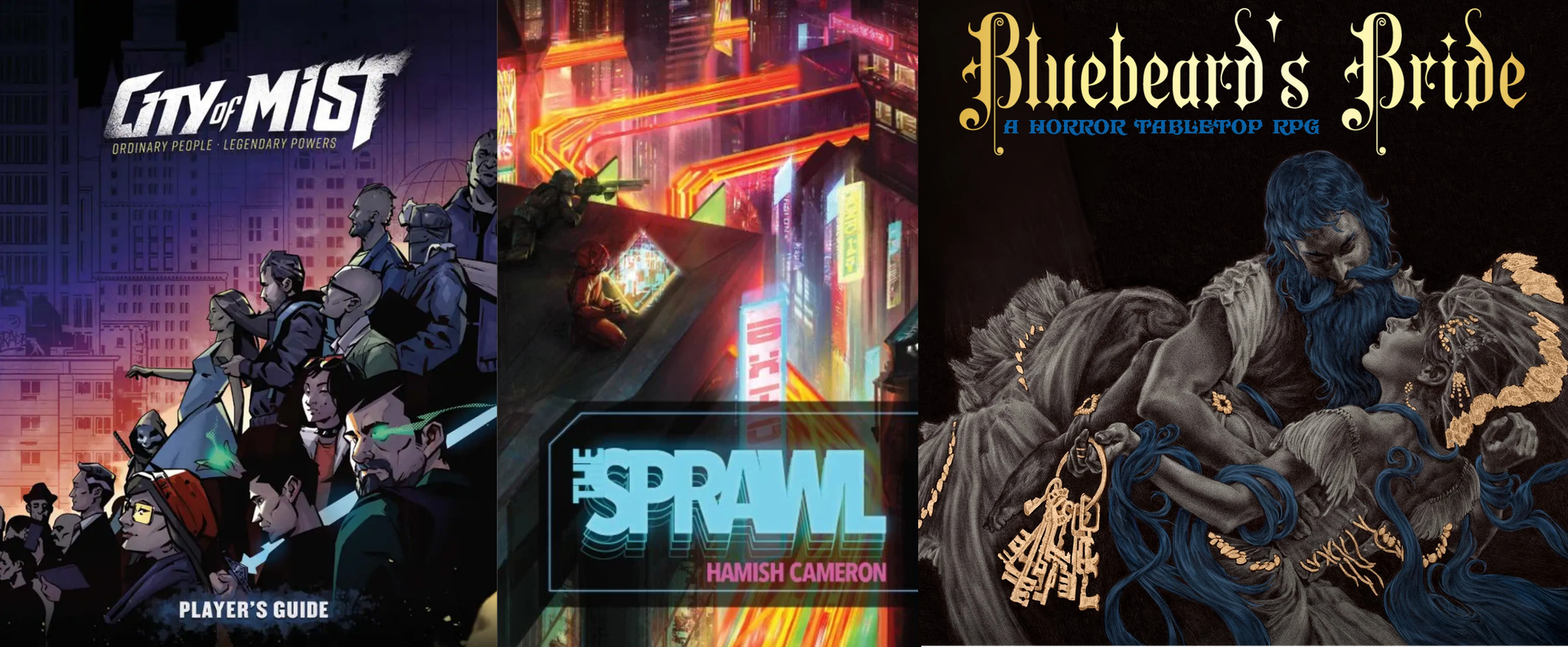
I don’t know if Guille really read the manual for The Sprawl (he’s a guy with a lot of experience and years of role-playing under his belt), but I did after we played that time. Not only did I find specific mechanics that facilitated the kind of direction he had deployed and that had blown my mind. I came across a creative agenda and a set of principles, immortalized in catchy phrases, that the DM should follow when directing The Sprawl. In those principles was encoded a philosophy of play that I instantly fell in love with. It happened to me again months later when I read the Dungeon World manual. The same thing happened when I decided to run City of Mist, a system built on the premise that each character is possessed by a mythological entity that gives them powers and also wants to control their entire life. Once again, a year later, when I had one of my best (and most terrifying) experiences with a table of Bluebeard’s Bride, directed by my mentor in the role-playing world, Juli Vecchione. And once more when I played a campaign of Root, the RPG inspired by the board game, which I feared would be a hack of D&D. Then I reviewed those manuals and in all of them, I found the same acronym (damn Yankees): PbtA. Powered by the Apocalypse. What could be an edgy tattoo or a great sticker on the back window of a truck condenses a game design philosophy that today frames hundreds of indie titles. And if you don’t know it, you should.
Three great PbtA games to get you started
Powered by the Apocalypse
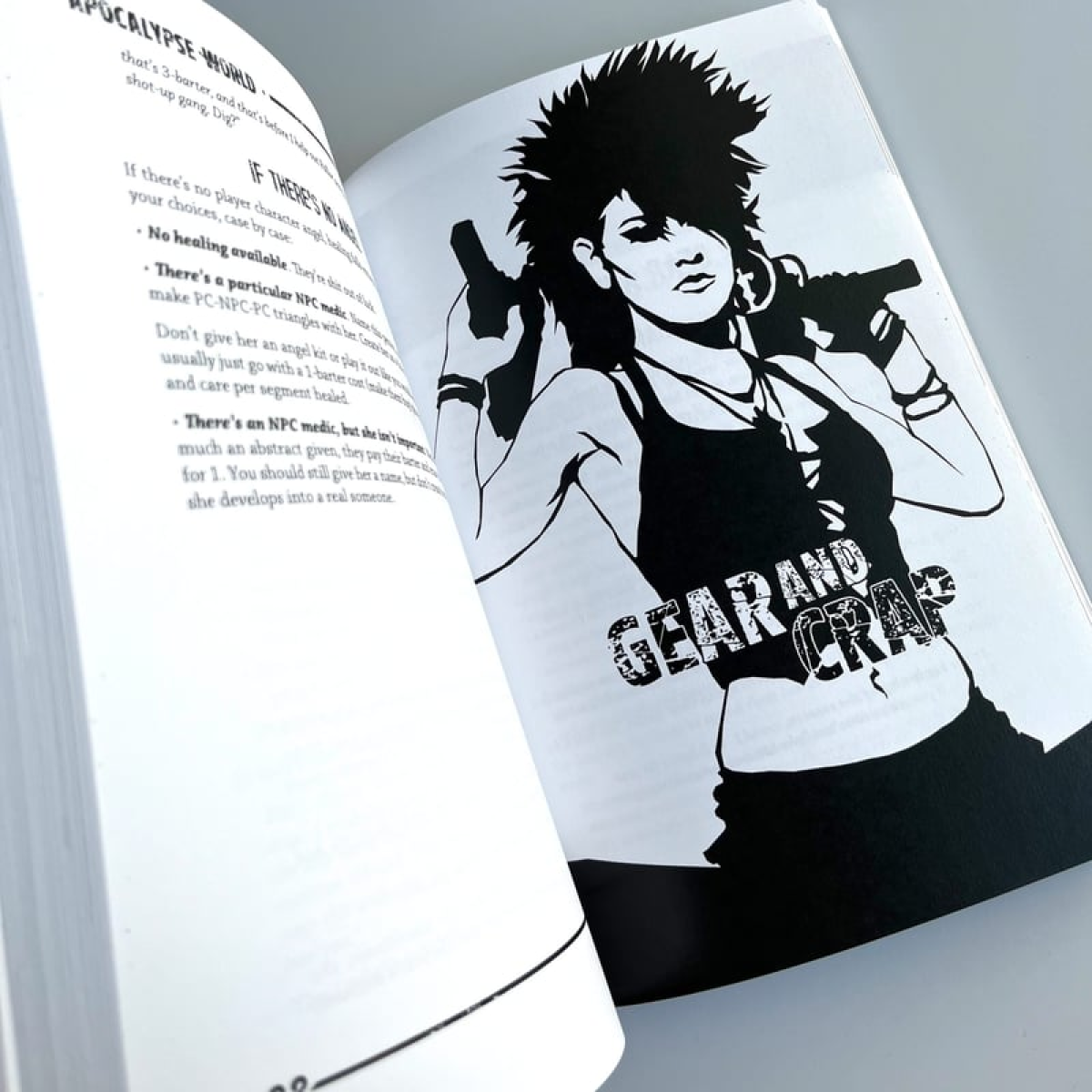
Apocalypse World was published by D. Vincent (a.k.a. Lumpley) and Meguey Baker in 2010 and, even during its creation, due to the enormous online activity of its authors (Lumpley participated a lot in The Forge, to the point that his phrase about what a system is was named by Ron Edwards as the Lumpley Principle), it inspired other games, like Dungeon World and Monsterhearts. The game is based on an engine that Meguey called Powered by the Apocalypse. I could talk about its more superficial elements, like how instead of classes there are playbooks or that all rolls are resolved with 2D6 + some stat. But, in truth, PbtA is not an engine in the sense that D20, Year One, Mist, or GUMSHOE are. What’s important is not its resolution system but its thesis on how to play. And to develop that, I’m going to stick with three of those iconic phrases that I found repeated like a mantra in all the games that made me fall in love with role-playing again.
The first is play to find out. Don’t waste your time planning out an entire adventure. Don’t develop a setting or detail a backstory before you’ve inhabited your character. The best role-playing game awaits you in the amalgamation of player decisions, the whims of the dice, and the serendipity that every director experiences in the midst of their craft. This isn’t an ode to improvisation. In fact, it’s the opposite. PbtA proposes a fierce commitment to a logic and internal coherence. But that logic arises from the characters (not the players). Those characters want to follow their passions. And their passions put them in conflict with other forces, both external and internal. Follow that trail of gunpowder and, when it’s about to explode, don’t try to put it out or cover your eyes.
The second is ask provocative questions and build on the answers. Playing role-playing games is an act of collaborative storytelling. Don’t try to resolve everything yourself. Plus, what better way to involve your players than to make them co-authors of the world and the story they’re living? And why couldn’t they themselves figure out the best punishment or the best fate for their character? In PbtA, rolling successfully doesn’t necessarily mean your character is doing well. It means you, the player, gain control of the fiction. For a moment, you are the sole source of credibility. What are you going to do with that agency? Are you willing to honor your character and take them down a path that isn’t (always) a power fantasy?
And the third is begin and end with the fiction. This principle supports the heart of the PbtA philosophy, which Vincent Baker summarizes as: “use real things (dice, stats, etc.) to drive the fictional things.” Every mechanic in a PbtA activates first in the fiction and generates a result that must then be transformed back into fiction, with the aim of enhancing that fiction in a dramatically interesting way. Let’s exemplify this with one of the most ubiquitous concepts in PbtA: the moves. In a traditional role-playing game, what your character can do is either codified and dictated by their equipment/race/class (they can cast a certain spell, they can see in the dark) or invented on the spot by a player and mechanically translated by the DM to determine their success (“I want to jump this ravine,” “okay, roll for acrobatics”). PbtA works differently. Role-playing happens in a conversation between the players and the DM, where we narrate what’s happening and what we’re doing, within some criteria of verisimilitude that prevents certain “impossible” actions.
Now, both players and the DM have a list of moves, always headed by a fictional trigger, expressed in terms of conflict. For example, “when you try to seduce, manipulate, deceive, or sweet-talk someone, state what you want them to do and give them a reason to do it. Then, roll 2D6 + Hot” (Apocalypse World, 2nd Ed.). You don’t decide to make a move because, as the principle states, everything starts with the fiction. When that situation is happening, the move activates and you add what’s stipulated (what you want them to do and the reason for doing it), roll the dice, and submit to the consequences, which are coded to impact the fiction. In this case, for example, if you roll 10 or more, the seduced NPC does what you want unless something contradicts the reason you gave them. If you roll between 7 and 9, they’ll need more evidence first.
In PbtA, rolling successfully doesn’t necessarily mean your character is doing well. It means you, the player, gain control of the fiction. For a moment, you are the sole source of credibility. What are you going to do with that agency?
The moves not only mark a clear flow of fiction -> reality -> fiction, but they also focus on the type of situations that the game is interested in. In Bluebeard’s Bride, a horror PbtA, one of the moves is caress a nightmare and refers to when you give in and have a moment of intimacy with one of the monsters that haunt you. In City of Mist, the PbtA where we are possessed by mythological entities that give us powers while seeking to control us, the most powerful move, the one that allows us to unleash our abilities like never before, is called Stop. Resisting.
The moves configure a genre statement. They are a treasure trove of tropes offered to us on a silver platter. A mix of carrot, Swiss army knife, and Lego block, the moves guide us, as players and DM, to live the kind of story that this PbtA wants to tell and that our characters are dying to experience.
I know my journey in the world of role-playing is just beginning. I sense that my fascination with this philosophy will also pass. And I know that out there, fresher and stranger things are being cooked up. Like any theoretical framework, PbtA can become a recipe, and some are more inspired than others. Vincent and Meguey assert that at first, they kept track of all of them but that lately that task has become impossible. And they have let it go, just like any pretense of arbitrating what is or isn’t a PbtA. They even humorously comment that they’ve heard people say that Apocalypse World isn’t really PbtA. “As far as we’re concerned,” they assert, “if a creator was inspired by AW or another PbtA to make their game and decides to call it PbtA, then it is PbtA.”
I have a somewhat silly concern that Apocalypse World won’t live up to my expectations. Falling into the Seinfeld is not funny effect because I didn’t live through that era of creative revolution and instead started with its fruits.
But it’s a ridiculous nostalgia, something that makes no sense to lament. Right now, I’m much more concerned with finding the wolves of the Maelstrom and revealing to the world their horrible appearance of insects with holes instead of eyes. Will I succeed? Let's play to find out.
Diseño juegos de mesa y videojuegos.
Dirijo el diseño curricular y la curaduría literaria del taller-librería-editorial El Cuaderno Azul.
Programo en el proyecto Cazadora, un videojuego de cazar monstruos del folklore latinoamericano.