Inspired by The Legend of Zelda and Titan Souls, this Argentine souls-like game invites us to take on the role of a simple rectangle in a minimalist journey filled with mystery, immersive sound, and challenging bosses.
Whenever I have to talk or write about a souls-like game, I think about how we got here. In 2009, FromSoftware released a title called Demon’s Souls, a work that at the time we referred to as a "3D Diablo" due to its level exploration, real-time combat, and resource and item management. It's a game that essentially became a cult classic, a personal favorite, and a driving force behind a genre that continues to be imitated and adapted to this day. The release of Dark Souls, its "spiritual sequel," marked the beginning of the cult following and mainstream success, but many of the key elements were already present in that title.
Speaking of which, what truly makes a souls-like a souls-like is a discussion that seems to get murkier by the day. Is it the precise combat, with unforgiving enemies and a stamina bar that depletes with every move you make? Is it the heightened difficulty that comes from that? Spectacular boss fights? The intricate, almost labyrinthine level designs that often interconnect and can be more challenging than the final boss? Is it the checkpoint system that respawns most enemies around us when we use it? Is it the ability to recover resources after dying if we return alive to where we met our end? Is it the minimal guidance, an open story ripe for interpretation based on ambiguous dialogues and events that aren't fully explained, outdated menus, etc.?
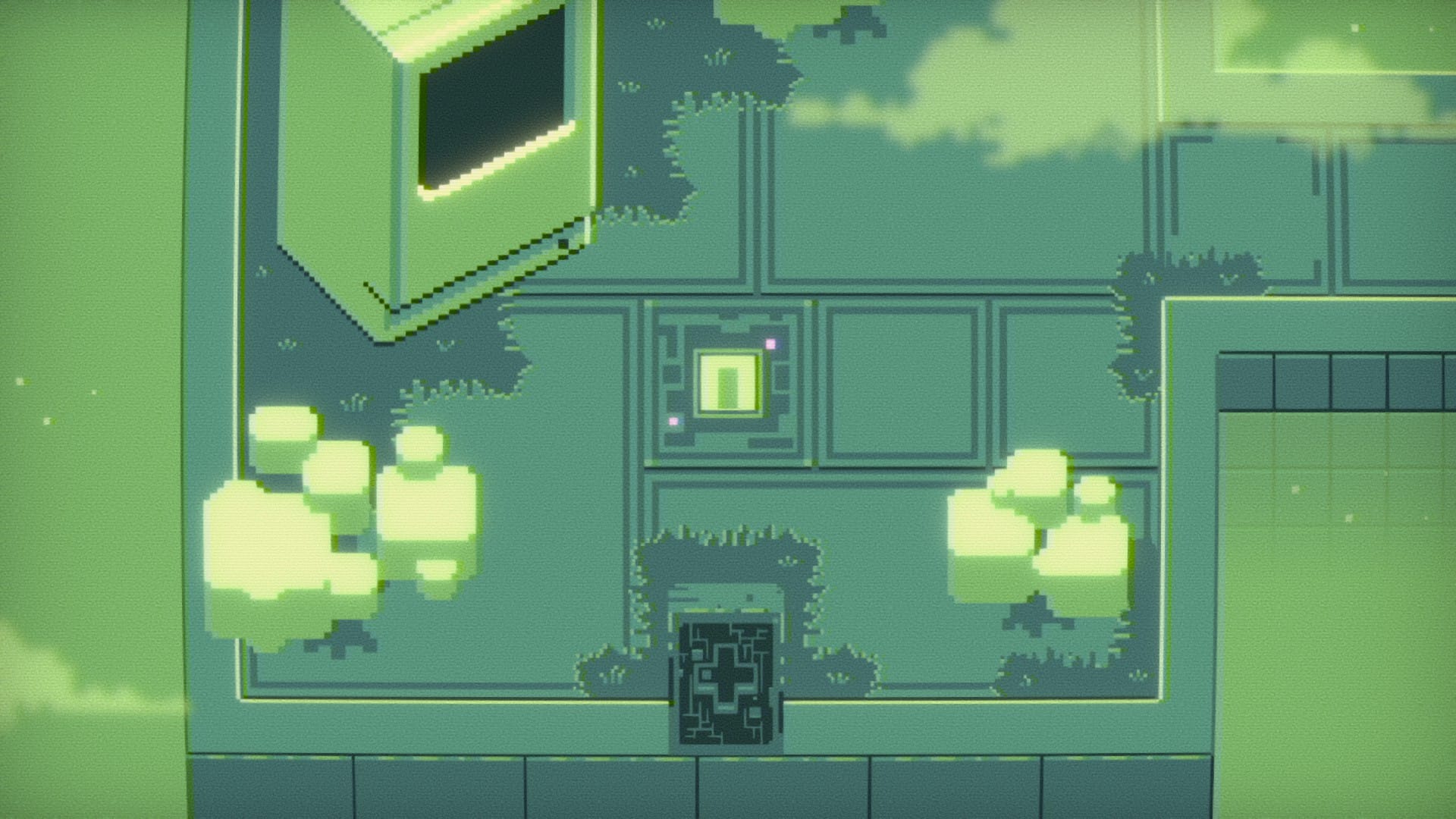
We are a rectangle, a health bar that "emerges" from a monitor into an unknown land, tinted in shades of green. We must move towards an unexplained destination.
Demon’s Souls laid all these foundations and systems (and many more), and then its heirs and those influenced tried to leave their mark. Personally, I think they stray from the path when the focus is primarily on difficulty, often artificial, and overlook what I believe are the true key elements: the exploration of a hostile and uncertain world, level design, and the management of our resources and energy.
The Bar Souls (Falling From Mountain, 2025) bases much of its proposal on these aspects and on the early and mythical The Legend of Zelda. We are a rectangle, a health bar that "emerges" from a monitor into an unknown land, tinted in shades of green. We must move towards an unexplained destination, following a vague path and with many secrets. We barely see walls with clear drawings explaining our movements: moving in all possible directions from a top-down perspective, attacking with a single button, and performing a short dash that grants us a moment of invulnerability. That's all.
There are no words we recognize in The Bar Souls, only drawings and other more cryptic signs. Not even in the main menu or the pause menu do we find the typical phrases explaining what we are seeing. This is a work that seeks to develop a bit of another language, like the excellent Tunic (Isometricorp Games, 2022) and Chants of Sennaar (RUNDISC, 2023), but mainly to sharpen your intuition. This crack seems to have meaning. That mark on the wall might indicate a path. The contrast with the pink of our weapon and certain objects is more than just an artistic choice.
When I take steps in this world, what moves me the most is: an unconventional exploration, a search for our nature, a why behind the use of language. The world expands despite its minimalist monocratic style and the limited variety of objects around. The sound design, captured in real outdoor locations in the province of Neuquén, along with contemplative music, captivated me, sometimes making me stop in front of simple trees and patches of grass, just listening.
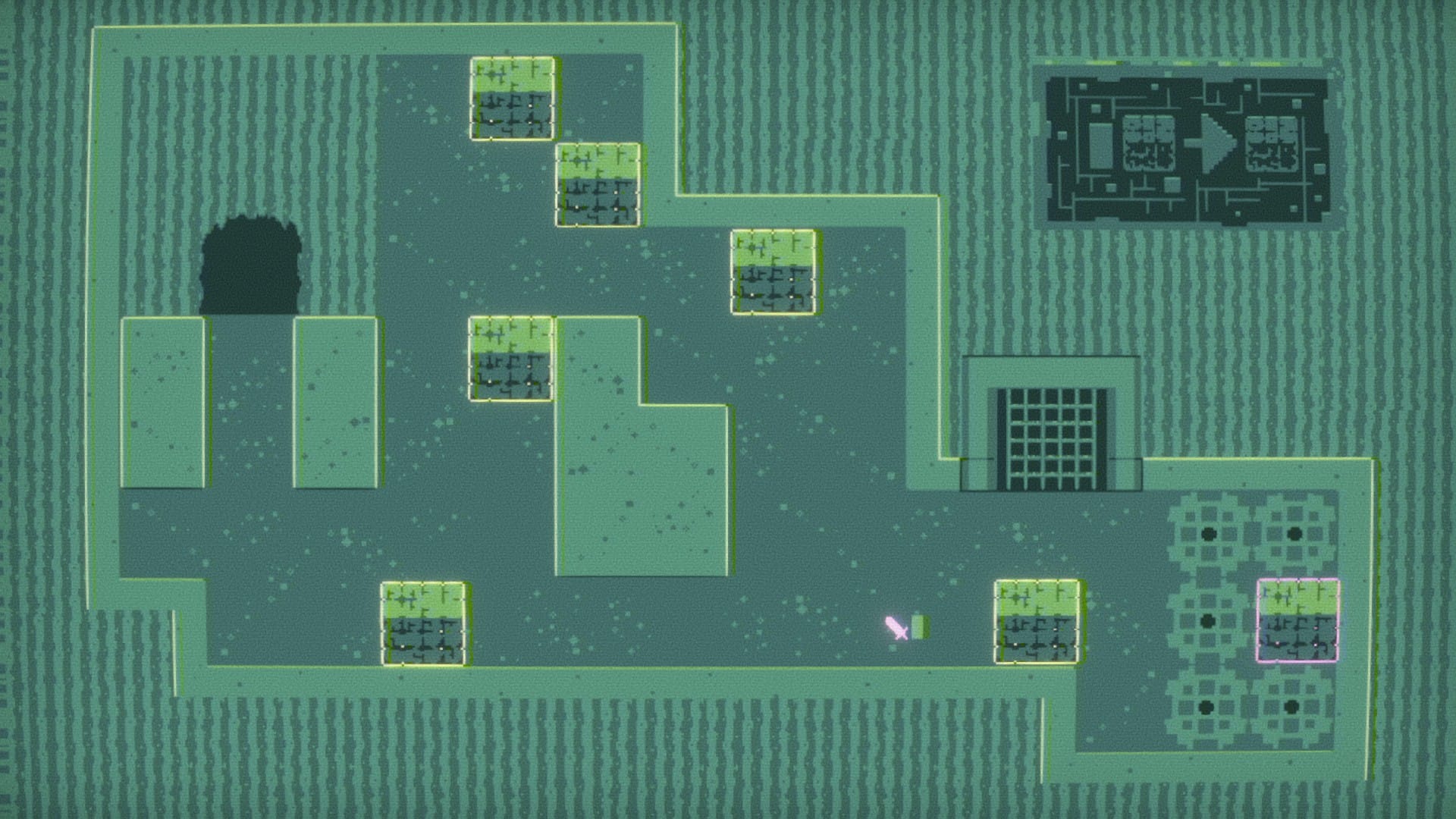
Not all scenarios are a sublime stroll into the unknown, as in some ¿dungeons? ¿strange areas? there are Sokoban-style puzzles to solve. "Sokoban" refers to games where you move boxes and place them in specific spots, moving one at a time and without blocking the path. Otherwise, you have to exit the stage and re-enter to try again. This is something uncommon in that genre, and I found it to be a more than pleasant change of pace.
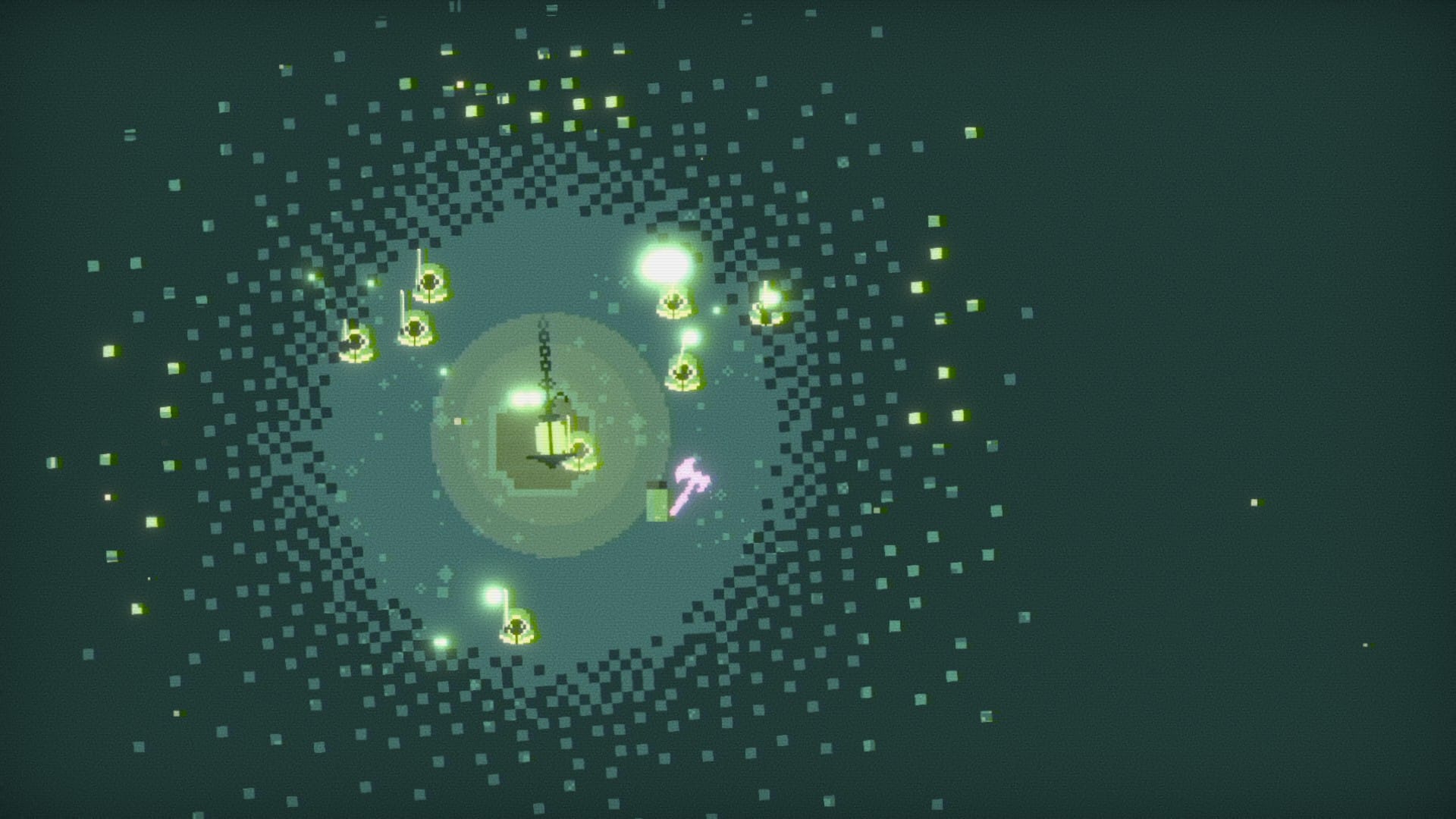
There are also connecting areas with simple enemies, like small swordsmen or their counterparts with bows and arrows. There are well-executed moments, like certain scenes in a smaller room, with a lamp in the middle and the big-headed enemies coming from around. However, often these brief fights felt a bit cumbersome, especially with ranged enemies that can appear and hit you almost immediately, which feels somewhat unfair. Their attacks also vary a bit more erratically, making it hard to judge when to approach and attack or not. Honestly, since in most cases you can run away from fights, I recommend doing so.
When I take steps in this world, what moves me the most is: an unconventional exploration, a search for our nature, a why behind the use of language.
None of the above undermines that search for intuition I mentioned earlier. It remains the main appeal I find in this work, and what makes it most enjoyable to play and ponder. How do we learn? What use do words and language serve us? What do we need to be understood by others? Why are we a health bar/a Pong paddle in this universe (In an interview, Ghigo clarifies that the bar/rectangle is the first "placeholder" design he made for the protagonist, and since he liked how it looked, he kept it that way)? Who are those others we see?
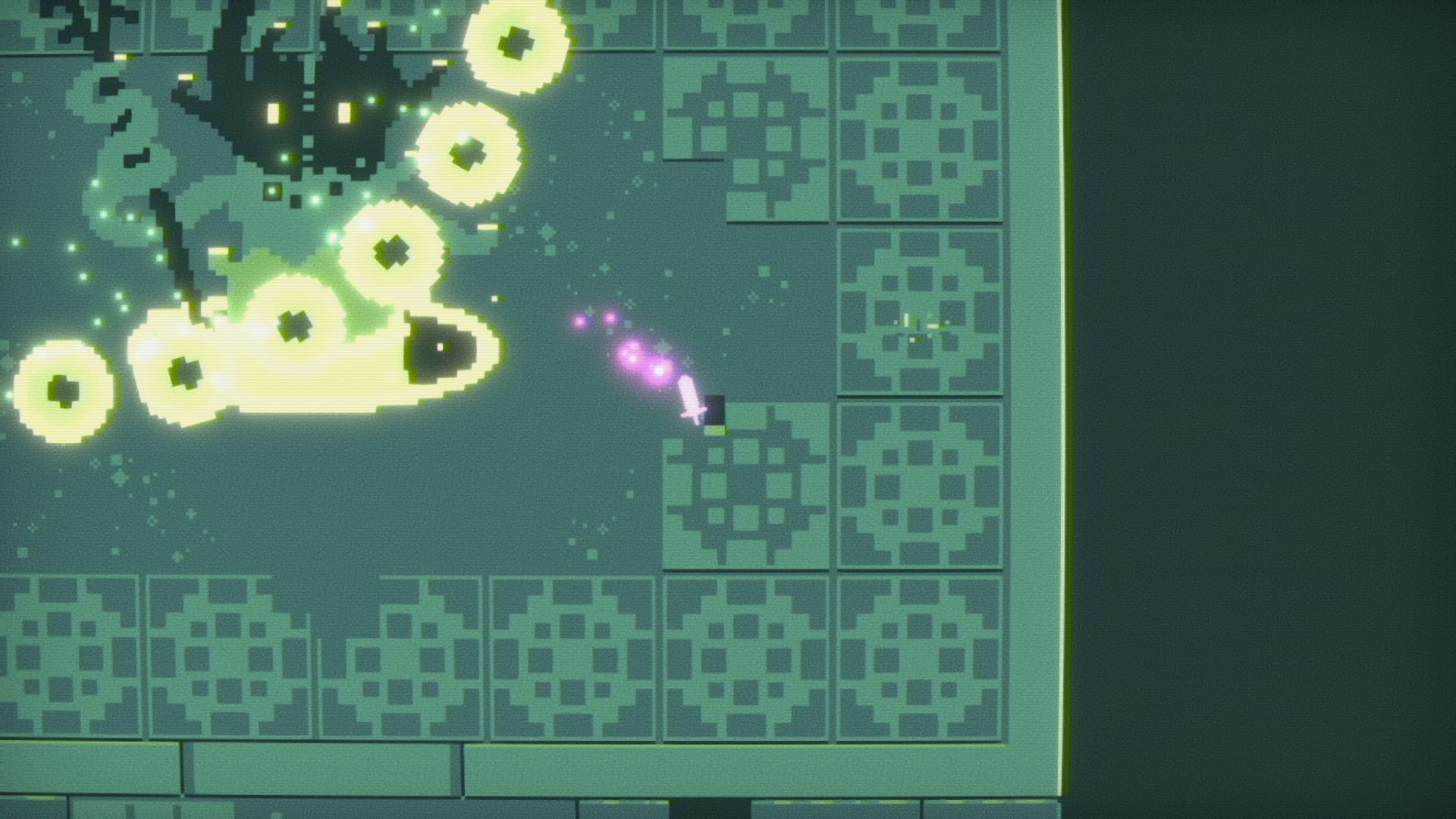
That music I mentioned earlier, contemplative, reflective, transforms when we enter any of the boss arenas, creatures much larger than us that can fill the screen with projectiles. Riffs reminiscent of any clean classic from a modern Thrash Metal band play, and all alarms go off within us. This is perhaps the other key aspect of The Bar Souls, where the design notes from the book of Titan Souls (Acid Nerve, 2015) are most evident, a title in the genre with the same camera and many similarities in overall geometry, but without intermediate enemies and with fights that end in a key hit to the enemy or any part of our body. Here we can take more hits, and so can the enemies. Still, if we're not used to it, boss battles can end in seconds, as we take a couple of hits in quick succession and have to start over.
Interestingly, our weapon changes every time we die. While what we first find is a sword, upon respawning we might get variants of the sword, an axe, or a bow and arrow. It's a charming idea that falls a bit short when the differences between the short-range weapons feel minimal (I barely felt a moment of speed, and while the damage per hit might have different values, in practice it felt almost imperceptible). There is a key difference with the bow and arrow for obvious distance reasons, making it a coveted weapon that drastically changes our positioning, even if it's a bit clumsy: you have to move at least a step in the direction you want to shoot.
The bosses themselves have their quirks. For starters, they always stay still. There's no need to change the target you're hitting, as the beast will always be the same. They also give us a clear reference of what type of attack is coming, with a dialogue bubble and a drawing in it. They always attack in the same ways, they don't change patterns, they don't improvise. This can be a hit or miss depending on our approach. On one hand, the fights become more of a puzzle to solve, forcing us to memorize movements and find the best positioning and way to dodge. On the other hand, it generates very little surprise and unease. If we have some muscle memory in this type of titles, we can wrap things up in just a few attempts. At least the lack of a health bar on the enemies adds to the uncertainty and tension of the how much longer?
With all its rough edges, I still found myself wanting to restart this adventure from scratch. I'm not up for the challenge of completing a full run without taking damage, as one of its achievements suggests. But I might be interested in uncovering the secrets and Easter Eggs I missed the first time, as well as a zone that was blocked for me due to missing a key item. What a simple and effective thing curiosity well-stimulated is.
You can find The Bar Souls on its Steam page and on its Instagram and X social media. You can also follow its director, Nicolás Ghigo, on Instagram.
If you have a video game made in Argentina and want us to write about it, go ahead and fill out this form.
✦ Suscribite
Las notas de 421 no tienen paywall
Y a cada colaborador se le paga por su trabajo. Las dos cosas dependen de los suscriptores.
Psicólogo que no ejerce y se dedica a escribir sobre videojuegos. De manera más tímida, de cine y series también. Tengo palabras en Polygon, IGN, Eurogamer, Game Informer, Bloody Disgusting, Into the Spine y otros sitios.