Hidetaka Miyazaki's masterpiece engages with classical Greek tragedy. Through the lens of philologist Albin Lesky, we explore how Dark Souls turns us into the protagonists of our own descent into hell.
Is it an empire
that light that fades
or a firefly?
Jorge Luis Borges.
This haiku by the Argentine writer Borges faithfully represents the apocalyptic nature and, above all, the cyclical nature that the world of Dark Souls presents to us. The game begins in the age of the eternal dragons, when the world was amorphous and shrouded in thick fog. However, linearity was shattered with the emergence of the First Flame. With fire came disparity and states of existence: light and darkness; cold and heat; and, of course, life and death.
From the flame also arose four great lords: Nito, the first of the dead; The Witch of Izalith; Gwyn, the Lord of Sunlight; and finally, the Furtive Pygmy, often forgotten. Three of these great lords faced the dragons with the help of Seath, the Scaleless, who betrayed his own. Thus, the great lords annihilated the ancient dragons and shaped the Age of Fire. However, no matter how bright it is, every flame eventually turns to ashes over time.
This brief narrative is the starting point for understanding the cryptic story of Dark Souls. And yet, it is nothing more than an interpretation. Hidetaka Miyazaki's work, while presenting a high level of difficulty in terms of mechanics, also challenges us to uncover what happened in that world, whose tragic history is revealed to us in dribs and drabs.
We are not passive actors. With the joystick in our hands, we are part of the fate of that world. Our actions have consequences. Dark Souls is a tragedy at its most intense because we are part of it.
And, indeed, to understand what is happening, we must engage in a work of digital archaeology: in the game, there are no cutscenes, except for the first one, the dialogues are scarce, and almost everything we can interpret from its “lore” is darkly narrated in the environments or in the descriptions of items.
Therefore, most of the reconstructions of this story are tied to the interpretations of its online community. Hence, when we talk about the story of Dark Souls, we are actually referring to its lore. I believe that the very concept of lore, in this sense, relates to the idea of myth that Erik Davis discusses in his book Tecgnosis. In the digital age, information becomes a spiritual, almost mythical quest, and in internet forums, the community of this video game completes the tragedy that the game barely hints at.
Only in this way, for example, have we been able to understand some of the most tragic destinies in the game: Artorias, the Abysswalker, and his great wolf, Sif; The Witch of Izalith and the chaos demons, and even the end of Solaire of Astora. In this sense, the classical philologist Albin Lesky, the father of the theory of Attic tragedy, pointed out that for the tragic to have meaning, the presence of a spectator is necessary. In video games, this logic transforms: we are not passive actors. With the joystick in our hands, we are part of the fate of that world. Our actions have consequences, and the undead we embody suffer just like the gods. Dark Souls is a tragedy at its most intense because we are part of it, with all that it implies.
However, before we continue, it's time to delve into its most substantial point, the analysis of its story through the postulates of tragedy by the philologist Albin Lesky. This journey will allow, from my perspective, to understand that the great works of video games have nothing to envy from the classics of literature.
The dignity of the fall
The fall in the tragic implies a movement from an illusory world of safety to “the depths of an unavoidable misery,” as Lesky states. The fall in Dark Souls perfectly fulfills this postulate and even takes it further, because we are faced with a story of epic character (as Aristotle proposed for this genre): we are witnesses to a creation myth, with its gods, heroes, legends, and its fatal outcome. In the game, the tragic fall is the end of the Age of Fire, but also the desperate actions that the gods took to prevent it, which only increased the scope of that misfortune.
The weakening of the First Flame also implied a weakening for the gods and a strengthening of humans, who no longer lived and died in a dichotomous manner, but found a new state of existence: the undead emerged, creatures that, after remaining in that void for too long, became violent and possessed an almost insatiable hunger. Moreover, from these beings arose a force capable of instilling fear even in the gods: the Darkness.
In this way, as one of the most legendary characters of the saga tells us, Lordran fragmented:
"We find ourselves among strange beings, in a strange land. The flow of time is intricate; centuries-old heroes appear and disappear. The very structure wavers, and relationships change and darken."
Faced with the fear of this downfall, the gods took two desperate measures. On one hand, the Witch of Izalith, overconfident in her pyromancy skills, attempted to create an artificial flame to breathe life back into that world. The consequences, however, were terrifying. The Witch and her daughters, along with their hometown, were transformed into horrifying and incomplete demons. This led to her own transformation into the Bed of Chaos, an amorphous creature resembling a grotesque root.
Her daughters, in turn, were transformed into wild beasts guarding the remnants of what was once a prosperous kingdom. This failed attempt to defy fate is yet another great downfall, as they not only failed to rekindle the flame but also birthed a new form of death: the Flame of Chaos, a distortion of life that ultimately consumed those who tried to control it.
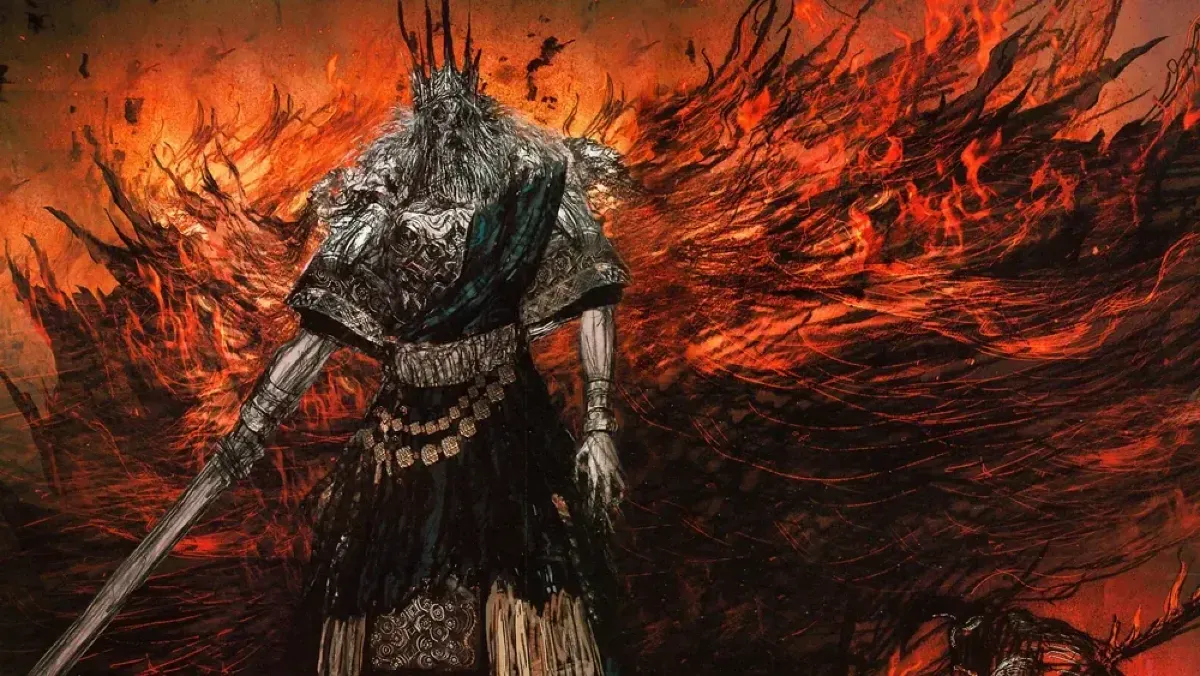
Gwyn's conceptual art consumed by madness.
In the wake of the Witch's failure, Gwyn knew there was no choice but to sacrifice himself to try to extend, even if just a little longer, the glow of the original flame. For this reason, he made his way to the First Flame and consumed himself in it, stripping himself of his title as “Lord of Sunlight” to become, with a cruel irony, the “Lord of Ash.” This act of heroism is, in reality, the final seal of the world's downfall: an all-powerful god reduced to an empty shell, wandering like a burned specter, while the outside world continues to rot, waiting for an undead to gather the fragments of his soul.
Gwyn's fall is something we experience firsthand while playing Dark Souls. Throughout the game, we witness the feats of the kingdom that this god built. In the resolution, as is customary in the genre, we anticipate a grand epic battle against Gwyn to conclude the story. But when we cross the threshold of the First Flame, the music that sets the tone for the battle is profoundly sad, and we only see an aged knight; a corpse trying with all his might to prevent us from extinguishing the last embers of his kingdom.
The relationship with our world and the struggle against the inevitable
For Lesky, an important aspect of tragedy is our ability to relate it to our reality, so that it has a significant effect on us as spectators. This does not mean that the environment in which the events unfold or the psychological traits of the protagonists are familiar to us. In reality, the issue is more about some universal themes present in Greek tragedies that, despite the passage of time, will continue to move human beings.
In fact, the philologist gives the example of Oedipus Rex and tells us that “the great tragedy” narrated in the work is related to the insecurity of human existence; we do not empathize because it deals with the fatality of incest, but because of that human aspect that runs through it.
An important aspect of tragedy is our ability to relate it to our reality, so that it has a significant effect on us as spectators.
In that sense, and as I mentioned earlier, Dark Souls intensifies the sense of the tragic due to the innate characteristics of its own format. Instead of being mere passive spectators, we become witnesses and actors of the tragic event. On the other hand, I also find it important to highlight that the human trait that emerges from the game and allows us to empathize with it is none other than the struggle against the inevitable. This is also related to the third postulate developed by Lesky: the irreparable opposition.
The philologist quotes Goethe who says: “In essence, it is simply the conflict that allows for no solution, and it can arise from the contradiction of circumstances, when it has behind it only an authentic natural motive and is an authentically tragic conflict.” The fading of the First Flame, in this sense, constitutes an inevitable fact. Opposing that fate only generates suffering, and in the end, twilight always arrives in Lordran.
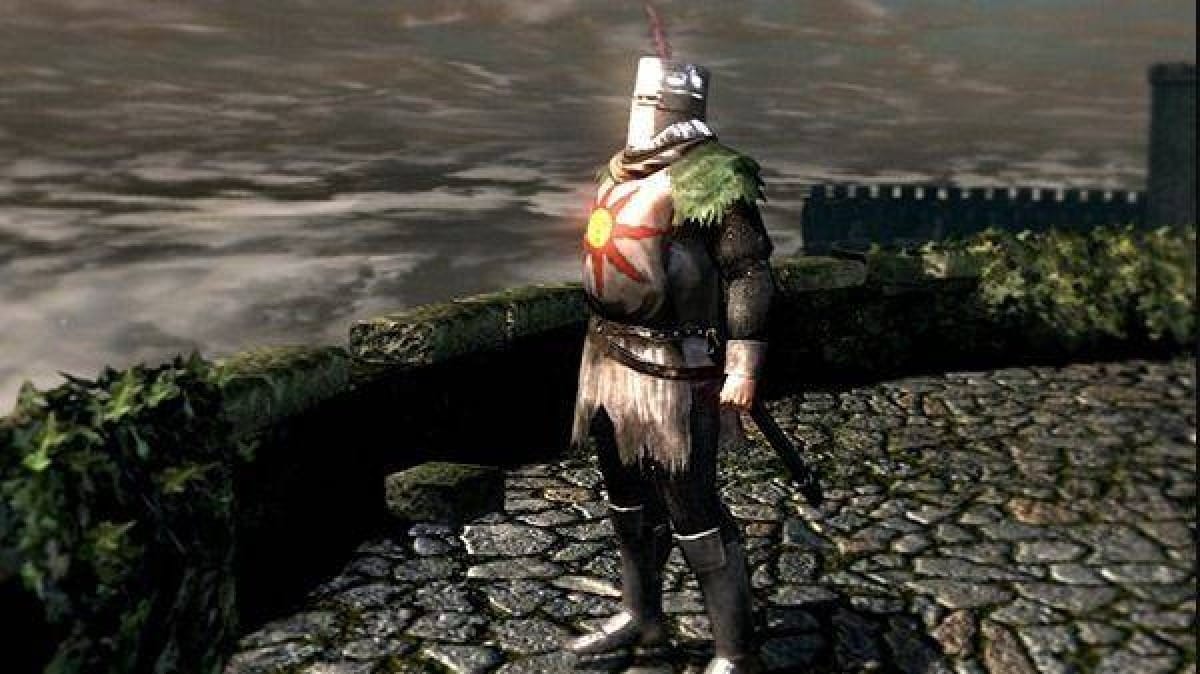
First encounter with Solaire.
On the other hand, the fate of Solaire of Astora illustrates this futility in a heartbreaking way. Solaire is perhaps the most charismatic and optimistic character we encounter on our journey; a warrior seeking his own “sun” with unwavering faith. He is the one who helps us overcome the most difficult obstacles during our trek. However, in Lordran, optimism is soon drowned by tragedy. For this reason, if we do not intervene in a nearly miraculous way (though that intervention is not canonical, according to the community), Solaire ends up succumbing to madness in the ruins of Lost Izalith, carrying a luminous parasite that he confuses with his longed-for sun, before dying and uttering his last words:
“Ah, it’s over… My sun… is setting… It’s dark, very dark…”
At this point, Goethe's irreparable opposition becomes personal: Solaire's search for light is genuine and noble, but the circumstances of a dying world do not allow for a happy resolution. His fall hits us hard because Solaire represents our own hope of finding a purpose amidst the chaos; seeing him defeated and alienated, we understand that in the tragedy of Lordran, not even goodness is a guarantee of salvation.
Another fundamental aspect of the tragic is that its characters, especially the hero, must be fully aware of the fatal atmosphere they are immersed in. There can be no tragedy if the characters are oblivious to the causes and consequences of their actions.
In the game, this understanding of the tragic emerges when the veil of the prophecy that Gwyn spread is lifted: the legend that an undead chosen one will appear to link the flame because that is their destiny, even though in reality it is for the convenience of the gods.
In this way, we progress through the story under the illusion that we are the chosen ones (just like in most games of the genre), tasked with bringing stability and saving the Age of Fire. The moment we learn that this is a lie is when we arrive at Anor Londo. At first, the city is presented to us as imposing: its colossal structures and grand golden buildings seem untouched by human influence, complemented by the glorious sun that bathes the entire city in its warm embrace.
There, after defeating Ornstein and Smough, Gwyn's elite soldiers, we face one of the last trials to see if we are worthy of the title of Chosen Undead. Once we pass this test, we come face to face with Gwynevere, one of Gwyn's daughters. She once again entrusts us with fulfilling our "destiny." However, the reality is much darker: Anor Londo is an empty shell, a mere stage set. One game object reveals this: Gwyndolin, the Dark Sun, is the only deity left in the city and uses his magic to maintain the illusion of that bright sun and hide the tomb of the gods. If the player decides to attack Gwynevere's image, the sun instantly goes out and Anor Londo is plunged into darkness.
This moment constitutes our tragic acceptance. The splendid world of the ancient gods no longer exists; their halls are empty, their treasures plundered, and their radiant light is nothing more than an illusion. This revelation is completed when we meet Kaathe, the primordial serpent, who shows us the harsh reality behind Gwyn's sacrifice: "You must destroy the decadent Lord Gwyn, who has coddled the Fire and resisted nature, to make way for an Age of Darkness." At this point, we as players understand that our mission is not to save the world, but to artificially prolong a lie that can no longer be sustained.
Tragic guilt and tragedy as meaning
Another very important aspect of the tragic is tragic guilt. This has a fundamental meaning: tragedy cannot occur without a reason for being; as a genre that, according to Lesky, relies heavily on the audience's reaction, fatal events must have an origin that is inherently linked to the actions of the tragic heroes. In other words, for there to be tragedy, the hero must have committed a flaw.
However, this is not necessarily related to guilt in a moral or Christian sense, that is, to the idea that we committed a sin and, therefore, are punished due to our moral deficiency, as tragedy generally does not present evil characters; in short, there is nothing tragic about a villain meeting a fatal end.
But it does happen, for example, when a poor judgment clouds the vision of the tragic hero and leads them to commit an act they believe to be just but, by the end of the events, causes deep pain both for themselves and for those around them: and this can drag down gods, humans, and entire nations.
Will we be moved by the faint heroism of a decaying world, or will we be swept away by the anger of a world that was not created for human beings?
In the case of Dark Souls, tragic guilt is inherently linked to Gwyn. In his attempt to prolong his hegemony, the Lord of Sunlight breaks the natural cycle of the world he inhabits and, as a result, establishes original sin. Linking the flame is the yoke of tragic guilt. There lies the origin of a series of cyclical events throughout the saga that we can summarize in the rise and fall of empires to infinity, leaving behind death and destruction.
This is detailed in the second game, when Aldia, known as The Scholar of the First Sin, speaks to us about Darkness: "Once, the Lord of Light expelled Darkness and all that derived from humanity. And men took on an ephemeral form. These are the roots of our world. Men are mere decor in the stage of life, and as sweet as it may be... a lie is a lie."
Sif greets the player before the match.
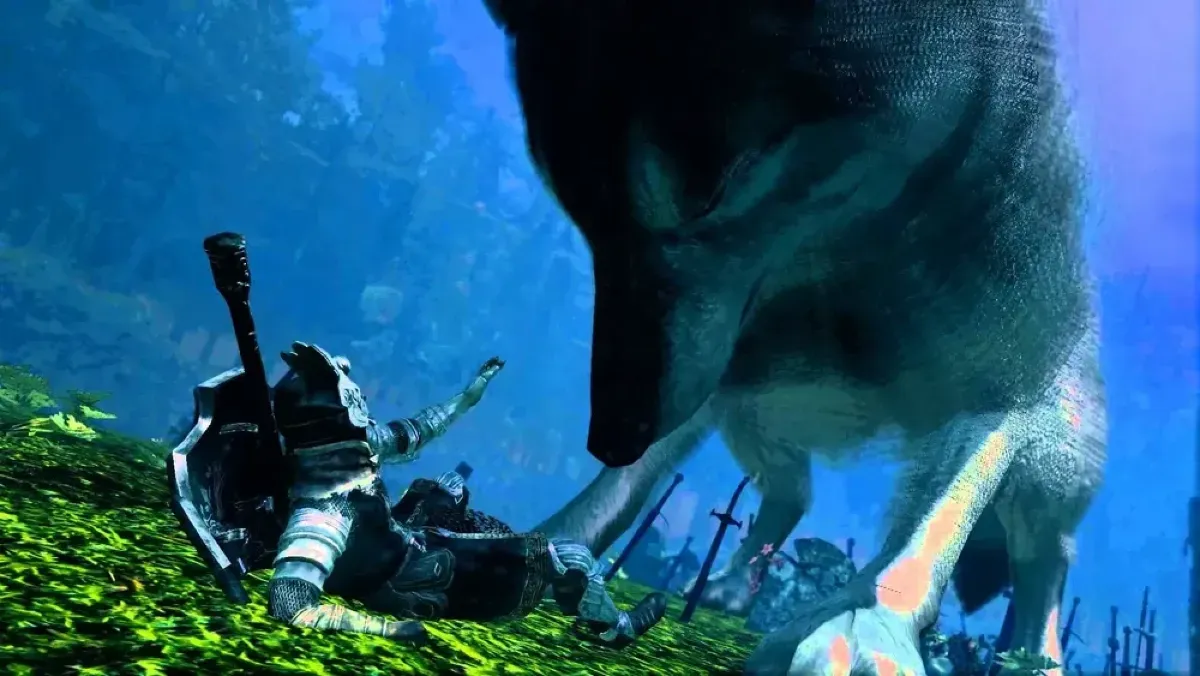
However, tragic guilt also stains our hands with blood. As we progress through the desolate lands of Lordran, we too sow suffering; our supposed quest is not so far removed from the vanity of the gods. There are two moments when this tragedy becomes unbearable. The first is the encounter with Sif, the Great Grey Wolf, whose emotional weight becomes devastating if we played the DLC and rescued him in the past: the wolf recognizes us, howls in sorrow, and yet must fulfill his duty to defend the honor of his master Artorias's grave, while also protecting us from the very darkness that consumed him. Meanwhile, we feel the need to advance to take the knight's ring and cross the Abyss. The battle is inevitable.
The second moment occurs after we face Queelag and meet her sister. We discover a blind and agonizing creature that was protected by the boss we just killed. At this moment, we as players understand that Queelag was a guardian of the ruins of what was once her home. In fact, being completely blind, she confuses us with her sister: "Quelaag, my dear sister..." she tells us, in agony.
It is hard to find other moments where the feeling of having blood on our hands is so vivid. This burden perfectly defines tragic guilt and the consequences of our journey. After lifting the veil and confronting Gwyn, we are faced with the most important decision of the entire game, which relates to the postulate of tragedy as meaning. Will we be moved by the faint heroism of that decaying world and its myths, gods, and legends? Or, on the contrary, will we be swept away by the anger of a world that was not created for humanity and watch in silence as the flame extinguishes and gives way to Darkness?
After all, the decision is in our hands.
✦ Suscribite
Las notas de 421 no tienen paywall
Y a cada colaborador se le paga por su trabajo. Las dos cosas dependen de los suscriptores.
Nací en Catamarca. Soy alumno avanzado del Profesorado en Letras. Actualmente trabajo para el diario El Ancasti en donde escribo columnas sobre literatura y conduzco el programa radial "El Códice".