ARPAC: The Story of Argentina's First Cyberspace
Before the web and Wi-Fi, Argentina created ARPAC: ENTel's data network that connected the country amid cables, dictatorship and mystery.

Originally published in issue #50 of Revista Replay. In memory of the ENTel operators and workers disappeared during the last military dictatorship.
At a certain point, any research into the development of computing invariably ends up hooking directly into the development of telecommunications. Today the two fields are inseparable: it's impossible to think of communications outside the realm of computing, but it wasn't always that way. In the early days of computing, most of the heavy machines that populated universities, corporate labs or the military's government facilities had no connection beyond their internal terminals. It wouldn't be until the late fifties that Bell Labs launched the first commercial modem, kicking off the experiments to connect computers to one another using phone lines to establish the links. In fact, it was the US military that built a radar network called SAGE (Semi-Automatic Ground Environment), linked together through Bell 101 modems. But that was still a far cry from a true computer network as we'd recognize one today.
In the beginning was the State
Starting in the sixties, when mainframes and large computers became more common in government institutions and/or companies, the idea of connecting different machines to each other didn't seem so strange. Especially considering that, at the same time, the computing paradigm was also starting to change. In the beginning, these machines, besides being gigantic, expensive and slow, could only run one task at a time. Clementina, built in 1959, was that kind of machine: to run a new task, you had to wait for the previous one to finish. But by the mid-fifties the idea of time-sharing was already brewing: first, with the ability to multitask on a single machine, though with only one active user; then, by the mid-sixties, with the implementation of multiple users running several tasks simultaneously. In fact, the SAGE system was a single-user time-sharing system, but geared exclusively toward the tasks that system had to perform (monitoring radars).
Today the two fields are inseparable: it's impossible to think of communications outside the realm of computing, but it wasn't always that way.
By the sixties, time-sharing computer systems were much more popular and were becoming the norm. “Dumb” terminals connected different departments of a university, company, bank or government agency to a central machine, where users logged in to do their daily work. Meanwhile, several researchers and scientists were already publishing papers and studies on the possibility of interconnecting these computers, so that, for example, researchers at MIT could access the computing systems at the University of Berkeley, or government agencies that also worked with them. Keep in mind that back then, if a scientist wanted to access a specific piece of research or work, they either had to go to the campus of the university in question and look for what they needed, or wait for someone to send it to them, whether by mail or in person.
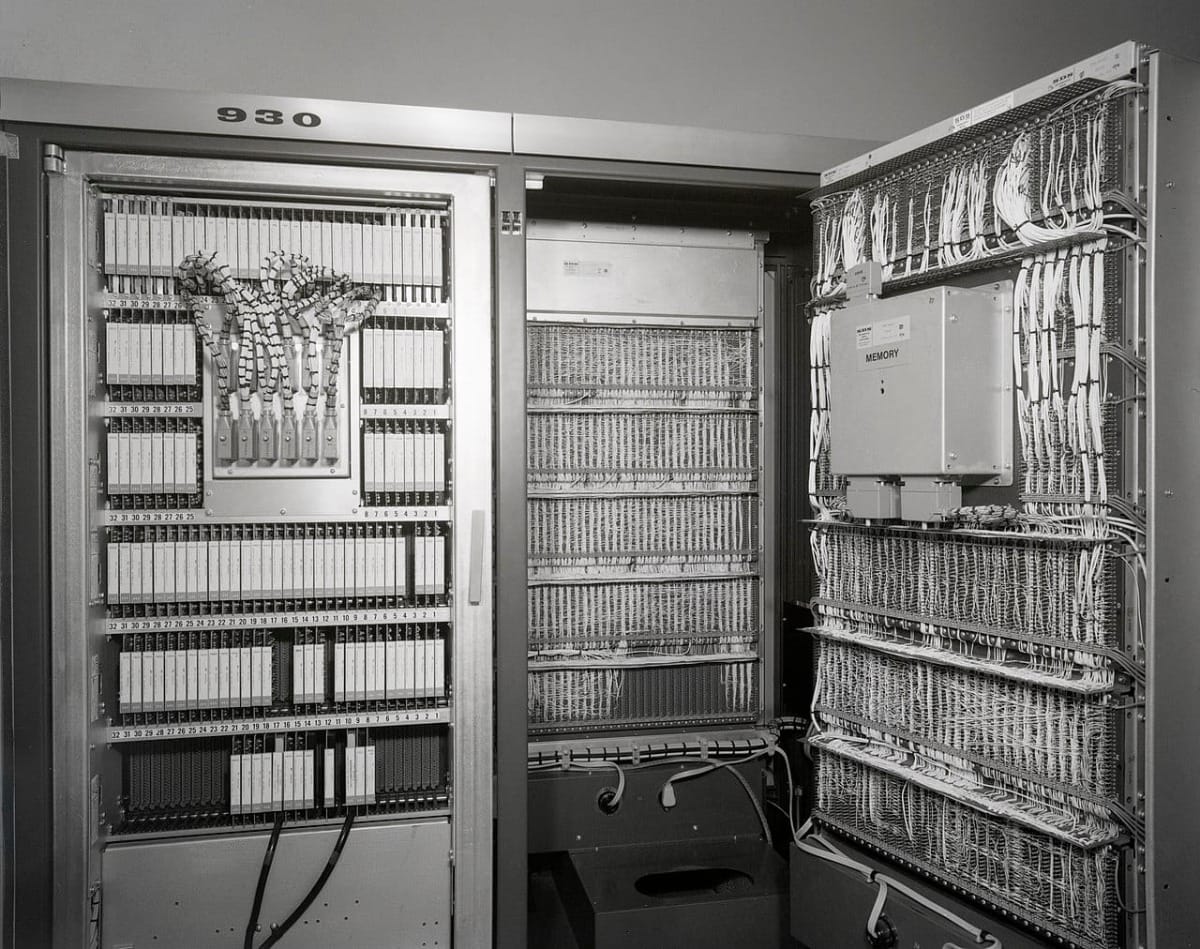
It was precisely in this context that ARPA (Advanced Research Projects Agency) emerged at the hands of the US government, which, spooked by the Soviets' progress in the space race, decided to heavily promote scientific and technological development, founding the agency with a juicy initial budget of 520 million 1958 dollars. ARPA took charge of developing many military projects, such as ballistic missile systems, geopositioning systems and nuclear missile detection. But they soon got involved in developing time-sharing systems and, inevitably, in creating a computer network. We won't get into the technical details of how the whole epic unfolded that would give birth to what we now know as the Internet, but we can say that, due to scientific needs, a direct connection with universities and research centers was required in order to get test results and new software versions instantly. And so, in 1969, ARPANET went live, connecting four points: the University of California, Los Angeles, which ran an SDS Sigma 7; the Augmentation Research Center, which used an SDS 940; the University of California, Santa Barbara, which had an IBM 360/75; and, finally, the University of Utah, with a legendary PDP-10. ARPANET thus became the first operational packet-switched network; this means that the information sent/received is split into “packets,” meaning a set of data in binary digital information, or bits, grouped into words called bytes and encapsulated in data packets that are then reassembled on the receiving machine. But also, unlike phone-line communications, which run point to point between terminals, with this kind of digital communication the packets can travel along different routes, seeking out the most optimal/reliable/operational one.
Meanwhile, in Argentina
At the same time, two landmark events in the history of computing and communications were taking place in our country. On one hand, in April '61, ENTel launched the first telex network, the successor to the telegraph. This technology had debuted in the twenties in Germany and picked up steam after the war ended. Basically, it allowed messages to be sent in real time using the phone line, which was connected to a teletype machine that ran at a whopping 50 baud, roughly 60 words per minute. This basically allowed direct, instant communication with different locations that had teletype lines installed. It was mostly used by news agencies connected to agencies in other countries (the so-called “wires”), but it was also used by companies and their subsidiaries to speed up communication. On the other hand, in 1969 the Balcarce Earth Station was inaugurated, the first satellite antenna station and, to this day, the largest in the country, marking the birth of our nation's history of satellite communications. It's worth noting that before that, domestic and international long-distance communications were carried over radio links and coaxial cables. In 1969, the Balcarce Earth Station relayed the Apollo 11 Moon landing and later, at its official inauguration, a message from Pope Paul VI to Argentina.

In 1959, Manuel Sadosky, the mathematician, physicist and founder of the Scientific Computing degree at UBA, began the process of acquiring a Ferranti Mercury, a vacuum-tube scientific computer, meaning it had no transistor technology. The machine was designed in Great Britain in 1957 and wouldn't arrive in our country until '61. Looking back with 20/20 hindsight, it turned out to be a machine that suffered from being developed at a turning point. The Ferranti was a handmade vacuum-tube computer, of which about twenty units were built, while by then IBM mainframes were starting to be industrialized and mass-produced. On top of that, Clementina was an heir to batch-processing computers, that is, one task at a time, while by then time-sharing systems were gaining popularity. But, of course, information didn't circulate that easily; even so, Sadosky and the generation of scientists he trained managed to pull off undeniable feats with such an “old” machine.
Data, data and more data
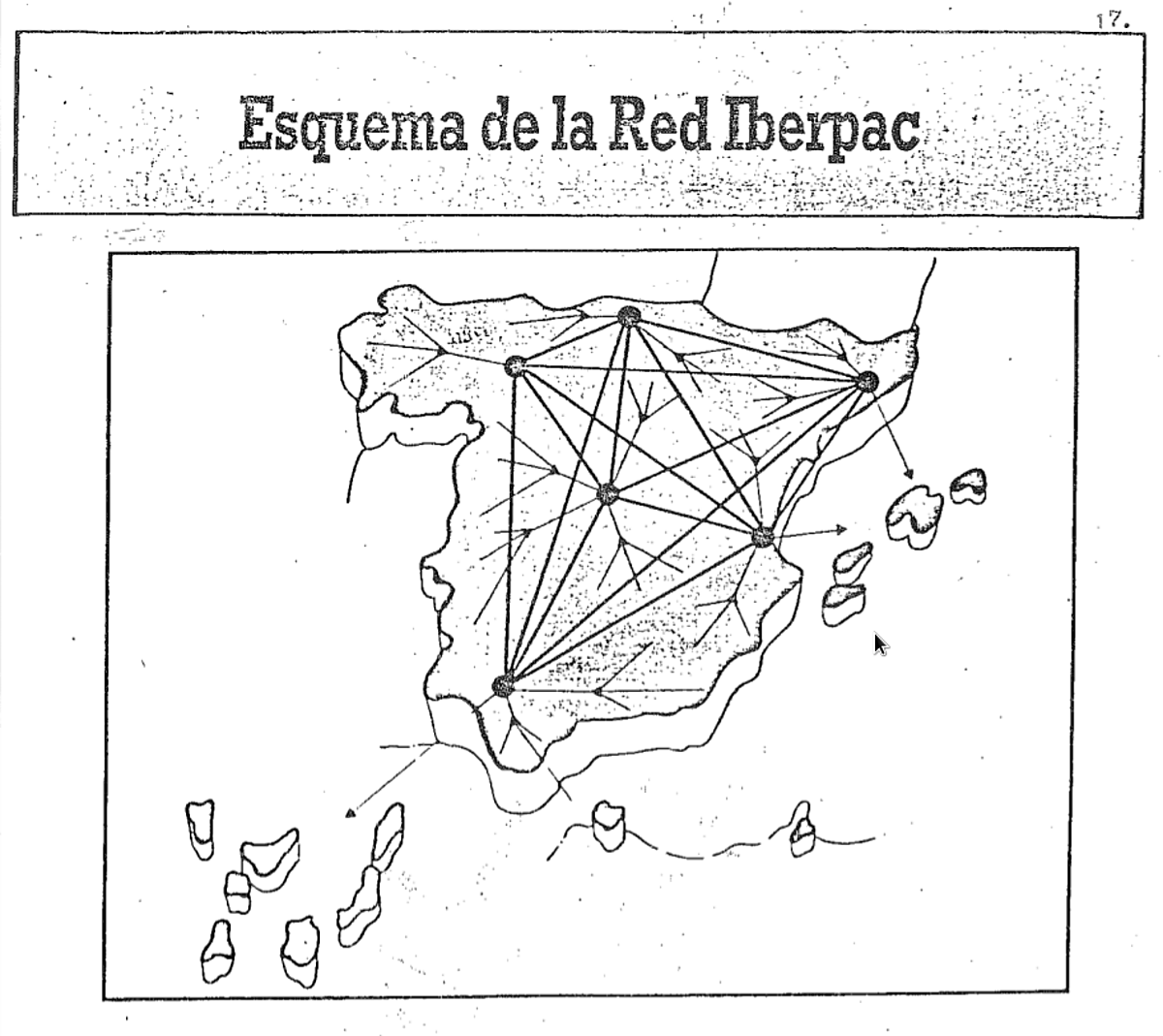
With the launch of ARPANET, new data networks quickly began popping up in other parts of the globe under the same idea: interconnecting the various computing centers operating in universities, companies or government agencies. In Great Britain came the NPL Network (1970), the National Physical Laboratory's network; in France, the CYCLADES network (circa 1970); in Spain, Telefónica created IBERPAC (1971), the world's first public data network. It would be very tedious to name them all, but across Europe, parts of Asia, Canada and the United States, data networks of every kind were cropping up, no longer just academic ones, but also some for commercial purposes.
But with this sprawl of interconnected computer systems, a problem arose. How do you get different systems from different countries to talk to each other when there was still no standardized communication protocol? In the heat of all those transmitted bytes, the need emerged to standardize telematic communications so they could actually intercommunicate.
With the launch of ARPANET, new data networks quickly began popping up in other parts of the globe under the same idea: interconnecting the various computing centers.
An analogy might make this even clearer. In electrical wiring, it's standard that the green-and-yellow wire is ground, light blue is neutral, and black, red or brown is the live wire. When that's not the case (who hasn't run into wires that are all one color?), you've got a huge mess on your hands. The same thing happened with data transmission: there was no standardization, every system communicated differently, and intercommunication was impossible—though less dangerous than mixing up colors in electrical wiring. ARPANET created its own communication standard so its various nodes (a node being a connection point on the network) could link up with one another, but as data networks started springing up in the rest of the world, intercommunication was impossible and an internationally accepted protocol was needed: that's how the CCITT No. 5 standard came about, better known as the X.25 protocol, courtesy of the ITU-T (the Telecommunication Standardization Sector of the International Telecommunication Union), which implemented it. We're not going to get into the technical details of the protocol because they're beyond our knowledge, but suffice it to say that the standard was designed to run over analog phone lines and was officially launched in 1976.
ENTel under military rule
While the X.25 protocol was being unveiled to the world, our country was going through the darkest night of its recent history. The civic-military dictatorship that staged the 1976 coup took control of the state telephone company. It's hard to talk about both things because, while the military sought to modernize the company (something they achieved to a certain extent, for strategic reasons), at the same time they disappeared some fifty ENTel employees, mostly women who did the classic work of switchboard operators. It's difficult to set these facts aside, but we have to in order to dig squarely into the matter at hand—not without making it clear that we carry in our memory and our hearts all those Argentine men and women who were detained and disappeared, and that we will never stop shouting “memory, truth and justice.”
It's hard to talk about both things because, while the military sought to modernize the company, at the same time they disappeared some fifty ENTel employees.
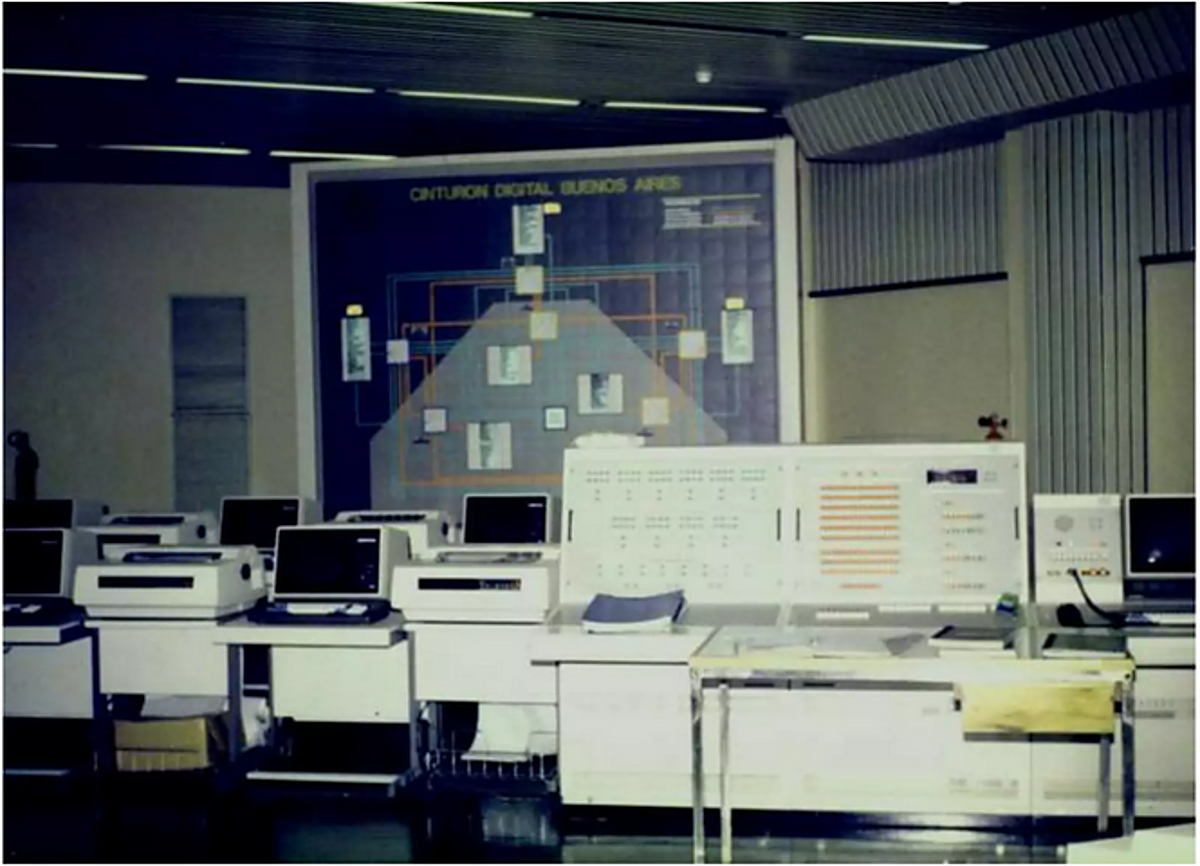
In 1978, the National Telecommunications Laboratory (LANTEL) was created under the umbrella of the United Nations Development Programme and the International Telecommunication Union, with the mission of “directing the actions that bring about the technological modernization of telecommunications” (Boletín de Telecomunicaciones, 1983). Under this agency, various improvements to the communications infrastructure began to be developed, and it was probably there that the idea of the Buenos Aires Digital Belt started to take shape. This project involved laying the first major fiber-optic network, which encircled the entire Greater Buenos Aires area in a huge digital ring of some 6,400 km (being, in turn, the first fiber-optic deployment in the world), replacing the old analog telephone trunks (or high-capacity lines) with digital connections and electronic exchanges. Put like that, it sounds simple and trivial, but the photos published in a file uploaded to Scribd, signed by engineer Oscar Szymanczky, attest to the sheer scale of the work carried out by NEC S.A., Nippon Electric CO, Sumitomo Corp, SADE S.A. and PECOM, all Japanese groups except for the last two, owned by the Pérez Companc group. It's fun to imagine the look on the Japanese engineers' faces as they stared at those tangles of old copper wire installed at the turn of the century by the British and the Americans.
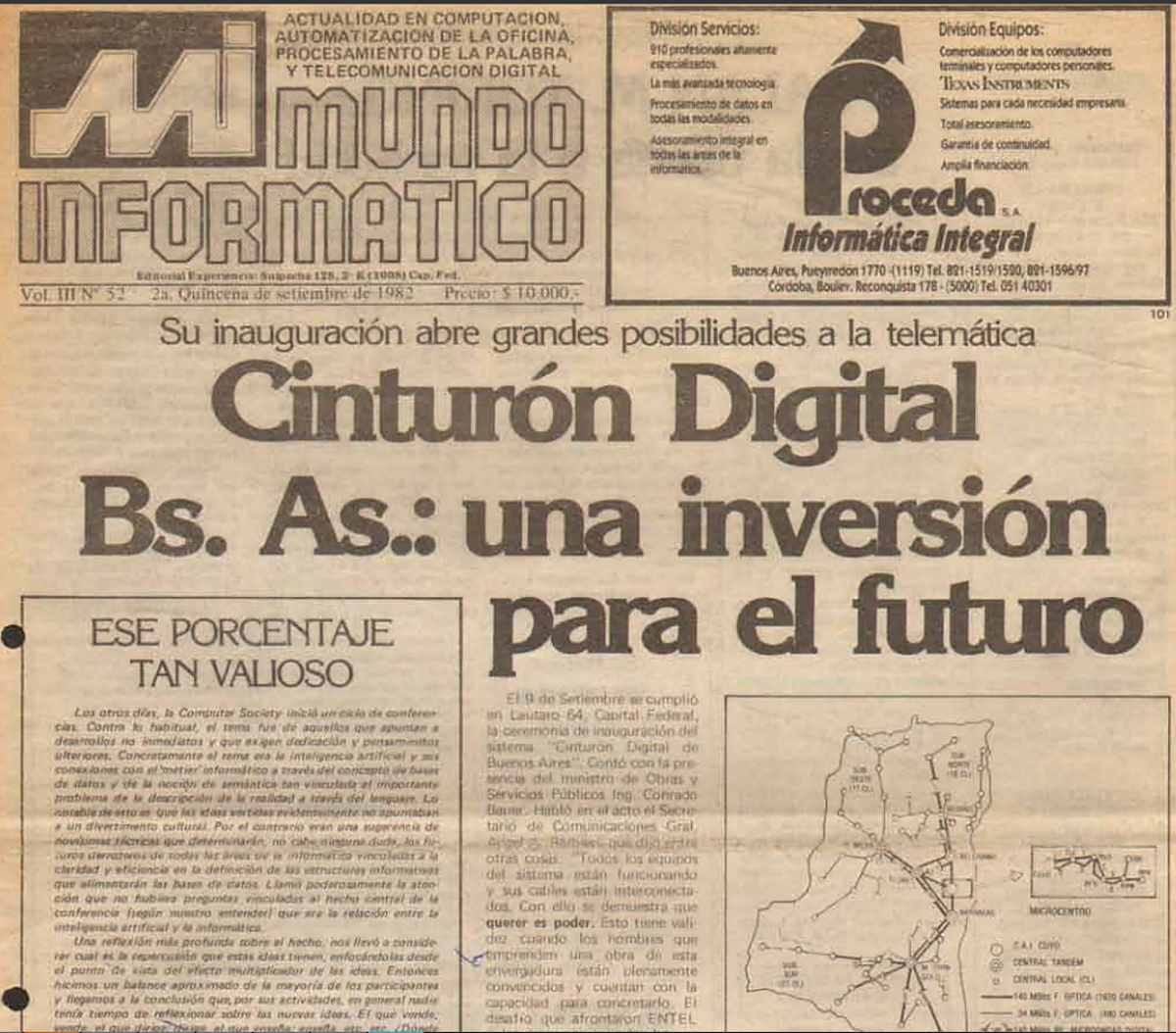
This is how the communications infrastructure got modernized, going from 1,367,950 subscribers in the Buenos Aires metro area (AMBA) in 1979 to 1,640,650 in 1982, and reaching a total of 2,730,000 lines nationwide. But other projects were underway at the same time. Terrestrial and satellite antennas went up, and the rural telephone and telex networks were expanded, though what concerns us in this story happens in 1978: “that year, the military signed an agreement with the Compañía Telefónica Nacional de España (CTNE) to install Argentina’s first national data transmission network,” Carlos Trabaldo tells us. He worked on the rollout of ARPAC, our country’s first switched data network.
The infrastructure of Argentine cyberspace
Carlos saw a newspaper ad looking for freshly graduated engineers for a phone company; at 29, with a degree in electronic engineering specializing in telecommunications, he didn’t think twice. “I took the entrance exam at ENTel’s training center on Avenida de Mayo, where the UIA building is now. Engineer Silverman gave me the test, and his secretary babysat my newborn daughter, because I had no one to leave her with. They were wonderful people.” Around 10 engineers and some 20 technicians began training to build ARPAC, through courses taught by Telefónica staff, who handed over the technology and know-how: they had already spent several years running the IBERPAC network plus others they had added along the way.
The Spanish used a system of equipment called TESYS, computing systems that ultimately had an 8086 processor or one of its successors (all the way up to the 80386) as their brain. “In provincial capitals or cities with large populations, they installed TESYS 5 (T5) units, which used a mesh network topology; that means several units are connected to each other, forming an all-to-all core. TESYS 1 (T1) units were installed in less densely populated cities and used a star topology, meaning all connections ended at that unit. That’s why there were T5 nodes in CABA, Rosario, Córdoba, Bahía Blanca, and later Tucumán, Mendoza and Mar del Plata; T1s were everywhere: Campana, Zárate, Chivilcoy, Munro, Posadas.”
This technology was developed by Telefónica, SECOINSA (Sociedad Española de Comunicaciones e Informática S.A.) and SITRE in 1977 as the successor to the IBERPAC network, which ran on UNIVAC-type computer systems; the name TESYS comes precisely from those names, as an acronym of the three companies. SINTEL and SESA handled the installation. The training, and there was a ton of it, was run by CTNE. The development was driven by customer demand for the data network; not to mention the banks, which started going digital with the rollout of the networks of the Society for Worldwide Interbank Financial Telecommunication, better known by its acronym, SWIFT, which we’ve heard a lot more about since the war in Ukraine and the economic sanctions on Russia that bar it from operating on that network.
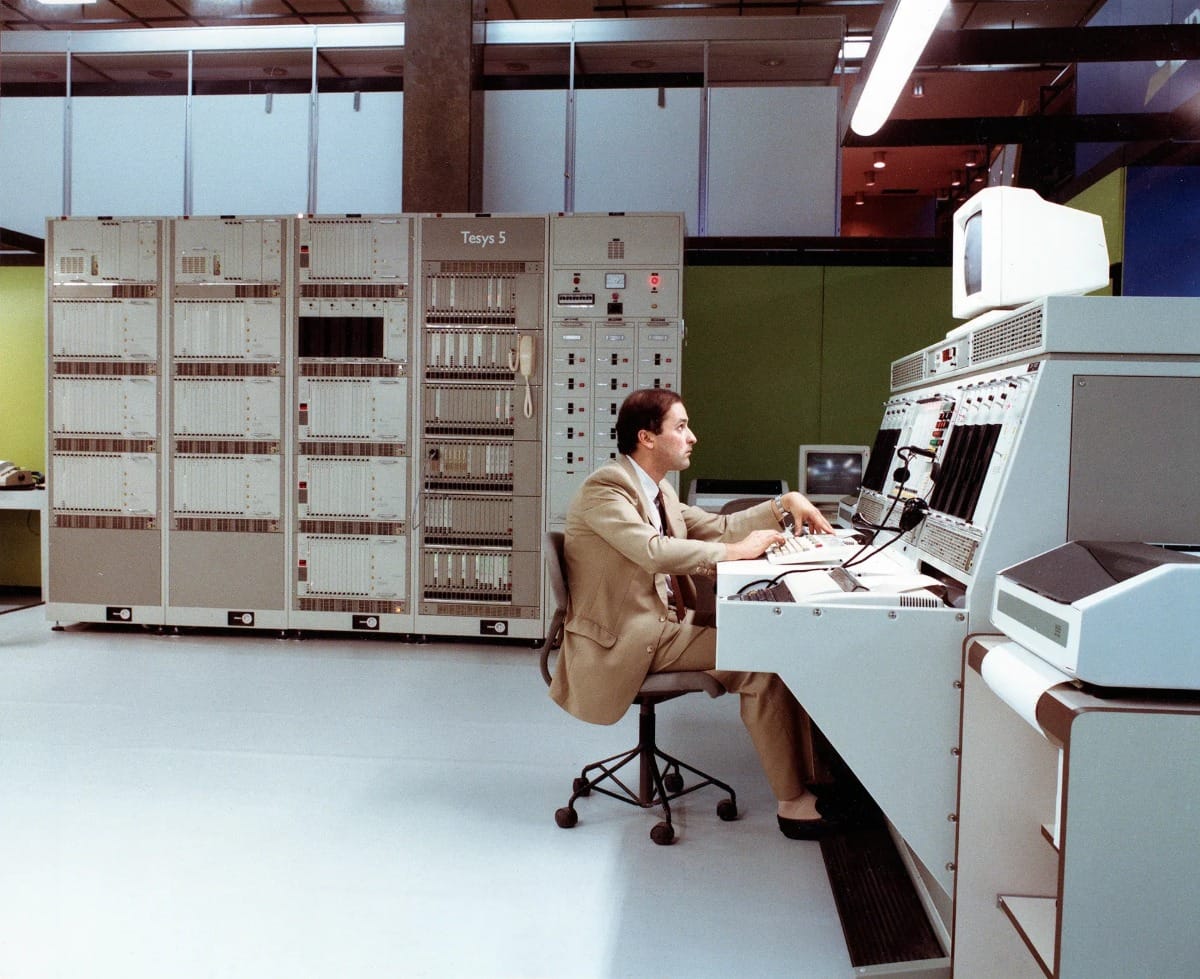
“We started working in ’81, between training, equipment arriving, upgrading the infrastructure and even getting CIDIBA up and running in 1982. The T5s were units interconnected within the same node through a high-speed bus, while the T1s in Posadas, Campana or other smaller cities were standalone units connected to an exchange that linked them to a T5 node,” Carlos continues.
Now, when ARPAC went live on October 14, 1983, it offered quite a few services: with a modem, you could connect to Aerolíneas Argentinas, the Automóvil Club Argentino’s ACAmática system, Banco Provincia de Buenos Aires, Banco Nación, the DGI (today’s ARCA), Banco Galicia, Banco del Suquía, the Ministry of Education, Banca del Lavoro and also the Delphi service. “International links were handled precisely through CIDIBA or the Balcarce Earth Station, directly under ENTel’s purview: from there you could jump to other data networks like ARPANET, IBERPAC, BITNET, among many others.” According to the few publications from the era we were able to check, when ARPAC rolled out, 15 Argentine cities had an ARPAC number for getting into this proto-cyberspace: Buenos Aires, La Plata, Mar del Plata, Bahía Blanca, Posadas, Rosario, Resistencia, Tucumán, San Juan, Córdoba, Mendoza, Neuquén, San Carlos de Bariloche, Comodoro Rivadavia and Río Gallegos.
Surfing the terminal
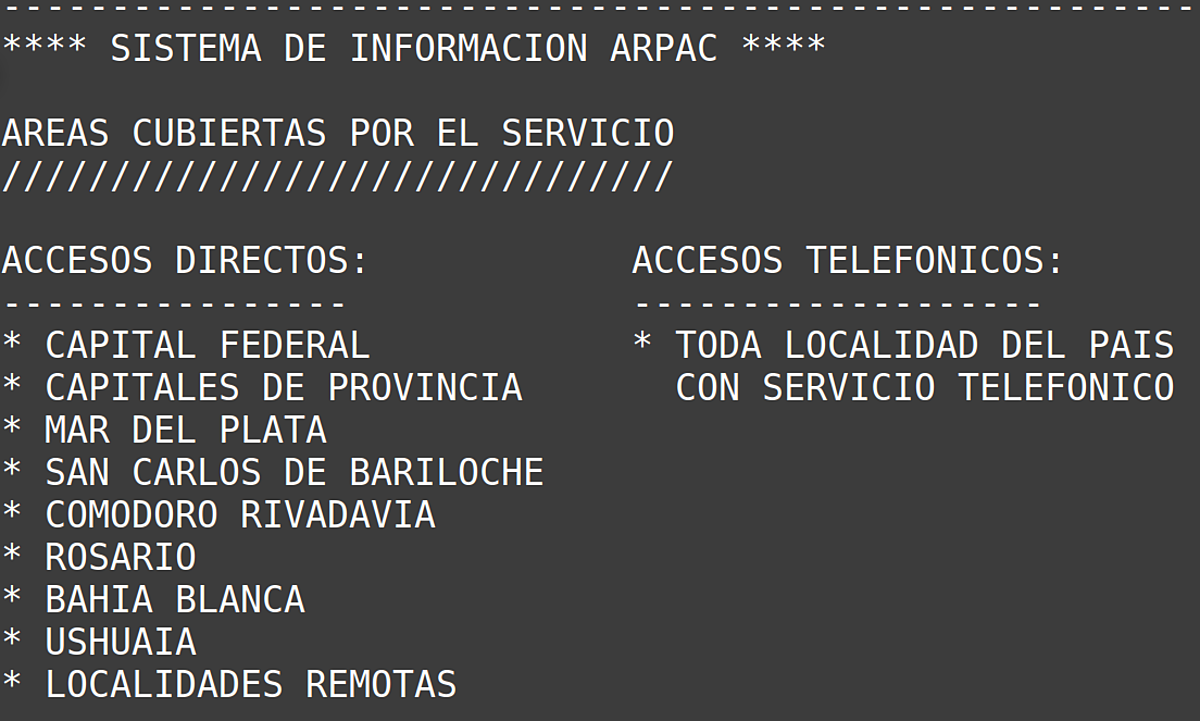
Given their age, and based on a survey we’ve run, it’s safe to assume most readers of this piece lived through the dial-up era and probably associate the Internet with those first experiences surfing the web. ARPAC was a completely different animal, since technology was at another stage altogether, but the concept of connecting and getting lost in the network was similar, except we’re talking about an era when everything was ASCII, plain text, pure and simple. Connecting required having a computer (which was not common at all), having a modem (even less so) and having some kind of access password to ARPAC (password? what’s that?). “I connected to ARPAC, but by sheer fluke, and in 1990. I used to volunteer at a library in my neighborhood. A donation arrived from UNESCO: a complete 286 computer, modem included, part of a joint program with CoNaBiP (Argentina’s National Commission of Public Libraries). The idea was to use the computer to enter the catalog of my town’s library and send that information to the National Library using the modem. We’d connect to a sort of library BBS and upload the file the management software had generated. But besides doing that, there was an option that read: ‘CONNECT TO THE ARPAC NETWORK.’” The one telling us this is ~peron, a friend from deep cyberspace who contributed key information and files to this investigation.
In his case, since he connected from a library system, no login details were required; but the rest of us mortals who wanted to get into ARPAC had to obtain an NUI, something like a user ID with its corresponding password, a concept as alien as the modem, the computer or the network itself. Remember that back then, connecting meant dialing a number through the modem and waiting for it to answer with the login screen and its options. “The first thing I did when I connected was print out the ARPAC help to try to figure out what the hell that thing was.” Those files, which ~peron preserved (he copied them onto a 5¼ floppy, then a 3½, then a CD and finally posted them online!), explained the network’s basic features and how to use it. To get in, you had to call one of the “exchanges” (the T1s or T5s). When the modem dialed, it returned the login prompt, which asked for the corresponding NUI.
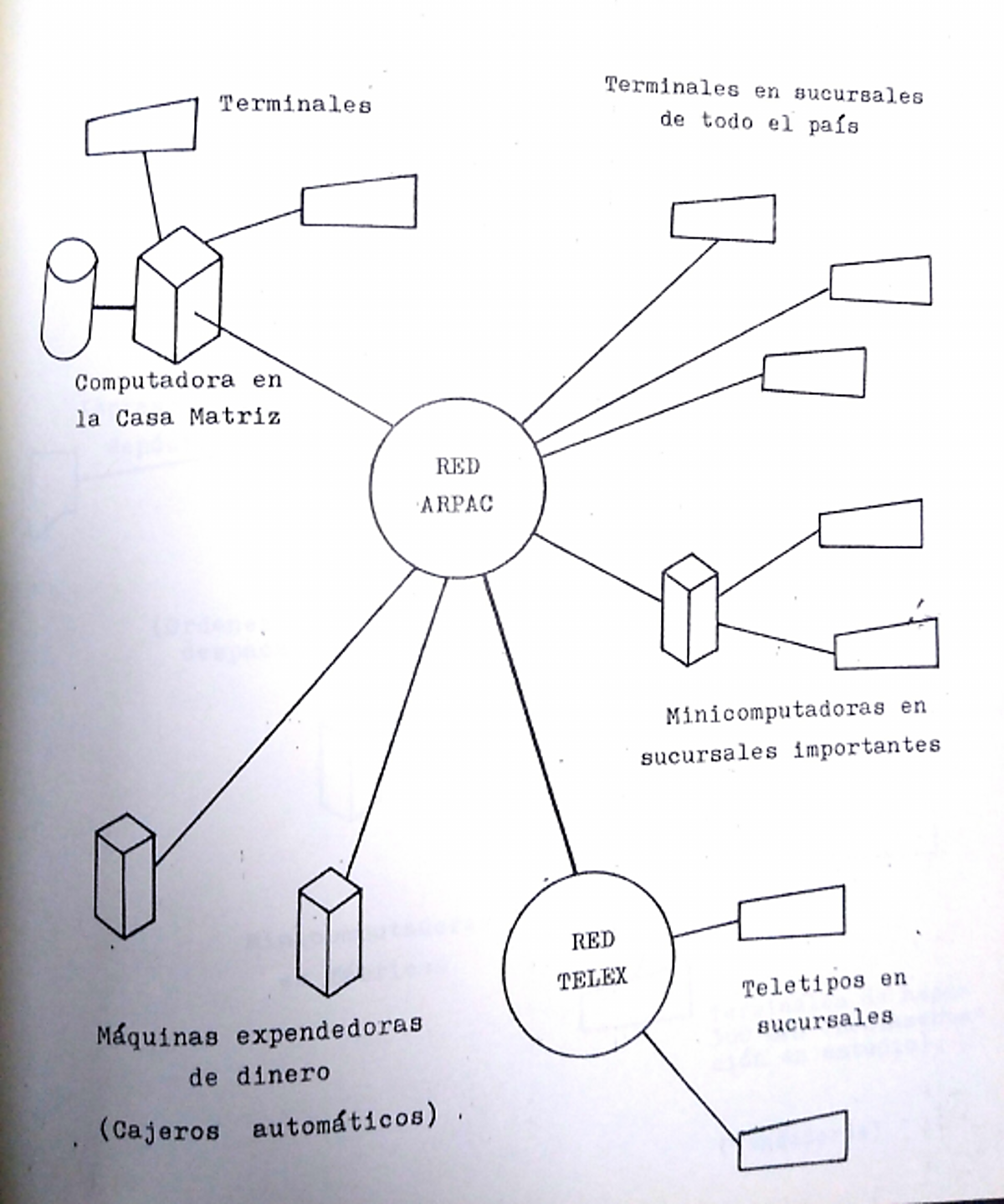
“ARPAC linked to other machines using what they called the ‘NUI.’ Inside the network, you could access other systems, like the ACA’s BBS, some universities, nuclear sector systems, big companies like Molinos, Alpargatas, Bunge & Born, Techint and several banks. It’s not like you got in to poke around their computers (as long as they were properly secured), but all those systems had accessible programs, whether forums, chats or some FTP with public files to download. Mind you, at very low speeds, 300 baud in our case... You ‘read’ as the text loaded,” ~peron tells us. ARPAC speeds ranged from 50 baud, if you logged in from a telex, up to 9600 baud, if you were at a company with a dedicated line. “Speed depended on the lines. Before CIDIBA’s fiber optics were installed, you had to measure copper pairs, coaxial cables, radio links or satellite links to pick the best ones, since you needed lines of far higher quality than for telephony. Finding transmission lines that could handle the required speeds was a huge problem. Keep in mind all of this had to be built on top of ENTel’s own existing network, which back then couldn’t even give people phones, so the most common speeds for end users were 300, 1200, 2400 or 4800 baud,” says Carlos Trabaldo.
Inside the network, you could access other systems, like the ACA’s BBS, some universities, nuclear sector systems, big companies like Molinos, Alpargatas, Bunge & Born, Techint and several banks.
One of the advantages of switched data networks was being able to use, pardon the redundancy, data rather than phone pulses. Say you had a Commodore 64, an Apple II or a 286 with a modem. If you wanted to dial into a BBS in Buenos Aires and you lived in Córdoba, you’d be charged for a long-distance call, with everything that cost. And if you wanted to hop over to a BBS in the US, doing it that way was practically impossible. With ARPAC, all of that was possible at the same data rate, meaning the national rate was independent of geographic distance. “We started little by little, very slowly. To give you an idea, Banco Provincia de Buenos Aires connected its host to two big T5 nodes. Then, in every town with a bank branch, there was an access point connected to the area’s concentrator exchange. That’s how it went, and all the banks, ministries, government offices and some private companies started joining: IBM, Sancor, Galicia, Banca del Lavoro, DGI, and so on and so forth,” Carlos adds.
ARPAC’s rates
Of course, the network wasn’t open to just anyone. Manuel Moguilevsky, a pioneer of Argentine BBSs, told us how the Delphi service was brought to Argentina, which meant buying 30 phone lines and a direct ARPAC link running to his offices; that way, Delphi Argentina subscribers got access to ARPAC. The investment involved was no small thing. If you wanted home access to the network, you had to pay for the installation of a dedicated line, and figuring out how much that cost is anything but simple. For starters, around the years the network went live, hyperinflation was starting to brew, which makes any monetary calculation pretty tricky. On top of that, the information we have from a document titled “Un instrumento para el cálculo de tarifas de la Red ARPAC” (“A Tool for Calculating ARPAC Network Rates,” 1981), written by engineer Jorge Badorrey of IBM Argentina, isn’t very illuminating, but we’ll still try to lay out some figures.
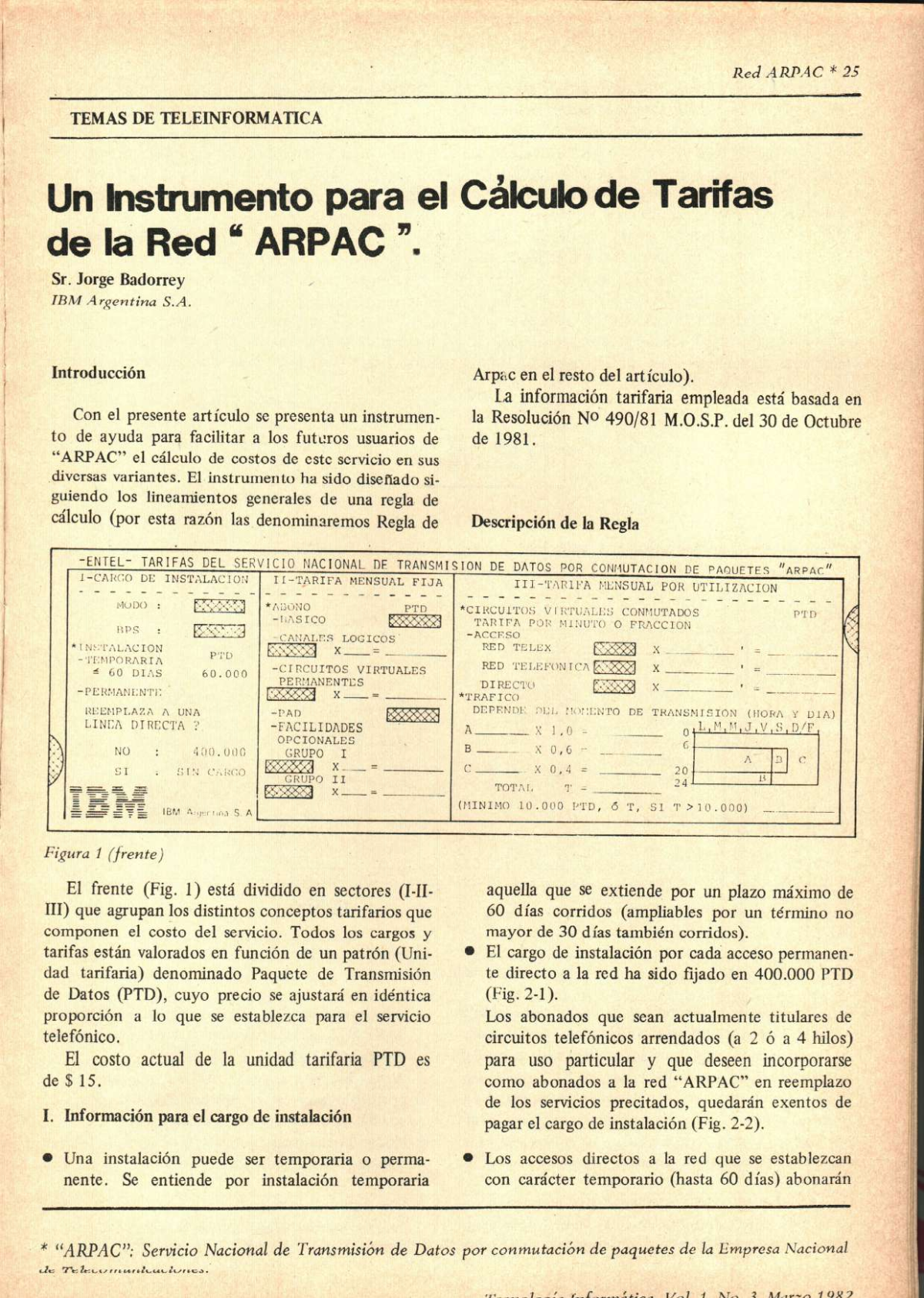
The rate was calculated using a unit called the data transmission packet (PTD). Basically, it was the data transmitted by each device connected to ARPAC. When that document was published, each PTD cost a whopping $15. Installing the network cost 400,000 PTD, about 6 million pesos at the time (1981), roughly 600 dollars back then (which would be about 2,100 dollars today!). Considering that in mid-’86 Manuel was charged 300 dollars per phone line, the calculated figure is fairly “consistent.” Now, when it comes to billing for network usage, the math gets even more complicated. ARPAC offered a flat rate of 10,000 PTD of 128 K, that is, about $150,000 for the basic plan, as long as you didn’t go over 10,000 PTD. To put it in today’s terms, my computer has been on for 2 days and the total packets transmitted comes to 4,980,359... Of course, back in ARPAC’s day there were barely any .txt files to download. Between ’81 and 2025 we went through hyperinflations, the Austral Plan, convertibility, crisis after crisis, so it’s really hard to make anything like an accurate calculation, but let these numbers serve as a reference for what things cost back then.
“I prefer a different calculation that I call the ‘Clarín Cover Price Index.’ The cover price of the newspaper Clarín in June ’81 was $2,500. Since the cover price of Clarín today is equivalent to what it was in ’81, having ARPAC today would cost about 5 million pesos or, at today’s dollar rate, about 4,300 dollars.” ~peron’s math may seem a bit off the wall, but it does a pretty good job of translating those costs into today’s numbers.
The road to the Internet
At almost the same time ARPAC was going live, the U.S. Department of Defense announced in March '82 that it was adopting the Transmission Control Protocol & Internet Protocol, better known as the TCP/IP stack, as the communications standard for all defense systems. ARPANET ran on the Network Control Protocol (NCP), similar to X.25 but developed in-house and used exclusively on its own network. By the mid-seventies, though, advances in telecommunications and the appearance of more and more data networks called for a new protocol: one that was more flexible and scalable, performed better, and also made it easy to interconnect different networks. In fact, the name “Internet” comes from “internetworking,” meaning the ability to connect different computer networks.
Both X.25 and NCP fell way short as data networks grew, so different groups of scientists started working on the idea that would give birth to TCP on one side and IP on the other. By 1983, the BSD 4.2 operating system became the first to implement the TCP/IP stack natively. In '84 came the Domain Name System (DNS), which lets you associate an IP address with an easier-to-remember name. Under NCP, each computer had an assigned number, and that number was mapped to a name in the hosts.txt file: for example, address 1.1 corresponded to the computer UCLA-1. X.25 was even more complicated, since addresses were strings of numbers impossible to remember. In TCP/IP, each address corresponds to a name; for example, the address 172.26.4.56 corresponds to revistareplay.com.ar. Before DNS, every computer had a hosts.txt file (which still exists in every operating system) listing IP addresses and their names. This was done manually and centrally until DNS came along to automate the job.
In '86, NSFNET (National Science Foundation Network) was created, running directly on TCP/IP and linking universities to one another over fiber-optic connections; eventually, it would replace ARPANET and become the backbone of the early Internet as we know it. By the late eighties, TCP/IP was spreading beyond military and academic use. So much so that in 1990 Tim Berners-Lee created the World Wide Web (WWW), which would soon become a fundamental Internet standard, since it would be the gateway for millions of users around the globe.
Privatizations and Scrapyards

In 1982, Roberto Alemann, then the dictatorship's Minister of the Economy, proposed a partial privatization of ENTel, which the magazine Mundo informático (1982, No. 41) followed closely. There, a certain engineer Rivera is asked various questions about ARPAC, including “ARPAC's fate in light of the privatization rumors.” Rivera replies that he only knows the details reported in the newspapers, nothing more. “ENTel's image was badly tarnished. The financial district and the big-money crowd were all hooked up with point-to-point lines that crisscrossed the sky like a spiderweb, and everyone there was looking out for number one. We were the oddballs. The ARPAC group was made up of people who'd had no contact with the traditional company, and all its methods were different from the existing ones. We handled a sensitive area, value-added services, which meant we had no choice but to interface with the ‘traditional world.’ That created some friction in an environment used to a bureaucratic organization where getting a service installed and/or repaired was an ordeal,” Carlos tells us.
ENTel's image was badly tarnished. The financial district and the big-money crowd were all hooked up with point-to-point lines that crisscrossed the sky like a spiderweb, and everyone there was looking out for number one.
After the fall of the Military Junta and the return of democracy, ARPAC kept growing, adding more nodes and exchanges. “At the peak, say 1988, we got up to 300 across the country... And to think that to install a unit in Bahía Blanca we'd drive out in a green Rastrojero that topped out at 60 km/h!” Under democracy, in 1987, Alfonsín announced Plan Megatel, an ambitious project aiming to create a million phone lines that would be sold in installments to anyone interested. The plan was a resounding flop: only a small fraction of the promised lines were ever delivered and, worse still, thanks to the ancient, obsolete infrastructure (remember, analog telephone exchanges were still in use), the lines got even more saturated and the wait to put through long-distance calls grew enormously. ENTel's president, Radical Party member Nicolás Gallo, who had just taken over at the company, ended up convicted of embezzlement (curiously, he was also one of the last men to leave the Casa Rosada on December 20, 2001).
Finally, after Alfonsín's exit and Carlos Men*m's arrival in the presidency, the privatization, sale and dismantling of ENTel began. Trabaldo sums it up: “Privatization split ENTel into four companies: a) pure, monopolistic telephone service in the Southern Zone, with Telefónica de España, later Telefónica de Argentina; b) pure telephone service in the Northern Zone, with France Telecom and Italtel Italia, later Telecom Argentina, again with a monopoly on that area; c) international services, with the creation of a Spanish-French-Italian joint venture called Telintar, which monopolized that business; d) value-added services, with the creation of another joint venture with the same ownership structure as Telintar, first called Sociedad Prestadora de Servicios en Competencia, later Startel. It was the only one that wasn't a monopoly and that provided non-telephone services. Naturally, that's where ARPAC landed.”
Given the new advances that kept coming, the new owners decided to build a new network called “Red Starnet,” with Alcatel equipment brought over from France and operated by Startel, 50% of which was owned by Telecom. The TESYS units stayed in service, but there was a gradual migration to Starnet. “In 1994, they put me to work on the migration, but I was never clear on when ARPAC was shut off. Why? Because in 1998 Startel disappeared as a company and my working life carried on in Telecom's transport engineering department. That's where I lost track of ARPAC. I think whatever little was still running must have been switched off before Y2K. That was the end of ARPAC.”
Unlike ARPAC, this story doesn't have an ending yet. This is just a sketch of its history: we had to leave a lot of information out, and while we were putting this piece together, more testimonies and information kept turning up. But the page is a tyrant, and sometimes it feels even more cramped than data packets back in 1981.
Las notas de 421 no tienen paywall
Y a cada colaborador se le paga por su trabajo. Las dos cosas dependen de los suscriptores.