Moving Between Realities: Reality Shifting, Dreams, and Writing
Reality shifting, maladaptive dreaming, literature, and the desire to escape reality by creating fictional worlds.

Reality shifting, maladaptive dreaming, literature, and the desire to escape reality by creating fictional worlds.

"Poor people," thinks my dreamer. And it’s no wonder he thinks that! Look at those magical ghosts taking shape before him in such a charming, whimsical, limitless, and vast way, in a lively and wonderful picture where, naturally, the main figure, in the foreground, is himself, our dreamer, his beloved self. Look at the varied adventures, the infinite swarm of ecstatic daydreams. You might ask: what does he dream of? Why ask? He dreams of everything…
Fyodor Dostoevsky, White Nights.
The human mind tirelessly seeks to escape the grayness of everyday life. Nowadays, phenomena like reality shifting and maladaptive daydreaming attempt to blur the line between reality and fiction. However, far from being a recent invention, retreating into imagination is an ancient mechanism for redefining the boundaries of our own experience. From ancient worldviews and esoteric currents to major literary figures, daydreaming has always served as a gateway to parallel worlds.
I will try to take a journey through these practices, starting from the end.
Last year, I came across a concept I had never heard of before: reality shifting. What is reality shifting? A trend that gained popularity on TikTok between 2018 and 2020, where teenagers shared their experiences of "traveling" to Hogwarts, or, more precisely, moving to a dimension where they were part of that fictional universe.
Currently, phenomena like reality shifting and maladaptive daydreaming attempt to blur the line between reality and fiction.
In truth, the concept of reality shifting is a bit more complex than simply fans of Harry Potter wanting to dream up a kind of fanfiction to be part of the book. Many familiar with the world of reality shifting believe that the TikTok trend is an exaggerated and often false version of a practice that has its science and is not easy (and for which there are several videos with precise instructions).
Reality shifting is defined as the practice of "moving consciousness" from this reality (CR, current reality) to another (DR, desired reality). That "desired reality" can be: a fictional world (like Hogwarts), an alternative version of one’s own life, or a completely invented universe, where the shifter usually takes on the role of protagonist.
There are several techniques for "shifting." Scripting, for example, involves defining in advance the characteristics of the desired reality: its rules, the identity the shifter will have there, the environment, etc. Scripting does not create a new dimension; it simply specifies which of the infinite possible realities one wishes to go to. The shifter is not a god nor a fictional author: they do not create anything from scratch. They merely channel something that is supposedly already out there.
Other suggested methods draw elements from meditation, astral projection, and lucid dreaming. Some suggest lying on one’s back and counting backward while visualizing a door leading to the desired place (the Raven method), or imagining a character from the world one intends to reach and following them down a rabbit hole (the Alice in Wonderland method). Others reproduce techniques associated with lucid dreaming, such as performing reality checks while awake to train consciousness and recognize when one is dreaming. Almost all of these methods share one thing: they take place on the border between sleep and wakefulness.
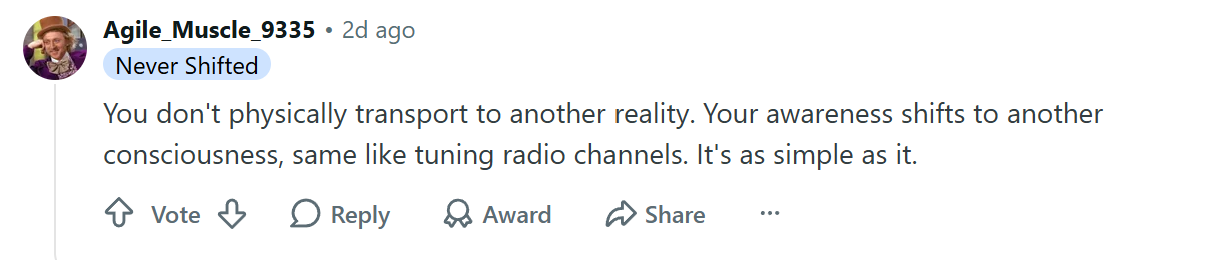
According to Valentina Tanni, in Liminal Aesthetics (Caja Negra, 2026), reality shifting functions as a new tool for relating to a world that appears unstable and impermanent: "Ours is a reality that we increasingly struggle to distinguish from fiction, which in many cases is already false in itself and seems to be getting more out of control every day." And if it is already impossible to pinpoint what the true reality is, if there is one, why not choose which fiction we traverse? Reality shifting is, above all, a fantasy of control.
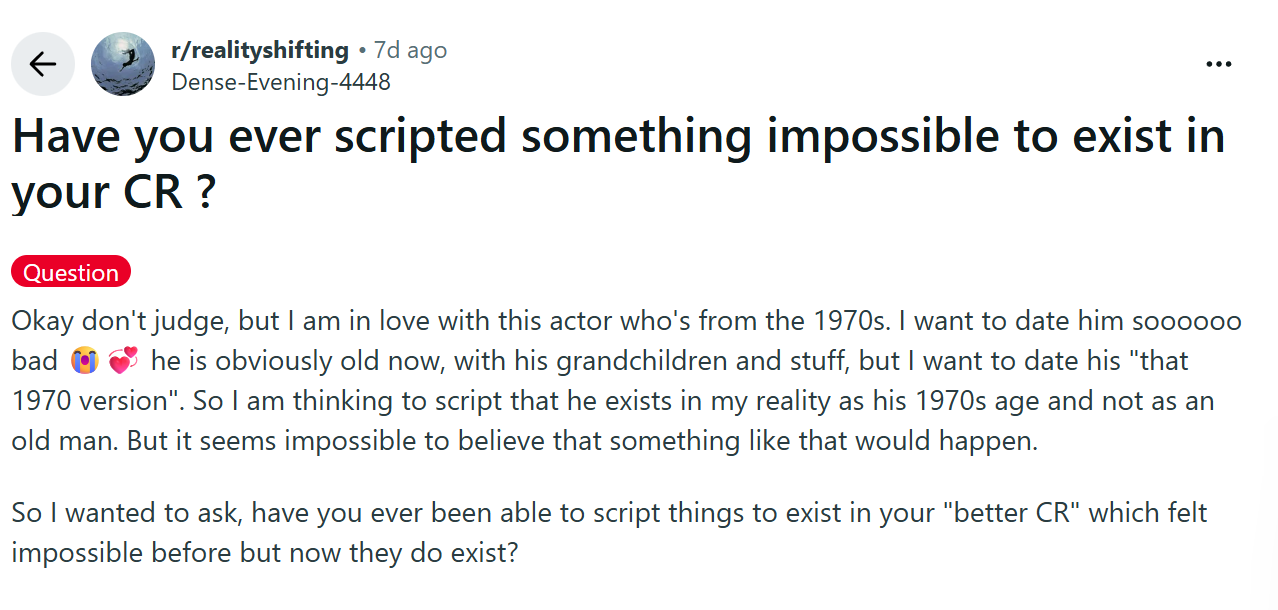
The idea of mentally constructing an alternative world is not new either. Various modern esoteric currents, from Aleister Crowley’s occultism to late 20th-century chaos magic, have worked with visualization and the deliberate creation of mental entities or "thought forms." In those systems, intense imagination was not mere fantasy, but an intervention on perception and, in a sense, on reality itself.
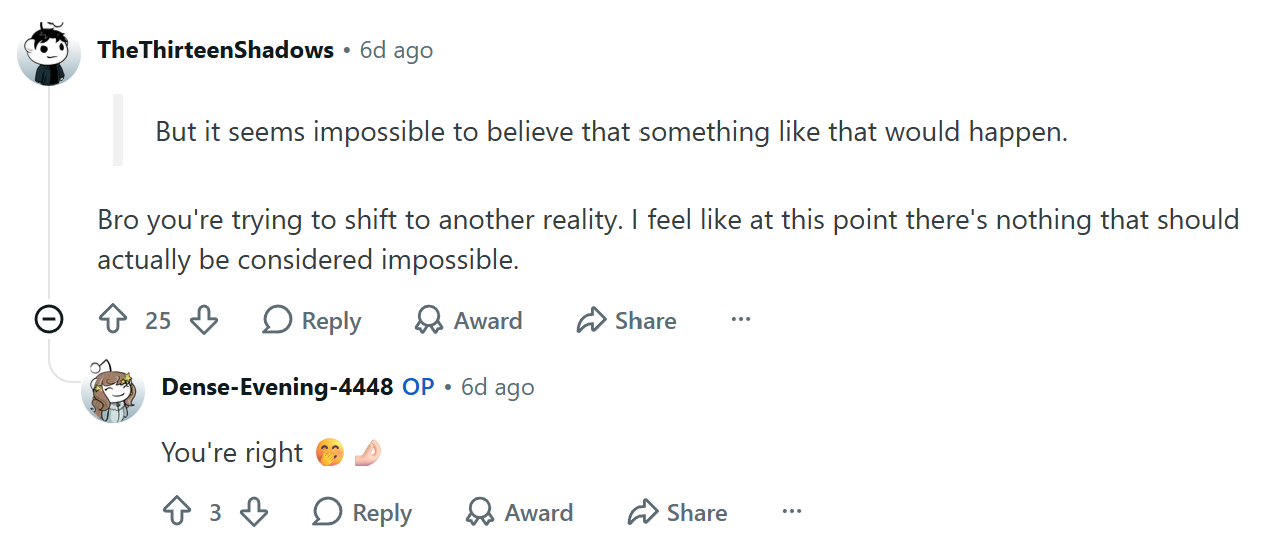
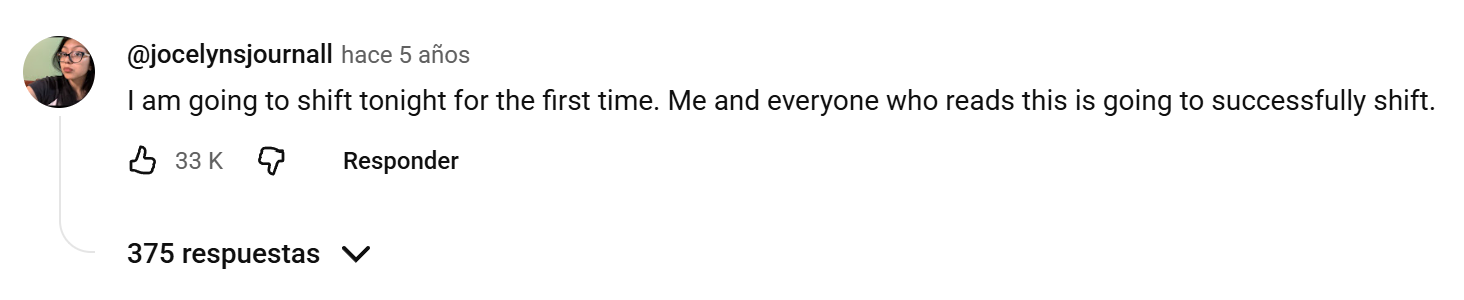
The comments shared in videos and threads about reality shifting resemble those advising to "reprogram the brain" to achieve the life we want. Users wish each other luck and share affirmations as forms of invocation. If you are not in your desired reality, they say in some videos, it’s because you are putting mental blocks in your way instead of manifesting it. It’s as simple as believing it.
Another term associated with this tendency to retreat into imagination is maladaptive dreaming. It is a psychological phenomenon characterized by intense and elaborate daydreaming. Just like in classic daydreaming, the mind wanders through free associations triggered by some stimulus. The difference lies in the compulsive nature of that daydreaming: it stops functioning as a momentary pause and begins to take up more and more mental space.
In moderate doses, daydreaming can have positive effects. While the mind wanders, we organize future scenarios, process emotions, and rehearse possibilities. Daydreaming serves as a tool to navigate between the external world and our mental life. The problem arises, as with everything, when it occurs in excess.
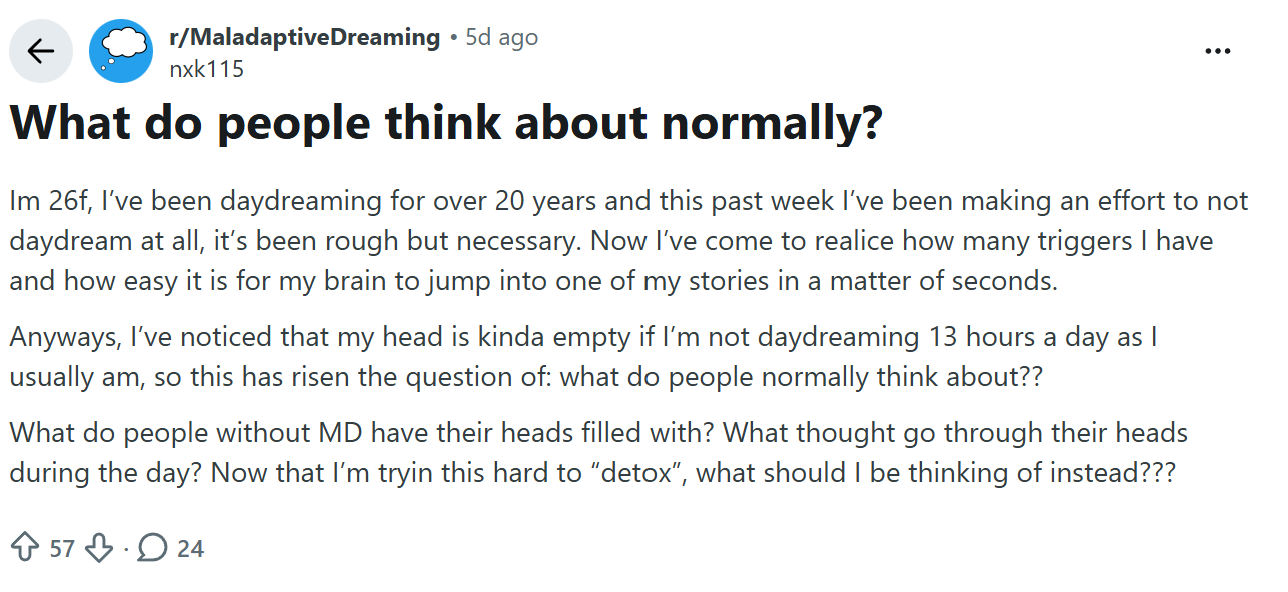
Just as there are people who have difficulty forming mental images consciously (a condition called "aphantasia"), others have an ease or propensity to "drift off into the clouds." Those who experience maladaptive daydreaming often describe extremely vivid fantasies, with recurring characters, complex plots, and persistent universes that continue for years. Often, these episodes are triggered by music, repetitive movements, or specific images, and can extend for hours, isolating the person experiencing them from their immediate surroundings. It’s not just about having "a lot of imagination"; it’s about feeling a constant pull toward a more intense or satisfying inner life than the everyday one.
Those who experience maladaptive daydreaming often describe extremely vivid fantasies, with recurring characters, complex plots, and persistent universes that continue for years.
Beyond its clinical aspect, many testimonies about maladaptive daydreaming carry a certain melancholic tone. Some people report having lost that capacity for daydreaming with adulthood, when they found jobs, partners, and more stable routines. Others stopped connecting with their fantasies due to anxiety, depression, or the effects of medication they were taking. In many comments, there’s a sense of having lost access to a parallel world that was once always available.

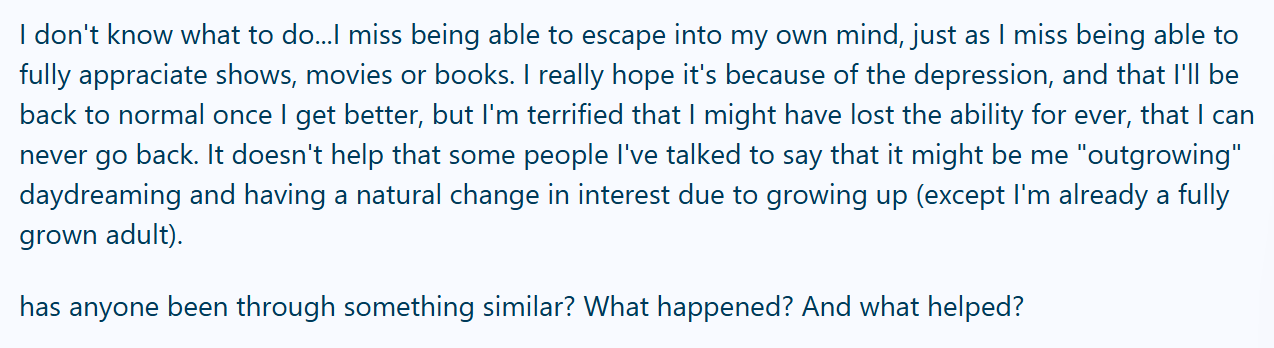
Imagination is like memory; it needs to be exercised to stay alive. Today, constant hyperstimulation seems to make those states of mental drift even harder to achieve. There’s no longer any time to play or to go for a walk without direction. Amid screens, notifications, and algorithms, there are fewer and fewer empty spaces left to be bored, daydream, or simply let thoughts wander. On Reddit and other forums, there are plenty of posts from people who miss the intensity of their inner worlds, even when they acknowledge that being less trapped in them has allowed them to connect better with reality.
Maladaptive dreaming and reality shifting often emerge as coping mechanisms: when the world around us feels too hostile, the temptation to dissociate and escape to another scenario grows, where there’s still a sense of control. It’s no coincidence that reality shifting exploded on TikTok in 2020, during the pandemic, when millions of people were confined to their homes imagining other possible places. In the current context, imagining an alternative dimension also seems more tempting than thinking about how to fix this one.

Beyond how strange or ridiculous reality shifting may seem, there’s something familiar about the idea of accessing pre-existing worlds through dreams. Long before TikTok, writers, mystics, and artists described their narratives not as inventions, but as experiences received in dreams, trances, or altered states. What’s unsettling is not just the possibility of escaping to another world, but the feeling that these worlds exist before being imagined. As if certain stories are not invented, but found.
In many ancient cultures, dreams were understood as a form of knowledge rather than just a private fantasy. In the Greek tradition, gods sent messages and visions through dreams. In certain Australian Indigenous cosmologies, Dreaming refers not only to a mythical past where the Ancestors dreamed the world, but to a dimension that is still active and accessible through rituals. Hinduism also conceives of the universe as the divine dream of Vishnu, with reality as something unstable, capable of dissolving the moment he awakens. In various shamanic traditions, trance and lucid dreaming served as ways to expand perception and connect with other planes of existence.
What’s unsettling is not just the possibility of escaping to another world, but the feeling that these worlds exist before being imagined. As if certain stories are not invented, but found.
Reality shifting recaptures this conception of the dreamlike as an expansion of perceived reality: it’s a controlled journey to a dimension that exists outside oneself. A blend of scripted planning and discovery.
This idea also permeates much of modern literature. Many writers have described their works not as fully conscious products, but as narratives received in dreams or states close to trance.
My favorite pastime (...) was "writing stories". But there was an even dearer pleasure for me: building castles in the air, surrendering to daydreams, following long chains of thoughts whose theme was the creation of a succession of imaginary incidents. My dreams were both more fantastic and more enjoyable than my writings.
Mary Shelley, Introduction to Frankenstein.
George R. R. Martin distinguishes between two types of writers: the “architects,” who plan every detail before writing, and the “gardeners,” who start with an initial idea and let the story grow on its own. Brandon Sanderson, another bestselling fantasy author, uses different names for a similar distinction: outliners and discovery writers. Most authors probably combine both types to a greater or lesser extent: part planning and part discovering the story as they write.
But what happens to the figure of the author when the narratives come from dreams, visions, or altered states?
Throughout history, writing has also been associated with the dreamlike. Many authors have claimed to find their ideas, characters, and scenes in daydreams. Borges revisits this idea several times when he writes about Coleridge and the shared dream of Kublai Khan's palace. It also appears in stories like “The Circular Ruins,” where one character dreams another into existence: “In the dream of the man who dreamed, the dreamed one awoke.” The dreamed one becomes a man capable of dreaming others, infinitely reproducing the creation of the author and their work as a divine act: “With relief, with humility, with terror, he understood that he too was an appearance, that another was dreaming him.”
Mary Shelley also dreamed of a man who in turn wanted to dream another. It was a summer night in 1816. While trying to imagine a ghost story for a game with her friends, in a state between asleep and awake, Frankenstein first appeared in her mind. A much more vivid image than any daydream:
I saw —with my eyes closed, but with a sharp mental vision—, I saw the pale student of unholy arts kneeling beside the creature he had assembled. I saw the horrendous ghost of a man lying there, and then, by some powerful mechanism, showing signs of life and stirring with a barely vital movement. It must have been terrifying; for supremely terrifying would be the effect of any human attempt to imitate the prodigious mechanism of the Creator of the world.
Robert Louis Stevenson also claimed that dreams “dictated” his stories, and that he received from them “three scenes, and the central idea of a voluntary change that over time becomes involuntary”: the seed of what would later become The Strange Case of Dr. Jekyll and Mr. Hyde, published in 1886. Six years later, Stevenson wrote A Chapter on Dreams, an essay where he describes the “theater of the brain” that takes the stage while he sleeps. In it, he says, little people act, whom he calls his Scottish Brownies or “Duendecillos,” whom he considers his true collaborators:
The fraction that is elaborated while I sleep is undoubtedly due to the Duendecillos; but that which is made while I am awake is not necessarily mine, as everything points to the fact that the Duendecillos also intervene in it. (...) I am an excellent advisor, something like Moliere's servant; I arrange here and cut there, and dress everything with the best words and sentences I can find; I also hold the pen and sit at the work table, which is the worst part; and when everything is finished, I elaborate the manuscript and pay the registration, so I can claim a share —in proportions that I truly do not deserve— in the profits of this common enterprise.
In his childhood, Stevenson was a frail boy who was forbidden to leave the house. We can imagine him looking out the window for hours, spying on the streets of Edinburgh. With nothing else to do but daydream, training his unconscious to allow him to travel far away.
A Chapter on Dreams anticipates the concerns of psychoanalysis regarding dreams and the unconscious, which arise in the early 20th century. The figure of the double, the doppelgänger, which we recognize in Jekyll and Hyde, also applies to the identity of the author: he is no longer a “solitary genius” as in Romanticism, but a figure who is unaware of the true origin of his texts and who admits to receiving inspiration from an undefined, remote, and immaterial place.
In the works of Stevenson and Mary Shelley, dreams serve not only as inspiration but also as a narrative device. The dreaming self is distinct from the waking self: a parallel consciousness that I can access to connect with other worlds beyond my material reality.
The link between literary monsters and the dream world deserves a separate note. Stephen King, an author obsessed with the materialization of nightmares, claimed to have dreamed the story of Misery during a flight. H. P. Lovecraft incorporated night-gaunts into his work: dark, faceless beings that appeared in his childhood night terrors. Most of Edgar Allan Poe's stories seem to unfold in an unstable border between dream, madness, and wakefulness. Even Twilight, with its sparkling and harmless vampires, came to Stephanie Meyer in a dream.
The dreaming self is distinct from the waking self: a parallel consciousness that I can access to connect with other worlds beyond my material reality.
Freud defined the uncanny as the distorted appearance of something familiar or repressed. That voice that emerges in dreams, intimate yet alien, also obsessed the surrealists, who sought to suspend rational control through automatic writing, free associations, and spiritual sessions. The writer then ceased to be a conscious creator and became a kind of medium: someone who records images arising from an uncertain zone between the unconscious and the external.
Perhaps that's why so many people describe their imaginary worlds not as inventions, but as places they return to. As if writing, dreaming, or shifting isn't about creating something new, but about learning to listen to a story that was already happening somewhere else.
The dreaming self is distinct from the waking self: a parallel consciousness that I can access to connect with other worlds beyond my material reality.
Y a cada colaborador se le paga por su trabajo. Las dos cosas dependen de los suscriptores.