For decades, fractals have inspired artists and scientists. Behind these mesmerizing objects lie fundamental truths about the behavior of complex systems, from galaxies to social networks. What are self-similar processes and scale symmetry?
Art and mathematics share a symbiotic relationship that dates back to at least the 4th century B.C., when the sculptor Polykleitos proposed the existence of an ideal proportion for representing the human body. According to him, if you divide the length of different parts of the body, such as the successive phalanges of the fingers or the ratio between the size of the torso and the arms, there is a number that appears repeatedly: the square root of two.
This concept influenced artists from ancient Greece to the Roman Empire and the Renaissance. Perhaps the most well-known example of a true obsession with mathematics was Leonardo Da Vinci, who was said to hide hidden messages in the proportions with which he designed his paintings (a myth perhaps exaggerated by the fanciful Da Vinci Code). By that time, the golden or divine proportion had shifted from the square root of two to an even more cryptic number known as phi or simply the number of God, with an approximate value of 1.618. In the Renaissance, mathematics, art, and esotericism were almost indivisible disciplines.
Back then, like Jim Carrey in the movie 23, people began to see the golden ratio in all kinds of organisms beyond humans: from the relationship between the thickness of branches and the trunk of a tree, the distance between the spirals of a snail, to the arrangement of artichoke leaves. Of course, this was interpreted as a divine message, which is why it was named the number of God.
Beyond the number itself, what’s relevant is that nature is filled with geometric relationships, meaning patterns that repeat at different scales. So, if we divide the length of successive forms, like the spirals of a snail, we consistently get the same number.
Nature is filled with geometric relationships, meaning patterns that repeat at different scales. So, if we divide the length of successive forms, like the spirals of a snail, we consistently get the same number.
In the subsequent artistic periods, mathematics lost relevance as various scientific and artistic disciplines took increasingly divergent paths, at least in the Western world. It was no longer common to find "total" sages who combined art and science in the style of Da Vinci.
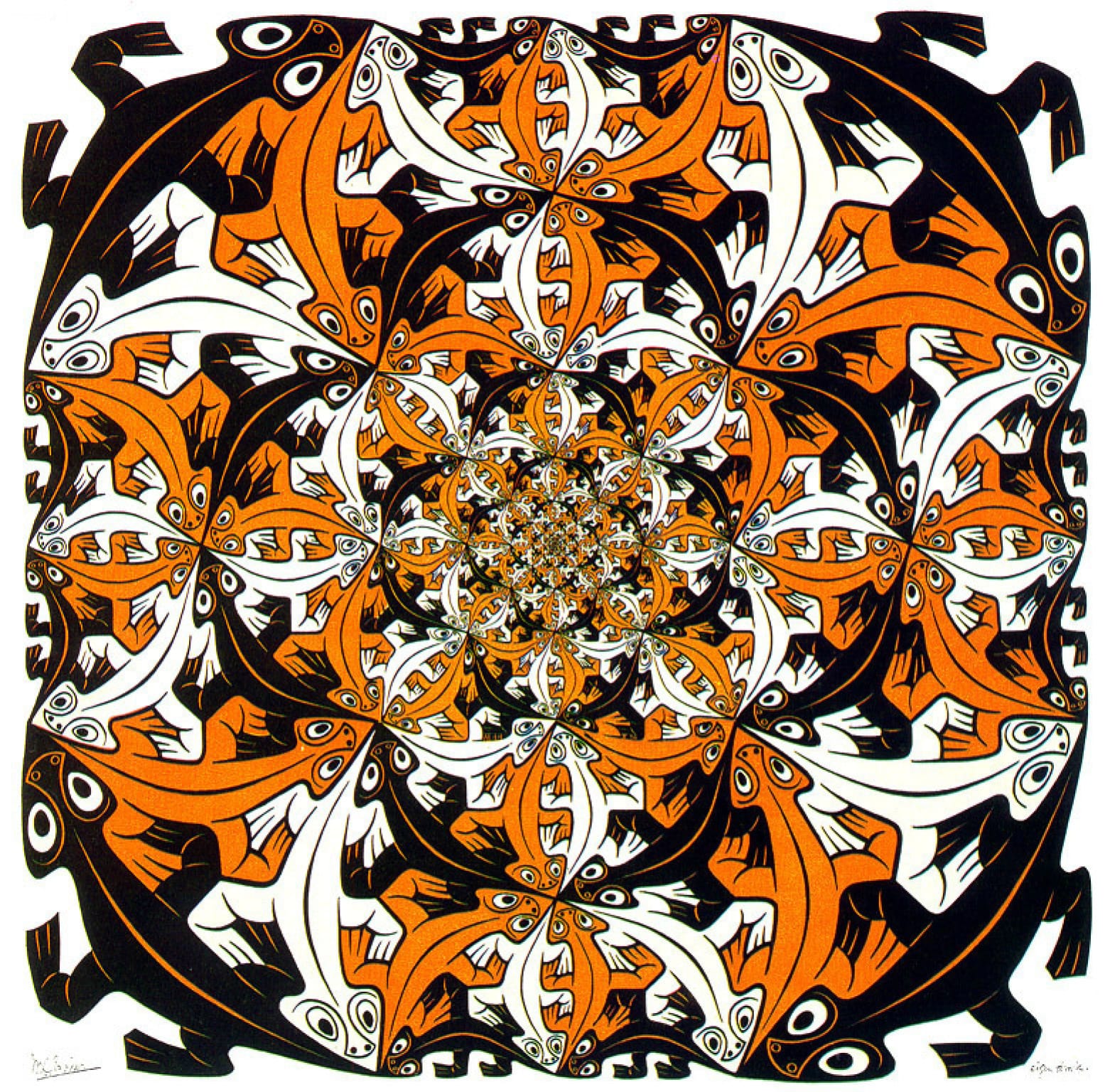
However, there is one notable exception: the Dutch artist Maurits Escher became interested in representing spatial paradoxes, impossible constructions, and above all, the concept of infinity. By the 1950s, Escher had begun depicting objects that repeated themselves at different scales.
Despite his unique style, Escher's work did not receive recognition from the art world. It wasn't until the 1960s, thanks to articles on mathematical curiosities in newspapers, that his drawings penetrated popular culture. The pinnacle was the publication of the cult book that won the Pulitzer Prize, "Gödel, Escher, Bach: An Eternal Golden Braid", where author Douglas Hofstadter extensively analyzes the profound relationship between music, art, and mathematics through the works of the three subjects in the title.
The Birth of Fractals
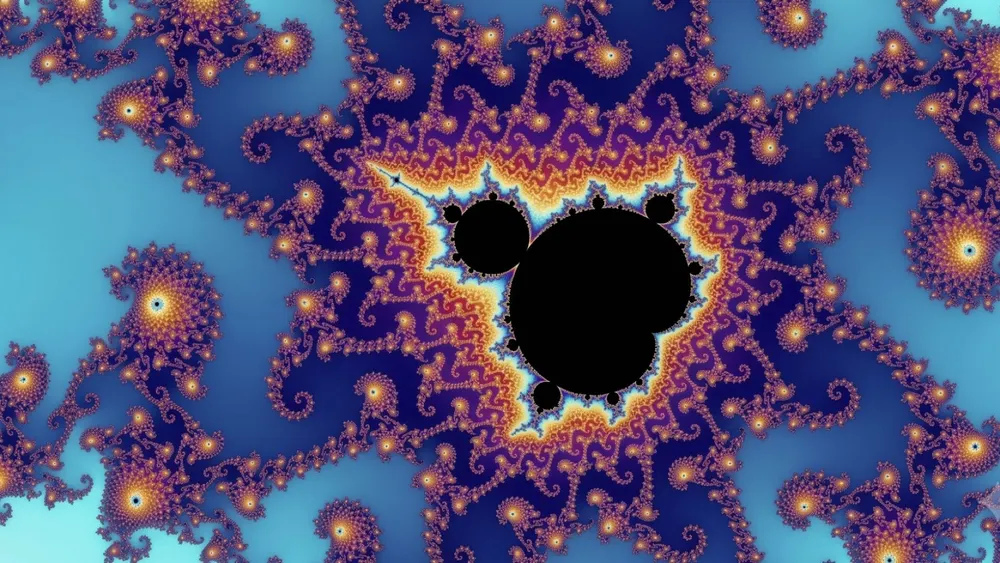
It wasn't until the mid-1970s, around the time of the publication of Gödel, Escher, Bach, that the term "fractal" was created to define a geometric object that exhibits the property of "self-similarity". Alongside Benoit Mandelbrot, not only was a new mathematical theory developed for studying fractals, but images of these objects were produced that made Escher's drawings look like mere scribbles by a beginner. Specifically, the so-called Mandelbrot set, which I won’t delve into, is among the most fascinating objects that mathematical art has produced. See for yourself:
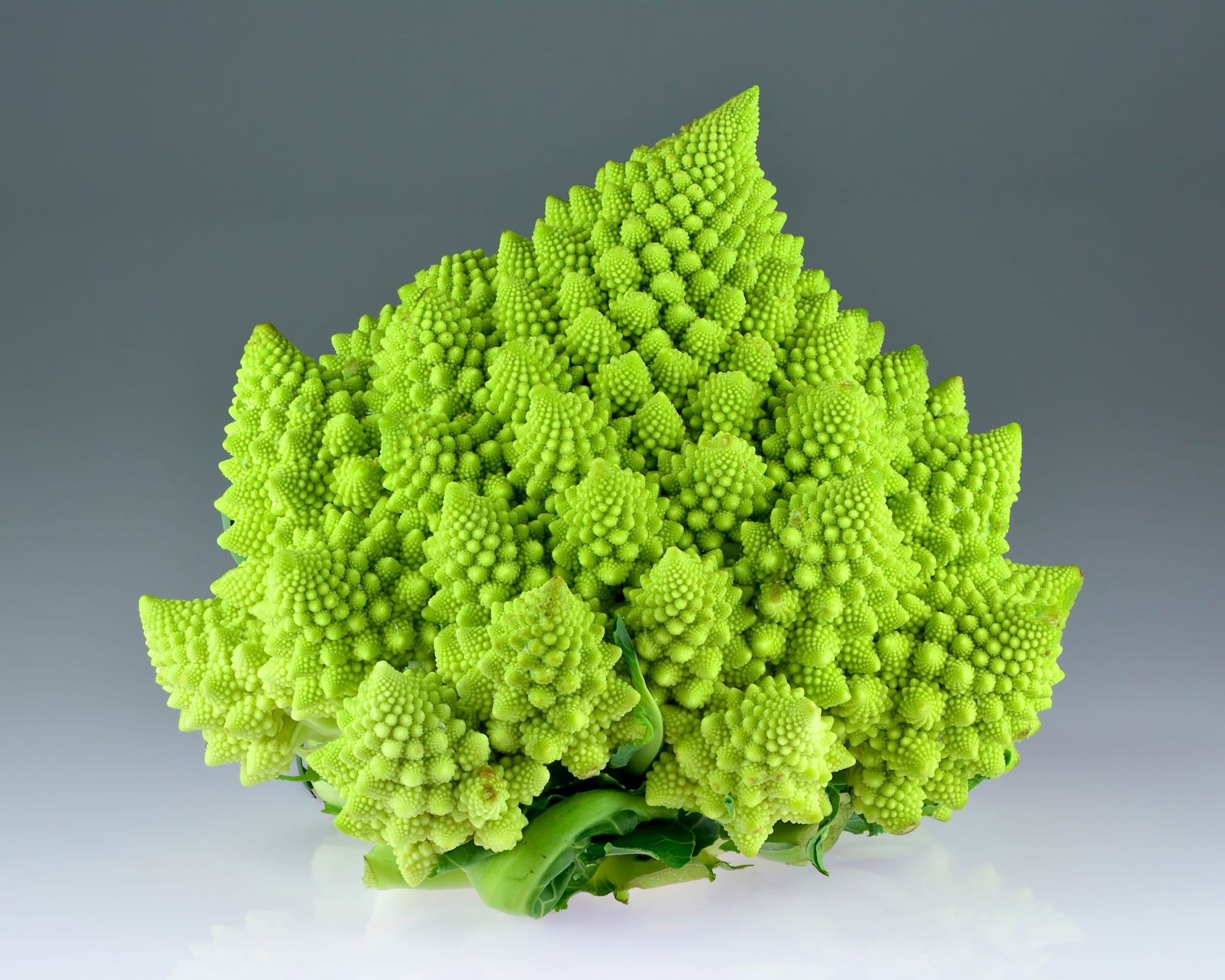
Just like the ancient Greeks searching for the golden ratio in the spirals of a snail, 20th-century science also studied the fractal shapes found in nature. While we can consider that, for example, trees exhibit bifurcations in their branches, emulating a fractal, there are examples where the fractal nature is much more explicit. Just look at the plant called Romanesco or the structure of an ice crystal. Even the distribution of galaxies in the universe seems to obey fractal geometry.
To understand why these types of shapes occur in nature, physicists turned to one of their favorite explanations: symmetry.
The idea is simple: symmetrical problems correspond to symmetrical solutions. For example, if we accept that the Earth has an approximately spherical shape (sorry, flat earthers), the gravitational attraction experienced by a body can only depend on the distance to the surface and not on the latitude and longitude coordinates. Why? Because a sphere is symmetrical with respect to a rotation operation, so any property that emerges from the sphere must also be symmetrical.
Romanesco. Source: wikipedia.org
In the case of fractals, the type of symmetry, instead of being rotational or translational, is a scale symmetry: a change in scale, or if you will, a zoom, does not alter the properties of the system. In other words, the process of forming a fractal lacks a characteristic scale or length. That’s why it’s also known as a scale-free process.
The Coastal Paradox
This way of thinking about fractals as scale-free phenomena allows us to extend their definition to other types of systems. Many natural forms are not exactly fractals, in the sense that zooming in does not yield an identical image. However, they can be thought of as the result of a scale-free statistical process: at different magnifications, we see images that are statistically indistinguishable.
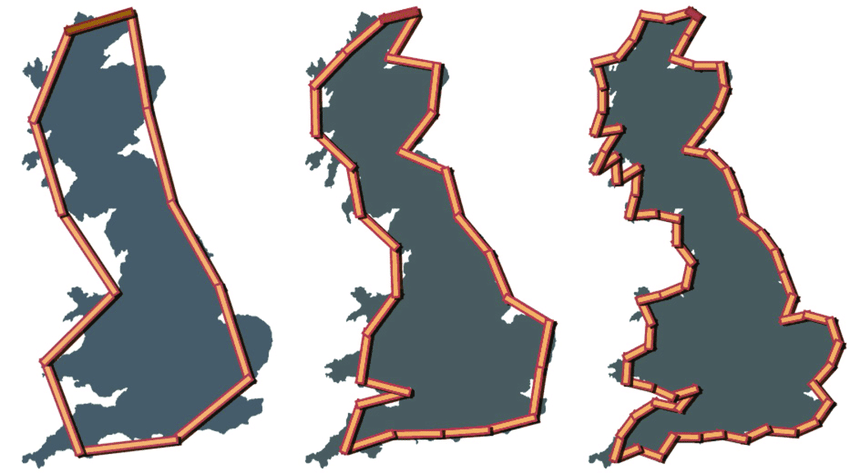
Coastal surveying. Source: wikipedia.org
An example of this (with geopolitical consequences) is the shape of coastlines. It turns out that in 1951 there was a conflict between Spain and Portugal over the length of the coastlines of both countries. To understand the reason for the difference, one must know the method used to measure the coastlines: a map is taken, and with a fixed-size "ruler," the number of times the ruler fits into the outline of the coastline is counted. The problem is that as a shorter ruler is used, the length of the outline becomes larger... infinitely larger.
This is known as the coastline paradox. Why does this happen? Mandelbrot himself discovered that the problem is that coastlines exhibit roughness at all possible scales. In other words, if we take a photo of the coastline outline at different zoom levels, we will see similar roughness: the silhouettes of the coastline at different resolutions are statistically indistinguishable. Are coastlines then fractals? Not in the strict sense, but yes in a statistical sense, in terms of presenting a scale-free phenomenon. The same can be said for mountains or natural landscapes, which show roughness at every scale, which is why recreating artificial landscapes requires using fractal generation algorithms.
An intuitive way to distinguish scale-free phenomena from fixed-scale ones is to ask the following question: how likely is it to find that property X is double or half in two specimens? Concrete example: how likely is it to find an adult human twice as tall as another? Unlikely. So in the distribution of heights, there is a characteristic scale. In contrast: how likely is it to find a mountain twice as tall as another? Or half? Quite likely.
Thus, the distribution of "geographical features" follows a law free of characteristic scales, which explains what we mentioned about landscapes as pseudo-fractals.
And what about, for instance, wealth distribution? We can surely find someone who earns double or half of what another person makes, especially in increasingly unequal societies. This means that wealth distribution also follows a scale-free distribution. The same could be said about the distribution of followers on social media: we enter the murky waters of statistics applied to social behaviors.
The world is a small place
Scale-free probability distributions, like the ones we mentioned, are known as Pareto distributions. Whenever we hear a phrase like "20% of individuals hold 80% of the wealth" (now closer to 99 to 1), we are talking about a Pareto distribution. What’s the connection with fractals? The Pareto distribution lacks a characteristic scale, so we can find very few individuals who concentrate the vast majority of a certain property. The same happens with the example of social media: a small number of people (influencers) hold most of the connections (or followers).
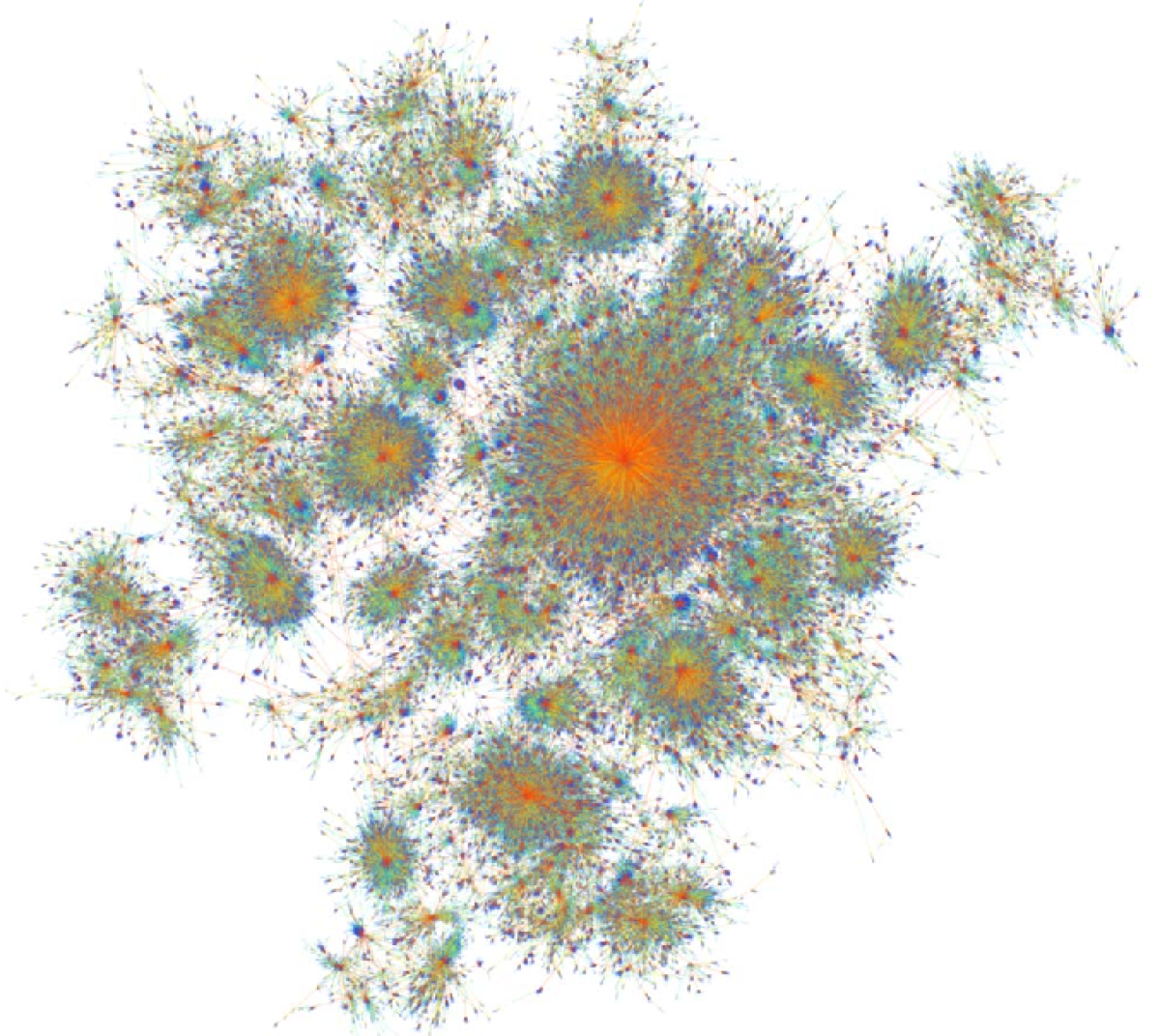
The theory of scale-free processes applied to networks is part of the field of complex systems physics, as we mentioned in a previous article, and it is responsible for some curious outcomes. Perhaps the most well-known is the six degrees of separation property, which states that if we take two random elements from a network A and B, we can find a path of six contacts connecting A to B.
The number six is anecdotal and can practically vary to any number from one to ten; what matters is that regardless of the size of the network, we can always find a very short path between two nodes. Systems that exhibit this property are called Small World networks.
The theory of scale-free processes applied to networks is part of the field of complex systems physics, and it is responsible for some curious outcomes. Perhaps the most well-known is the six degrees of separation property.
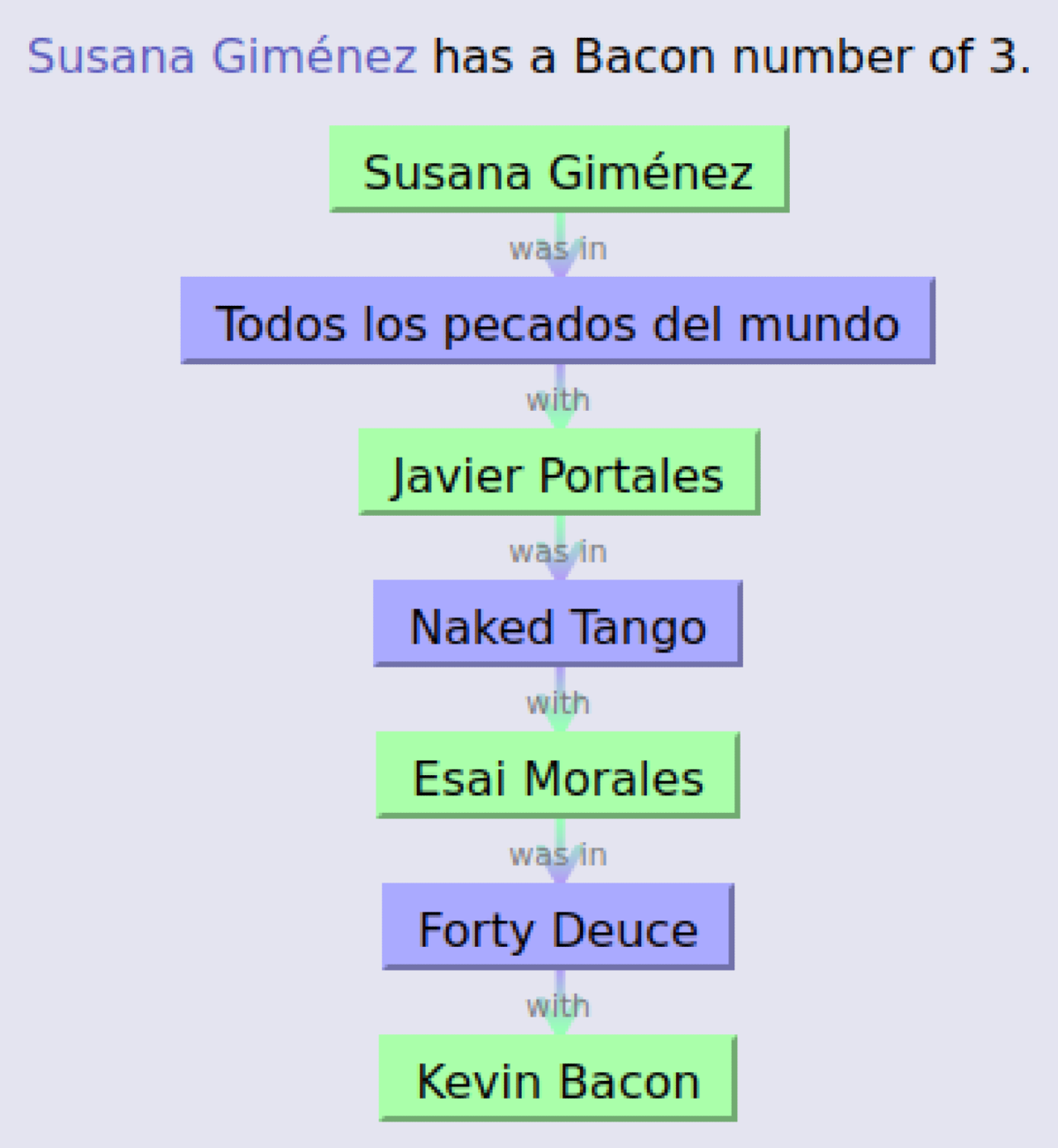
Examples of this include all social networks (Facebook has an average distance of 4.74 between users and Twitter 4.77), neural networks in the brain, and venturing into the bizarre, the Kevin Bacon index. It turns out that the set of all actors and actresses forms a Small World network, and given any actor, we can find a path of common movies connecting them to Kevin Bacon. As undeniable proof, we include the path to the Argentine actress Susana Giménez, and you are invited to try others using the following link.
This phenomenon can be explained as follows: if there is a scale-free organization, then there will be members of the network with an arbitrarily high number of connections. These elements act as "bridges" between regions of the network that might initially seem distant. Thus, social distances are shortened by the intermediation of members with a massive number of connections.
These types of concepts can be used to study the propagation of messages on social media, and even for detecting bots, which would alter the "natural" dynamics of organic diffusion. For example, we can cite the work done by Analía Celeste Luis and Yamila Abbas to detect trolls in the smear campaign on social media that CONICET faced in 2016. This was a common practice during the government of Mauricio Macri that ended up taking on the tone of a meme with epic tweets like "Satisfy Mauricio, don’t relax! Significant caress from Hurlingham! #YoVotoMM" from the ghostly user Lavonne Smythorsmith. In this work, the researchers use elements of network theory to identify which users artificially alter Twitter's dynamics.
Ultimately, as happens in Small World networks, everything is connected to everything. And between Leonardo Da Vinci and the trolls of Marcos Peña, there are also less than six degrees of separation.
✦ Suscribite
Las notas de 421 no tienen paywall
Y a cada colaborador se le paga por su trabajo. Las dos cosas dependen de los suscriptores.