How to Expand Our “Resonance” with the World in the Age of Screens
Our heads tilted downward toward our cell phones is how we are both present and absent at the same time. How can we regain that “resonance” with the world when faced with a screen that monopolizes our attention and dulls our ability to connect with others?
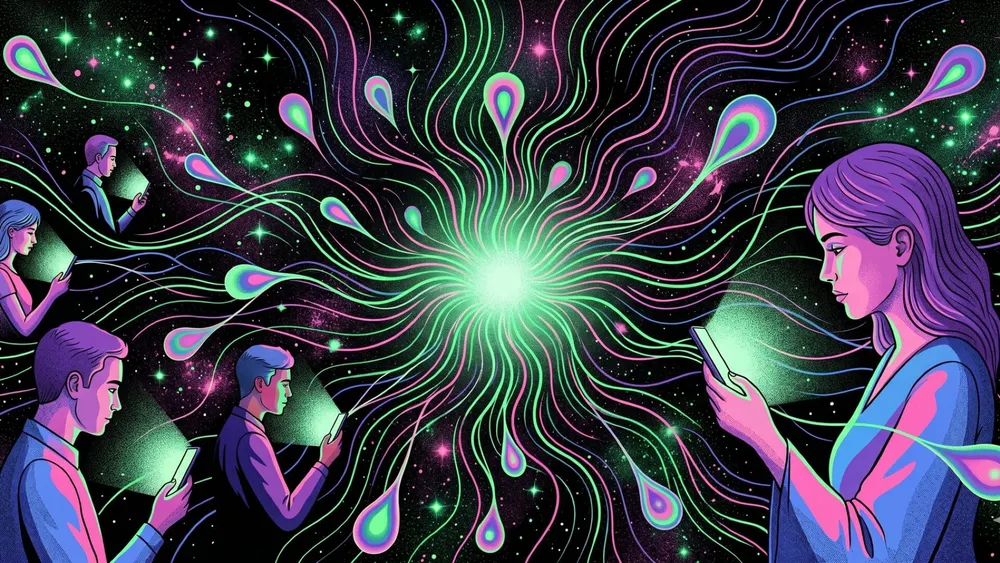
There’s an image so commonplace that it doesn’t even need an example to be recognized: someone with their neck bent, staring at the glowing screen of their cell phone. In any establishment, institution, or public space, this scene repeats itself with a kinetic regularity: a technology of light that holds (both symbolically and physically) the subject's head down. Whether in a waiting room, in line at a bank, at a bus stop, on the subway, on the stairs of a public building, during a simple walk, or in the breaks of a gym routine. The phenomenon is always the same, it’s always the same. In fact, there are almost no spaces left with “dead times”: a category that now roams like a zombie and which we used to morally designate as refuges of inactivity.
There’s an image so commonplace that it doesn’t even need an example to be recognized: someone with their neck bent, staring at the glowing screen of their cell phone.
I must admit that I feel that the first paragraph is unnecessary: what’s striking about this everyday image isn’t the act itself, but its normalization. Durkheim said that when a way of thinking, doing, or saying becomes regular, external (and therefore coercive), and independent of individual wills, we are facing a social fact. His nephew Marcel Mauss added: if that social fact intersects and simultaneously permeates multiple dimensions of social life (the economic, the political, the cultural, the aesthetic, the ethical, etc.), we are facing a total social fact. Precisely because of that naturalized totality, the scene no longer surprises anyone, nor does it raise warnings. It’s one of those things that feels most normal in the landscape of our days. It organizes our experience with the world and therefore: our relationship with (and towards) the world. Thus, that bodily inclination towards the screen is the regular disposition, the way of being both present and absent simultaneously within the framework of contemporary social space.
An idea in a story
In 1810, Germany, Heinrich Von Kleist, a young writer of the time, published a story titled On the Puppet Theater in an evening newspaper. In that tale, a narrator recalls conversations he had with a dancer named Herr C., who argues that puppets possess a grace superior to that of any human dancer because their movements, governed by gravity and a single central point of control (the puppeteer), are perfect and free from affectation. To demonstrate his point, Herr C. tells three stories: the first is about a handsome and agile boy who one day realizes that his pose resembles a famous statue, and from that moment on, he begins to look at himself in the mirror all the time trying to reproduce the gesture, and the more he tries, the clumsier and more artificial he becomes, because that self-awareness destroys his naturalness; the second is about a bear that is impossible to defeat in a fencing match, not because of its skill but because it doesn’t think or let itself be deceived by the opponent’s movements; and the third is a reflection on whether a perfect machine could move with more elegance than a human body. What do I mean by this? The final idea: perfect grace only exists at two extremes, either in one who has no consciousness at all (like a puppet or an animal) or in one who has total and infinite consciousness (like God). People find themselves in the middle: we know too much to be innocent but too little to be perfect. It is on this human ambivalence that I reflect on the bodily disposition of the time, as a form of relationship with the World.

The body and our relationship with the world
It is known: for some time now, various positions have emerged on the aforementioned issue, in a discussion that likely began in the digital world before transcending to other spheres. Some of them are tinged with a caricatured techno-pessimism (and for now very little proactive in political terms) that alarmingly observes the “future” of the human community. Like a good moral panic, it tends more towards underestimating people's agency than proposing possible worlds. On the other side are the advocates of technofeudalism, who advocate for technological optimization while denying the effects of a screened society. And in the midst of this polarization? The rest of the people who do not take a stance, perhaps because they don’t have one or they do but in a much less extreme way. Many of these debates have begun to be informally canonized in 421.
To continue this conversation that seeks to propose a habitable present for humanity, I found it interesting to revisit the expression “mass culture of bent necks” by Ulrich Grober, a German psychologist who published an article in 2012 that anticipated some of these conversations titled Finding Calm: The Open Secret of Serenity (zur rouwe kommen: Das offene Geheimnis der Gelassenheit). That year was a time still less co-opted by digitality than the current one, and the German was already beginning to outline powerful critiques of digital stress. These critiques would later be capitalized on by Byung-Chul Han up to the present day. Beyond the critical weight that the term may suggest, it is undeniable that this stance has elements to be thought of as an inseparable trait of the time: the bent neck is not just a biomechanical gesture that subordinates the head downwards, but also, and above all, the way we position ourselves in the world and, therefore, the way we relate to it. Elements also addressed by His Holiness Pope Leo XIV in his encyclical titled On the Custody of the Human Person in the Age of Artificial Intelligence.
Let the screen obscure the forest has precisely become our experience with the forest. Barely any institutions survive that do not require, demand, or compel the use of an application to manage subscriptions, process files, or certify records. All elements that Juan Ruocco attributes to a system of subscription economy and to which I attribute functions of statehood: we have ceased to be citizens to become a kind of civil-users. Whether we like it or not, the vast majority of the establishments we frequent demand that we interact with our phones to resolve a substantial part, if not the entirety, of their administrative management. In this scenario, adopting an unyielding “anti-screen” stance doesn’t make much sense either. The disconnection from the device would ultimately imply some kind of institutional disaffiliation or even (allow me the exaggeration) social disintegration. Whether in the labor, sports, cultural dimension, or in the simplest daily activities, the cell phone has become an obligatory instance with which to reconcile some of the narcissistic traps of the social fabric.
The opposite of acceleration (which tends towards an endless loop of alienation) is not deceleration, but Resonance.
I revisit Grober’s expression because it is cited in the book by another German author, from the realm of phenomenological sociology, named Hartmut Rosa. The book is called Resonance: A Sociology of the Relationship with the World and, notably, the first edition was published a year before the pandemic. It is an immense book because its proposal is ambitious, and I will attempt to summarize it with a bit of selective injustice: it provides a theoretical framework to analyze the history and present of modernity in the interrelation between Subject (the Self) and World (understood not literally as the planet Earth, but as the totality of the experienceable). Rosa begrudgingly discusses the paradigm of acceleration, avoiding a clumsily “anti” stance, and synthesizes it by saying: "the opposite of acceleration (which tends towards an endless loop of alienation) is not deceleration, but Resonance."
What is resonance? It’s hard not to think of it as part of the hippie cultural heritage that alludes to an idyllic and hedonistic state of meditation in which one seeks to control the World at will. Well, it’s not like that. So what is it? An active relationship with the world. In what sense? Let’s be a bit metaphorical: in the sense of being held by a vibrant and magical thread that connects (that is: links/supports/sustains) Subject and World in a mutual imbrication (or in a phenomenon that Rosa calls transformative assimilation) between both. For this author, modernization is a historical process that has tended towards a crisis of resonance in which the Subject relates more and more to the World in a “mute” and reified way, governed solely by the increase of resource acquisition. Thus, the more exacerbated (or late) Modernity becomes, the more alienated and accelerated, in the increase of resource acquisition, social subjects are. Therefore, the concept of resonance implies that the Subject is “reached” and moved by that external totality (which is the World) while the Self acts, reacts, and executes activities and actions that constitute it. There is no Subject without World, nor World without Subjects.
Beyond individual strategies: making the thread vibrate with the World
Given the amount of vital time we dedicate to screen consumption, the main challenge lies in not relinquishing our capacity for agency and therefore our capacity for resonance (to actively relate to the World). It is here that Juan Ruocco’s conceptual proposal returns, in this case, that of cognitive sovereignty (along with psychic autonomy). Claiming, conquering, or, if you will, colonizing parcels of that sovereignty implies an act of resistance against devices that, by their very architecture, tend to erode our ability to consciously make decisions. If the digital environment promotes that we disassociate our attention, the next step is to promote active strategies that allow us to regain control. The problem arises when the screen, as a segment of reality, becomes the only possible mediator. I think, for example, of all the videos of YouTubers recommending dopamine loading, the minimalist reformulation of cell phone widgets, or the eternal return to dumbphones. We are witnessing a scenario where mobile devices have become the great modulator of our symbolic currents: we work, we inform ourselves, we participate in groups of belonging, we advocate for political positioning, we self-design on social networks, we play, we communicate, and even seek through the screen strategies to use it less. As the totality of our life experiences becomes confined to the tactile surface of phones, computers, and tablets, we are heading towards a society where the general bond with the World is mediated by digital symbolism.
Nonetheless, it is important, beyond personal intentions, to critically examine the social conditions that allow the threads of our relationship with the World to vibrate. The strategies of “disconnection” tend to be short-lived or work only for tiny minorities who perceive themselves from a sort of pedestal of moral superiority over the alienated majorities who fail to conquer the cognitive agency and resonant of their digital consumption.
The screen is a mediation of reality, as is language, aesthetics, culture, economy, or politics. The risk does not lie in the mediation itself, but in its exclusive nature.
In this sense, we must understand agency as the human (and at the same time modern) capacity to not become a cultural puppet of social structures (as illustrated by part of Von Kleist’s story), but to constitute oneself as an individual who reasons, thinks, and acts both with the screen and without it. The screen is a mediation of reality, as is language, aesthetics, culture, economy, or politics. The risk does not lie in the mediation itself, but in its exclusive nature. If the digital interface becomes our only bridge to the environment, our relationship with the World will become increasingly mute and reified, as well as fully visual and subordinated to the increase of resource acquisition. An existence modulated exclusively by the glass of the screen tends to neutralize our active and vibrant bond with the World, which has historically infused sacred magic into the human experience. I am mainly referring to the rituals and ceremonies that involve collective co-presence and which, no matter how many screens one carries, function independently of them: a political march, a concert, a football match, going to the movies, a religious celebration, a party… do you understand that the etcetera is immense? The challenge is not the elimination of technology, but the firm defense of other forms of modulation that prevent our daily lives from being reduced to mindlessly caressing that mirror of light that elevates me to the algorithmic throng of the day.
It should be clarified that these notes do not wish to be techno-pessimistic in the slightest, but to propose a structural reading. The first is that the screen is becoming a bottleneck for human experience. By centralizing our connections in a single device, our relationship with the world becomes uniform: the World responds to us and we reach it always in the same way, under the same logic of visual interface. This homogeneity nullifies the richness of other ways of being present: perhaps slower than immediate stimuli, but with much more qualitative density. The second reason is that, while digital mediation is not inherently deficient, it is hard to deny that relationships become problematic when reduced to that single channel. When the screen becomes the only mediator, other channels of resonance are narrowed and thus muted: friends, love, God and Nature, art, education, science, literature, and once again a giant etcetera. The risk is not technology itself, but the annulment of other forms of connection that allow the world to genuinely engage with us and not merely functionally.
Las notas de 421 no tienen paywall
Y a cada colaborador se le paga por su trabajo. Las dos cosas dependen de los suscriptores.