Whole Earth Catalog: The Internet on Paper
Brand and Fuller embodied their philosophy of free and accessible information in a catalog that first appeared in the 1960s. Stay hungry, stay foolish.

Brand and Fuller embodied their philosophy of free and accessible information in a catalog that first appeared in the 1960s. Stay hungry, stay foolish.
In 2005, Steve Jobs stood before Stanford graduates and uttered a phrase that would echo around the world for decades as a mantra of creative capitalism: stay hungry, stay foolish. He said it with the elegance of someone who doesn't need to cite the source. No one questioned it too much. And perhaps therein lies the first problem: the phrase didn't originate in any university auditorium or on the margins of a Silicon Valley chalkboard. It was printed on the back cover of the last edition of the Whole Earth Catalog in 1974, above a photograph of a rural road at dawn. That the greatest capitalist of the digital age inherited his motto from a hippie catalog is no small irony: it's the key to everything that follows.
Classifying the Whole Earth Catalog is difficult because it wasn't any of the things we have names for. It wasn't a magazine, it wasn't a technical manual, it wasn't a political manifesto, although it contained elements of all that. Jobs himself described it in that talk as a kind of "Google on paper, thirty-five years before Google existed: idealistic and overflowing with brilliant tools and great ideas." The description isn't bad, but it's not complete either. It was, above all, a bet on intellectual autonomy: the conviction that if you gave people access to the right tools, they could reorganize the world on their own. With a first publication in 1968, a 1972 edition sold one and a half million copies and won the National Book Award. Quite an achievement for a catalog.
"I am what I do," Stewart Brand could have said, although the more accurate formulation came from another: I am a verb. Brand's trajectory encompasses territories that shouldn't fit into a single life: paratrooper, Stanford biology graduate in 1960, photographer of Native American communities, early hippie alongside Ken Kesey and the Merry Pranksters, editor of the Whole Earth Catalog, founder of The WELL, co-founder of the Long Now Foundation. Each stage is not a closed chapter but a layer that overlaps with the others. Brand embodies the figure of the polymath who doesn't choose between disciplines because, simply, he doesn't conceive that there should be a choice. That figure already appeared in these pages when we traced the experience of the Black Mountain College, where another polymath (Richard Buckminster Fuller) arrived in 1948 to construct the first large-scale geodesic dome in front of an audience of bewildered artists.
It was, above all, a bet on intellectual autonomy: the conviction that if you gave people access to the right tools, they could reorganize the world on their own.
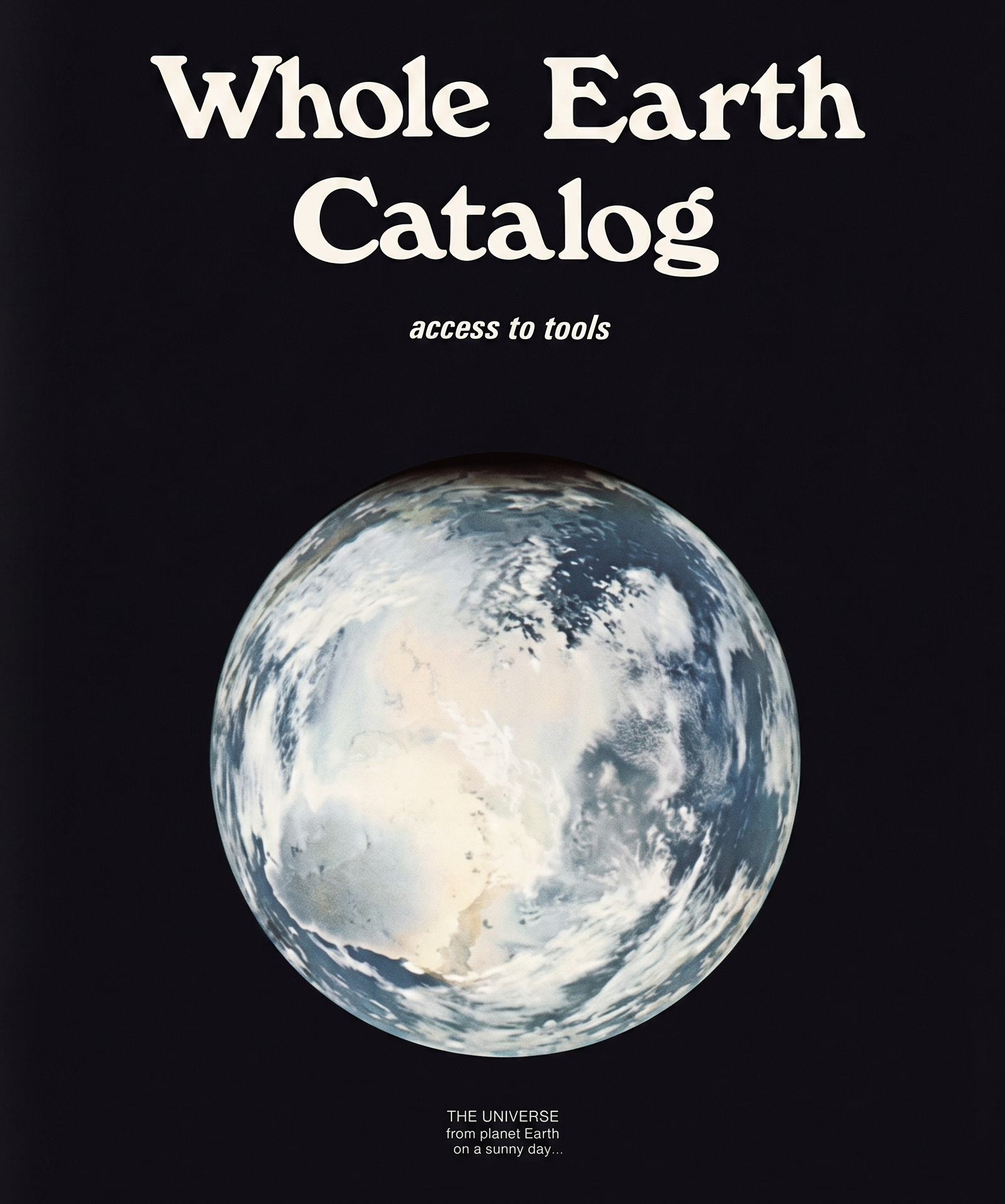
The path to the Whole Earth Catalog inexplicably passed through the roof of a house in North Beach. In 1966, at the height of the psychedelic fervor, Brand had a revelation: if there were a photograph of the entire Earth seen from space, it would change the way humans relate to the planet. Not as romantic poetry, but as a cognitive strategy. The finite, blue image, suspended in the black void, would make evident something that reason knows but the senses forget: that this is all there is, and it is fragile. Brand then made pins with the question "Why haven't we seen the complete image of Earth yet?" and sold them for twenty-five cents. During that campaign, he met Richard Buckminster Fuller, who immediately offered to collaborate. The meeting was not coincidental: both shared the conviction that an image could change a civilization.
Brand's connection to the hippie movement deserves a more careful reading than it usually receives. It wasn't a uniformly anti-technological counterculture: there was a fracture within it. Brand belonged to the branch that believed technology, when used correctly, liberates. "What Buckminster Fuller said, what Marshall McLuhan said, and what I said, each in our own way, was that technology liberates if one decides it to be so," he explained in an interview. Within the counterculture, this stance was countercultural. From there, he built the Whole Earth Catalog: not as a return to nature but as a manual for inhabiting the present with intelligence and without intermediaries. The recommended items had to meet four conditions: be useful as tools, relevant for self-education, of reasonable quality, and accessible by mail. Democracy, in practice.
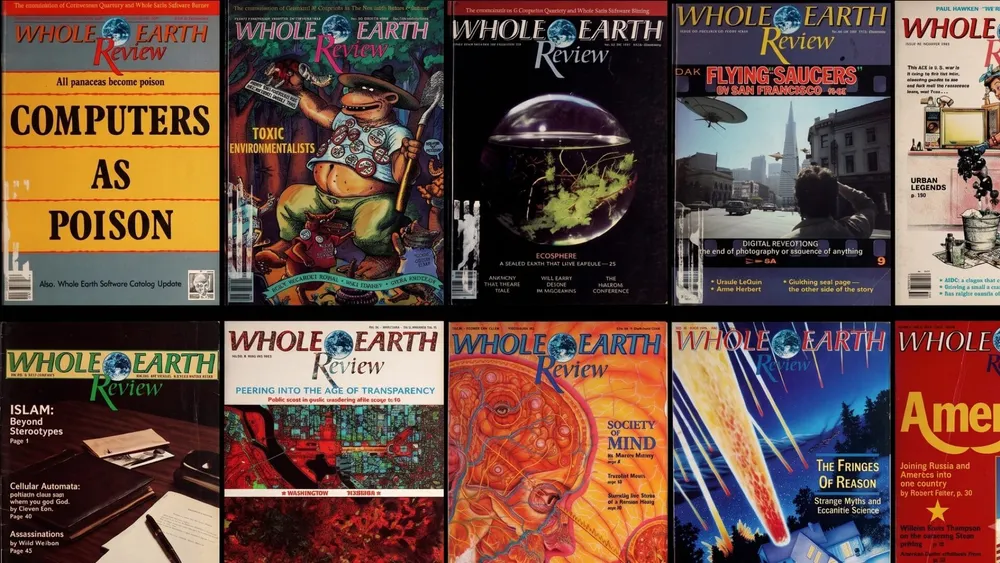
The catalog was first published in the fall of 1968, using basic typography, scissors, and Polaroid cameras. There were no trained graphic designers, no budget, no national distributor. And yet it reached millions of Americans who at that time were experimenting with alternative forms of communal living. Writer John Markoff, a technology chronicler at the New York Times, defined it as "the internet before the internet: the book of the future, a web made of newspaper." The phrase is more accurate than it seems: the Whole Earth Catalog not only anticipated the architecture of digital information but also its philosophy. The idea that information wants to be free (a phrase that Brand himself uttered at the first hackers' conference in 1984 and reprinted in the Whole Earth Review in 1985) is the same logic that decades later would shape the open web. Now that idea has a new incarnation: the complete archive of Whole Earth publications is available at wholeearth.info, digitized for "research, education, and academic use." A sort of second twist, or demonstration that ideas that refuse to stay still, don't stay still.
To be a verb and not a noun: that was the central philosophical bet of Richard Buckminster Fuller since 1970, when he published I Seem to Be a Verb, one of the strangest experimental books of the second half of the twentieth century. The thesis is seemingly simple: human beings are not static categories. We are processes. We are flow. We are, in any case, verbs in permanent action, not nouns that can be classified and archived. This idea was not just philosophical writing for Fuller: it was the design principle behind all his architectural work. If existence is a process, then architecture (the art of making the world habitable) cannot aspire to the inert permanence of stone. It must aspire to dynamic efficiency. It must, in his own words, "do more with less."
The Whole Earth Catalog not only anticipated the architecture of digital information but also its philosophy. The idea that information wants to be free
The geodesic dome is the most visible materialization of that philosophy. The spherical geometry distributes weight evenly: no point bears more load than another. The larger the dome becomes, the lighter it is in proportion to its size, because tension is distributed across the triangles that make up its surface. Fuller even designed a geodesic dome capable of covering all of Manhattan, not as a fantasy but as a serious exercise in climate engineering: he calculated that the cost of climate-controlling the interior would be less than maintaining conventional urban infrastructure for a decade. The fact that it was never built doesn't make the argument incorrect; it makes it, perhaps, premature. The domes that were built (from military installations in the Arctic to the United States pavilion at the 1967 Montreal Expo) demonstrated that the principle worked. The dome was not decorative: it was a hypothesis in steel and aluminum.
What makes geodesics philosophically interesting goes far beyond structural engineering. Fuller conceived them within a broader concept: Spaceship Earth. The Earth is not an inexhaustible territory but a ship with limited resources, and humans are its crew, not its owners. Within that framework, building well is not an aesthetic exercise but an ethical responsibility. The geodesic dome is the architecture of the good ancestor: the one that uses the least amount of materials to protect the greatest number of people, thinking not of the present but of generations that cannot yet speak for themselves. There is a direct thread between this idea and Brand's later work at the Long Now Foundation, building a clock designed to last ten thousand years as an exercise in temporal responsibility. The past is not the only thing that needs preservation: the future does too.
Brand and Fuller met, as we mentioned, during the campaign for the photograph of Earth. But the meeting was not just personal: it was conceptual and programmatic. "Fuller said that if all the politicians in the world died this week, it would be a nuisance, but if all the scientists and engineers died, it would be a catastrophe. Where's the real juice?" Brand recalled. And he took that conviction not as provocation but as a work program. The Whole Earth Catalog was the practical response: not to change human nature (impossible, Fuller said) but to change the tools, and through the tools, change civilization. The logic is so simple that it is hard to argue against. It is also difficult to sustain. It takes just the right mix of naivety and ambition to believe that a catalog can change the world, and at the same time have enough rigor to ensure that catalog actually does change it.
The phrase has a context that Jobs, generously, omitted. The 1974 edition was called Last Whole Earth Catalog and was deliberately a closing statement. Brand decided to end the project at its peak, before inertia drained it of meaning. The back cover with that phrase was not a motivational slogan: it was the farewell of something that had taken shape and was choosing to dissolve. Stay hungry was not a call for voracious consumption of experiences. It was a warning not to become complacent, not to turn curiosity into entitlement. Stay foolish was not a celebration of ignorance but of epistemic openness: the willingness to not yet know, to remain in a state of questioning. If Jobs turned it into the mantra of successful entrepreneurship, that's not the phrase's fault. Good ideas always run the risk of being appropriated by the nearest present.
It takes just the right mix of naivety and ambition to believe that a catalog can change the world, and at the same time have enough rigor to ensure that catalog actually does change it.
There is something in Brand's trajectory that today seems particularly difficult to replicate: his willingness to publicly revise his own convictions. In his book Whole Earth Discipline, published decades later, Brand defends nuclear energy, genetic engineering, and geoengineering (positions that directly contradict some of his earlier ideas). Not as opportunistic conversion but as a consequence of continuing to look at the evidence. "One must love problems more than solutions," Fuller used to say. Brand practices this. This willingness to intellectual self-critique is perhaps the most difficult tool to find in the Whole Earth Catalog and also the most necessary: it is not in any specific chapter, but it is in the attitude that organizes the entire project. Polymaths do not accumulate certainties; they accumulate better-formulated questions.
A noun is always, in some sense, a betrayal. To name something is to stop it, to turn a process into a category, to transform flow into definition. Fuller theorized it. Brand practiced it. The Whole Earth Catalog was never quite a catalog: it was a gesture, a method, an editorial attitude that said the right information and tools could change the world without needing to ask permission from any institution. That same attitude being available today in a digital archive at wholeearth.info says something about the permanence of ideas that refuse to stand still. Stay hungry, stay foolish. Not as a corporate slogan. But as an epistemological stance in a world that would prefer us to be nouns.
Y a cada colaborador se le paga por su trabajo. Las dos cosas dependen de los suscriptores.