Leo XIV's Encyclical on AI: Does It Signal the End of Human Exceptionalism?
Are we divine wonders or beings like any other? In the face of the rise of AI, Pope Leo XIV revisits debates about our very nature. Does AI merely inflict “narcissistic wounds” on us, or does it truly spell the end of our uniqueness?
On May 25, 2026, Pope Leo XIV published his first encyclical titled “Magnifica Humanitas.” The title comes from the hymn known as Magnificat, which is based on the words spoken by the Virgin in the Gospel of Luke (1:46-55), beginning with the phrase: “My soul magnifies the Lord” (Magnificat anima mea Dominum). The most striking aspect of the encyclical, which has sparked significant debate since its release (even here, on 421), is the reflection it proposes regarding the development of Artificial Intelligence. However, that is not the only issue it addresses; even in the sections focused on the dangers of this technology continuing its current trajectory, the matter is rooted in much older debates.
 Javier Pallero
Sigmund Freud, who was not particularly fond of religion and was not exactly a friend of the Catholic tradition, famously declared that humanity received three narcissistic wounds that forced it to reconsider its position in the world. The first is the Copernican, when it was demonstrated that we are not the physical center of the cosmos. The second is the Darwinian, which placed us under the same rules as other living species. The third is the one produced by Freud himself (perhaps not modestly), revealing to us through psychoanalysis that we are not masters of our own subjectivity. Nowadays, some claim that AI is driving the fourth knife into us by showing that a completely artificial system can reason and create as well as we do, or perhaps even better.
The truth is that the issue Leo XIV addresses goes even further than the first case mentioned by Freud, although the Renaissance in which Copernicus and his successor Galileo lived is undoubtedly a key point in this journey. The problem of humanity's position in relation to the rest of the cosmos (or, in terms of monotheistic religions, “Creation”) is one of the most debated topics since ancient times, and many of the positions taken in those debates have translated over millennia into political, social, economic, and technical issues.
The Christian tradition
In very simple terms, the key question is: Are we human beings wonderful, or rather a mess? Even setting aside the history of philosophy and religion, we all ask ourselves this question fairly often, and we all have good reasons to hold one position or the other (often depending on things like whether the bus driver didn’t stop even though we were at the stop, or if we feel slightly feverish). The question itself is key in the humanist tradition upon which the encyclical is built, and that tradition, while it has secular branches, cannot be thought of in the West outside the history of the most influential religions.
The problem of humanity's position in relation to the rest of the cosmos (or, in terms of monotheistic religions, “Creation”) is one of the most debated topics since ancient times.
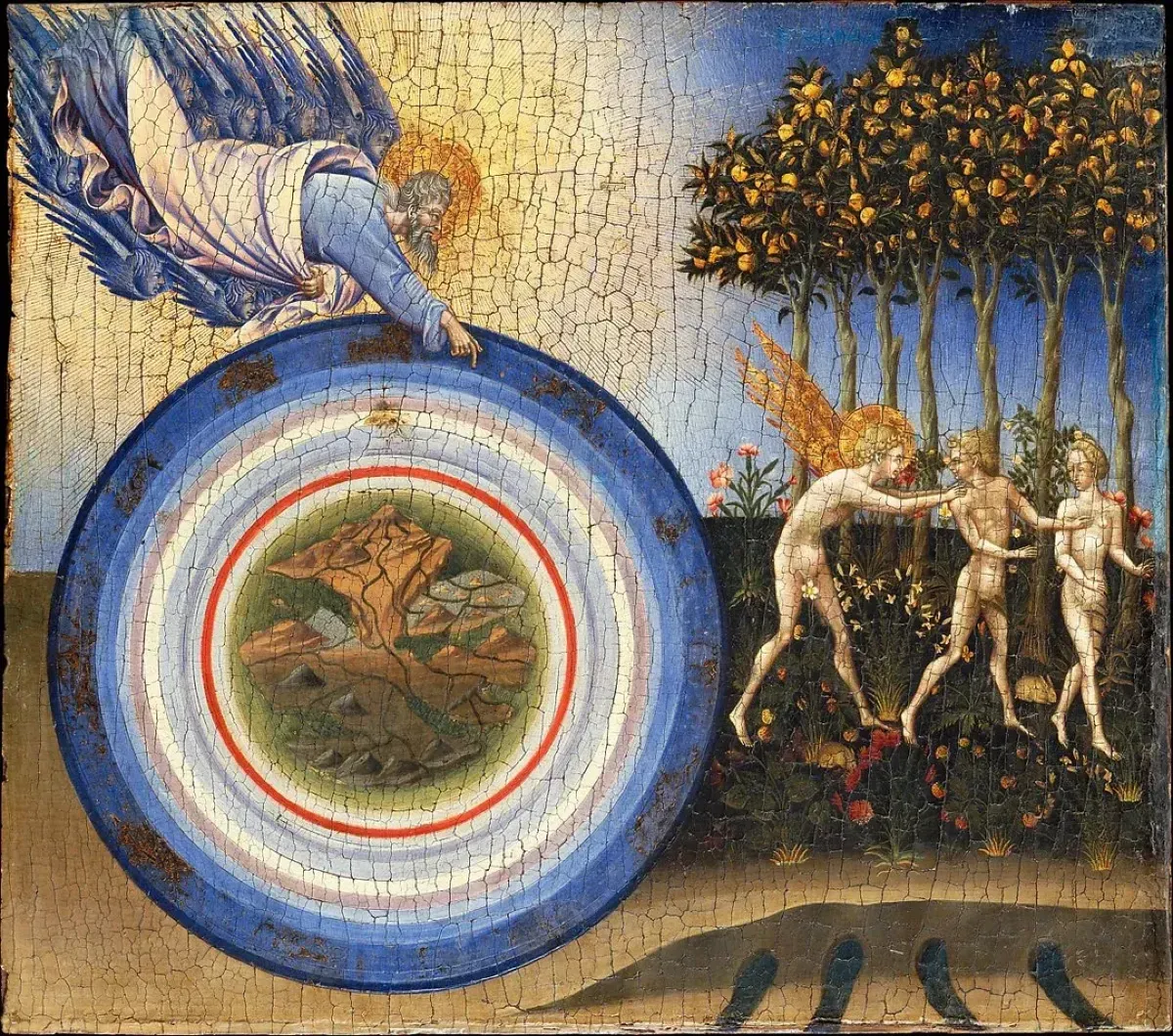
The two pillars of the optimistic view of humanity in the Christian tradition are well known. The first is the very Genesis, that is, the first book of the “first part” of the Bible, the Old Testament, which is also the foundation of the Jewish religion. There, we are told of Creation, and that of humanity has very special characteristics:
Then God said: Let us make man in our image, according to our likeness; and let him have dominion over the fish of the sea, over the birds of the air, over the cattle, over all the earth, and over every creeping thing that creeps on the earth. So God created man in His own image; in the image of God He created him; male and female He created them. Then God blessed them, and God said to them: Be fruitful and multiply; fill the earth and subdue it; have dominion over the fish of the sea, over the birds of the air, and over every living thing that moves on the earth (Gn 1:26-28).
It is worth noting three aspects that are absent from the other divine creations and that have been interpreted thousands of times by theology. First: God deliberates before creating humanity (“Let us make man…”), as if this creation required some special consideration first. Second: humanity is to “have dominion” over the rest of creation; it is not just another among them. Third, the utmost dignity: humanity was created in “the image and likeness” of God, although exactly what that “image” consists of (is God visually similar to us?) and that “likeness” (does humanity act or think similarly to God?) is a point of major disagreement.
The second pillar of the exalted view of humanity in the Bible is specific to the Christian tradition and is one of its most original points: God sent His Son (who is Himself) incarnated in a man. The Word became flesh, according to the famous saying from the Gospel of John. What more is needed to affirm human dignity? God could have chosen a Leviathan or a mountain of fire, yet He lived as a humble and mortal man.
Now, the reader with at least a minimal biblical background knows that the concrete destinies of Adam, Eve, and Christ (with all their differences) do not exactly speak of the magnificence of our species. The first sinned, the second was betrayed, humiliated, tortured, and killed by other humans. So, where do we stand? The Old Testament is full of worse stories and also contains one of the most influential and dreadful texts in the pessimistic line: Ecclesiastes, famous for its phrase: all is vanity.
In very simple terms, the key question is: Are we human beings wonderful, or rather a mess? Even setting aside the history of philosophy and religion, we all ask ourselves this question fairly often.
The tradition of miseria hominis has numerous exponents. One of the most compelling was written by Pope Innocent III (1198-1216) and is titled De contemptu mundi sive de miseria conditionis humanae (“On the contempt of the world or the miserable condition of humanity”). The basic idea, which Innocent also takes from earlier texts, is that humanity is a disgrace. We are born naked, defenseless, made of semen and blood, and we require extensive care that no other animal needs. We produce mucus and excrement while other species produce flowers with beautiful scents. We are fickle, violent, vain, and stupid. We do not swim like fish, we do not fly like birds, we do not run like gazelles. God created us from clay, that is, from the earth, the lowest of elements. Innocent promised to write a text compensating for his ultra-pessimistic view of humanity in another text that would glorify it, but as far as we know, he never did. Perhaps he didn’t have time, or maybe the idea didn’t quite sit well with him.
Roberto Chuit Roganovich
The Greco-Roman Tradition
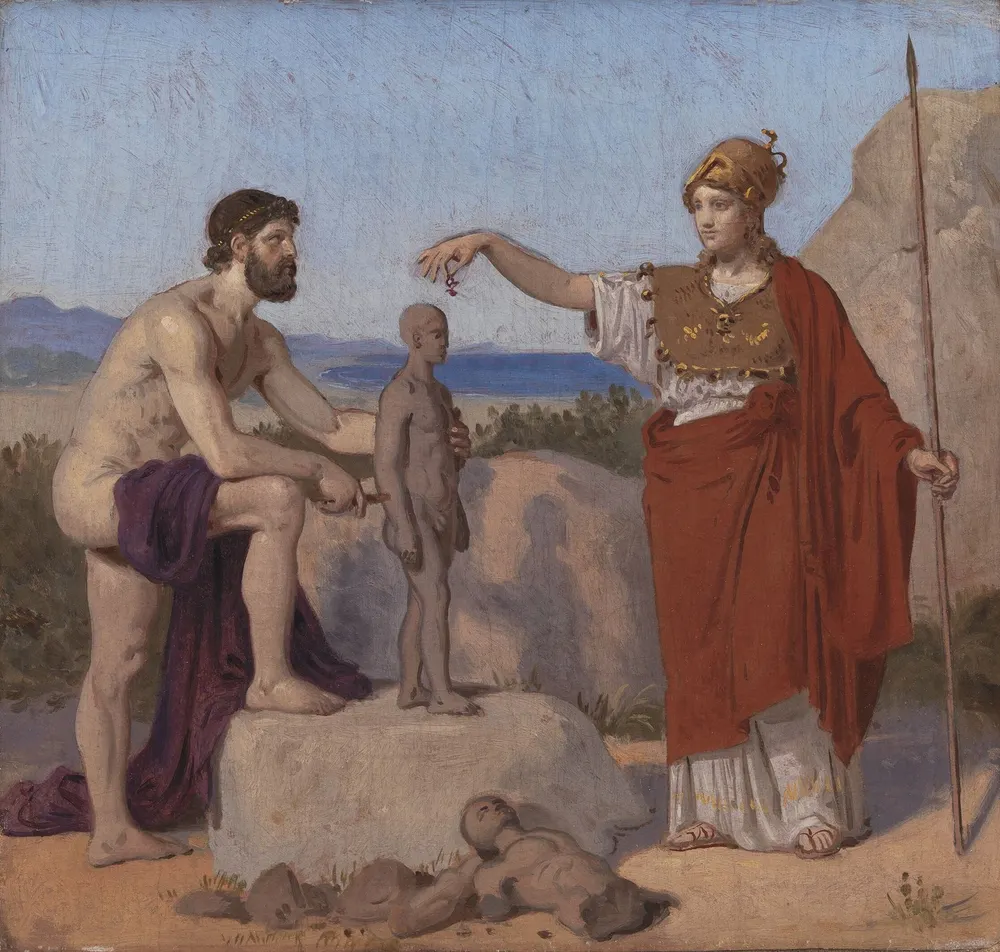
Although the Greco-Roman world lacks a text equivalent to the Holy Scriptures, it certainly has its own creation stories. Ovid's Metamorphoses (read in the Middle Ages as a sort of 'Bible for the Gentiles') bears remarkable similarities to Genesis:
There was still one living being missing, one more noble and capable of elevated thoughts than the others, one that could rule over the rest. Man was born; either he was made with divine seed by the creator of all things, the origin of a better world, or the newly created earth, recently torn from the unfathomable ether, retained the seed of its brother the sky; the son of Japetus mixed earth with rainwater and shaped him in the image of the gods who govern everything; while the other animals, bent down, look towards the ground, man was given a head that rises above the body and was commanded to look to the sky and lift his face upright towards the stars. (I, 75-85)
'The son of Japetus' is Prometheus, whose myth is well-known. Note that here too, man is the 'image of the gods' (effigie, in Latin) and master of the world. The detail of the elevated head is also key, as it is one of the most ubiquitous topics that distinguishes us from other species, as well as our ability to gaze at the stars.
In Plato's Timaeus, one of the few Platonic texts known in the Middle Ages, the human head and its position are particularly emphasized. In this case, however, the central argument (which runs throughout the text) goes beyond the image/likeness. The human being is a 'microcosm,' a scaled-down replica of the rational fabric that orders the entirety of the universe. Our upright anatomy is not an aesthetic whim: it is an operational necessity. The head functions as a sphere that houses the revolutions of the immortal soul, positioned high on the body so that we can contemplate the celestial movements and tune our own reason with the harmony of the cosmos. For Plato, we are magnificent not for what we weigh on Earth: we are so because we carry the blueprint of the universe imprinted in the architecture of our brain.
This idea of anatomical design as a justification for our supremacy finds its most practical side in the Roman tradition, specifically in Cicero's De natura deorum ('On the Nature of the Gods'). There, it is argued that the gods not only endowed us with a mind capable of deciphering the cosmic order. They also gave us two fundamental tools to intervene in it: hands and language. Through these, humanity ceases to be a mere spectator of Creation and becomes a craftsman. Cicero argues that by tilling the fields, diverting rivers, building cities, and taming matter, man constructs a sort of 'second nature' within the physical world. In this classical framework, technique is neither an anomaly nor a declaration of war against the natural order: it is the logical culmination of our dignity. The universe was given to us incomplete so that we could finish it with our own hands.
The Indeterminate Man
A simplifying view states that the Middle Ages were characterized by a pessimistic outlook while the Renaissance gave rise to its opposite. Although this is not technically true (there are testimonies in both directions in both periods), it quite well expresses a conception of History in which, whether we like it or not, we are all embedded since Modernity.
The most cited (and according to some, least understood) testimony of this 'new Renaissance man' is Pico della Mirandola's 'Oration on the Dignity of Man,' produced in the late 15th century when its author was not yet 25 years old. Strictly speaking, the text was not written to circulate on its own, but to be read in a debate that never took place because the Vatican prevented it. It was the subsequent tradition that granted it the status of a 'manifesto' of Renaissance humanism.
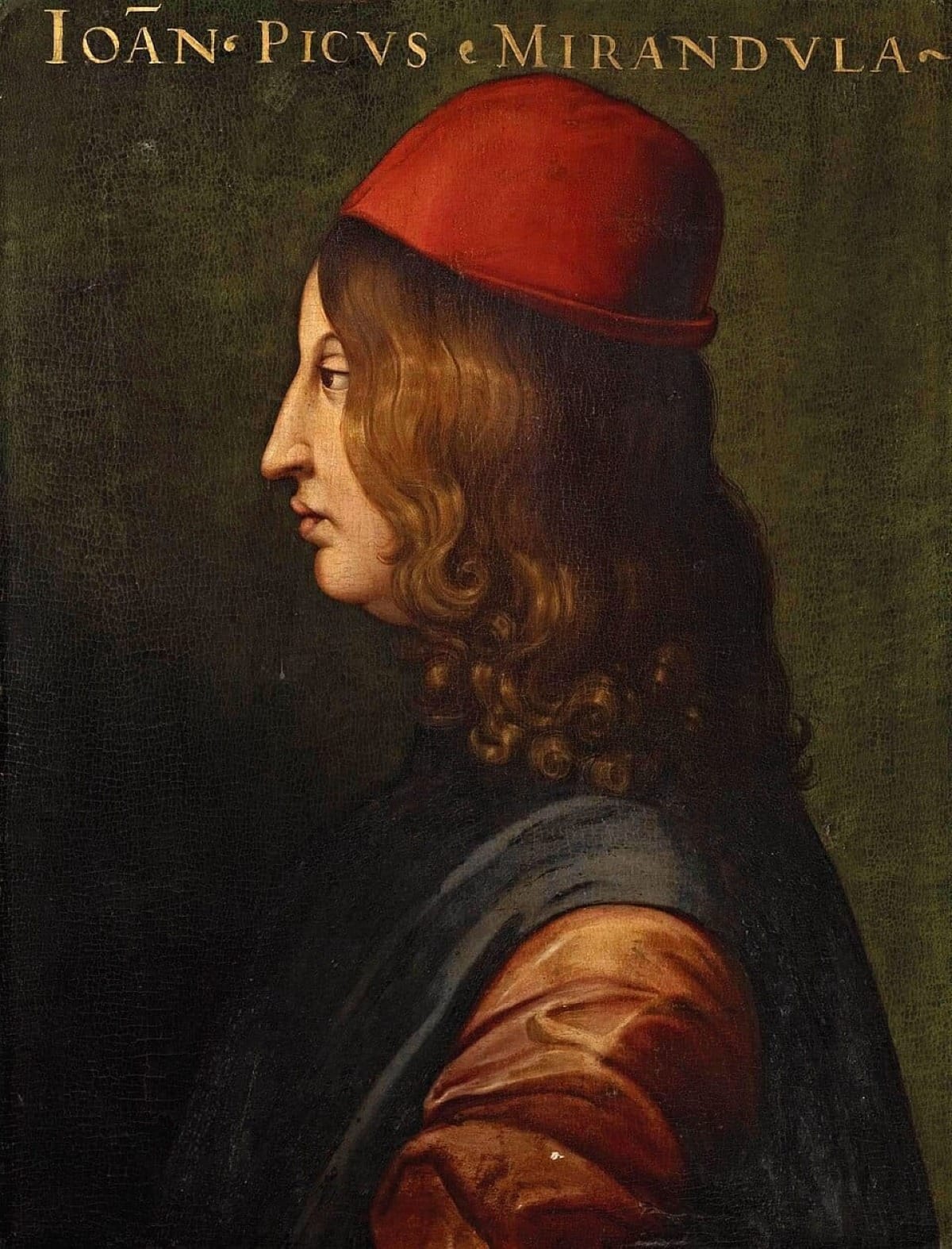
Pico's most cited thesis appears at the beginning of the text, where he recounts the divine creation of Genesis but with some changes. In the first five days, God creates the cosmos, the plants, and the animals. But on the sixth day, He decides that someone worthy of admiring this wonder is needed. Up to this point, it is the traditional narrative. But Pico's God discovers something more: there is no more room. All attributes have been distributed, all spaces occupied. The text states: iam plena omnia, 'everything was full.' Thus, the human being will be a bit of everything and above all, will be free to choose his place. So God speaks to His most important creation:
I did not give you, Adam, a specific place, nor a proper appearance, nor a prerogative of your own, so that you may obtain and retain whatever place, appearance, and prerogatives you choose, according to your intention and judgment. The defined nature of other beings is contained in the precise laws prescribed by me. You, on the other hand, unconfined by any narrowness, will determine it according to the discretion in which I have placed you. I have constituted you in the midst of the world so that you may more comfortably observe all that is in it. I made you neither celestial nor earthly, neither mortal nor immortal, so that, as the arbiter and sovereign craftsman of yourself, you may shape and sculpt yourself in whatever form you prefer.
These beautiful words will follow a story that goes far beyond Pico's intentions, who was particularly interested in magic and Kabbalah as esoteric paths to reach, from humanity, the angelic plane. The truth is that today we read them as one of the most powerful and original ways to synthesize the weakness with the strength of humanity, as a precursor to existentialist indeterminacy (the human being has no prior essence) and as a manifesto of a humanism that, even when supported by religion (and a specific religion), seems to open up beyond it. Human dignity, Kant will say from an Enlightenment position, arises from its rational capacity to give itself its own laws.
Projections
Evidently, this journey has been very partial, both in the materials chosen and in the extent I dedicated to each one. However, it serves to open a panorama on contemporary debates, whether they are religious, political, technical, or (as is often the case) all of the above. León XIV's encyclical indeed references posthumanism and transhumanism, two movements (the first more philosophical, the second with a technical load) that have connections with the problems discussed by the ancients and medieval thinkers.
The more technophilic branch of platform capitalism operates under a premise that we can associate with miseria hominis: that the human being is a predictable bundle of impulses and inconsistencies, a defective entity.
Today, this pendulum between the exaltation of our capabilities and the disdain for our finitude has translated into the sophisticated infrastructures that shape our daily lives. On one hand, corporate transhumanism reinterprets, in its own way, Pico della Mirandola's optimism, promising that silicon and algorithmic engineering will finally free us from biological contingency to sculpt ourselves as unrestricted divinities. On the other hand, the more technophilic branch of platform capitalism operates under a premise that we can associate with miseria hominis: that the human being is a predictable bundle of impulses and inconsistencies, a defective entity whose attention must be captured, shepherded, and optimized by a rational third party. Thus, the promises of technical emancipation become strategies of psychopolitical control.
León XIV's encyclical is a valuable document for this debate even for those of us, like me, who are neither Catholics nor Christians, but are humanists. Because the truth is that, beyond what we may think about the Anthropocene or the effectiveness of humanist education to improve our individual and collective lives, we have yet to find under the stars (nor above them) anything resembling humanity.
Las notas de 421 no tienen paywall
Y a cada colaborador se le paga por su trabajo. Las dos cosas dependen de los suscriptores.