Neri Oxman: Breaking Down the Boundaries of College Majors
Neri Oxman challenges the traditional university with an interdisciplinary approach that brings together science, art, and engineering. Discover her disruptive approach: academic knowledge can no longer be divided into rigid compartments.

There is an author in contemporary academia who makes people uncomfortable, because her trajectory and experience challenge the organizational logic we are accustomed to in universities. The system that the vast majority of us have inherited, live, and uphold divides knowledge into watertight compartments: physicists who don’t talk to designers, biologists who glance sideways at engineers, artists who shrug at an equation. This division is not innocent. It is a technology of epistemic control that has been functioning for centuries and today, in light of the scale and complexity of the problems we face, shows all its seams.
Where this fracture became most evident was not in a manifesto or a critical pedagogy conference. It was in an MIT lab where an Israeli architect built a pavilion using 6,500 s silk worms. Not as a metaphor. As a method. Neri Oxman, founder of the Mediated Matter Lab (2010-2021), professor, designer, scientist, or none of those things separately, has spent two decades working at the exact edge where categories dissolve. Her work is the most compelling evidence that the map we use to organize knowledge no longer describes the territory.
The system that the vast majority of us have inherited, live, and uphold divides knowledge into watertight compartments: physicists who don’t talk to designers, biologists who glance sideways at engineers, artists who shrug at an equation.
The diagnosis has a technical name within its own conceptual framework: the passage from Rich Gold's diagram to the Creativity Krebs Cycle. Gold (designer, writer, researcher) proposed in the late nineties a map divided into four quadrants: science, engineering, design, and art. Each with its differentiated mission. Science explores, engineering invents, design communicates, art expresses. It was an honest map for its time: clear, functional, well-defined. Being a citizen of one of those quadrants meant, almost inevitably, being a tourist in the other three.
Neri Oxman did not reject that map. She transformed it. What she proposes in her article "Age of Entanglement" (published in the Journal of Design and Science by MIT Press in 2016) is that contemporary computational tools have made possible something that was structurally impossible before: to inhabit all four quadrants at the same time. Not just as a polymath accumulating knowledge, but as a creator who integrates them in the very act of producing. The visual result is the Creativity Krebs Cycle: a circular diagram where science turns information into knowledge, engineering turns knowledge into utility, design turns utility into behavior, and art turns behavior into new perceptions that restart the cycle. The boundaries do not disappear: they become porous, traversable, productive.
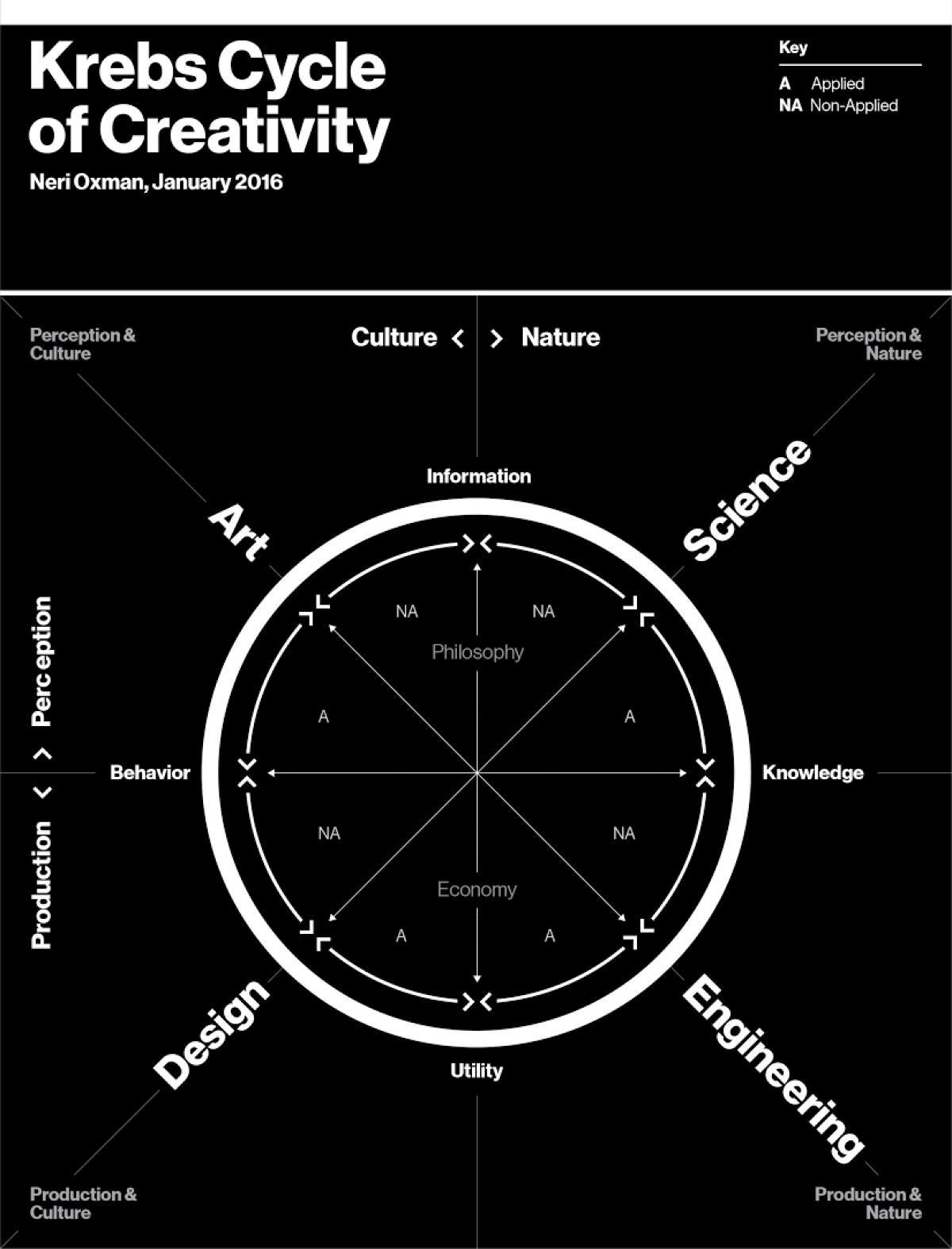
Oxman is not the first to point out that disciplines have a scale problem. What sets her apart is that she did not stop at merely pointing it out; she built a practice. In her systematization of material ecology, she proposes to see how materials, production processes, and the environment interact, with principles of interconnection and cyclicality: any waste can be an input, materials must be adaptive and capable of evolving. This is not design philosophy: it is a working methodology that simultaneously traverses biology, computing, materials engineering, and architecture. And it produces objects that could not exist if any of those dimensions were missing.
The concept with which Oxman describes her relationship with nature is biomimicry, which is how most designers have historically thought about that relationship. Biomimicry studies forms in nature and copies them in synthetic materials; Oxman's approach is biodesign: enlisting nature as a literal collaborator in the manufacturing process. Imagine if a building could be cultivated instead of assembled. A structure could be produced by organisms rather than machines. As she puts it: moving from consuming nature as a geological resource to editing it as a biological resource. The difference is not aesthetic. It is ontological.
The academic world knows well the cost of maintaining that position. Oxman herself formulated it with questions that have no easy answers: Is global intellectual citizenship a path to perdition? Does inhabiting all four domains of knowledge simultaneously imply a loss of disciplinary depth? Alejandro Piscitelli, who includes Oxman among the distinguished group of polymaths, points out that figures like her have antidisciplinary, para-institutional, and often disruptive proposals that cannot be inscribed within conventional academic categories without betraying them. The cost of that freedom is permanent discomfort. The reward: creating things that would otherwise be impossible.
That discomfort being a method rather than a symptom is perhaps Oxman's most underestimated contribution to the debate on how knowledge is produced today. She seeks for her team to inhabit the eye of the storm: that place where chaos, solitude, and the serenity necessary for creation coexist. It is not motivational rhetoric. It is an epistemic condition. The problems worth tackling (for Rittel and Webber, the "wicked problems", or for Morton, the “hyperobjects”, are those that cannot be approached from a single perspective) require creators who can tolerate "not knowing" for as long as it takes for something new to emerge. The curricular and course dimensions imposed by the university are not designed for that. Therefore, even the laboratories Oxman built allow bypassing these departmental issues.
The problems worth tackling require creators who can tolerate "not knowing" for as long as it takes for something new to emerge. The curricular and course dimensions imposed by the university are not designed for that.
We misuse the term "interdisciplinary" when describing this type of work. Interdisciplinary implies that several disciplines come together, negotiate, and each returns to its territory having learned something. What Oxman proposes is something else: the antidisciplinary. The term, which she coined herself, describes objects and processes so intertwined that it is no longer possible to untangle the disciplines or the specific knowledge that contributed to their creation. She calls them knotty objects: knotted objects. Not in the sense of being difficult, but in the literal sense of knots: points where multiple threads cross and support each other, and where cutting any of them destroys the entire object.
Organic machines, living structures, breathing architectures: Oxman's knotty objects are exactly that. The Silk Pavilion (built in 2013 with a CNC machine and 6,500 silk worms) is perhaps the most iconic. The machine installed 26 polygonal panels of silk thread as scaffolding; the worms completed the structure, migrating to the darker and denser areas, filling the panels with silk deposited according to their own behavioral patterns. The solar path diagram determined where the openings would fall. The result is not a work of art, nor a scientific experiment, nor an engineering prototype: it is all three simultaneously, and none separately. That is what makes it impossible to evaluate with the metrics of any of the three disciplines individually.
What makes a knotty object truly knotted is not its technical complexity but its epistemic indivisibility. An airplane is technically complex but perfectly decomposable: the wing was designed by an aerospace engineer, the navigation system by another, the interior by an industrial designer (with apologies to the airplane creators reading this article who might want to throw stones at me). Each part has its disciplinary author. In Oxman's objects, that does not work that way. The science that determined what proteins a silk worm produces under certain light conditions is the same that defined the shape of the pavilion, which is the same that determined the manufacturing protocol, which is the same that gives it its aesthetic dimension. Cutting any of those threads means the object ceases to be that object. We can consider these objects antidisciplinary due to their declaration of intent and structural condition: they could not have been created from within a single discipline because the problem they solve does not exist within any particular discipline.
The antidisciplinary describes objects and processes so intertwined that it is no longer possible to untangle the disciplines or the specific knowledge that contributed to their creation.
That the process reflects the knots of the product is one of the most elegant principles of Oxman's work. There is no phase of research followed by a phase of design followed by a phase of manufacturing. Everything occurs intertwined. Aguahoja, her water-based manufacturing platform, builds structures from chitosan, an organic fiber derived from chitin —the material of insect and crustacean exoskeletons—; when its purpose is fulfilled, it dissolves in water and returns to the earth as compost. A building designed to disappear is not a failed architecture: it is a different relationship with time and matter. One of its fundamental principles: all waste can be input. The cyclical not as a value of sustainability, but as a design principle.
The tool that makes all this possible has a proper name: digital morphogenesis. The concept comes from biology (morphogenesis is the process by which an organism develops its shape during growth) and Oxman translates it to computer-aided design. It is not about using software to draw organic shapes, which would be merely visual biomimicry. It is about replicating the very logic of growth: structures defined not by a prior plan but by iterative algorithms that respond to environmental conditions, just as bone tissue responds to the mechanical loads it receives. Stanislav Roudavski described it as analogous to biological morphogenesis: developing gradually, without an explicit definition of growth or adaptation methods. The result is structures that could not have been conceived in a hand-drawn plan because their logic is emergent, not projected. Advances in digital fabrication (3D printing, precision robotics, material synthesis) have allowed these algorithmic structures to stop being simulations and become tangible objects, with physical properties that no human designer could have intuitively calculated. Digital morphogenesis is, in that sense, the technical language of antidisciplinary thinking: a way of creating that does not start from a prior idea but from conditions, constraints, and possibilities that the process itself reveals.
To understand why this matters beyond design and architecture, it is useful to think in a broader context. Since 1950, the proportion of materials produced by humans —iron, concrete, asphalt— is comparable to all existing biomass on the planet, and by 2040 it is expected that this "concrete jungle" will exceed double the mass of living beings. The problems generated by that figure (climatic, ecological, civilizational) have no solution within any discipline. They require exactly the type of thinking that Oxman practices: one that does not recognize the boundaries between the living and the manufactured, between nature and technology, between science and art. Not because those boundaries do not exist, but because the problems that matter cross all of them.
This is the final argument of the Creativity Krebs Cycle: that knowledge can no longer be produced within disciplinary limits, because it is completely intertwined. It is neither a complaint nor a utopia: it is a description of the current state of affairs. Oxman does not expect those structures to change to do her work. She builds in the interstices. She cultivates in the knots. And lets the objects speak for her.
Las notas de 421 no tienen paywall
Y a cada colaborador se le paga por su trabajo. Las dos cosas dependen de los suscriptores.