The Old Roots of the "New Right"
Is the new right really that new? How Nick Land and Curtis Yarvin remix old reactionary hits in cybernetic code.
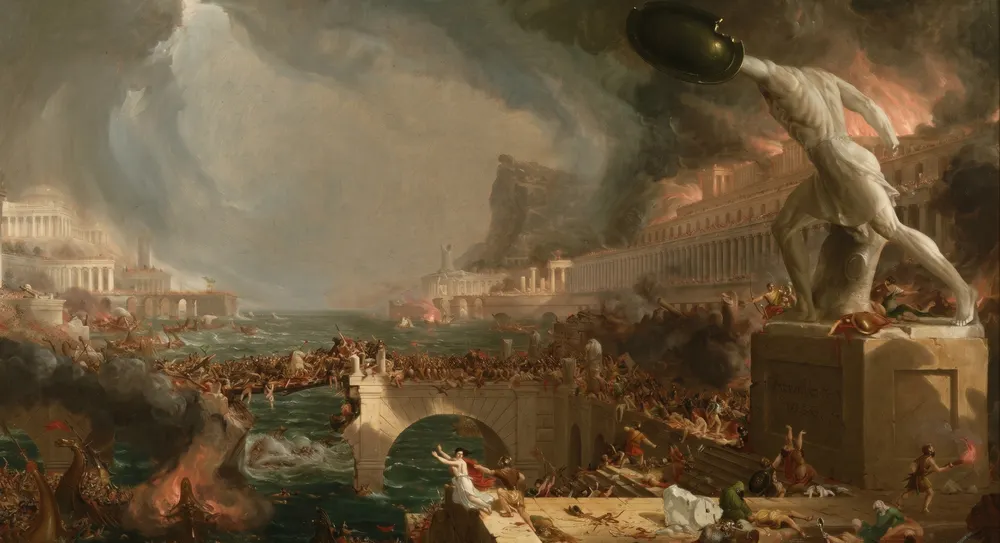
Ever get the feeling there's nothing new? It's an old idea, so old that the Old Testament already said it: nope, there's nothing new under the sun (Ecclesiastes 1:9). The other day, for example, I was watching a video about the show 24 and why it's the ultimate example of the “ticking time bomb” argument: we need to torture this terrorist so he'll give us information that will help us defuse a bomb that's about to go off. You know, something that has never actually happened, built on an implausible hypothetical that, conveniently, gives me the green light to electrocute someone with a car battery. Know where the bomb argument came from? A French novel about the Algerian War, written to justify paramilitary torture. You know, the guys who trained the torturers of our last dictatorship. It's. All. Happened. Before.
That's why, when I look at what the authors of the new reaction are saying, and specifically at the tenets of the accelerationist Land and of Curtis Yarvin, I can't help but see what other people said before them. To quote George Lucas: “It's like poetry, it rhymes.”
See, I'm currently writing my undergraduate thesis on the German philosopher and jurist Carl Schmitt, which requires me to read not only a big chunk of what he wrote but also the people he was reading. Schmitt would end up known as the “crown jurist of the Third Reich,” because, while he held fairly critical views of liberalism and democracy during the interwar period and the Weimar Republic, he'd later become an early defender of Hitler's government (and, well, he never recovered once it turned out the Thousand-Year Reich lasted about a dozen).
When I look at the tenets of the accelerationist Land and of Curtis Yarvin, I can't help but see what other people said before them.
He thus became associated with authors like Spengler, and also with the way he reinterprets Donoso Cortés and Georges Sorel... And I keep feeling the echo, the resonance: the syllables and the melody sound similar. Time to explain them. Why? Well, people on the right might be interested in reading what came before, and people on the left in getting to know their enemies better. That's as good an answer as any. But also to reflect on time and novelty.
What's new about the new reaction: the internet, memetics and neo(lib)con corporatism
Before we look at why the instruments keep repeating a motif, let's see whether the orchestra has any new instruments and what the singer's voice sounds like. Yes, we're sticking with the music metaphor. Yes, I'm very sorry.

The first thing you learn when doing conceptual history is that time changes. You can't say, for example, that because the Jesuits were expelled from the Americas, writings by those Jesuits distinguishing Spanish America from Spain itself appeared for the first time, and therefore the entire Spanish American Revolution boils down to and is explained by that expulsion. It's a bit more complex. There are always a lot more people involved, with other interests, goals, books on their shelves, etc. So while the new, antiliberal right resembles the recent liberal or conservative right, or the old reactionary one, there are clearly different elements. For example:
- The internet and its culture: Since the mid-eighties, the internet has changed everything, and it's the most effective US foreign policy there has ever been. Curtis Yarvin is a programmer turned blogger; his intellectual training is self-taught. In his writing he draws not only on the jargon of his line of work but also on nerd pop culture references: the red pill from The Matrix, Cthulhu swimming left, and so on. Then there's Nick Land, who's a different creature, since he's a philosopher who ended up a reactionary intellectual after leaving the University of Warwick. Along that path, his writing adopted a computing-based newspeak to account for changes in the world, using terms like feedback loop. And, once again, nerd sci-fi shows up here too. Terminator, Neuromancer, Lovecraft for all the boys and girls. Needless to say, the classic reactionary right was largely technophobic (because until half a century ago technological progress was read as going hand in hand with liberal civilizational progress), and its culture was classical and traditional.
- The meme as discursive theory: The mixed-breed offspring of communication science and genetics: the meme. A big development of nineties theoretical frameworks: cultural ideas as something that operates synonymously with biology. Language use and the affirmation of beliefs read not as a free action or personal decision but as a biological fact. If you ask me which reactionary or anti-popular theory came up with something along those lines, I'd say the biologistic positivism of authors like Le Bon or Ramos Mejía, but we're talking about what's new here, and those guys were liberals too. Land updates Adorno and Horkheimer's reading of the Kantian Enlightenment ethos, but in terms of a human security system that contains us, its infectious character (by way of Deleuze) imposed through education. Yarvin, for his part, opens by talking about how we need to purge ourselves of the parasite of Puritan universalism that has reigned in the West since... Cromwell and the Parliamentarians.
- Neocon (or neoliberal?) corporatism: One could argue it's not that new compared to the immediate past if we read it through the lens of neoliberalism. If you picture neoliberalism as essentially libertarian, you weren't paying attention. Thatcher and Reagan were pretty conservative when it came to centralizing the role of the State (except for the economy, they deferred everything to a central decision-making authority), immigrants and diversity, gender roles, etc. For neoliberalism, the State should be thought of as an efficient corporation. And market capitalism? Unbridled, globalized and unchained, thank you very much. The State (or sovcorp, sovereign corporation, an idea found in the ironically social-democratic Laski and Tönnies) that Yarvin proposes is one of efficient corporations whose only quality standard is efficiency, and for Land we have to accelerate capitalism in its financial-cybernetic guise until the anticapitalist rebound arrives (The Chicken's on his way, just chill).
I wouldn't say that's everything that's new, but I'd say it's the core, the most important part, what allowed their followers to feel comfortable with and understood by these authors. It's their sense of novelty, folded into the Zeitgeist of the era. Now, let's talk about the déjà vu.
The old in the new
A key point for the reactionary right is claiming that the present, usually identified with liberal democracy, is decadent and will run us over if we don't kill it first. Conservatives don't like democracy, but they understand it's necessary to some degree (domesticated). Liberals, for their part, are democrats from the get-go, until things start happening in non-liberal ways. Reactionaries? Nope. But let's be precise.
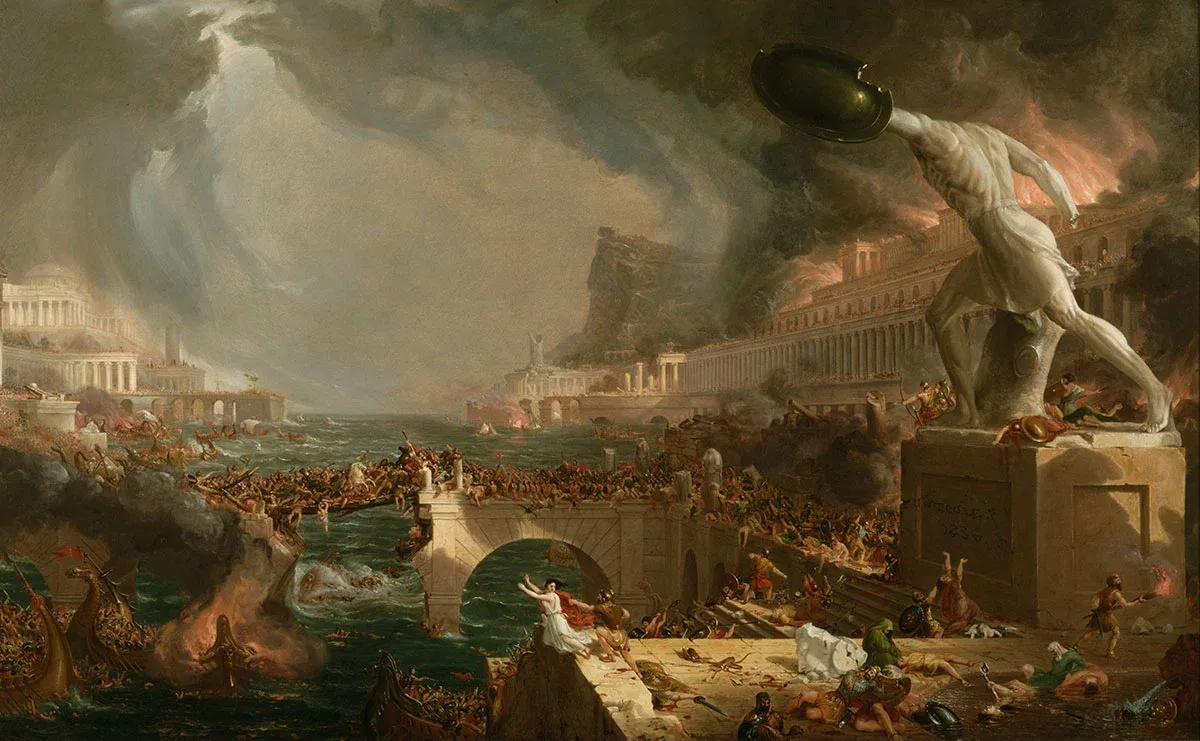
- Antiliberalism: Reactionary thought can't be understood except as a wholesale rejection of the Enlightenment and its political ideology, liberalism. In fact, if you press me, the reactionary has more respect for a left that admits the whole thing has to be torn down than for a liberal. And by liberal we generally mean a grab bag of people that includes: intellectuals and university folks, leading figures of the middle and upper classes in various economic spheres, journalists, etc. If you reject the ideology of the present, you logically reject the institutions of that present (ring a bell, the “Cathedral”?). In the 19th century this was Donoso Cortés lashing out at the fearful, debating class that allowed the revolution of 1848; in the 20th it's Schmitt calling liberals romantics incapable of holding a clear, consistent position. Above all, for Sorel, Donoso Cortés, De Maistre, Schmitt or Spengler, what liberals don't get is that violence exists in the world and how it explains the political. Land would leave Warwick and the CCRU to later put together the reactionary “Dark Enlightenment,” while Yarvin would take aim at the democidal democracy of the universalist Puritans of the “Cathedral.” Consensus-seeking dialogue and its refusal of violence are read as a sign of weakness and a cause of critical decline.
A key point for the reactionary right is claiming that the present, usually identified with liberal democracy, is decadent and will run us over if we don't kill it first.
- Political theology: What? What's that? That if Land and Yarvin are atheists, wouldn't that make for a radical break with traditional reaction? Not as much as you'd think. When Yarvin criticizes the “Cathedral” and traces the history of its memetics back to the 17th century and the English Civil War, he's explicitly doing political theology, a philosophical analysis that ties the meaning of political ideas to their religious parentage. What we call the “secularization thesis,” carried out by Schmitt (“All significant concepts of the modern theory of the state are secularized theological concepts”), who in turn takes it from Donoso Cortés, who, like De Maistre, contrasts and prefers a monarchical, hierarchical and authoritarian idea of religion (an ultramontane Catholic papism), radically antidemocratic, over a democratic, individualist and assembly-based logic of faith. Why point out the genetic “religiosity” of ideas reactionaries oppose? With Yarvin and his right-wing atheism, to underscore an innate irrationality in his broad notion of the left (similar to Spinoza's logic when discussing superstition, or Nietzsche's on moral ressentiment).
- Satanic chaos and the left: Swap the prince of darkness for the ruler of R’Lyeh and functionally you've got the same thing. For Yarvin, the Puritan democrats are a religious and democidal cult, the Cthulhu that always swims left and makes the world more and more unstable. Pretty similar to the decadentist readings of the West by Spengler (by way of Nietzsche) or by Schmitt, who picks up Donoso Cortés calling Pierre-Joseph Proudhon satanic. An accusation the anarchist Bakunin embraced, just as he crafted a satanic atheology against politics, just as Sorel invoked the violence of the general strike. And here, if you'll allow me, we can place Land, who calls for the final apocalyptic acceleration of capital's contradictions. You know, against capital itself. The “satanization” of the left is simply these authors' bluntest way of declaring their ideological enmity.
Here are the rhymes, here are the matching notes. Sound alike, huh? The old in the new. It's not the same thing, mind you. This has to be understood in its novelty.
And what good is this to me?

Good question. I'm a teacher and I teach philosophy in high school. And when I studied philosophy, a lot of what I did was similar to reading history, sure, but the history of thought. Everything always shaped by a chronology: Plato was Aristotle's teacher, who later inspired the medievals, with whom Descartes would have major disagreements... and so on. Because there's a history of thought, one that keeps changing and shifting, just like and hand in hand with social history. This kind of training isn't what you picture when someone tells you “I'm a philosopher”: we imagine the thinker, hammering away at concepts and new ideas, chasing novelty and... That's not how it is. There are new ideas, sure. But first you have to do the groundwork, so you don't end up developing an argument that was refuted back in the 3rd century BC.
Like we said at the start, if you're on the right, maybe now you'll want to take a look at Donoso Cortés and see what's up. If you're on the left, same deal, but to understand how the people who don't think like you think. As for the old, the new and the repeated, it's important to understand that similar doesn't mean identical. Don't be reductionist: refuting the old part and the new part takes different arguments, and so does understanding them. And that's why you study the history of ideas. See? I answered the question.
Las notas de 421 no tienen paywall
Y a cada colaborador se le paga por su trabajo. Las dos cosas dependen de los suscriptores.