
The Other Kaczynskis
Beyond Ted, the Unabomber: who are the other Kaczynskis? Somewhere between Crowley's occultism and comics. An exclusive interview with Tom.
On September 19, 1995, the Washington Post and the New York Times published the manifesto “Industrial Society and Its Future,” signed by FC. After reading it, David Kaczynski recognized a few phrases that were classic lines from his brother, Theodore. It didn't take him long to turn him in. Tedploitation has saturated the internet and the media, whether through memes or the thousands of documentaries and biopics Netflix makes a point of releasing once a year. But the surname also belongs to two other people who'd be worth putting the spotlight on: Richard, the biographer of occultist Aleister Crowley, and Tom, a Polish-born comics artist.
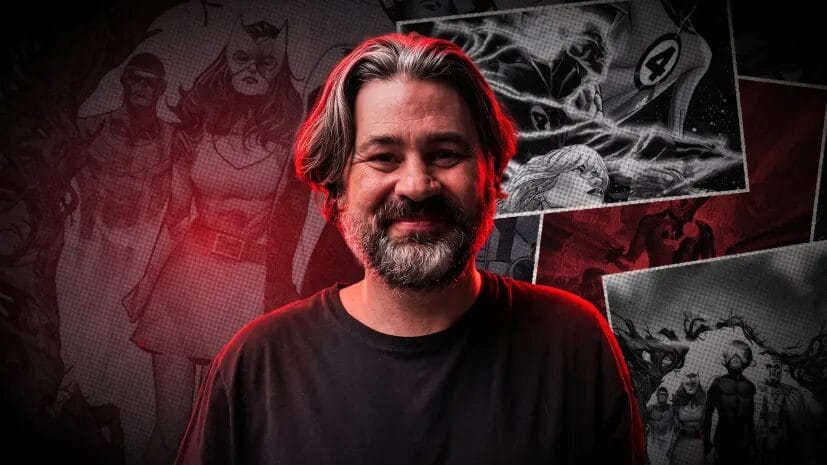
Let's start briefly with Richard: he's one of the leading experts on the life and work of Aleister Crowley; in fact, his biography, Perdurabo, is one of the most celebrated, serious and widely read. Richard Kaczynski was born in 1963 and began his Thelemic studies toward the end of the seventies. He studied on his own for ten years before turning to writing the biography. When he started his research, he decided to be initiated into the Ordo Templi Orientis, a Masonic-style order that ended up being absorbed by Crowley: he took it over and turned it into the space where he shaped the practices of his own philosophy, Thelema. Kaczynski was initiated at a messy moment, when several groups claimed to be the true O.T.O.: from Kenneth Grant and his Typhonian Order, which borrowed Lovecraftian archetypes, to Marcelo Motta, the Brazilian who founded the Society Ordo Templi Orientis.
The surname also belongs to two other people who'd be worth putting the spotlight on: Richard, the biographer of occultist Aleister Crowley, and Tom, a Polish-born comics artist.
In an interview with the French esoteric magazine La Voix de Satan, Richard explained: “I found all of that confusing and distasteful, especially what Motta was publishing. So I stayed out of it and remained a solitary practitioner. Once I dug into the actual history, it didn't take me long to figure out which one was the real deal. For me, joining was a way of saying: ‘I've personally gotten so much out of Crowley's system that I want to help make it available to others who are interested.’ (…) One of my goals with Perdurabo was to write an account that was as objective and impartial as possible. I was—and still am—interested above all in the truth. For those reasons, like you, I'm also skeptical about the supernatural. But so was Crowley. Whether Bartzabel or Ab-ul-Diz exist objectively or are manifestations of the subconscious, my experiences are real, and those experiences have shaped me as a human being. I think a fundamental part of Crowley's system is about instilling discipline, concentration and the ability to manifest your own intentions. Magick provides the tools to practice that. It gives you introspective techniques for discovering your Will. Once you've done that, you carry that learned discipline, concentration and capacity for manifestation over into accomplishing your Will, whether that's painting, writing, sculpting, recording or anything else.” Beyond his interest in Crowley, Richard is also a superb keyboardist and a prog rock fan: he's played in the band House of Usher, touring and recording several albums with them.
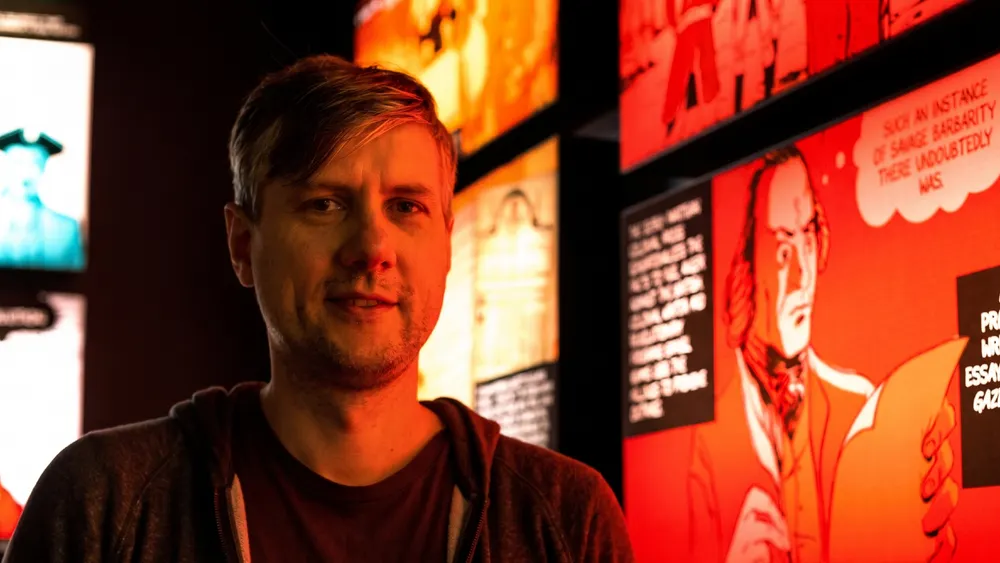
Tom, on the other hand, hails from Poland, but moved to the United States a few years before the Berlin Wall took its first hammer blows. His work very subtly blends urban alienation with elements of J. G. Ballard's science fiction. His best-known work, published by Fantagraphics, is the anthology Beta Testing the Apocalypse, made up of pages originally published in the anthology magazine MOME. I got to do a short interview with him about his work, his surname, being born in the Soviet bloc, and comics in general.
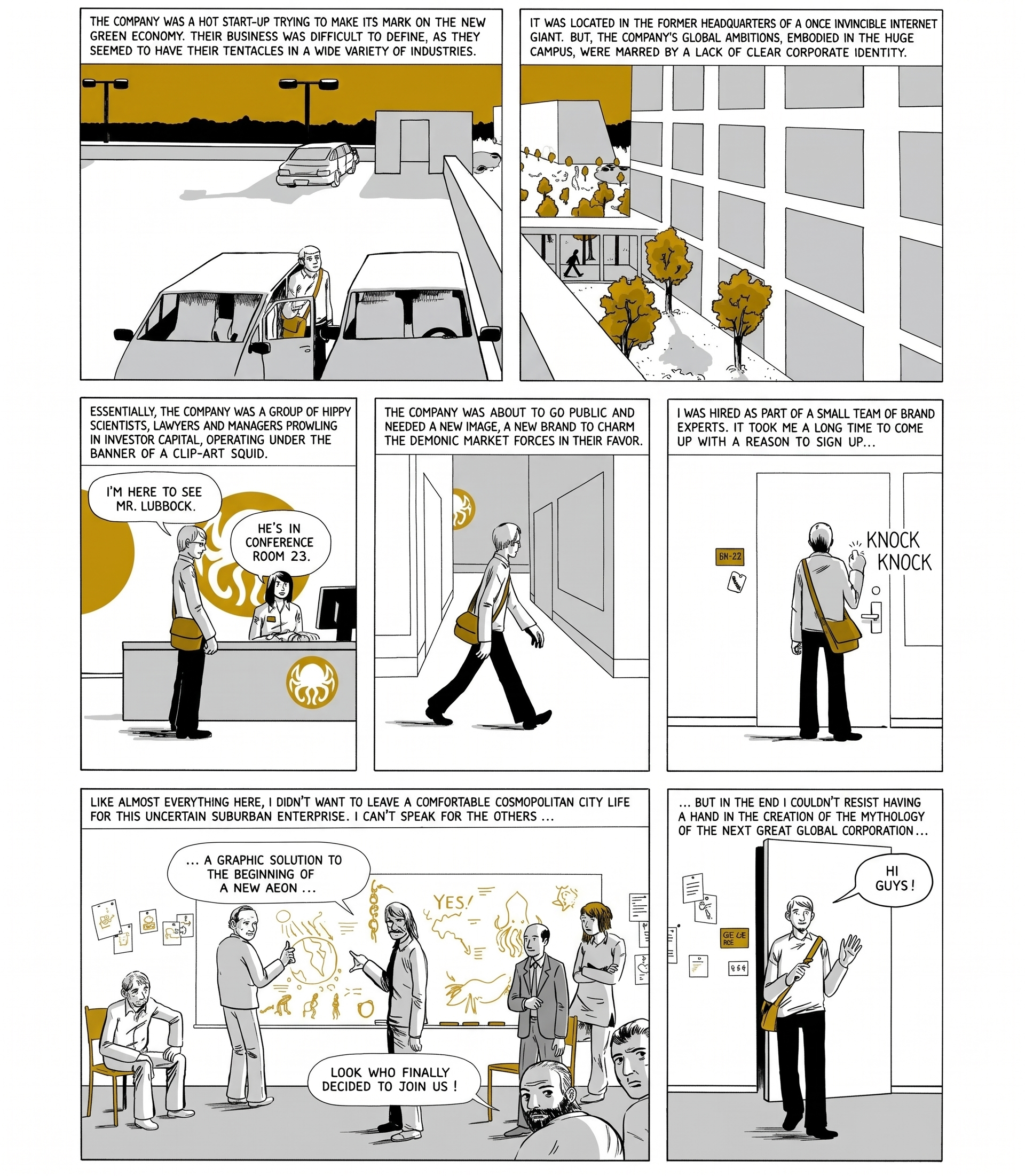
You're originally from Gdańsk, Poland. Did the Polish poster school have any influence on you? Are there any artists you'd recommend?
I'm a huge fan of Polish posters, but I mostly came to appreciate them from the outside. Growing up, I saw a lot of posters from the late seventies and early eighties, but I didn't know they belonged to a broader movement or style. Nor, for that matter, that there was anything “weird” or unusual about them; I found that out much later. Some of my favorite artists are Cieślewicz, Klimowski, Erol… My favorite is probably Walkuski's Danton poster. His work is like an oblique cross between Giger and Beksiński.
This might just be me projecting, but your style sometimes reminds me of Daniel Clowes and other times of Raymond Pettibon. Could you do some name dropping of illustrators and cartoonists who've influenced you?
Daniel Clowes is a big influence. Eightball #3 went off in my head like an atomic bomb (to paraphrase William Onyeabor). At first I resisted the grotesqueness of his work, but then, as if a switch flipped in my brain, I came to embrace it completely. My influences go back pretty far. I started reading and drawing comics very young, so it depends on where you want to start. From the Polish wave: Papcio Chmiel (Tytus, Romek i A’Tomek), Christa (Kajko i Kokosz), Polch (Funky Koval), Rosiński (Thorgal), to the American mainstream: Byrne, McFarlane, Larsen, Lee, Silvestri, Kirby, Buscema, Chaykin, Baker. Also the nineties indie wave from the US and Europe: Sim, David B., Blutch, Brown, Seth, Ware, Burns, Mazzucchelli, and some of my peers too: Zak Sally, Anders Nilsen, Jonathan Bennett, Jon Lewis. I read everything and soak things up from everywhere.
You studied architecture. Buildings play a key role in your work, as if living in apartments or condos had something inherently alienating about it. Where does that reading come from?
I studied art and architecture. Funnily enough, architecture was much more open to comics (as a tool and as an aesthetic choice) than my art professors were. Both comics and architecture are a kind of Gesamtkunstwerk (total work of art): in both cases you have to conceive of the world as an integrated system. The building has to fit into the city, plugging into its social and commercial flows. You have to account for everything, down to the smallest detail, like windowsills or doorknobs. Comics, for their part, have to create a believable, livable world for the characters and for the reader.
 Amadeo Gandolfo
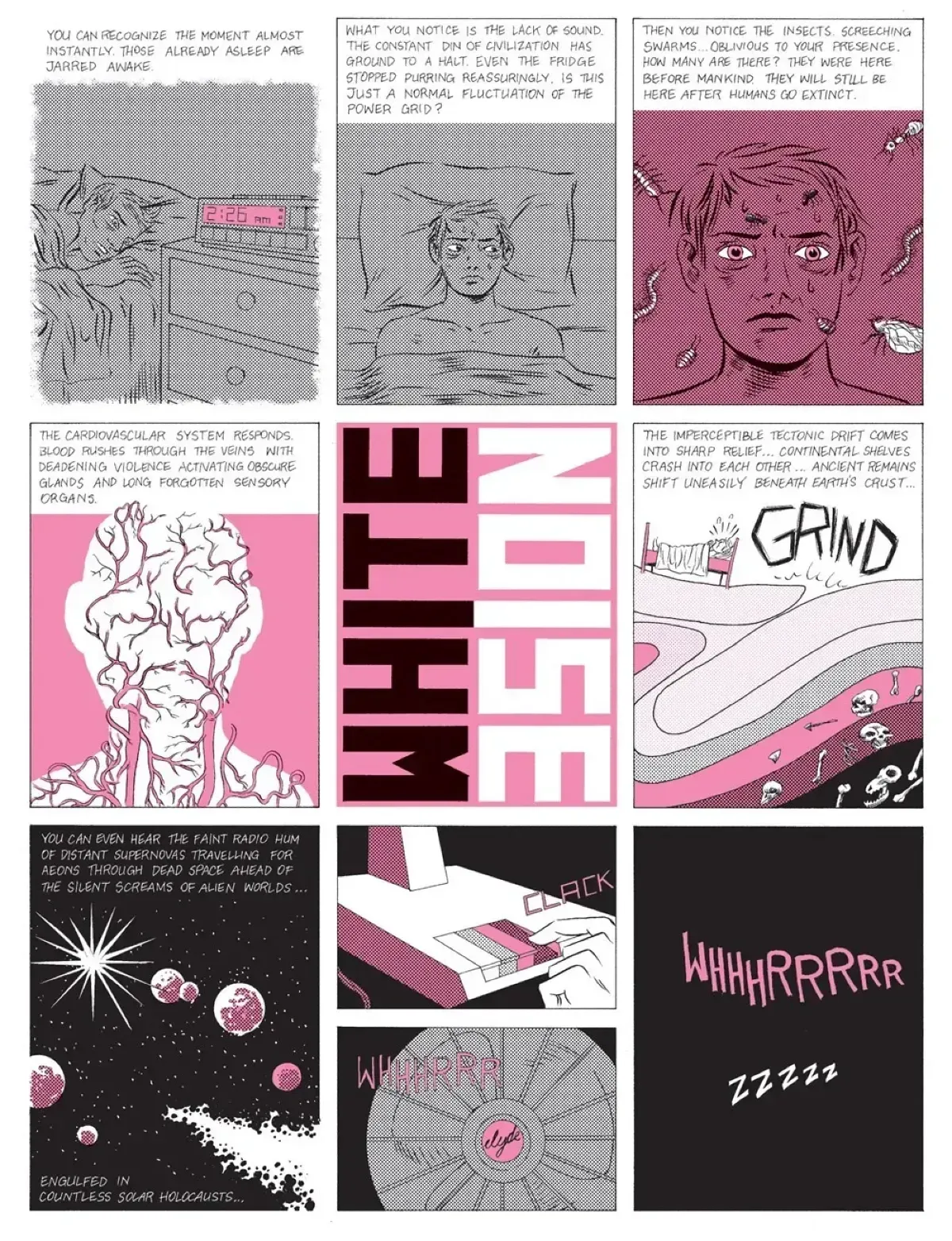
I don't think apartments are inherently alienating; it all depends on the context. In the US, outside of big metropolises like New York, apartments tend to be run-down, underfunded or considered undesirable. In Europe or Asia, on the other hand, they're the norm. Some of the work in Beta Testing the Apocalypse was made during the insane real estate bubble of the early 2000s. I was living in New York and watching the skyline fill up with soulless buildings. That created an alienating, chaotic environment that was hard to navigate. I was also letting myself be influenced by J. G. Ballard, always on the lookout for the psychopathologies bubbling beneath the surface of those brand-new “affordable luxury” apartments.
In a way, I'm an “optimistic apocalyptic.” Some of my more recent work plays with that dynamic. The apocalypse is a suburb of utopia.
In a way, I'm an “optimistic apocalyptic.” Some of my more recent work plays with that dynamic. The apocalypse is a suburb of utopia. Can we find any green shoots among the multitude of imminent apocalypses looming over us? Can something new grow out of the cracks in the world? There's a longing for a new frontier, for something capable of resolving the contradictions of our hermetically sealed rat utopia. You have to step outside that narrative to see what's possible.
Among other gigs, you contributed to Punk Planet magazine. My publishing house put out its interview anthology, We Owe You Nothing; I'm a big fan. What did you do for the magazine? How did Daniel Sinker, the editor, get in touch with you? Was it just another commission, or are you into punk and hardcore?
I never met Daniel Sinker; it was a different editor who commissioned me. If I remember correctly, it was an issue about the “death of print,” and they asked me to contribute a comic on the subject. Honestly, it was just another commission. Although I like some punk music (all the usual, obvious stuff), I was never drawn to punk as a culture. When I got to the US, my musical and cultural tastes were too “European” to fit comfortably into that world. I had good friends who were into it, but I just never quite fit in. I found it kind of suffocating and weirdly authoritarian. To satisfy my need for aggression or intense energy, I leaned more toward industrial music, various flavors of techno, IDM, etc. But I never became part of any particular “scene.” My tastes were always all over the place… Other Music, in New York, was my favorite record store; maybe that gives you an idea.
The original edition of We Owe You Nothing was published by Akashic, whose head played in punk bands in Washington, D.C. The press has the Noir book series, anthologies of crime stories set in different cities around the world, written by local authors. You were the only illustrator to take part in the entire series. How did that come about?
At some point Akashic expanded the Noir series to cities all over the US. They approached me for Twin Cities Noir (focused on Minneapolis and St. Paul). I was asked to submit something, I asked whether I could do it as a comic, and they said yes. I worked with local editors rather than with Akashic's people in New York.
As I understand it, part of your work deals with the contrast between leaving the Soviet bloc and entering cutthroat capitalism. How old were you when you emigrated to the United States? Was the contrast between what American propaganda had led you to idealize and the reality very extreme?
I left Poland in 1985 and moved to the US in 1987 (after a year and a half in East Germany). The contrast between what I imagined and the reality was dramatic, but so was the contrast between actually existing communism and actually existing capitalism. One thing worth pointing out is that much of my work on these subjects unfolds within broader questions, like nostalgia and utopia. I try to examine not just the societies themselves, but also the phenomenology of the idealized (or “rose-colored glasses”) view people hold of those ideas. For me, utopia and nostalgia are tightly intertwined, just like communism and capitalism. The idea that the West represents unfettered capitalism and the Eastern Bloc embodied communism realized (and that the two were fundamentally different entities) isn't entirely accurate. Although they were opposed to each other, in many ways they were similar and sprang from the same source.
The idea that the West represents unfettered capitalism and the Eastern Bloc embodied communism realized (and that the two were fundamentally different entities) isn't entirely accurate.
Another recurring theme in my work is the “end of history.” Culturally speaking, much of the early 2000s in the West was marked by a kind of malaise and stagnation (see Mark Fisher's Capitalist Realism, among other works). You could compare that situation to the final stage of the Soviet Union. In this context, the economic system is almost beside the point; what matters is the logic typical of empires in decline (marked by bureaucratic bloat, cronyism, gerontocracy, stagnation, decay, etc.) that ends up dragging down a revolutionary regime that was once vigorous and competent.
The themes you explore in your stories (technology, big corporations, alienation) bear a resemblance to those of the “other” Kaczynski. How did you find out about Ted? Have you read his manifesto?
I learned about Ted through the press when he was caught in the mid-nineties. I'm not sure I was really aware of his activities before that; I certainly didn't know his name. Nobody did. I read the manifesto much later. Honestly, for a long time I ignored the whole Ted thing. I got tired pretty quickly of people asking if we were related, so I stayed away from it for that reason. Later on, I got curious when I found out what the manifesto was about. I'd started getting interested in technology, technological determinism and so on, and it became obvious I needed to know more about Ted and read his manifesto.
We talked briefly about the other Kaczynski, Richard, Crowley's biographer; you told me you'd read a biography of the legendary occultist. Are you into all that, and do you think it has anything to do with what you do?
I don't know anything about Richard, except that he's Crowley's biographer. I have his short guide to Crowley, but not the full biography (Perdurabo). I read Sutton's biography of Crowley and I remember liking it. I've always been interested, if only tangentially, in the occult and mystical phenomena. One of my favorite subjects is Atlantis, and there's a lot of occultism tied up with it. Plus, some of my favorite comics were written by occultists (Alan Moore, Grant Morrison) or featured characters connected to the occult (like Hellblazer or Doctor Strange).
For a long time I ignored the whole Ted thing. I got tired pretty quickly of people asking if we were related, so I stayed away from it for that reason. Later on, I got curious.
Actually, I don't think of the occult as a separate field of knowledge. In that sense, I follow the chaos magician Ramsey Dukes, who laid out a framework for understanding the different forms knowledge takes across the ages: magic, religion, science and art. It wasn't a linear succession but a cyclical continuum. If you're into McLuhan and media theory, you'll see that these forms map onto the transitions between different media (oral/aural, manuscript, print, electronic). I think our media landscape today is so intermingled that it creates the perfect storm for these various modes of thought to resurface and overlap… though it's worth saying that none of them ever fully disappeared. It's a matter of emphasis. Meanwhile, I'm trying to figure out how comics fit into all this.
Beta Testing the Apocalypse became your best-known book, with several editions. It grew out of a compilation of previously published stories. What was the process of choosing which stories to include?
There was no selection process. When I started drawing my comics for MOME, I stumbled almost by accident on the idea of using numbers in (almost) all the story titles. I wanted readers to sense that they were somehow related to each other. But that also forced me to think of all the stories as part of a larger cycle… over time, the book took shape fairly naturally. In the second edition, I added three stories I felt fit into the whole.
Why did you decide to include an index in Beta Testing the Apocalypse?
I rarely saw an index in a graphic novel and I'd always wanted to make one. It's also an indirect nod toward a new kind of literacy in which images are on the same level as words. Sometimes the index points to something literal, like a specific sound effect on the page. Other times it's more indirect and points to a concept (philosophical or metaphorical) that's built into the panel or the image. I want readers to be aware of the multiple narrative layers unfolding at the same time. In the second edition, I also added notes. I wanted the book to come across as something more than “just” a graphic novel. One of the experiences that shaped my relationship with comics was where I bought them: in Poland and West Germany, I got them at newsstands, surrounded by other stuff like newspapers, magazines, etc. I saw them as part of a broader print culture. In the United States, things were a bit different. A lot of comic shops specialized exclusively in comics, games and pop-culture ephemera. That gave it a ghetto feel, like being pushed to the sidelines. Though sometimes it was different. My favorite comic shop in Minneapolis was Shinder's. It was a mix of newsstand, head shop, bookstore and comic shop; it even had a porn section (heh), among other things. Comics were part of a wider cultural movement. I'd often buy comics, the occasional issue of The New Yorker, some other magazine or a science fiction book. I wanted to reproduce that quality in my book: comics are the core, but there are also texts, theory, speculation, indexes, charts, etc.
How did your publishing house, Uncivilized Comics, come about? What's the unifying concept behind the project?
It was an organic process. I created the “brand” for my self-published work, but over time (as artists like Gabrielle Bell, Jon Lewis, Laura Park and others asked me to help publish their work) it turned into a broader minicomics imprint. Then, when Gabrielle asked me to publish The Voyeurs, that name became the name of the publishing house itself. If there's a unifying “concept” behind Uncivilized, it's treating comics seriously as literature, with their own qualities, effects and resonances. Gary Groth's The Comics Journal had a huge influence on how I understand comics. Gary fought to carve out a space for adult, interesting, quality comics in an environment mostly focused on kids and teenagers. In a way, he's won that battle. I'm walking through the clearing they cut, but the challenges today are different. One question I ask myself is: where do comics fit in today's media landscape? If we really are becoming a post-literate society, what does that mean for comics? Can comics fill the void left by an audience less and less interested in reading long texts? Can they preserve print culture in a new way?
Las notas de 421 no tienen paywall
Y a cada colaborador se le paga por su trabajo. Las dos cosas dependen de los suscriptores.


