What Is Weird Literature?
A journey through the evolution of weird fiction: from protoweird and Weird Tales, through the influence of Borges and the New Weird, to Latin American weird fiction.

A journey through the evolution of weird fiction: from protoweird and Weird Tales, through the influence of Borges and the New Weird, to Latin American weird fiction.
“Weird” is perhaps the word that has resonated the most in recent years within the Argentine literary scene. Weird is discussed in talks, book presentations, prefaces, essays, academic papers, reviews, journalistic notes and social media publications. Weird as a subgenre of speculative literature, as a sensibility, as an aesthetic, as a declaration of intentions.
In the last ten years, non-mimetic genres have pushed realism out of the spotlight in the literary scene. Just look at some of the most prominent names today to dispel any doubts: writers like Samanta Schweblin, Mariana Enriquez, Ricardo Romero, Luciano Lamberti, Dolores Reyes, Juan Mattio, Roberto Chuit Roganovich, Flor Canosa, Pablo Farrés, or Michel Nieva have ventured into some variant of speculative fiction with varying degrees of commercial success, but always garnering awards, recognition from their peers, and the fascination of readers.
We live in a disjointed time (“out of joint,” as Shakespeare and Philip Dick would say) and inhabit an altered reality that seems increasingly difficult to assimilate with our categories. Therefore, it’s not surprising that in this context, and considering the long tradition in fantasy genre in our country, realism has been replaced by gothic, cyberpunk and especially weird, a literature overflowing with diffuse boundaries that allows for a narrative experimentation space from which fictional universes can be created that engage more effectively with this strange and complex present. Paraphrasing Eugene Thacker in In the Dust of This Planet (2011): what in the past would have been described with the language of the mysticism of darkness, that of negative theology and realism, our contemporary era thinks of in terms of supernatural terror weird fiction.
But then, what is weird?
To begin to approach a possible answer, it is necessary to dive into the past to understand its origin and evolution.
At the end of the 19th century, horror narratives began to distance themselves from their origins in gothic storytelling, inaugurated by Horace Walpole with The Castle of Otranto in 1764. Some British writers suddenly chose to forgo the decadent castles, pale specters, nobles turned villains, and timid young women to introduce into their stories pagan deities, archetypal gods, violent nature, daylight terror, non-human times, and an indifferent universe.
Weird is a literature overflowing with diffuse boundaries that allows for a narrative experimentation space from which fictional universes can be created that engage more effectively with this strange and complex present.
Welsh writer Arthur Machen lays the groundwork for weird fiction and folk horror with fundamental works like The Great God Pan (1894), The Novel of the Black Seal (1895), or The White People (1904), where pagan deities, primitive beliefs, and daylight terror play a fundamental role. Robert Chambers introduces the idea of the cursed book that causes madness and death (a clear precursor to the infamous Lovecraftian Necronomicon) in his anthology The King in Yellow (1895). Algernon Blackwood continues Machen's legacy in stories like The Willows (1907) and The Wendigo (1910), where the true protagonists are wild nature, mythological entities, and ancient superstitions. William Hope Hodgson proposes a proto-cosmic horror where he pits insignificant man against strange gods, infinite dimensions, non-human temporalities, and monstrous creatures in novels like The House on the Borderland (1907) and The Night Land (1912). In all of them, eerie atmospheres, the return of the ancestral, and a strong presence of the sublime stand out— a sensation popularized by gothic storytelling that this new wave of writers did not discard (as they did with the castle, the night, and the ghost) when creating their own horror stories.
To understand weird fiction, then, it is necessary to delve into this aesthetic and philosophical concept: the sublime was initially posited by Edmund Burke in A Philosophical Inquiry into the Origin of Our Ideas of the Sublime and the Beautiful (1957) and by Immanuel Kant in Observations on the Feeling of the Beautiful and Sublime (1764). For Burke, the sublime is a visceral aesthetic experience, a physiological reaction triggered by proximity to something terrible or inconceivable, such as the contemplation of violent phenomena (storms), immense systems (oceans), vast biomes (deserts), infinite objects (stars), or dark spaces (catacombs). Kant, for his part, proposes an aesthetics of reason and asserts that the sublime occurs when our senses are overwhelmed by everything that suggests chaos, disorder, or formlessness (the immeasurable, the infinite, or the unlimited), and initially makes us feel powerless and insignificant, but ultimately reason rises above the limits of sensory experience and prevails over fear, allowing us to comprehend that which exceeds our senses.
Where both philosophers fully agree is that to enjoy this aesthetic feeling, the object must be contemplated from a safe distance, which is the same as what allows us to enjoy a novel or a movie that disturbs us: the safety of knowing we are in a controlled environment and have the power to close the book or hit pause whenever we want to return to our predictable daily lives. An analogous concept to the sublime (and also fundamental for protoweird narrative) is that of awe, a noun with origins in Old Norse and Middle English that refers to the feeling of wonder that arises from deep admiration or reverential fear towards some divinity, beauty, or vastness of such magnitude that it challenges our understanding and forces us to recognize ourselves as insignificant beings before that which overwhelms us, and which in weird fictions often ends with the loss of sanity or the outright death of those characters who witness what they were never meant to see.
The insignificance of humanity within cosmic time (later popularized by Carl Sagan in his cosmic calendar) and the idea of a universe that is not anthropocentric but also not hostile, rather indifferent to humanity (that indifference which a few years later Lovecraft would call “cosmicism,” leading to the cosmic horror narrative that would become the core of his work) are already present in protoweird tales like The Willows, where one can read fragments like this:
“There are forces nearby that could kill a herd of elephants in a second as easily as you or I could crush a fly. Our only chance is to remain perfectly still. Perhaps our insignificance can save us.”
So far, what we might call protoweird, or the beginnings of cosmic horror and folk horror.
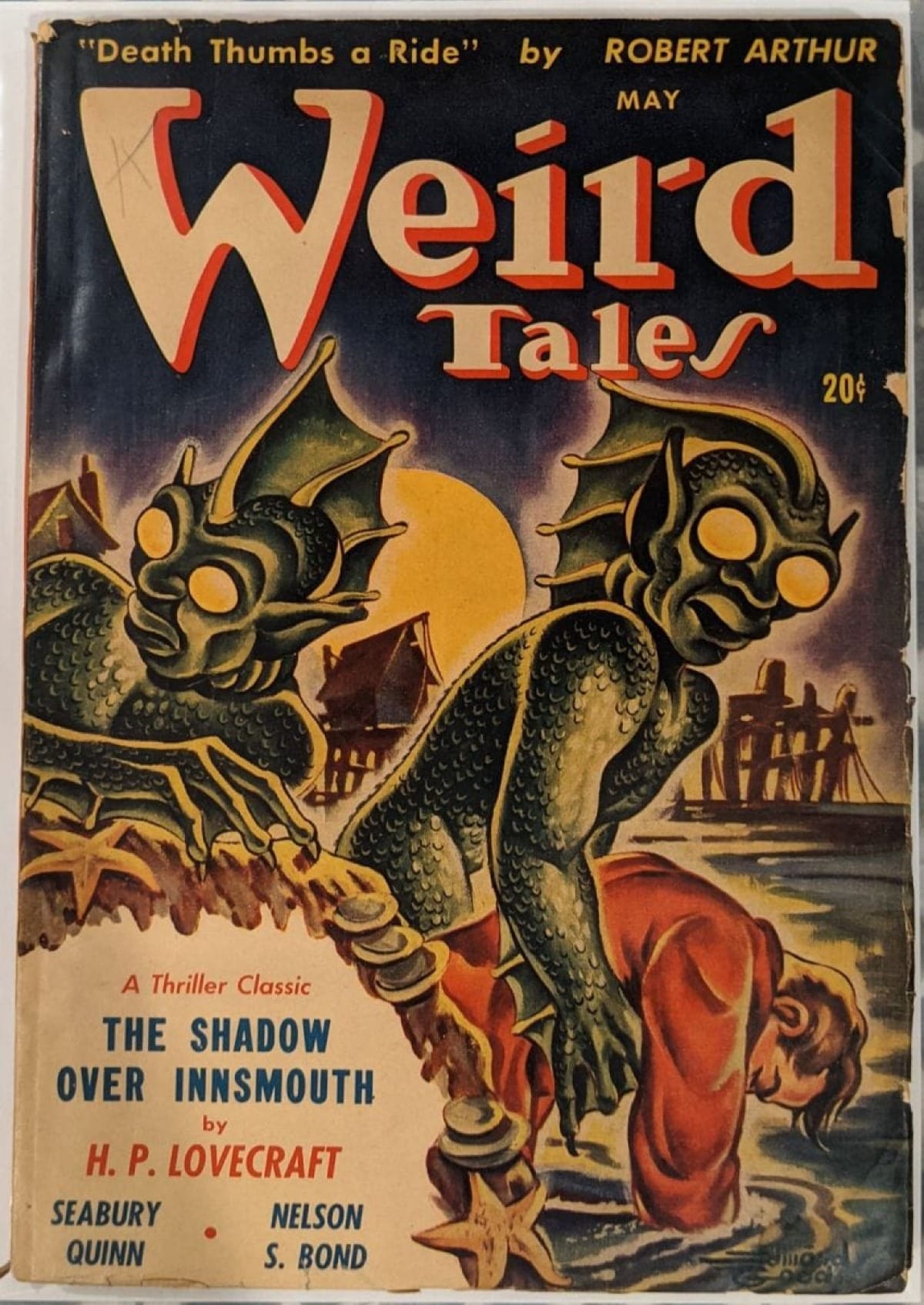
In the early 1920s, influenced by the protoweird authors, a group of writers from the pulp magazine Weird Tales, among whose signatures stood out those of H. P. Lovecraft, Robert Howard (a master of epic fantasy and weird fiction, creator of characters like Conan the Barbarian and Solomon Kane) and the writers known as “the Lovecraft circle” (Robert Bloch, Clark Ashton Smith, Frank Belknap Long, and August Derleth) began to shape classic weird fiction.
Haunted by the traumas of the post-war period, the Russian Revolution, the impact of economic crises, the influence of psychoanalysis, and the imminent rise of fascism, these pulp writers resorted to the fusion of genres as an aesthetic quest and explored new ways of narrating that moved away from the traditions of conventional gothic storytelling, giving rise to cosmic horror and materialist horror tales, where the ghost of the castle is replaced by primordial beings from other dimensions, archetypal gods, and alien races from remote regions of the universe that transcend space-time.
Haunted by the traumas of the post-war period, the Russian Revolution, the impact of economic crises, the influence of psychoanalysis, and the imminent rise of fascism, these pulp writers resorted to the fusion of genres as an aesthetic quest.
To narrate these stories, the writers of weird fiction had to alter the classical conception of the monster and the monstrous and introduced into their tales the idea of a non-human perception of temporality in pursuit of approaching the notion of deep time and highlighting the insignificance of humans against the vastness of the cosmos. The recovery of what philosopher Quentin Meillassoux calls ancestral (that is, all reality prior to the emergence of the human species, and even before any recorded form of life on Earth), the exploration of spaces of cyclopean architectures, and notions related to mathematics and physics (like non-Euclidean geometry or the fourth dimension) coexist with pagan rituals, esoteric cults, and underwater races fused with humans, thanks to the indiscriminate mixing of the imaginaries of horror and science fiction. Cosmic horror and the literary philosophy that Lovecraft dubbed cosmicism (whose fundamental premise is that the laws, interests, and common emotions of humans hold no validity or significance in the vast cosmos) stand out in this stage (something like the golden age of classic weird) that produced essential works like The Call of Cthulhu (1926), The Dunwich Horror (1928), or At the Mountains of Madness (1931) by H. P. Lovecraft, The Hounds of Tindalos (1929) by Frank Belknap Long, The Black Stone (1931) by Robert E. Howard, or The Star Vampire (1935) by Robert Bloch, to name just a few examples.
From 1930 until the late 20th century, weird fiction loses its relevance, partly due to the decline in popularity of pulp magazines and especially with the advent of the golden age of science fiction. From this moment on, the flame of the weird barely flickers, kept alive only by the works of authors like Ramsey Campbell (The Inhabitant of the Lake, 1964), Giorgio De Maria (The Twenty Days of Turin, 1975), Clive Barker (Books of Blood, 1984-1985), Thomas Ligotti (Noctuary, 1994), or M. John Harrison (The Course of the Heart, 1992).
But at the dawn of the new century, weird fiction makes a powerful comeback when the literary movement destined to be the spiritual successor of Lovecraft's circle decides to reclaim many of the characteristics of classic weird fiction, updating and adapting them to an urban, technological, and globalized context. The new weird takes the fusion of genres and formal experimentation a step further (drawing from both the old weird and the New Wave of 1960s science fiction), indiscriminately utilizing the aesthetic and literary tools of horror, science fiction, noir, urban fantasy, and 80s and 90s horror films to blur the lines between avant-garde literature and the pulp of Weird Tales, allowing cosmic horror to coexist with experimental fiction and enabling social critique to permeate dark fantasy, always in an organic manner.
Starting in 2000, some writers from this new wave of weird fiction begin to stand out, such as Michael Cisco (The Divinity Student, 1999), Mark Z. Danielewski (House of Leaves, 2000), China Miéville (Perdido Street Station, 2002), Kirsten Jane Bishop (The Etched City, 2006), Blake Butler (Ever, 2009), Jeff VanderMeer (Annihilation, 2014), Victor LaValle (The Ballad of Black Tom, 2016), Laird Barron (The Croning, 2012), or B. R. Yeager (Negative Space, 2020).
In parallel with the consolidation of the new weird, Lovecraft begins to gain relevance outside of pop culture and is increasingly taken seriously by critics and academia. With the exception of Michel Houellebecq (a pioneer who published his essay H. P. Lovecraft: Against the World, Against Life in 1991), at the dawn of the 21st century, cultural theorists and critics (Mark Fisher, Benjamin Noys), speculative realist philosophers (Graham Harman, Quentin Meillassoux, Reza Negarestani, Eugene Thacker), and dark enlightenment ideologists (Nick Land, Curtis Yarvin) write essays, biographies, literary analyses, and philosophical books centered on the work and figure of the most cited writer when discussing the influences of the new weird. A well-deserved reputation that no one in their right mind would dispute, though I would like to add a not-so-risky hypothesis: the new weird fiction originated from the influence of both Lovecraft's pulp and Borges's modernism, resulting in a literature that, with one foot in each zone, ultimately settled in the territory Fisher called pulp modernism.
I will argue with some examples: Perdido Street Station, a nouvelle by China Miéville considered one of the inaugural works of the new weird (which in its original edition featured a foreword by M. John Harrison titled “China Miéville and the new weird,” likely one of the first mentions of “new weird fiction” to refer to this type of literature) is a direct continuation of Borges and Margarita Guerrero's story Animals of the Mirrors (Manual of Fantastic Zoology, 1957); a literary sequel, if you will, that reclaims the Borgesian mythology and characters and expands their story into a post-apocalyptic and weird narrative.
The new weird fiction originated from the influence of both Lovecraft's pulp and Borges's modernism, resulting in a literature that ultimately settled in the territory Fisher called pulp modernism.
Tlön, Uqbar, Orbis Tertius (Ficciones, 1944), due to its narrative procedures, ideas, and themes, becomes a powerful influence for writers of the new weird fiction. Tlön is the story of a fortuitous discovery and the invasion of a fictional world into reality. In this story, all of Borges's obsessions are condensed into fiction: his aversion to mirrors and his obsession with labyrinths and libraries; heresiarchs, anomalous objects – like the small, incredibly heavy metal cone comparable to the coin in The Zahir (1949) or the disk of Odin from The Disk (1975) – apocryphal texts, copies, metafiction – which connects it to other texts like The Theologians (1949) or The Abominable Mirrors (1935) – and fictions that invade the real world.
Some writers linked to the new weird fiction directly conceived their own version of Tlön: M. John Harrison wrote Egnaro in 1981, a story that narrates the search of two friends for a place that may or may not exist, a conspiracy that obsesses the protagonists. Grant Morrison, for his part, imagined a Borgesian world-city for his weird comic Doom Patrol, a fictional space called Orqwith that escaped from an unnamed black book to invade and devour reality. John Carpenter plays with the idea of a fiction that invades reality in In the Mouth of Madness (1994), his most Lovecraftian film, and therefore the most weird. The notion of a fiction that becomes real and invades our world will be taken up by Nick Land and the Cybernetic Culture Research Unit (CCRU) at the University of Warwick, coining the term hyperstition. House of Leaves by Danielewski is both one of the best weird novels of the 21st century and one of the most powerful examples of the influence of both Borges and Lovecraft on strange fiction. It is a cult object-labyrinth book with an experimental layout, a metafictional exercise featuring a house with an architectural aberration that generates hallways with diverging paths, infinite labyrinths, and an ineffable monster akin to a Minotaur that inhabits those anomalous and fantastic spaces.
The suspicion is great: if we examine one by one the works of the most representative writers of the new weird, we will find traces of Borgesian narrative procedures in all of them.
I tend to think that Latin American weird fiction is neither “old” nor “new,” but simply “strange fiction.” In this region of the world, we have a long tradition in fantastic literature, but until the early 2000s, very few works could be called weird: The Immortal (1947) and There Are More Things (1975) by Borges, Report on the Blind (1961) by Ernesto Sabato, The One Who Lurks in the Rain (1963) by the Chilean Hugo Correa, and that’s about it. Our strange fiction draws from both the old weird of the early 20th century, the New Wave of 1960s science fiction, Anglo-Saxon new weird literature, Borgesian modernism, cinema, music, and video games, incorporating into its blend of subgenres cyberpunk and body horror, as well as saints, popular myths, and a certain magical-religious component, that is, a paganism that returns with strength as in the beginnings of weird fiction.
Perhaps its germ can be found in a novel phenomenon that began to emerge around the year 2000 when a kind of late cyberpunk arose in Latin America that distanced itself from the classic science fiction of publishers like Minotauro and specialized magazines like Más allá, El péndulo, or Próxima, but also strayed from the cyberpunk of predecessors like the Mexican Gerardo Horacio Porcayo (The First Street of Solitude, 1993) or the Argentinians Rafael Bini (The Revenge of Killing, 1992) and Rubén Mira (Guerrilleros. A Sea Exit for Bolivia, 1994).
This neocyberpunk (with a Latin 'i') promotes fusion with the weird, body horror, paganism, and the supernatural under the influence of novels like Luz (2003) by M. John Harrison, but especially inspired by Count Zero (1986), the second installment of William Gibson's Sprawl Trilogy. In Count Zero, Gibson makes a decisive move: he introduces into the net artificial intelligences that simulate being deities of the voodoo religion, such as Baron Samedi or Dambala: Afro-Caribbean gods within cyberspace.
Twenty years later, cyberpunk novels like Ygdrasil (2005) by the Chilean Jorge Baradit, Iris (2014) by the Bolivian Edmundo Paz Soldán, The Maid of Omicunlé (2015) by the Dominican Rita Indiana, Habana Underguater (2021) by the Cuban Erick Mota, and Materials for a Nightmare (2021) by the Argentine Juan Mattio will revisit that Gibsonian idea to reinvent the subgenre and establish a kind of ritualistic cyberpunk where the link between the technological and the spiritual is no longer a mere artifice, and cyberspace is presented as a place where spirits, deities, and hackers can achieve not only an internet connection but also a link to the beyond, to the gods, and to the dead.
Starting in 2000, a kind of late cyberpunk emerges in Latin America that distances itself from the classic science fiction of publishers like Minotauro and specialized magazines like Más allá, El péndulo, or Próxima, but also strays from the cyberpunk of predecessors.
Body horror also seeps into the interstices of neocyberpunk under the influence of works like Hellraiser and Clive Barker's Books of Blood, or the new flesh of David Cronenberg's cinema. Ygdrasil, The Second Mother Tongue (Flor Canosa, 2021), Magic in the Age of Its Technical Reproducibility (Hank T. Cohen, 2024), or the stories from the anthology Perfect Parasites (2021) by Luis Carlos Barragán introduce concepts such as extreme pain and bodily mutilation into their plots to connect with the machinic, but also with the divine and even with hell. From these ideas, Latin American strange fiction begins to take shape, a literature in constant construction and expansion that blurs genres and dissolves those categorizations that once seemed so clear; fiction of folds, interstitial, political, and in many cases experimental.
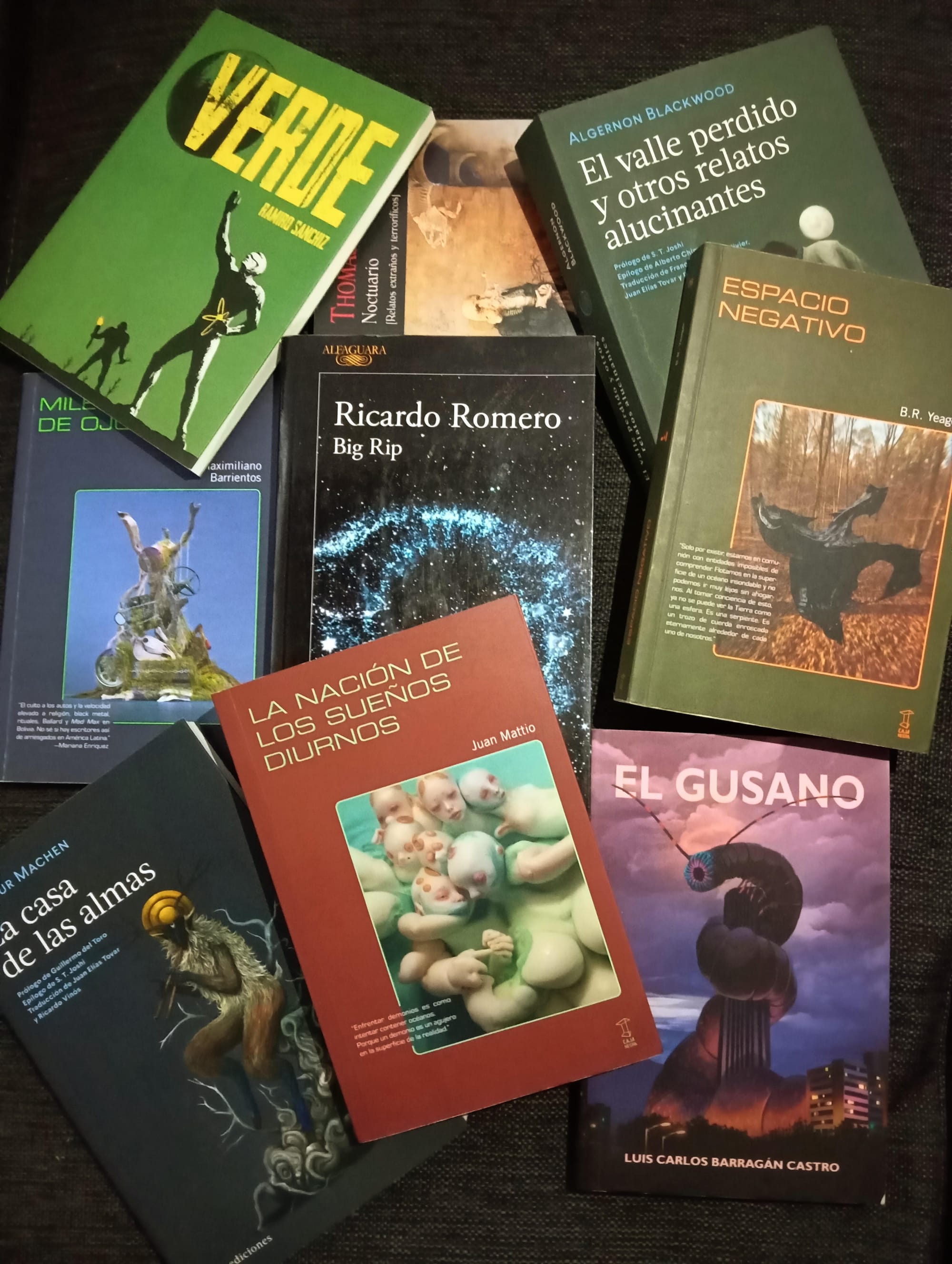
Green (2016) by Ramiro Sanchiz, The Worm (2018) by Luis Barragán, and Thousands of Eyes (2021) by Maximiliano Barrientos (three paradigmatic and initiatory works) may be the first purely weird Latin American novels of the 21st century; books where body horror is taken to its paroxysm through the fusion of bodies, machines, and plants, and Lovecraftian cosmic horror manifests in cults seeking to awaken an ancient and destructive deity from another plane of reality, in the advent of a giant worm, or in contact with an indescribable being that sickens and drives mad those who behold it.
Now that what we might call Latin American strange fiction is consolidated, other weird novels are published such as The Shadow of the Whales (Cynthia Matayoshi, 2019), The Mabuya Pit (Erick Mota, 2022), A Provincial Pianist (Sanchiz, 2022), The Infinite Series (Farrés, 2022), God Sleeps in the Stone (Mike Wilson, 2023), or The Absolute Dimensions (Rodrigo Bastidas, 2025), whose common elements are the apocalyptic or (post-apocalyptic) context in which some of these stories unfold or culminate, the exploration of a non-human time, and the connection with a strange, broken, or incomprehensible nature for the ephemeral and insignificant human being.
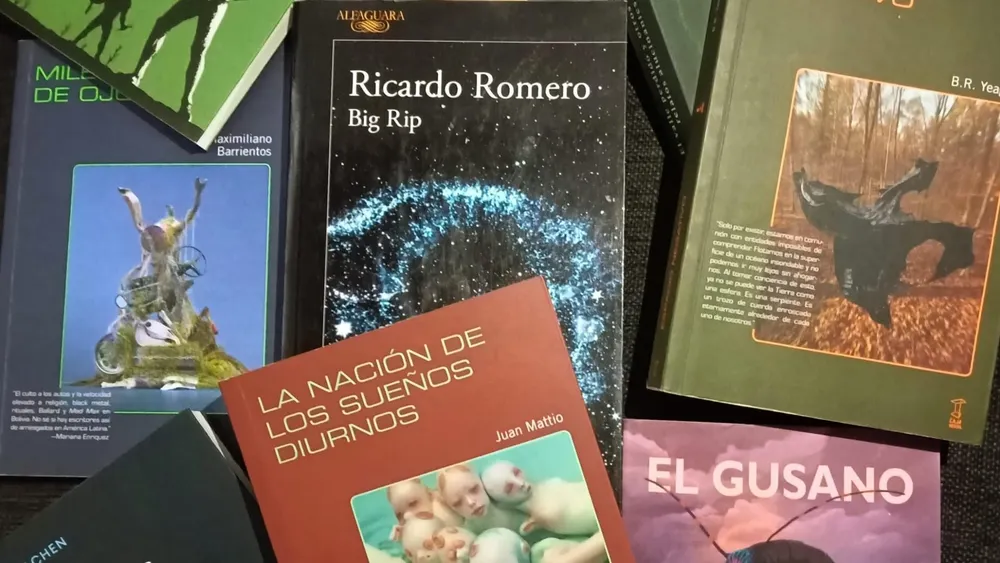
In our country, the trio of most important strange fiction novels (and I dare say of Argentine literature in general over the last ten years) consists of Big Rip (Ricardo Romero, 2021), If You Felt the Greater Structures Beneath Your Feet (Roberto Chuit Roganovich, 2025), and the recently published The Nation of Daydreams by Juan Mattio. While all three narrate the inexorable advance toward an apocalypse, a total paradigm shift resulting from some breach in space-time or a fracture in the veil of reality, along with everything that enters through that crack (accelerated entropy, a hybrid organism - Bionte, fictions that become real) and approach strange fiction from formal experimentation or non-linear narrative, each has a particular take on the weird: Romero plays with cosmological hypotheses and the deformation of space-time (Fisher said a black hole is weirder than a vampire), Roganovich recovers protoweird and the folk horror of Arthur Machen, flirts with Victorian gothic and revitalizes the concept of the sublime, and Juan Mattio unleashes digital, esoteric, and literary forces that destroy the old reality in ways that had not yet been conceived.
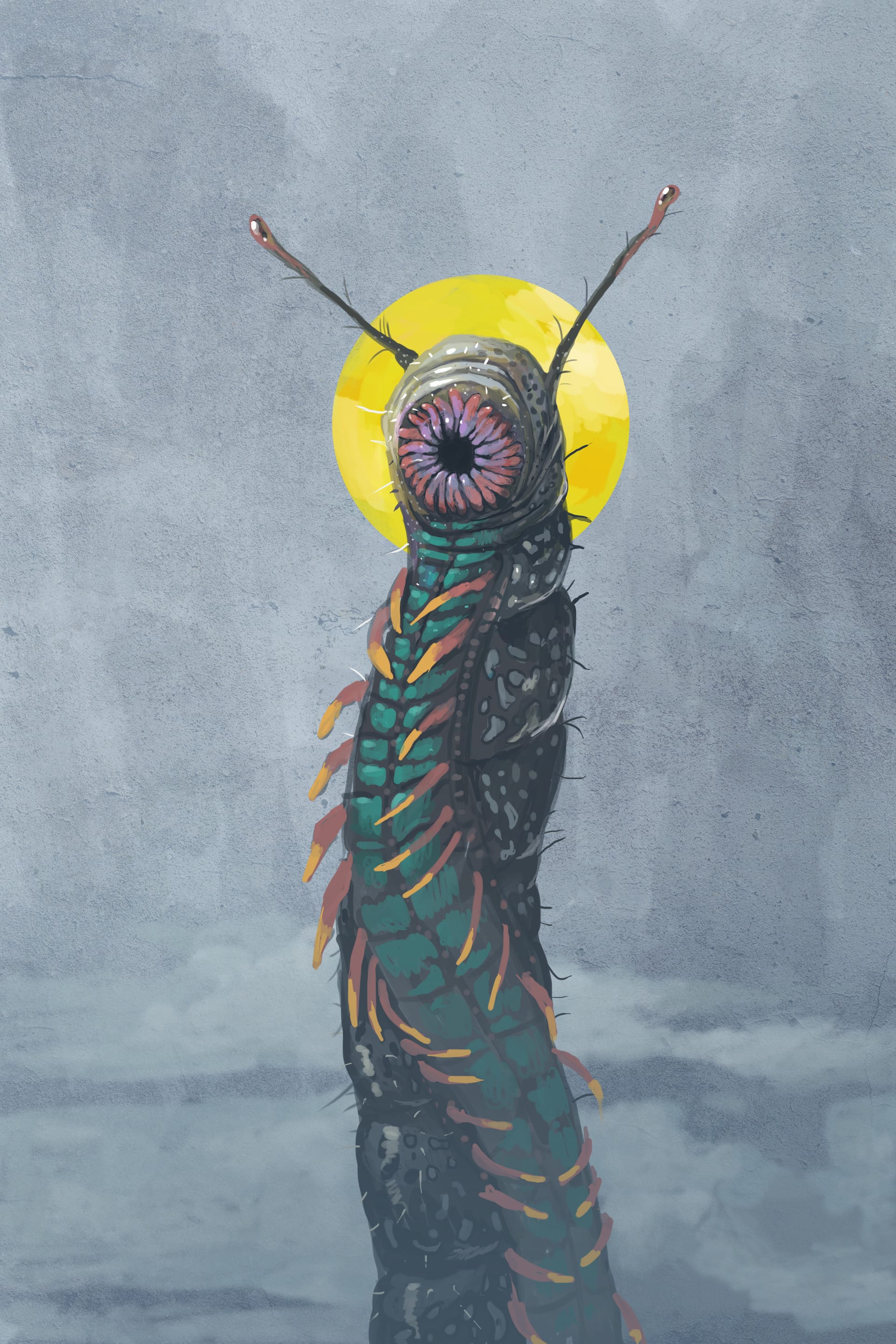
The nation of daydreams is, to date, not only the most ambitious novel of Argentine weird fiction, but also one of the most ambitious in all Spanish-language weird fiction.
Mattio proposes a cybernetic weird where the combination of advanced algorithms, generative AI software, and impossible esoteric events pierce the fabric of reality, creating a rift through which entities made of hyperstitional matter—that is, duplicated objects and bodies, egregores, strange beings born from imagination, memories, and hype—enter. This intrusion of inexplicable anomalies weakens ontological structures, fractures time, and forces a radical transformation in the perception of the real. Human categories no longer suffice to understand this new world that is emerging, giving rise to concepts like strange mathematics or geometric specters. And while the Old Reality dies and the new one takes its time to be born, the Borgesian monsters known as hrönir appear.
Mattio's narrative moves through cracks, merging genres without falling in love with any particular one, carving a path through the intersection of theory and fiction, employing different registers and metaliterary resources to create a complex literary artifact that is simultaneously pop. His aim seems to be the estrangement not only of what he tells but also of how he tells it, utilizing a non-linear narrative structure and systematic estrangement. The result is a dense, powerful, dreamlike work that shifts from the cold medical report to poetic prose, from academic rigor to the wildest fantasy, from technical language to a psychedelic ramble. In other words: it represents the next level in Latin American weird fiction.
Mattio's narrative moves through cracks, merging genres without falling in love with any particular one, carving a path through the intersection of theory and fiction, employing different registers and metaliterary resources.
The nation of daydreams is a vanguard and modernist pulp novel that does not seek to hide its influences (on the contrary, it displays them proudly), ranging from the Argentine literary tradition to classic weird, passing through the new weird, the New Wave of science fiction, and the more experimental writings of the CCRU, the theory-fiction of Nick Land, William Burroughs, and Reza Negarestani, the J.G. Ballard of The Atrocity Exhibition (1970), the tales of Borges, the speculative and critical work of Ricardo Piglia, or The Dreams in the Witch House (1933) of late Lovecraft, which deconstructs the cosmic horror he himself created by introducing the (at that time) nascent notions of quantum physics and non-Euclidean geometry to mix them with mysticism and ancient folklore in search of a counterpoint between science and myth, between popular knowledge and scientific understanding. But the myths that interest Mattio to revisit are not those of popular knowledge or folklore, but those of Argentine literature (the desert as the territory of the birth of our narrative, Borges' paranoid fictions), those of theory-fiction (the hyperstition, water as a telluric lubricant), and those of cybernetics (the advent of strong AI, the theory of dead internet).
We live in a present where, according to what is believed in the internet forums, Donald Trump reached the White House thanks to memetic magic; Palantir Technologies (the Artificial Intelligence and Big Data analysis company of a techno-feudalist that believes it is fighting the Antichrist) is used by the army and Israeli intelligence agencies to carry out a “televised” genocide in Palestine, and the Argentine president communicates with his dead dog, which he claims to have known in another life inside the Roman Coliseum and was cloned in 2018 by a company called PerPETuate. In this context, Juan Mattio chooses to narrate from a weird sensibility and the field of formal experimentation a story that speaks of digital demons, technological and esoteric forces, aberrant cities, apocalyptic futures, the dead zone of the internet dominating the world, and the ontological fragility of the real in a fictional universe where the first hrön that enters the Old Reality is, coincidentally, a dead dog, “a body made of unreality with nothing about it that could be called organic.”
The nation of daydreams marks a before and after in Latin American weird fiction, the origin of a new paradigm. What Luis Barragán, Ricardo Romero, and Roberto Chuit Roganovich began (the deconstruction of the weird) Juan Mattio perhaps takes to its ultimate consequences, its event horizon, setting the bar very high for anyone who wants to write weird in Spanish from here on out, which raises some final questions for me: What will writers do in the face of this challenge? Will they pass under the bar or manage to raise it even higher? Is what follows the decline of Latin American weird fiction or its evolution into an even higher literary stage? A new book by Luis Barragán is about to be published in Colombia by the Vestigio publishing house, and I suspect that within its pages we may begin to glimpse a possible answer to these questions.
Y a cada colaborador se le paga por su trabajo. Las dos cosas dependen de los suscriptores.