Arcane: The Series That Improves the League of Legends Universe
Arcane reinvented LoL with dazzling animation, politics, ethics and a far deeper story.

Arcane reinvented LoL with dazzling animation, politics, ethics and a far deeper story.
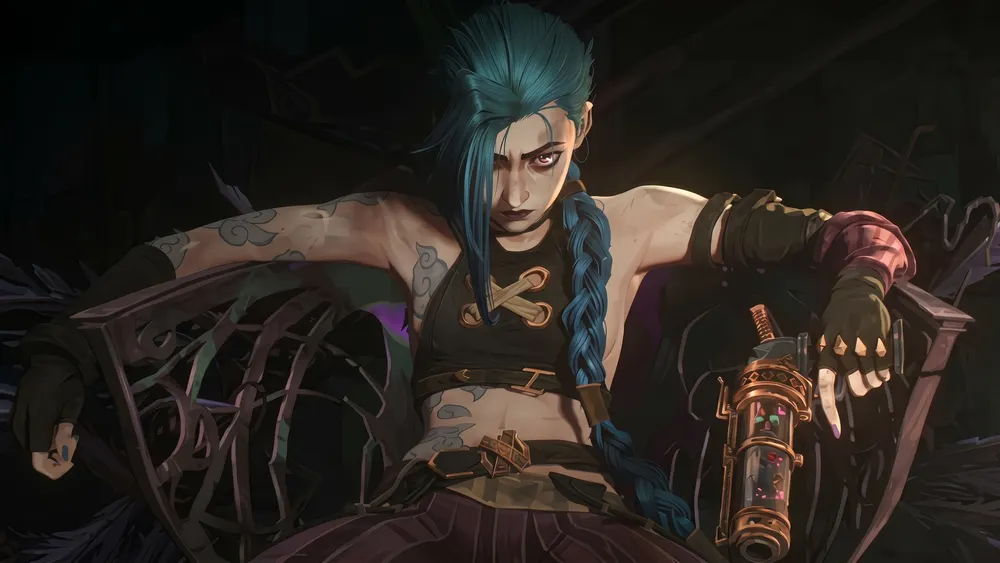
It's time to talk about the Arcane phenomenon: What's it about? Why has it earned a must-see spot in our era? And one more question: what's the deal with its philosophical and political undercurrent in relation to our times? But before answering that we have to get into the source material of the universe the series proposes: we're talking about the mythical, beloved and hated League of Legends.
If you lived through your preteen or teenage years in the 2010s, you surely went through an event that had the power to define your future, the moment someone asked you: hey, wanna hop on a round of LoL? Out of that question there are two kinds of people: those of us who managed to escape such a fate after playing a few matches and never getting hooked, and those who were co-opted FOREVER.
It's time to talk about the Arcane phenomenon: What's it about? Why has it earned a must-see spot in our era?
League of Legends landed in this world in October 2009, developed by Riot Games. Its creators, Brandon Beck and Marc Merrill, drew inspiration from the Defense of the Ancients (DotA) map from Warcraft III. LoL is a free-to-play multiplayer online battle arena game, meaning a free game where you fight simultaneously against a bunch of people in an arena. Well, not so free: some say you pay with your soul. The dynamic is simple: you pick a champion who becomes your playable character and you form a team with other players, you play 5 vs. 5 and the goal is to advance through the arena until you destroy the enemy's base. There are currently more than 170 champions to play.
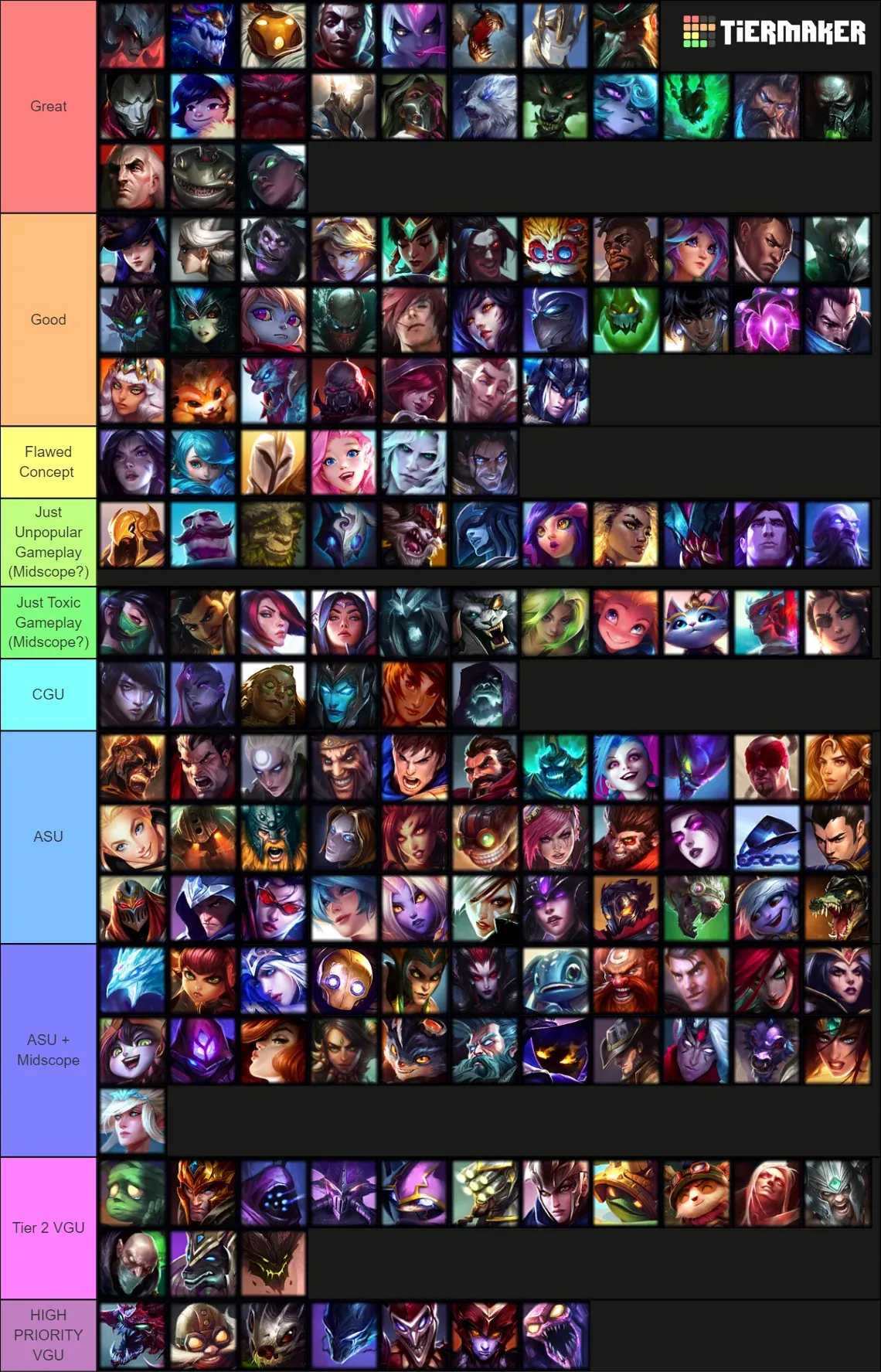
How important is LoL? If you've spent the last few years living under a rock, you should know that, along with Minecraft, Fortnite and Counter Strike, LoL is one of the biggest collective experiences for PC players in the world. The estimated record for simultaneous players was set in February 2022 with 14 million people playing at the same time. Absolutely all of us know at least one League of Legends player. This game also has a high level of professionalization, being the most important eSport of them all. There's a huge base of pro players, leagues in almost every country in the world, a very consolidated competitive ecosystem and, on top of that, the all-time record for simultaneous viewers at a video game tournament: the League of Legends World Championship final (Worlds 2024) hit a peak of 6.94 million viewers (not counting Chinese streaming platforms). Despite that massiveness, simply identifying as a LoL player during the 2010s was a direct sentence to ostracism. But things changed.
On October 15, 2019, on the tenth anniversary of the game's release, Riot Games announced the development of an animated series about two emblematic playable characters. Something that at the time generated high expectations as well as plenty of detractors, because there are always skeptics when it comes to audiovisual adaptations of video games, though that distrust has solid historical and empirical justifications.
When you adapt something from source material with millions of rabid fans you can either screw up monumentally and unleash torrents of hate poured into millions of posts across every social network, letter bombs and threats to your relatives, or do things RIGHT. And that was a big risk, since the LoL community is not one of the most peaceful ones.
Another challenge when developing a series about this game was the canon material: LoL “doesn't have” a story as such, because while its world exists and each character has their dialogue lines (among them the odd one that might hint at some particular relationship with another character, careful, there are spoilers here) and a chart explaining a bit about their origins, none of these are elements that condition gameplay. And as I mentioned before, there are more than 170 playable characters in this game. Another problem was striking a narrative balance where a veteran player could enjoy the references to the universe, but a casual viewer who had never played could also understand what they were watching.
Luckily Arcane was an overwhelming success, but why?
Arcane is a French-American animated adventure and drama series that spectacularly combines fantastical science fiction, steampunk and transhumanism. Its artistic style is simply a marvelous proposition: it works 3D animation over backgrounds that look like hand-painted canvases with a marked Art Nouveau and Art Deco inspiration.
The animation studio in charge of producing Arcane was Fortiche Production. This studio was a small company that occasionally collaborated on graphics and audiovisual content for Riot Games until the time came to put the series together. Developing Arcane took around 6 years; Fortiche revealed that the animation process was so detailed and meticulous that an animator could take an entire day to complete barely half a second of footage. It wasn't released all at once: each season was split into three acts of three episodes each, aired over consecutive weeks, in November 2021 for the first installment and November 2024 for the second.
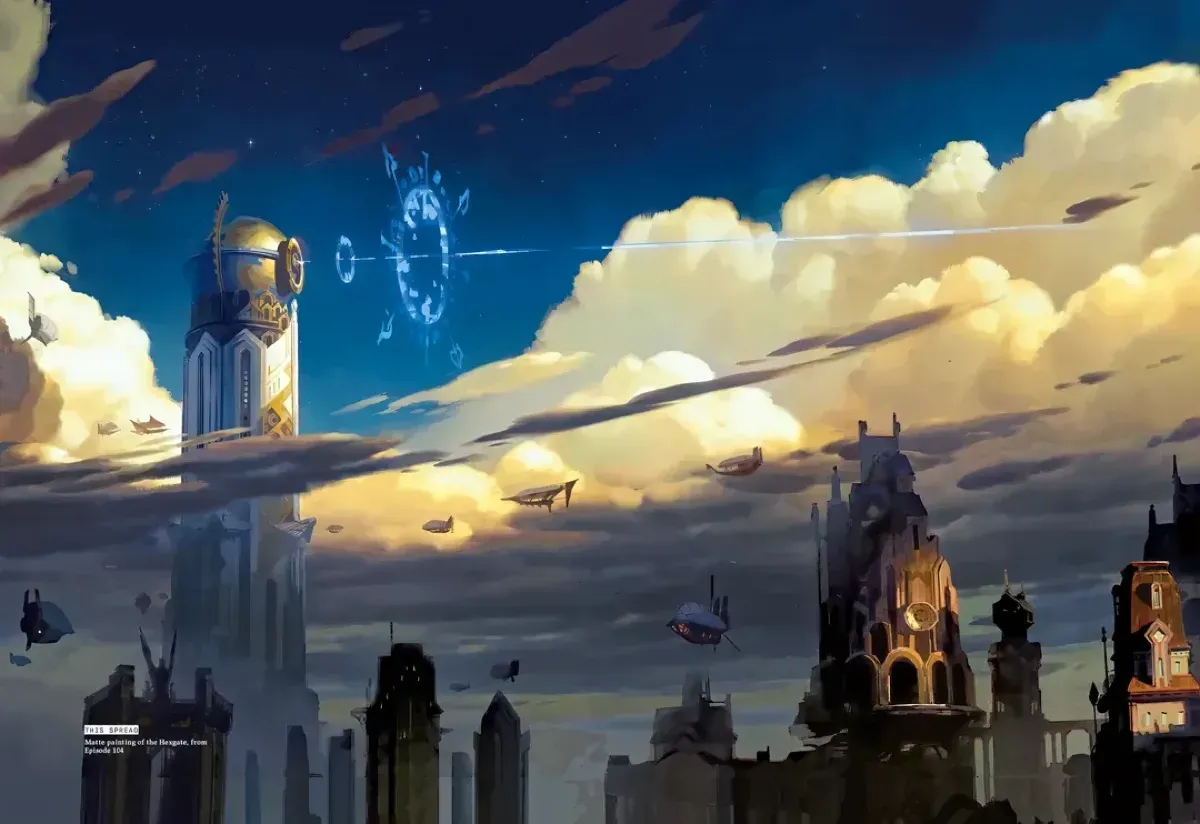
The series' aesthetic worldbuilding takes us back to the 19th-century Industrial Revolution and the Victorian era, that is, the early days and consequences of capitalism consolidated as a socio-economic model. The architecture in the series is also used as narrative support, besides being a huge visual delight. You might have to watch it a couple of times to catch every detail, especially if you're a pain in the ass (like yours truly).
So what is Arcane about? We follow the lives of two sisters (playable characters) called Powder and Vi who live in the warring cities of Piltover and Zaun. We can split the series' narrative into three axes: the problems of inequality and power, the duality of magic and technology, and the debate over the ethical limits of transhumanism.
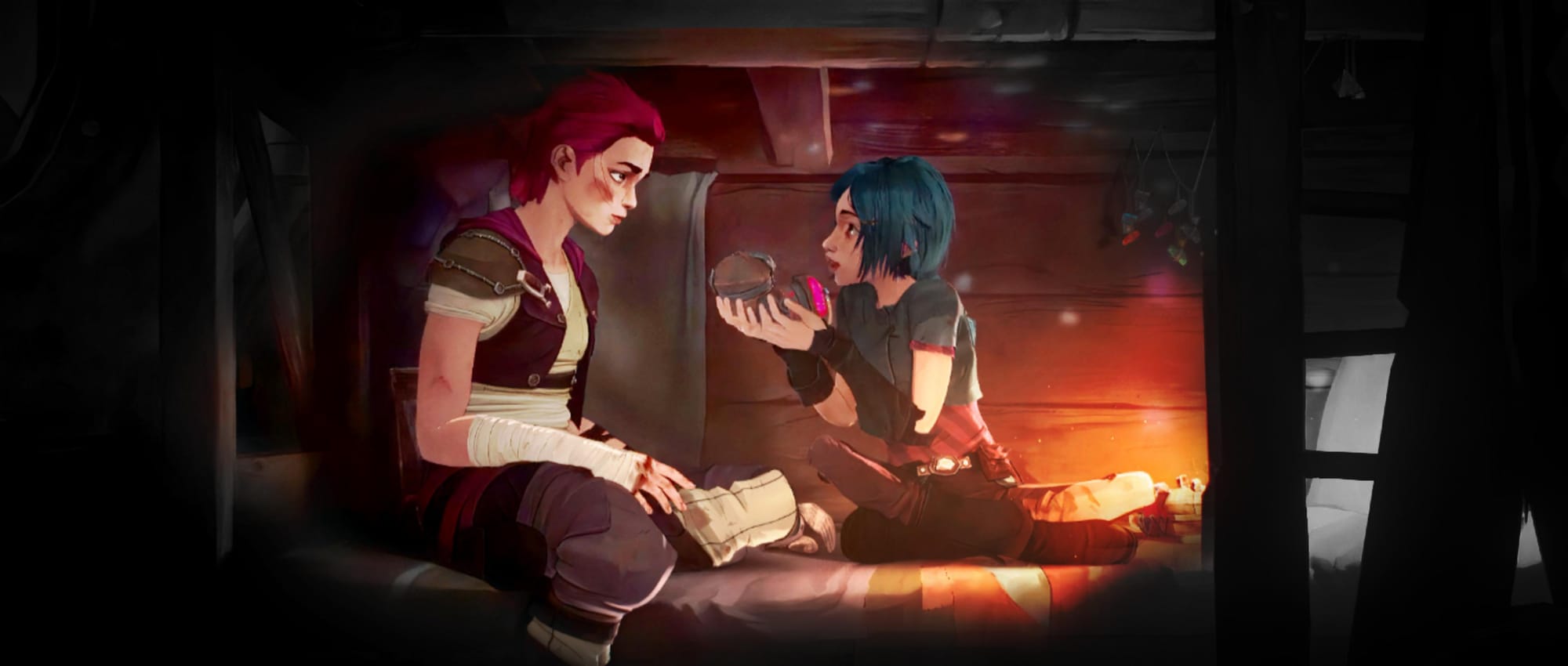
Arcane falls within the dystopian steampunk genre, because technological progress in this world leads to disastrous consequences for the community. Arcane's sociopolitical proposition is radical and it tells us a story of systemic inequality: one city that condemns the other to live under a constant yoke, which leads to inexorable and violent civil wars that never stop.
Piltover is a prosperous city, known for its academy and scientific advances, while Zaun, its underground counterpart, is marked by poverty, crime and chemical pollution. Zaun has no transparently organized central authority, just a fragile social balance sustained in large part by Piltover's military intervention. This inequality shapes the subjectivities of its inhabitants to the point that the cities run right over their lives, their longings and their destinies. Arcane is beautiful and cruel, it even plays with the “what if?” trope: What if we had built the future some other way? What if our luck had been different?
This inequality shapes the subjectivities of its inhabitants to the point that the cities run right over their lives, their longings and their destinies.
Something else worth highlighting about this dystopia is that the inequality laid out in Arcane isn't grounded in things like racism and sex/gender discrimination; instead it sidesteps that barrier, and possibly thanks to that decision it can build very interesting characters, like the odd fascist lesbian whom nobody discriminates against for being a lesbian (or for being a fascist).
As for the magic-and-science duality, Arcane's plot centers on the development of a new technology called Hextech and its consequences. These advances are driven by two other characters who build one of the deepest relationships in the series: Jayce and Viktor (also LoL playable characters, though Viktor was built around the series). Magic in Arcane is called the Arcane, a hidden power considered extremely dangerous, but which is at the same time the creative force of the world's nature. There are those who are touched by the Arcane, which lets them channel this power naturally, but for everyone else getting close to it turns out to be destructive. Jayce and Viktor manage to master this magical energy through science, creating the Hextech crystals, but that manipulation becomes their doom. Arcane takes us into a conflict generated by the instrumentalization of mystical forces after turning them into a technological, political and military resource.
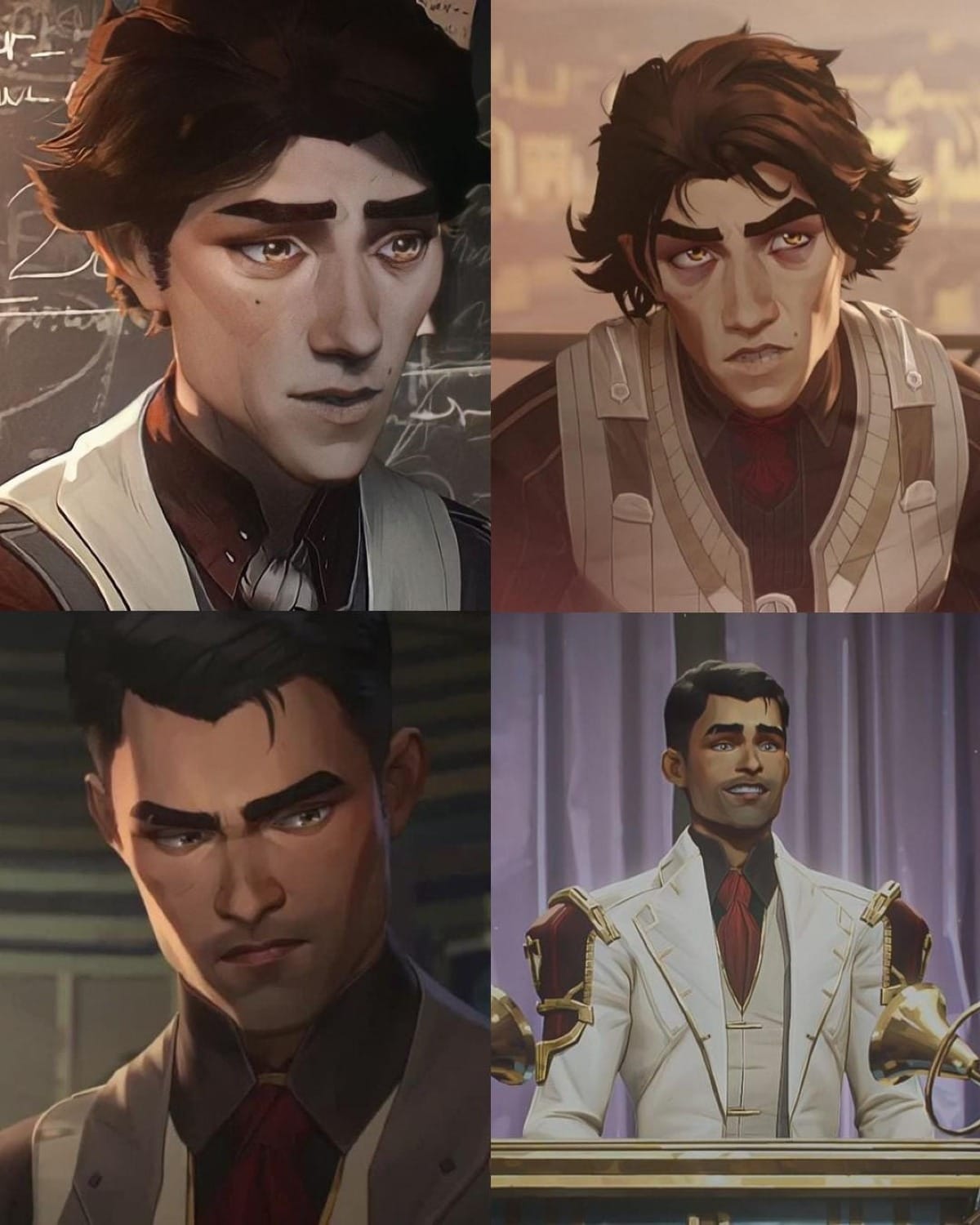
The series also tackles the problem of technological singularity, when Hextech stops being a simple scientific tool and becomes an entity capable of learning and self-improvement that seeks to return to the organic, causing huge problems. It's a story about how technological optimism can lead to a self-induced apocalypse, especially when it's shot through with hostilities that cloud and corrupt it. Though it also offers light by presenting characters who look for a resolution despite their conflicts, characters who pick up the scraps tossed at them from the sidewalk of progress in order to build a tomorrow in spite of and against everything.
But every decision made in the face of these obstacles hurts. In each Arcane character the psychological conflict manifests differently, bringing a lot of nuance to the plot. The final arc of this story has a markedly transhumanist spirit: throughout the whole plot, faced with the fragility of the human body and the injustices of the flesh, several characters seek to overcome human limits at any cost, first with drugs, then with prosthetics, implants and mutations, and later by attempting to do away with suffering once and for all. But I don't want to spoil any more.
We don't know whether Arcane's ending amounts to a horizon that transcends things or to conformist escapism; there are people who even accuse it of being a revolutionary proposition that ends up falling into naive centrism. No clue, I loved it (I've still got things to argue about). But it strikes me as almost nonsensical, a miracle and above all a tremendous piece of work that Arcane's audiovisual proposition was born out of the much-maligned LoL, a game that had (and has) millions of detractors around the world and also a horde of fans ready to murder you if you interrupted them during a ranked match.
In an era where everything is pure slop, readaptations, remakes and so on, Arcane brought a ton of freshness in narrative, animation, writing, character building and worldbuilding.
It's an adaptation created with a lot of love and respect for those fans, so much so that writers Christian Linke and Alex Yee interacted with the show's followers and LoL players via Reddit to ask them about the decisions they were making. In an era where everything is pure slop, readaptations, remakes and so on, Arcane brought a ton of freshness in narrative, animation, writing, character building and worldbuilding. A production created out of passion and talent by a handful of lunatics who love what they do. Every minute on screen is worth it; I'd even say 18 episodes aren't enough. It's a must-see of our time. Luckily, expansions of the universe are in development as standalone stories, but there are no confirmed release dates yet.
To close, let me answer a very important question: do you have to be Diamond in LoL to watch Arcane? The answer is NO, so if you haven't seen it, go watch it right now, and if you already have, I'm waiting for you so we can fight about it.
It would have been really hard to write this piece without the advice of my trainer Lucas from PowerGym: thanks for turning something as boring as working out into a safe haven for a freak. And thanks to Juan, Facu and Agus for the endless marathons of shows and movies.
Y a cada colaborador se le paga por su trabajo. Las dos cosas dependen de los suscriptores.