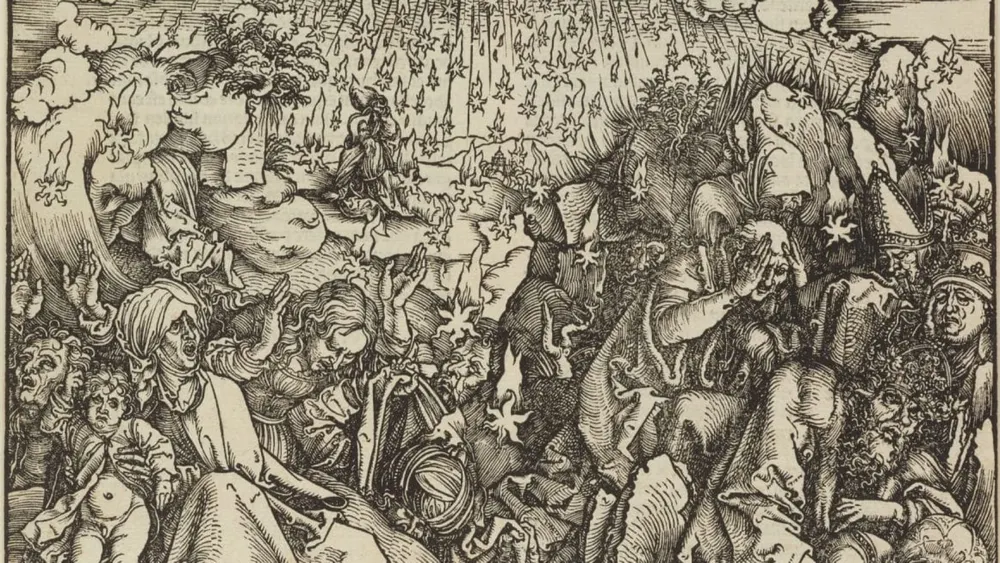
Atheist, nihilist? It doesn't matter: your political mindset is shaped by the biblical apocalypse. How fiction and the desire for a “meaningful” ending shape our reality. Do you spend your life waiting for the end to come? Find out why.
It doesn't matter if you're a practicing Christian, a non-practicing one, a fervent atheist, an agnostic, vaguely superstitious, a pastafarian, a cultivator of vitalist nihilism, or a devotee of Gilda, your political imagination is deeply influenced and largely shaped by the narrative power of the biblical apocalypse.
The foundational thesis that allows me to argue this was proposed by Canadian literary critic Northrop Frye, who claims that biblical figures and narrative structures forged a mythological universe in which Western literature has developed to this day. Frye is not the only one who believes this, but he is the one who most explicitly articulated it in his study of the Bible, called “The Great Code.” Another important work to support this thesis is “Mimesis: The Representation of Reality in Western Literature,” by the Marxist critic Erich Auerbach, which develops the history of literary realism based on biblical narrative models. The conclusion is that realistic writing, which was the paradigm in the 19th century for representing reality supposedly free of artifice or fantasy, is the late fruit of a long process of developing narrative techniques based on the ways of using language, metaphors, and treatments of temporality from the Old and New Testaments. In summary, the conclusion is that our way of telling stories is encoded by biblical writing, and the narratives through which we organize political imagination are not exempt from this at all.
Our way of telling stories is encoded by biblical writing, and the narratives through which we organize political imagination are not exempt from this at all.
The biblical apocalyptic imagery present in contemporary politics is sometimes explicit (see Juan Ruocco's analysis of QAnon's millenarianism) and, more generally, biblical figures continue to be rewritten in narrative pieces that seem more distant, like Terminator. Here, I want to delve deeper into this line, noting that even where it is not as evident as with the Trumpist loudmouths, the apocalypse continues to operate as a deep structure of political imagination.
A little theory of fiction doesn't hurt anyone
The elephant in the room is that we are operating in a register that allows us to talk about the Bible, the Capitol riot, Terminator, and Flaubert's realism on the same plane. This can generate anxiety for those who want to maintain an untainted sense of reality, which would force me to constantly differentiate between “serious” politics, religion (oh no; suspicion of obscurantism), or “mere” fiction. I'm not going to do that.
This collapse of registers is one of the things that particularly interests me about 421 and why I'm happy to be putting this note together, because it happens all the time here and it's all chill. The fictional constitution of reality was recently thematized in an excellent piece by Dante Sabatto on hyperstitions, so I will try to deepen the concept of “fiction” that I'm using from there. I want to rescue a strong notion of “fiction” that does not oppose the real or the sacred, but rather includes them. Fiction as ficto, something constructed with these materials we have to make sense of the world, which are words, and their many ways of combining them.
And to dispel the ghost that looms largest at this point: “So, you scruffy postmodern idealist, are you saying that reality doesn't exist and that everything is fiction?” Well, let's say yes. It's not that I'm so stupid as to believe that if I spill the hot water from the mate I'm drinking on my hand, it won't hurt because reality doesn't exist. But I'm convinced that when I try to tell you how I burned myself like an idiot, I'm going to do it with verbal structures where there are thousands of options, and that the narrative, no matter how true it is, will not be any less ficto.
A strong theory of fiction is perfectly compatible with a healthy everyday realism and a materialist ontology. We just have to consider that in addition to having a world and being in the world, we seek to say something meaningful about it, and to do so we use the tools we've built, which are verbal structures, and that these verbal structures develop historically, influencing each other and mixing. Thus, for example, Hayden White demonstrated that the works of historians use archetypes of tragic, comic, romantic, or ironic plots, and that this choice, whether conscious or not, of narrative forms modifies the ideological implications of the work. Or, as Karl Löwith pointed out, the philosophies of history in modernity, which left us with such important notions as “progress,” are based on the model of Christian providence. If we take what has already been said about how Auerbach shows the processes of narrative development that led to realism, a style that has the audacity to present itself as a transparent access to the world, we can see that even when we cling to the most austere realistic register, we are using fictional techniques to create a notion of the real.
Well, dude, when are you going to talk about the apocalypse?
The word “apocalypse” encompasses at least two meanings. In the first translation of the Hebrew Bible into Greek, called the Septuagint, “apokalupsis” appears for the Hebrew word “gala.” The word “gala” appears more than a hundred times in the Hebrew Bible with a semantic spectrum of uncovering something, unveiling, revealing. It almost always appears in contexts where what is discovered is someone's veil to whisper a secret to them, or to reveal some part of the body, for example in Genesis 9:20-21.
Noah, a farmer, began to cultivate the ground and planted a vineyard. He drank from the wine and became drunk, and lay uncovered in his tent.
“Gala” in that passage appeared for an “uncovered” that we could well translate as “naked.” In the translation of the Septuagint, that sense combines with the Greek metaphor par excellence for truth: the unveiling, aletheia, a word formed from the Greek verb “lanthano,” to be hidden, and the privation “a.” Even today, which annoys many who want language to express the “true” without rhetorical ambiguities, it is very difficult to define “truth” without metaphors from that side. Truth is something that comes to light, that is revealed, that must be clarified, something that illuminates. Our concept of “truth” depends on the visual metaphor of the hidden/dark against the uncovered/illuminated.
“Apocalypse” brings together the meanings we use daily: narrative closure, an ending with gunfire, chaos, and cosha golda, but also the resurgence of something better, a significant revelation.
All this helps us understand that the title of the last book of the New Testament, the “Apocalypse of John,” can be perfectly translated as the “Revelation of John.” As a prophetic vision, it is an unveiling of the meaning of everything that has happened until then, a revelation of the ultimate truth of the times.
Blessed is the one who reads, and those who hear the words of this prophecy, and observe the things written in it, for the time is near (Revelation 1:3)
And now, indeed, “apocalypse” brings together the meanings we use daily: narrative closure, an ending with gunfire, chaos, and cosha golda, but also the resurgence of something better, a significant revelation.
A very nice thing is that from this union of concepts Greek with the super update that Christianity gives to Hebrew mythology, our concept of “crisis” also emerges. Fundamental for any diagnosis of whatever. Conceptual historian Reinhardt Koselleck tells us that in antiquity we find “krisis” among the fundamental, irreplaceable concepts of the Greek language. It derives from “krino,” whose semantic spectrum moves between cutting, selecting, deciding, judging, or measuring. “Krisis” takes on the meaning of decision, judgment, and measure; the “krisis” of the Greeks implied an irrevocable decision, strict alternatives that did not allow for later revision. In the writings of Thucydides, krisis refers to decisive battles where the fate of a war is defined. With the New Testament, “krisis” gains a new meaning taken from legal language: the judgment before God. It refers to the judgment of the end times, the judgment that comes with the second coming of Christ.
What remains for us in the language of this notion of “crisis” is a moment of extreme indefinition, where everything is wrong and coupled with the urgency of time; there is no time for anything because the decision must be made now. On the other side of the etymology, of course, is the notion of “critique” as separation and examination. According to Habermas, it is Marx who first gives a political significance to “crisis,” a word that only enters the German language strongly after the French Revolution. And, as we all know who live in Argentina, this has become a political concept used indiscriminately. We diagnose a crisis in everything that casts a shadow (and doesn't have a dime). But even in that incontinence of crisis, the problem is that the judgment does not come. We have crises without an apocalypse. This is nothing other than the biblical-political-twitter battle between the “it's coming fat people” and the “nothing's happening fat people.” The “nothing's happening fat people” may admit the instance of crisis, but they doubt it will have an outcome. The “it's coming fat people” proclaim the imminence of the final judgment.
It's the end, my friend, it's the end…
The apocalyptic dispute is, then, about the end. And the very theme of the end is one of the significant contributions of the biblical apocalypse to Western narrative. The notion that the end condenses all meaning. Again, a magic of the union between Greco-Roman culture and Christianity. Let’s think about the structure of the Greek tragedy. A great man, better than you and me, commits an excess, things start going terribly wrong for him, we identify with him, we fear for his fate and ours, he clashes with destiny, and in the end, there’s a recognition, he realizes his mistake, and we reach catharsis, the final purification in which we understand and accept the cruelty of living. There’s already an ending that condenses meaning, of course. But with the apocalypse, something more arrives.
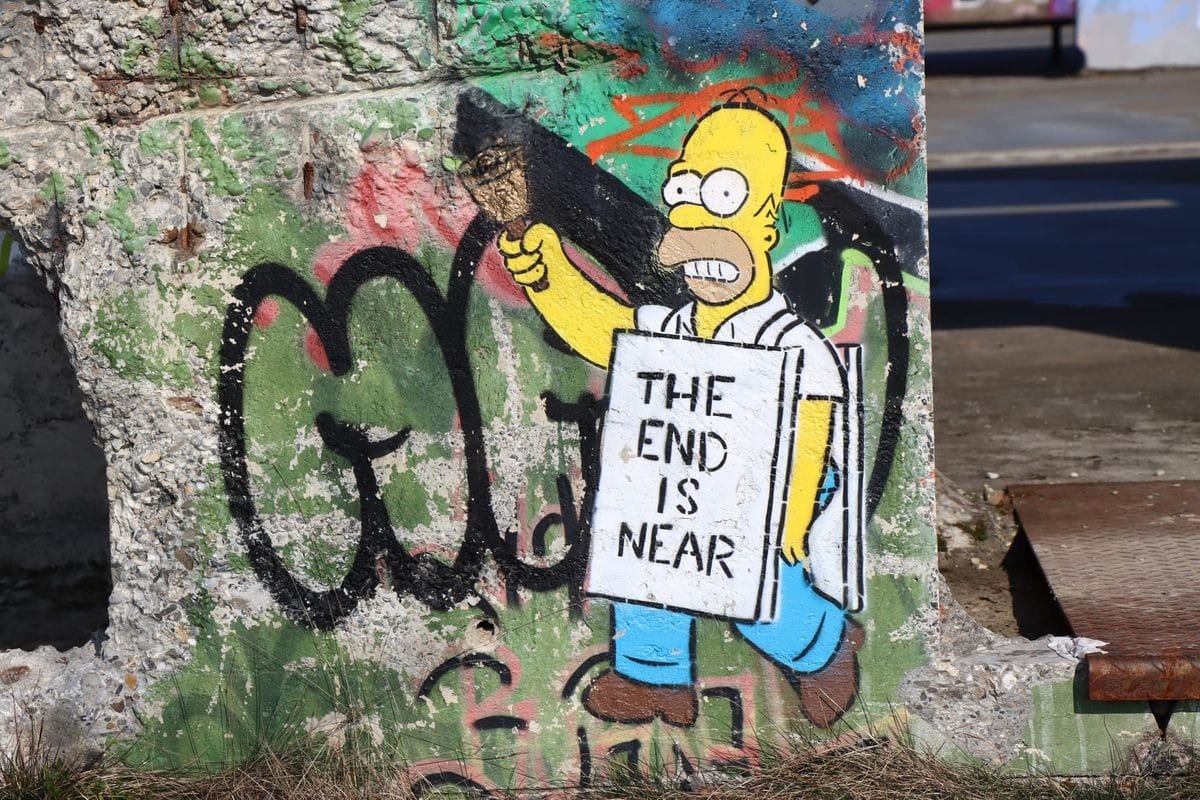
Graffiti about The Simpsons, Episode 183, “Fandom and Religion.” Source: https://fansplaining.com/183-fandom-and-religion/
The entire Bible is filled with figures that function together as “types” and “antitypes.” When Jesus resurrects and speaks to his apostles, who doubt when they see him, he says:
This is what I told you while I was still with you, that everything written about me in the Law of Moses, the Prophets, and the Psalms must be fulfilled.
Saint John, 24, 44-45.
Paul, in his Epistle to the Romans 5:14:
But death reigned from Adam to Moses, even over those who had not sinned in the likeness of the transgression of Adam, who is a type of the one who was to come.
The Old and New Testaments are written as a system of mirrors, where both reflect each other. Auerbach, who suggests calling the “types” and “antitypes” by the clearer names of “figure” and “consummation,” interprets this as a narrative strategy to give universality to the stories that until then had been the mythology of a specific people, but also as a self-legitimizing movement of the New Testament writers.
The apocalypse functions narratively as the consummation of all figures. The alpha and the omega, the beginning joins with the end in a totality of meaning.
How do we prove the truth and relevance of the characters and events of Christianity? By showing that they are linked with the characters and events of the Old Testament in a relationship of figure and consummation, of umbra and imago. With a similar interpretative technique, the true meaning of the story of Moses is only revealed with Christ. The later rewrites the earlier and gives it a new meaning in a larger narrative that closes as a whole.
I saw a new heaven and a new earth, for the first heaven and the first earth had passed away; and the sea was no more. And I saw the holy city, the new Jerusalem, coming down out of heaven from God [...]. And he who was seated on the throne said: Behold, I am making all things new. And he said: Write this down, for these words are trustworthy and true. He said to me: It is done. I am the alpha and the omega, the beginning and the end.
Revelation, 21, 1-7.
The apocalypse functions narratively as the consummation of all figures. The alpha and the omega, the beginning joins with the end in a totality of meaning. The narrative structure that forms is one in which everything that has happened, no matter how meaningless it may seem, tends toward an end, a telos.
Telos and éskaton
Presented then, the great apocalyptic narrative legacy, the meaning of an end. This last expression is the title of a beautiful book by Kermode that, if someone were to give you a link to pirate it, I would tell you to run and read it. With the great model of the apocalypse, Western culture built a monumental edifice of fictions about the end. Of course, here we must distinguish the two senses in which we use the word. Let’s look at it with two examples.
If I say that the purpose of my life is to drink fernet every day, I’m talking about “end” as “meaning” to which everything tends.
If I say that the end of my life was due to drinking fernet every day, I’m talking about cirrhosis, and therefore a temporal end, a cut in chronology.
Conventionally, we distinguish these two senses with the Greek words “telos” as the purpose of meaning and “éskaton” as the temporal end. In the biblical apocalypse, there is a concordance of telos and éskaton, but this does not always occur. In the apocalyptic notion that the world will end in a few years due to a climate crisis, there is an eskaton without telos. Everything ends, and it meant nothing. In the great philosophies of history, there are telos without eskaton. In Marx's thought, for example, there is a purpose of meaning in history, the classless society. And the entire apocalyptic narrative model is there: crisis, decisive moment, revolution, judgment that defines and redeems the injustices of the entire past, the end of a story and the purified resurgence of a new world. In general, all strong political definitions that tend toward historical optimism are teleological, and the disillusioned ones are eschatological. Hence, for example, the overused phrase (but what can we do) “it’s easier to imagine the end of the world than the end of capitalism” can be interpreted as meaning that in an era of strong skepticism regarding meaning, it’s easier to imagine any dreadful éskaton than some desirable telos. Regarding the need to create new myths that provide some kind of meaning to the everyday political void, I’ll link again to Robi’s article because it’s really great.
In our political dreams of an organized community with harmony between capital and labor, of a classless society, or whatever it may be, there is a narrative notion of end that reconciles the totality of history in a fullness of meaning.
I think it’s time to wrap this up because the end is near. What I tried to show was how in our daily anxieties of “it can’t be that a guy in diapers who talks to dead dogs governs us and nothing happens” there is always an apocalyptic demand for a resolution that shows that what seemed meaningless actually has meaning. That in our historical imaginations “now Peter Thiel becomes the sovereign of the world with Palantir and we’re all going to be his sex slaves” or “the third world war is starting with nukes that are going to kill us all” there is a narrative compulsion to place ourselves in the moment of a crisis that is decisive, where our fate will be defined. And that in our political dreams of an organized community with harmony between capital and labor, of a classless society, or whatever it may be, there is a narrative notion of end that reconciles the totality of history in a fullness of meaning. I swear I say this last part without any pejorative sense, and I return to how I started. Everyone will believe in what they want, but apocalyptic imagination is a powerful tool of our culture that operates even if we don’t believe in it. Taking it into our hands is a way to prevent it from crashing down on us and to be part of the discussion about what kind of apocalypse we want and how we’re going to make it happen.
✦ Suscribite
Las notas de 421 no tienen paywall
Y a cada colaborador se le paga por su trabajo. Las dos cosas dependen de los suscriptores.
Nací en 1995. Marplatense. Doy clases de Filosofía de la Historia en la Universidad Nacional de Mar del Plata y estoy haciendo mi tesis doctoral sobre el aceleracionismo como filosofía especulativa de la historia. Trabajo con teorías de la ficción.