Argentine Animation Turns 100: History and Future
From the pioneering El Apóstol to global milestones like La Huella del Oro, Argentine animation turns a hundred. A tool of cultural soft power.

From the pioneering El Apóstol to global milestones like La Huella del Oro, Argentine animation turns a hundred. A tool of cultural soft power.
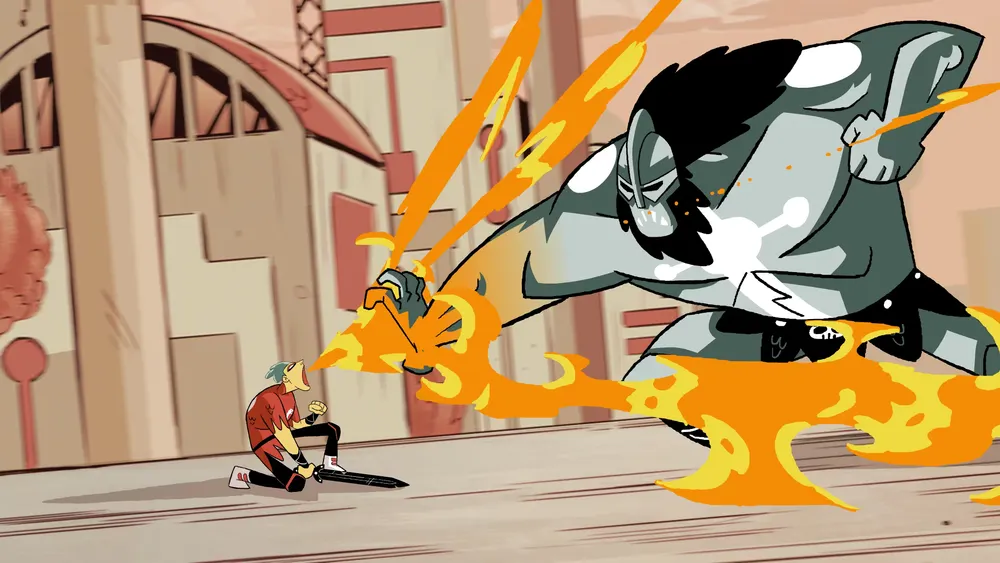
The premiere of La Huella del Oro on Adult Swim and HBO Max marked a historic milestone for the local industry: it became the first animated production, not strictly for kids, based on a 100% Argentine IP (Intellectual Property) developed directly for a platform with global reach. Created and directed by Daniel Duche out of his studio Puño Robot, the miniseries, made up of five episodes of about six minutes each (for a total runtime of roughly half an hour), required the coordinated work of a team of more than 35 professionals working side by side with Warner's infrastructure.
La Huella del Oro follows a wandering mercenary named Fafner, who roams a hostile world with one clear goal: to collect a series of mysterious gold coins, each engraved with a particular symbol. In the spirit of the legendary wanderers of classic Argentine comics like Nippur of Lagash or Alvar Mayor, the plot weaves together dark fantasy, action and greed across a range of territories. Each episode works as an allegory and a critique of power, morality and the shallowness of the modern world.
At the same time, a new crop of filmmakers is developing animation projects that seek to rally support, coproduction models and financing to break through the development barrier and see the light of day. Standing out in that pursuit is Electroandes, a miniseries project from the studio Bellolandia, led by Nacho Malter, Damián Fernández Gomes and Martín Gil (Rojo), which rises as an ambitious bet on cyberpunk action and drama, heavily inspired, both thematically and aesthetically, by the Andean north, and which already has a finished twenty-minute first episode and a second episode in the animatic stage.
Here's episode 1 of Electroandes, with over 500,000 views.
To unpack the present and future of Argentine animation, toward the end of this piece we interview Daniel Duche and Nacho Malter. Two leading figures with very different approaches and development strategies, but with the shared goal of proving that Argentine animation has the technical chops, the narrative identity and the international standard to conquer screens all over the world. But to understand the present, we need to take stock, however partial and incomplete, of how we got here.
The arrival of La Huella del Oro on Adult Swim / HBO Max isn't an isolated event but the latest step in a deep, pioneering tradition. The history of animated film, both national and international, has its cornerstone in 1917 with El Apóstol, the work of Argentine-Italian caricaturist Quirino Cristiani. Made with cut-out, articulated figures as a satire of President Hipólito Yrigoyen, the film is widely recognized by historians as the first animated feature in film history, predating the first classic Hollywood features like Snow White by two decades.
Argentine animation has the technical chops, the narrative identity and the international standard to conquer screens all over the world
Some time later, during World War II, Walt Disney's visit to Argentina spurred Dante Quinterno to bring his universe of comic-strip characters to the big screen. That initiative gave birth, in 1942, to Upa en apuros, made with the help of American animators connected to Disney. The short, starring Patoruzú and his brother Upa, was the first Argentine and Latin American cartoon made in color.
Decades later, Argentine animation entered a true golden age and put down deep popular roots thanks to Manuel García Ferré. The Spanish-born, Argentina-based illustrator and cartoonist built a universe of characters that left its mark on entire generations, moving seamlessly from the pages of Anteojito magazine to television with the legendary Hijitus, which premiered in 1967 and is considered Argentina's first animated TV series. Then came memorable features like Mil intentos y un invento, Petete and Trapito and Ico, el caballito valiente. This rich legacy of more than a century helped consolidate studios, schools and a graphic tradition that, to this day, feed the technical and narrative skills of contemporary filmmakers.
Toward the late nineties and early 2000s, Argentine animation went through a period of renewed momentum, boosted by new technologies and by the emergence of production companies able to take on the hefty investments that animated features required. In that context, Patagonik Film Group played a leading role with productions like Manuelita (1999), Cóndor Crux, la leyenda (2000) and Patoruzito (2004), later joined by Patoruzito 2 (2006). All of them big box-office hits for Argentine animation. Meanwhile, in the late nineties, a particularly significant international precedent took shape: the animated adaptation of Cybersix, based on the comic by Carlos Trillo and Carlos Meglia. Premiering in 1999, the Cybersix series was developed as a coproduction between Japan's Telecom Animation Film and Canada's NOA (Network of Animation), giving a work of Argentine origin wide international TV distribution for the first time.
Conceived as an Argentine intellectual property (what industry folks loosely call an IP) with global prime-time potential, its arrival on American television via Fox Kids fizzled thanks to airings in marginal time slots (Saturday mornings) and an abrupt cancellation after thirteen episodes. The controversy wasn't long in coming: shortly afterward, FOX premiered Dark Angel in prime time, a big-budget sci-fi production created by James Cameron and starring Jessica Alba. The similarities with Trillo and Meglia's work (a woman genetically engineered in a military lab, on the run, with a tattooed barcode, who dresses in leather on the rooftops of a metropolis and teams up with a journalist) were so obvious that the Argentine creators tried to file a plagiarism lawsuit. But the case went nowhere: the creative duo didn't have the exorbitant financial resources needed to fight a Hollywood giant like Fox in the Los Angeles courts. After decades as a cult item nearly impossible for local audiences to find, the Cybersix animated series officially returned to circulation on Amazon Prime Video, where you can find it today.
The turn of the millennium opened up another crucial avenue of expression: the era of independent, digital animation, driven by technological innovations like the vector animation made possible by Macromedia Flash and by internet distribution. From Mercano, el marciano (2002), by Juan Antín and Ayar B, to pioneering web animation phenomena like El Mono Mario and Alejo y Valentina, Argentine animation proved it didn't depend exclusively on big budgets to build audiences and communities. With the spread of the internet and, later, YouTube and social media, that self-made tradition found new channels of distribution and gave rise to auteur productions with strong generational and countercultural roots, like Trukini's iconic Tres Acordes, or the slice-of-life humor of El Gato Moncholo. A freer, more laid-back ecosystem that showed that scarce resources and the absence of industrial structures can be limiting, but can also inspire alternative aesthetics and workflows.
By the 2010s, the Argentine film and TV industry had fully embraced computer-generated 3D animation (CGI), seeking to bring the medium's new technical possibilities to stories and characters with a local identity. Standing out in this process was Underdogs (2013), directed by Juan José Campanella, one of the largest-scale Argentine animated productions up to that point, with a budget of over 20 million dollars. Before and after it, a new generation of features explored different techniques and possibilities of digital animation, including La máquina que hace estrellas (2012), Plumíferos (2010), El último mago o Bilembambudín (2014) and the coproductions The Hairy Tooth Fairy (2006) and The Hairy Tooth Fairy 2 (2009). Nor can this growth be understood without the State's film funding system. During those years, many national productions tapped into INCAA mechanisms, including loans and subsidies designed to make it easier to produce films and recoup their costs. The agency managed the Film Development Fund, and its support policy extended to animated features as well, helping sustain an industry whose technical costs were especially high.
Meanwhile, under the Kirchner administrations, the national government built an extensive scheme for funding and producing audiovisual content, especially through public children's television and the competitions tied to Open Digital Television (TDA). Starting in 2010, the Pakapaka channel, run by the Ministry of Education, pushed an active policy of producing national content for kids, while INCAA, together with the Ministry of Planning and UNSAM, developed the Operational Plan for the Promotion and Development of Digital Audiovisual Content, which included competitions for digital TV, children's programming and animation projects. From this ecosystem, virtuous in many ways but also dogged by complaints and questions about possible irregularities, misappropriation of funds, favoritism and biased selection criteria, came or grew productions like La asombrosa excursión de Zamba, made by El Perro en la Luna at the request of the Ministry of Education and later added to Pakapaka's lineup, and Medialuna y las noches mágicas, coproduced by Focus and Pakapaka.
The result was the consolidation of a public production model that expanded opportunities for local studios and professionals, created jobs and made it possible to develop children's content tied to Argentine and Latin American history, culture and identities. In that sense, the expansion of Pakapaka and the TDA funding mechanisms helped build an audiovisual ecosystem that would hardly have emerged from the commercial logic of the market alone.
The expansion of Pakapaka and the TDA funding mechanisms helped build an audiovisual ecosystem that would hardly have emerged from the commercial logic of the market alone
And yet one of the biggest, most resounding phenomena in Argentine children's animation of recent decades came from outside the traditional circuit of state subsidies and funding: Plim Plim the Clown. Created by Guillermo Pino and produced by Smilehood, the character debuted on television and then found in YouTube and digital platforms its main engine of international expansion. With content in multiple languages and a global-scale audience, Plim Plim became an emblematic case of Argentine intellectual property capable of building an international phenomenon through digital distribution and audiences' direct response.
Among the many techniques in Argentine animation, stop motion has earned remarkable international prestige. One of its leading figures is Juan Pablo Zaramella, a member of the Hollywood Academy and creator of the multi-award-winning short Luminaris, made using pixilation and stop motion and recognized by Guinness World Records as the most awarded short film in history. Added to this tradition are auteur works with major global impact, like those of Santiago “Bou” Grasso (The Employment, Padre) and the productions of the Can Can Club studio (Dos Pajaritos, Inercia), benchmarks in handcrafted frame-by-frame exploration and in building a visual identity all their own.
Today, after more than two decades making shorts and earning international recognition such as the Ciclic award at Annecy-MIFA, Zaramella is developing his first animated feature, Soy Nina. Made entirely in stop motion, the film is a fable about identity, discrimination and social divides, told through Nina, a little rat who grows up in a dark, hostile underground world and ends up in a gleaming metropolis inhabited by rabbits.
Plenty of cartoonists have gone back and forth between comics and animation. From the legendary work of Carlos Loiseau (Caloi), both in production and in spreading the word through his iconic show Caloi en su Tinta, to the occasional animation work of Salvador Sanz, Juanungo or Delfina Pérez Adán (A.K.A. Estampita), among many others. An emblematic example of this interplay is the film Ánima Buenos Aires, directed by María Verónica Ramírez, where animators like Juan Pablo Zaramella share the screen with cartoonists like Carlos and Lucas Nine and Caloi himself.
Likewise, adaptations of Argentine comics into animation have a long tradition. During the second half of the 2000s, the push to bring the most popular IPs of Argentine comics to the big screen found a key player in Illusion Studios, a production company that bet on stereoscopic 3D and hybrid formats. Under the direction of Gustavo Cova, the studio took on the adaptation of Boogie, el aceitoso (2009), based on Fontanarrosa's famous character. Shortly after, the same team brought Nik's comic strip to the big screen with Gaturro: The Movie (2010), a 3D children's feature co-produced with Ánima Estudios (Mexico) and Toonz Entertainment. This crossover between comics and film was joined by other takes on the national graphic universe, such as the animated Martín Fierro: The Movie (2007), directed by Norman Ruiz and Liliana Romero, which brings the Argentine literary classic to animation in Fontanarrosa's style.
The most ambitious project, in both name and budget, on the near horizon of Argentine animation is the new animated Mafalda series for Netflix, produced by the Mundoloco CGI studio and led by Juan José Campanella as director, writer and showrunner, alongside Gastón Gorali as co-writer and executive producer. Developed in collaboration with the heirs of Quino (Joaquín Salvador Lavado), the production is planned as two seasons of ten episodes, each running 20 to 25 minutes. Facing the challenge of translating the expressiveness and linework of the page into contemporary animation, the team aims to preserve the timing, irony, humanist humor and sharp social eye of the original strip in order to connect with new global audiences. And the list of possibilities stretches to the far reaches of Argentine comics history: from Robin Wood's works like Nippur or Gilgamesh, through El Cazador, all the way to the whole new crop of graphic novels from recent years, the trove of Argentine comics IPs is as lush as it is hard to take in. But the ideas and intentions are there, waiting.
Over the last few decades, animation stopped being a mostly self-taught adventure and became a professional, specialized career path for the country's illustrators and audiovisual artists. This leap in both quantity and quality was built on an ever-wider network of educational institutions: from the historic public breeding ground of IDAC (Instituto de Arte Cinematográfico de Avellaneda), which has been training film and animation makers for more than half a century, to private institutions focused on technical and professional training, such as Escuela Da Vinci and Image Campus. Then there are the university programs, notably the Bachelor's in Audiovisual Arts with a concentration in Animation at the Universidad Nacional de las Artes (UNA), while the Universidad Nacional de Villa María (UNVM) includes animation within its Bachelor's in Audiovisual Design and Production.
The most ambitious project, in both name and budget, on the near horizon of Argentine animation is the new animated Mafalda series for Netflix.
Alongside academic training, the sector built its own spaces for gathering, exhibition, training and business. Festivals like ANIMA, born in Córdoba in 2001 and now one of the leading specialized events in the country and the region; BITBANG, which brings together animation, video games and digital art; and SMOF (Stop Motion Our Fest), devoted specifically to stop motion, along with DIY initiatives and alternative screening series, helped consolidate an increasingly connected scene.
These circuits were joined by industry organizations and networks such as AOBA (Animadorxs Organizadxs Buenos Aires), APA (Asociación Productoras de Animación Córdoba) and RAMA (Red Argentina de Mujeres y Diversidades de la Animación), which boosted visibility, professional exchange and coordination among artists, studios and producers. Together, these institutions, festivals and networks helped legitimize animation as a professional field in its own right and build the ties Argentine talent needed to join international productions, reach international markets and work as outsourced labor for an increasingly globalized industry.
For several decades now, Argentine animators have built production companies and studios capable of competing at the most demanding standards of the global market. This tradition of service work for foreign clients has key pioneers, like Jaime Díaz's historic studio, which in the seventies and eighties produced large-scale animation for giants like Hanna-Barbera and Disney, or Rodolfo Sáenz Valiente's, focused mainly on advertising animation. Meanwhile, after settling in London with his studio Klactoveesedstene, Oscar Grillo became another major international name in Argentine animation. Among his biggest milestones is the Palme d'Or for Best Short Film at Cannes for Seaside Woman (1980), the celebrated music video for Wings made in close creative collaboration with Paul and Linda McCartney.
Within this ecosystem of studios geared toward the international market, Rudo Company stands out for its work on animated music videos. The studio gained international visibility through its collaboration with Argentine indie rock band Siamés, with whom it made a series of 2D musical shorts that spread widely online. Chief among them is The Wolf, which has racked up hundreds of millions of views on YouTube. The collaboration continued with works like Mr. Fear, Summer Nights and No Lullaby, which helped define a visual identity built on dynamic linework, limited color palettes and an anime influence. The Rudo and Siamés case shows how pairing independent music with animation can help productions made in Argentina reach international audiences.
The Wolf, Argentine music and animation, with 244M views and counting.
With digital professionalization and a generational changing of the guard, the local ecosystem saw the birth of studios internationally recognized for their technical chops. Companies like Hook Up Animation, 2Veinte, Le Cube, Rudo Company, Gizmo, Clubcamping and Pistachios became regular suppliers of ads, music videos and promo pieces for global brands, networks like Cartoon Network and Nickelodeon, and the video game industry (League of Legends, Royal Match, among others). Alongside the growth of studios, individual Argentine talent left a direct mark on landmarks of contemporary Hollywood and streaming animation. Argentine animators and illustrators have been part of the teams behind blockbusters like the Spider-Man: Into the Spider-Verse saga, the acclaimed sci-fi series Scavengers Reign and Common Side Effects: Diego Polieri, Juan Manuel Tumburus and Constanza Oroza, among many others.
For years, this phenomenon was helped along by an exchange rate that made Argentine production costs competitive in international markets. But the picture has changed: with a relatively cheap dollar in real terms and rising local costs, Argentine studios now have a harder time protecting their margins and competing internationally. As a result, some are forced to supplement their teams with professionals based in other countries or to outsource part of the production abroad to keep costs under control and meet their international clients' demands.
After many years of learning to plug into professional pipelines alongside some of the most important studios in the world, local animators inevitably start thinking about making something of their own. Telling their own story. But compared to other narrative media like comics or literature, telling a story through animation is extremely expensive. Locally, there aren't many companies, venture capitalists or studios willing to put up the full cost of a production, so many studios look for funding in international rights markets like MIFA in Annecy, co-productions with other countries, or crowdfunding.
Compared to other narrative media like comics or literature, telling a story through animation is extremely expensive
But in this endless hunt for those little gold coins to make their own IP happen, La Huella del Oro is the exception to the rule: they didn't travel to international markets looking for funding; everything was done from Argentina, even the pitch and the sale of the IP. Electroandes, for its part, also landed local funding, but now has to complete it in international markets. Its goal is more ambitious in scope and reach. While La Huella del Oro is 6 five-minute episodes, for a total of 30, Electroandes is 8 twenty-minute episodes, for a total of 160. Two different goals and strategies with the same end: getting their own project made. La Huella del Oro is already a reality; it successfully completed its proof of concept and now it's on to season two. Electroandes, meanwhile, is still in the fight, with a good shot at rallying new backers to finish its first season.
Better to let the people behind them tell it:
Historically, many local studios keep themselves afloat by offering production services to foreign clients. In your case, what commissioned or third-party work has funded you (if you can mention it), and how does that role coexist with the desire to pour yourselves into an original work of your own? What pushed you to make that leap?
Daniel Duche (La Huella del Oro): Both the Vigía Planetario series and the pilot episode of La Huella del Oro were made entirely by me, with no outside funding. I did all of that production as an investment. In parallel I was freelance directing for other studios and teaching, but during that period I didn't take on any commissions through Puño Robot. The difference between the two series is huge. La Huella del Oro is a show with a team of more than 35 people, a production we made for Warner where we also had to work side by side with some of their people. Vigía Planetario, on the other hand, is something I do on my own. I think the difference also shows in the final quality of each series, the complexity and the length of the episodes.
Nacho Malter (Electroandes): We've always been pretty selective about the services we take on, and we try to avoid traditional advertising as much as possible. Mostly we've done trailers and promos for video games like League of Legends or mobile games like Royal Match. We also offer white label services (uncredited) for other series and films. The goal of making our own work was the spark that started the project, and it began more as an experiment that picked up enough momentum to grow into the shape it has today.
What stage of production is the project in right now, and how has the general reception been, from both the industry and the audience, to the latest previews or pilots you've shown?
Daniel Duche (La Huella del Oro): The reception of the series has been very positive overall, luckily. Not just here but across the rest of Latin America too. And we hope it keeps growing, which could open the door for us to tell more stories. But it's too early to talk about a continuation.
Nacho Malter (Electroandes): We've finished the pilot, or ep. 1. Episode 2 is in the visual script stage, which is what we call what's traditionally known as the animatic. We've found that once we start this stage the script changes quite a bit, so we prefer to think of it as an extension of the writing. Right now we're fielding the first wave of interest, from co-production possibilities to distribution. The production is going to need a bigger volume than the local industry can handle, so co-producing is going to be a requirement from here on out. Our social media metrics show that our audience is mostly regional, which is where we get the most love: here in Argentina there's a lot of enthusiasm; when we showed a preview in Chile the response was really effusive, the Andean identity made them feel it was theirs too; and the demographic numbers also show a big Peruvian audience. We hope to open up to an even wider audience in the coming months. At the Annecy premiere in France we did two screenings and both had an excellent turnout. We ran a merch test sale that sold out in just over an hour. I recently got back from China, where there was a lot of interest too. All signs that we're building an emotional connection with a wide range of international audiences.
In terms of plot and themes, where does the story's Argentine DNA lie, and how does it engage with universal codes to become appealing to the international market?
Daniel Duche (La Huella del Oro): I think in terms of plot, the Argentine DNA comes through in the genre and the kind of story. It's a wandering mercenary following a path toward a goal, passing through different places, each with its own story. That structure follows the tradition of comics like Nippur de Lagash or Alvar Mayor, among other Argentine works. The themes of greed and the shifting of power are common all over the world, which makes it an accessible story.
Nacho Malter (Electroandes): Electro's identity has to do with an organic way of telling a story. Watching movies from the '80s, it seems like every alien invasion and every big hero or detective story happens in New York or LA. I think that has to do, among many other things, with the geography they're being told from. The most organic and authentic thing for us is to approach universal genres like cyberpunk, drama and action from a local context. In this period of first showing the project locally and internationally, I've seen that this local factor brings a breath of fresh air to stories that are traditionally told from other places.
What has your experience been looking for funding through markets like MIFA (Annecy) and others, platforms, international co-productions or crowdfunding? Is there any specific strategy you'd recommend?
Daniel Duche (La Huella del Oro): I've never gotten any kind of funding from those markets, and I've never been to Annecy either. Honestly, I don't have any advice to give on this particular topic.
Nacho Malter (Electroandes): Rarely has a single channel brought us a concrete opportunity. A contact made at Annecy later becomes useful for discussing a co-production; an event brings in the perfect partner to design a pitch or a crowdfunding campaign. In that sense, I'd recommend not pinning such specific expectations on each funding step, but rather staying alert and open to the possibilities they bring, because a lot of them show up over time. We go after every one we can, and I recommend doing the same. But every project is unique, and every path is discovered by walking it.
How do you see the current state of Argentine animation? In this context of resistance, do you feel that competition for scarce resources prevails, or has camaraderie and collaboration among peers grown stronger?
Daniel Duche (La Huella del Oro): Having different projects out there is very good news, and above all it's a landscape that can get your hopes up. At the same time, there's little animation work worldwide in general, the result of several factors. Protectionist policies in some countries and the use of AI threaten not only the work itself but its value. All of this hits us both as a country that exports services and as a content maker. The scarcity of work makes competition come more naturally than camaraderie.
Protectionist policies in some countries and the use of AI threaten not only the work itself but its value.
Nacho Malter (Electroandes): I'm one of those people who think we live in a network, and if the people around me are doing well, directly or indirectly that benefits all of us. Resources are scarce in general, and Argentine animation isn't immune to a global recession that's very real everywhere. But specifically, the biggest problem we have in Argentina is that the cost of living is very high and we're not very competitive on a global scale.
Beyond the current situation, what do you think the ideal role and support framework of the State should be in funding and promoting national animation so that the industry can be sustainable?
Daniel Duche (La Huella del Oro): The State's role should be to support the animation industry by funding national studios that produce content, ensuring maximum participation of Argentine professionals living in Argentina. And to require screen quotas from channels, platforms and theaters to guarantee that what gets made is actually seen. That's no more than what's done in countries where animation is an established industry.
Nacho Malter (Electroandes): The key thing would be recognizing that our potential is real and that the animation industry thrives in other countries. The historical examples would be Canada, France and Japan as major producers. But the case of the Philippines is really interesting: it's been growing its industry for a couple of decades now, and today it's starting to compete not just as a service producer but with its own projects. There's a lot of economic growth value in the sector, on top of its cultural contribution. On the State's side, I think there's a lack of vision on this. Australia also strongly supports the industry and today has massive hits like Bluey and Digital Circus, which show that animation isn't just a cultural model but also an economic driver. The animation tradition we have in this country, from García Ferré to today, sustains a pool of trained professionals, but with structural support that could grow exponentially.
At first it might sound like an exaggeration, but one of the cold wars over global cognitive soft power is being fought on the terrain of comics, animation and video games. The central powers pound us with a downpour of IPs that end up shaping the way we perceive and interpret the world: the US with its staggering mass media machine and Japan with manga and anime. A step behind, but climbing fast, China, France and South Korea are fighting to make the podium. The rest of us are elbowing each other from the bottom just to qualify. Argentina is a regional benchmark and a Latin American powerhouse, but the lack of a national strategic plan to consolidate the international promotion of our cultural industries comes at a price. These days we're about to be overtaken, if we haven't been already, by neighboring countries like Chile or Brazil, which used to look at us as a model to follow. In this landscape, with State support questioned and slashed to historic lows, Argentine creators are forced to turn to private or foreign funding to compete against powers that have decades of virtuous coordination between public policy and the private sector. For now, all we can do is hang in there, keep creating and hunt around for those elusive gold coins that might fund our next animated dreams.
Emphatic recommendations:
As with La Huella del Oro and Electroandes, there are other projects in different formats and lengths trying to gather enough goodwill and resources to become a reality. Among others, we recommend keeping an eye on:
Calesita
Sike x Bellolandia
Esther
Ezequiel Torres x Rudo Company
Gorrionetas
Ezequiel Torres and Gastón Pacheco
Luz Diabla
Produced by Ojo Raro and Lakeside Animation
Deportivo Baby
Delfina Pérez Adán x Bellolandia
Cosmic City Cruiser
Ivan Olszevicki
Y a cada colaborador se le paga por su trabajo. Las dos cosas dependen de los suscriptores.