The creator of When Evil Lurks, Demián Rugna, reveals the keys to his horror filmmaking: creative freedom, personal mythologies, and obsession.
In my brief experience with literature, one never wants to write. One either writes or doesn’t write. That's it. It feels like an annoying weight, an unbearable ghost hanging in your ears that forces you to sit down, open a Word document, and start typing. But generalizing how I feel would be irresponsible, a foolish leap to conclusions that I’d like to avoid. I suspect, then, that there are indeed people who might benefit from a little nudge.
That’s why I decided to start working on this series of interviews with writers for those who want to begin writing. I called people I respect and whose writing, in one way or another, inspires me. Perhaps you’ll find in their answers, their advice, and their working methods what you’ve been missing to finally start putting one word after another. The saga continues with Demián Rugna to discuss screenwriting.
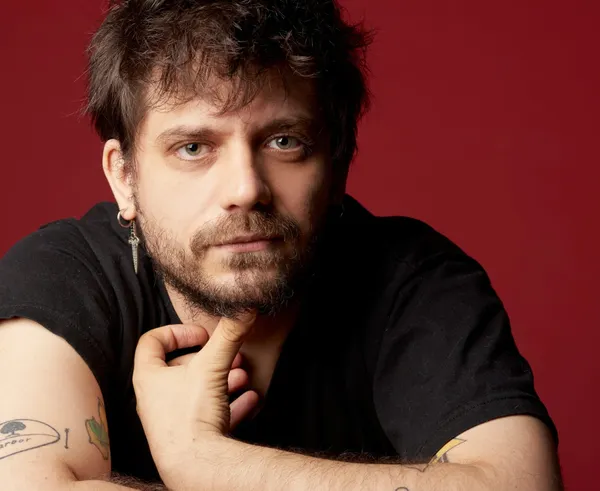
Demián Rugna. Photo: Sáshenka Gutiérrez.
Horror is still considered a "minor genre." There’s an extensive bibliography that shows us why the fantastic, horror, and science fiction are annoyances to the status quo, and why we should pay a little more attention to them. You’ve cultivated this, particularly, since your first feature film, La última entrada, from 2007. What draws you to genre cinema? What do you see there that other traditions don’t offer?
I believe that horror and fantasy go hand in hand with the idea of creating universes, alternatives to our reality. Those genres give me the opportunity to create my own codes and my own mythologies.
Horror combines two things I love to explore: fantasy and violence. My love for monsters since childhood makes me always try to think of a creative way to generate some kind of morbidness, fear, or repulsion. Of all the genres, I think horror gives me the most freedom, even though it sometimes requires a lot of structure and comes with its own codes and rules.
I believe that horror and fantasy go hand in hand with the idea of creating universes, alternatives to our reality. Those genres give me the opportunity to create my own codes and my own mythologies.
Honestly, I don’t choose them. Those stories come to me naturally. They are always stories that one carries from childhood and only organizes when they grow up. But from the very beginning, since I was little, my idols were Jason and Freddy. They were my heroes. It’s a childhood deformity (laughs).
On paper, you’re a visual designer. At least, that’s your title. Some might say it’s a static form of art, a still image that isn’t necessarily narrative. When did you realize that, in addition to composing an image, what you were really interested in was telling a story? Did you always know? What did it mean to understand that you wanted to become a writer?
This journey of becoming a writer, a storyteller, a filmmaker, of telling my stories… I don’t know. To say I always knew would be a bit pretentious. But I can tell you that I’ve always dreamed of it and that I’ve always been very creative since I was little. I spent my entire childhood and early adolescence playing with action figures and “making movies.” Every weekend, always with the same friend, we improvised with our toys. I was the one who led the stories. He let me take the lead because my stories were fresh and had a spice he couldn’t find. So he would join in on my tales. And that kept happening to me.
At a young age, around 9, I dreamed of writing. I would type on my dad's typewriter and improvise my first pages of novels, dreaming, of course, of being the Argentine Stephen King. Then, well, I kept creating: world of comics, for example. And then the image came along, which led me, and that’s how I ended up being a screenwriter.
I started, professionally, writing a lot for others, which was very frustrating for me due to my own ambitions. I ended up deciding to write only for myself, but as a director, I also decided not to direct stories that weren’t mine.
You trained at the University of Morón, but there’s no curriculum that truly prepares us for the task of writing, producing, filming, etc. What definitive formative experiences did you have outside of academia? Is there any particular one you remember fondly?
When I was training, I wasn’t very inclined to join external formative experiences. Nor did I take courses. What happened was that I also loved guitar, comic drawing, and other things outside of university. My training outside the classroom came from that side.
But everything helps. The problem of musicality in a work, dramatic tension, story construction. Learning an instrument, learning composition, drawing comics, all those things shape you as an audiovisual creator. I fondly remember, for example, the years of comic drawing training with Horacio Lalia.
On the other hand, I always saw university as a space to work as a team, with a common goal. The audiovisual world is inherently heterogeneous: you learn a bit from home, but mostly you learn from others: from what they do, how they succeed, and how they fail.
Many people taught me many tools for storytelling. One becomes aware of that as they grow.
Every experience is valuable; everything helps.
What would you say to someone who resists making films (or any form of art) because they believe they must go through an academic training phase?
I feel that training programs are necessary, but not indispensable. Training programs help you grow as a human being. I believe that an artist’s formation lies more in their cultural and aesthetic proposal (what they carry inside) than exclusively in creativity.
I don’t find any program that can give you “more creativity.” It’s like not daring to write because you’re afraid of making spelling mistakes. When I wrote my first story in elementary school, a short little tale, I got a 9. It was full of spelling mistakes, and the page was covered in red marks. The teacher told my classmates: he deserved a 10, but I didn’t give it to him because it’s full of spelling mistakes.
Of course, as an artist and as a human being, one has to strive for excellence: to write well and without spelling mistakes. But the genesis of creativity, I don’t know, is very hard to learn. It’s something innate to humanity. I’ve seen great masters create ugly things. And one might say, wait a minute, if you’re a great master, everything you do should be brilliant.
The artist's training lies more in their cultural and aesthetic proposal (what they carry inside) than exclusively in creativity.
What drives me is the impulse to tell a story much more than the form itself. Courses help a bit to give context and weight to the form and what you do, but they’re not essential.
Of course, one can be self-taught or simply driven by their own creativity and imagination, and that’s the most important thing. If you have the desire to create, to sit down and write, you already have the most important tools. That’s what happened to me. I was going to do something creative anyway. I didn’t know if it would be film, comics, or what. But something.
What helped you understand how to write? Do you have any go-to books on creative writing?
Stephen King’s book, On Writing, was quite relevant for me, mainly because it’s a first-person narrative that speaks from a personal rather than a technical experience. I couldn’t say I have a go-to book… No, I don’t have one. It’s good to know those books, but I’m not one to stick to a structure. I try to avoid that a bit. I aim to surprise myself when I write.
How did you start writing scripts?
I think it was out of necessity. In college. That’s the good thing about a formative space. At least in a formal sense (in its rules, in its structures). It pushes you, even if you already have it in you.
Sitting down to write is a necessity. Maybe everyone says the same thing in interviews, but well. There’s a need within you, a restlessness. And also a challenge: to know if you can do it.
There’s a general idea that literature is a solitary art, as is painting. Nothing could be further from the truth. There are always third, fourth, fifth parties assisting you. Even more so in film. Who do you show your progress to? How open are you to the reformulations and revisions from others? Do you find feedback helpful?
I’m not one to show much, that’s the reality. But as a general rule, the first person I always show my writings to is my partner. Usually not much during the process, but when I have it finished.
‘Notes’ are common in film, but there’s a huge difference with literary feedback. In literature, the editor has space to express opinions, to help you build and shape a book. But in film, notes can sometimes be much harsher, because not only the creative aspect comes into play but also a commercial one: ‘hey, it’s not a good idea to have so many locations because you won’t get that much money’ or ‘hey, why don’t you lower the number of protagonists because we can’t afford a famous actor,’ or ‘this might work, but we should tone down this or that, or include an African American character, or involve an LGBTQ community.’
In that sense, I don’t get along very well with notes. I’m quite stubborn. The reason is that in film, one is exposed to filters of other interests that don’t explicitly refer to the narrative or creative aspects. So, no. I don’t get along well because some notes change my vision as a director, or what I want to tell in the film or how I want to tell it.
It’s like there’s something about this cultural product that is film that acts as a magnet to often pull you away from the core of your work.
How many writers hate movies based on their books because they feel they have nothing to do with them, because the perspective of many people participates and many people with strong decision-making power.
I’m quite reluctant to notes, except those that help you grow the story, because they exist, obviously they do.
Collective construction in film appears mainly when the script is ready and you move on to the game, which is the film, making the film. That’s much more collective than the part of sitting down to write and reworking the script several times. In my personal experience, despite having co-written scripts, I’m a lone wolf.
Aterrados (2018) created a tremor that began to renew horror cinema in Argentina. Cuando acecha la maldad (2023) was more like a magnitude 9 earthquake on the Richter scale. More than one list of recognized critics from around the world places Cuando acecha la maldad as one of the best horror films of the decade. The brutal exposure you’ve faced globally in recent years, does it intimidate you or does it, in a way, make you feel like you might not hit the mark again, or does it rather renew your energy to keep producing?
It doesn’t intimidate me, but it does make me reflect.
Having won a final and the following year playing in the championship again and thinking ‘hey, it’s hard to win that final again, but I’m still excited.’ That final win makes you think about all the finals lost before, and all the games you’d like to play in the future. Sometimes it’s about learning to choose your battles, to understand where to move, to know what you want to do thinking about the future.
Of course, after that exposure, I received tons of offers to make all kinds of movies. But those circumstances led me to ask myself what kind of films I wanted to make. Do I want to make the movie that will fill my pockets but leave me empty inside? And well, no. Because after losing so many matches, I understood a bit about how to win (laughs). And you win with my own tools, whatever they may be, but betting on them.
I received tons of offers to make all kinds of movies. But those circumstances led me to ask myself what kind of films I wanted to make.
Today I can say that those movies don’t diminish me; they actually make me bigger: they make me more ambitious and even more stubborn. I choose the harder path to continue asserting my vision as a director and not lean towards something purely easy, which would be much more commercial or with less content or less creative substance.
Generally speaking, I fight for creative control. That’s always the hardest part for big productions. But now I come with credentials: “Look, guys, I had control here, and this movie did well.” It doesn’t diminish me. It gives me a power (laughs) that I didn’t have before. The hard part, in any case, is using it well and being able to put it into action.
Once, Diego Capusotto, in response to a question about the show Cha Cha Cha (1992-1997), said: "There’s a myth in television about improvisation. People think we arrive at the channel, take a couple of pills, and do whatever. But that’s not true. Well, we do take a couple of pills, but we don’t improvise. In any case, we take the pills afterward." From another perspective, Herzog said that often what he had in mind ended up mutating not only in editing but in the filming itself. How much of what you write actually ends up in the final product? How much do you play off the heat of the filming days?
In general, my main job as a director is to fight for what’s written. I say this because, generally speaking, they often try to cut things out (in pre-production, in post-production, for example) to save costs. In every project, I’ve fought hard to ensure that the script survives.
Of course, the final results aren’t always what you hoped for (like that ambition, that level of effects, for example). Sometimes those crazy ambitions give you a reality check, too (laughs).
My job as a director is to try to respect the screenwriter as much as possible, which is me (laughs).
I try to make what happens in the script come to life. What I do has to be very well thought out beforehand because what I do has many technical conditions. So that planning is super necessary. I can’t go out and make a fantasy film with special effects, for example, without having them very well planned.
Sometimes many scenes turn out better than I had imagined. Sometimes they don’t, of course. But it happens that when you see them materialized (already worked on with the production designer, with the director of photography), you end up surpassing your own projection.
I always end up happier than sad at the end of filming. However, I find that the little sadness I do have sometimes gets the better of me because I’m very demanding with myself. So whenever I finish a shoot, I seem sad, but it’s just that I’m lamenting those missed goals.
I always end up happier than sad at the end of filming. However, I find that the little sadness I do have sometimes gets the better of me because I’m very demanding with myself.
In my films, improvisation sometimes happens out of necessity: something happens, something, and you have to try to do what you can in the time you have and in the circumstances you’re facing. Sometimes you plan one thing, and something different comes out of necessity, and that’s where you have to bring in improvisation.
And with the actors, I like to play; I let them take the text for themselves, unless there’s some information that’s essential. Generally, I let them play a bit, improvise, always within the script, trying to keep things from going off the rails.
Do you use any specialized software to organize the writing process? Notion, Scrivener, Plotter, Hemingway Editor, Final Draft?
Just Final Draft. A bit of Word. But nothing more.
All of us who try to write steal. Where do you steal from? Why is stealing important?
We are all permeable to all the works we love and that have influenced us. We all steal. I believe that what I steal has always been unconsciously, and then it appears in my consciousness when I discover it. I’ve stolen a lot from Tarantino, Clive Barker, Stephen King, and the Coen brothers.
In one of my movie scripts, there was a scene that was almost identical to a scene from the clock in Pulp Fiction, and I didn’t realize it. A colleague said to me: “You paid homage to Pulp Fiction in this scene.” And, oh man, I wanted to die. Because I hadn’t noticed, and it was a huge homage. I ended up modifying it.
The nice thing is that we are permeable. Something sticks with us, and we transform that something from our perspective. So we steal, but each person uses it in their own way. It’s good to steal (laughs). I’ve never been able to identify something particular and say, “I’m going to put this here.” It’s always impossible to dodge everyone.
Three movies. Three books.
Books: The Vampire Hour, by Stephen King. Books of Blood, by Clive Barker. Stories of Love, Madness, and Death, by Horacio Quiroga.
Movies: The Exorcist, by Friedkin. Braindead, by Peter Jackson. And... how difficult it is to choose number three. I should say... It's so hard for me... Back to the Future, by Robert Zemeckis.
What should I do if I want to start writing?
I don't think it works the same for everyone. I can tell you what I do. Generally, I try not to be too sure about where I'm going when I write. That motivates me a lot. Not knowing exactly what's going to happen frees me from many things. Sometimes you say: 'this story is about a little dog where this and this and this happens...' And you already have everything in your head, and all you have to do is sit down and write. But sometimes that doesn't settle. I, on the other hand, know there's a little dog, and I don't know what's going to happen. So I sit down to write and let the characters talk to each other. That's when I start to get to know the characters, to understand the role each one plays once I start giving them actions.
It's a beautiful need to sit down and transfer what's in your mind to paper, what flows through your soul and intellect. It's very beautiful and unique. As a species, right? It makes us unique, and it's wonderful to take advantage of it.
I'm open to the idea that things can go in another direction: that the protagonist might be someone other than who I initially thought, or that the best situation I had in mind might never make it into the story because it never found its place. That helps me. It's a tool to motivate me to sit down, that openness to anything happening.
Why should I dare to write?
Writing gives you many tools.
You don't just use creativity for writing. You also use it to fix a flower pot. You find ways to solve things from a different perspective. Sometimes big companies encourage that: the creative, the playful, so that employees have alternative tools.
Knowing how to tell a story is a very powerful tool. Being able to create your micro-universe and your macro-universe is fascinating. Being able to make your own catharsis about what you're going through is also liberating, therapeutic.
I think it's a way to leave a piece of your life that someone else can pick up at some point and appreciate, or not. In any case, it's nice to leave a record forever.
It's a beautiful need to sit down and transfer what's in your mind to paper, what flows through your soul and intellect. That filter that transforms everything. It's very beautiful and unique. As a species, right? It makes us unique, and it's wonderful to take advantage of it.
✦ Suscribite
Las notas de 421 no tienen paywall
Y a cada colaborador se le paga por su trabajo. Las dos cosas dependen de los suscriptores.
Nací en 1992 en Córdoba. Soy Doctor en Letras. Escribí "El archipiélago. Nuestra retirada del mundo y notas para un regreso", y las novelas "Si sintieras bajo los pies las estructuras mayores" y "Quiebra el álamo". Toco en Ox en Mayo Alto.