Tired of having geopolitics explained to you through the lens of chess? This article takes a radical new approach and shows that the international system bears a much closer resemblance to Truco: a game featuring multiple players, shifting alliances and, above all, the ability to lie.
You turn on the TV, check your phone. There it is, for the umpteenth time, the analogy of chess to explain and comment on geopolitics and international relations. The pawns, the kings, checkmate. All very nice, but...
The reality is that chess is far from being a good representation: perfect information, a minimal and limited number of players. Nothing resembling the International System.
The truth is that there is a game that, while not a perfect analogy, contains many characteristics of the international system. I’m referring to our beloved Truco.
The problems with chess
Let’s talk numbers. Chess pits two players against each other; a setup that, even when trying to think of a limited regional scenario, is impossible to accept because the actors in the International System (what we colloquially call "countries", to keep things simple) do not operate in a “state of nature.” They are not abstracted from what is called structure.
What is structure? In short, structure answers the question of how the System is organized (who the powers are, who occupies the core), its form (what the power relationship is with the rest of the countries: how the peripheral units “orbit”) and the size of the units (how powerful those countries are). The interactions and the increase in their power define how the structure is configured, establishing who occupies the core and who is satellite. The System answers the what and the structure answers the why.
The reality is that chess is far from being a good representation: perfect information, a minimal and limited number of players. Nothing resembling the International System.
Argentina and Brazil, just to think of one example, are not separated from a (at minimum) regional framework. Whether due to geography, history, culture, institutionality, and a thousand other things.
Truco surpasses the limitations of chess. Like the International System, Truco can have various configurations. It can be played with three, four, six players (and some, those who add chuker to their mate, play with two). This plurality of actors allows for and enables a multitude of relationships that chess does not offer or propose.
Opaque, cunning
Chess presents another flaw. It is a game of perfect information: all elements are laid out on the board: “Hello, nice to meet you. This is what I have.”
The International System is not like that. In fact, much of what units do, especially the weaker ones, is to try to reduce that ignorance of what we know about others through international organizations and regimes (principles, norms, rules, and decision-making procedures).
The system is an arena, a dimension, where uncertainty is both a means and an end. Just like in Truco, we don’t have all the information; and hiding our resources is both a tool and a goal.
In international relations, uncertainty is everywhere. Starting with the theoretical conception of Anarchy as the organizing principle of the International System (the absence of a world government), which emerged from the Treaty of Westphalia (1648), where kings and emperors shooed away the Pope to initiate the principle of sovereignty and non-intervention. But, moreover, and especially, uncertainty is present in perceptions: in how one country reads another (and its difficulties in doing so).
Raymond Aron said it best in “Peace and War Among Nations”:
“Political and military action takes place within a framework of uncertainty inherent in human relations, where the intentions of the adversary, the reactions of allies, and the consequences of each decision cannot be predicted with absolute certainty.”
In Truco, you receive your cards face down. You don’t know the other player’s cards. Slowly, and if our partner communicates cleverly through signals (since it’s not always possible), we start to gather information.
We find ourselves, then, needing to overcome a scenario of opacity. States must find resolutive ways to obtain information and plan based on it.
This leads us to identify that Truco allows for iterations quite similar to the game theory of international relations from the neorealist school: zero-sum games that “allow” for relative gains. This theory understands the role of international organizations as instruments of the powers: they are spaces for orderly competition to preserve the status quo.
Truco facilitates these moves, whether through unwanted bids or by handing over cards to the opponent to draw them into a position of trust and ultimately defeat them.
Silent, sing it
We can even think that each hand has its theoretical reading, like a metagame. While there aren't always three hands, it's true that the more elaborate games are the ones that accumulate more hands (and points). In this way, the first hand reflects a lot of neorealist theories, both defensive and offensive in nature. The defensive players believe that states seek to maximize security, while the offensive ones think that the goal is power. Because they are unaware of the cards (resources/intents), they see rivals as necessarily a threat, which leads them to want to neutralize them (to restore the status quo), as well as to overcome them (to impose a status quo).
The first hand has an initial instance (though not mandatory): the singing. It even allows us to close the game: I sing the fault; a disruption of the system that favors rogue states or bold players. Defensive realists are more likely not to sing or accept the challenge to quickly close the hand (neutralizing the threat). Offensive players sing immediately and escalate without fear (imposing).
The first hand has an initial instance (though not mandatory): the singing. It even allows us to close the game: I sing the fault; a disruption of the system that favors rogue states or bold players.
But international relations cannot be explained from just one place, from just one school. Liberals also play (or let others play). Within teams, this theory operates informally, where certain values (especially the strength of international organizations) are valued because they work towards increasing transparency, providing information, and reducing costs to coordinate interests. Unlike realists (classical or new), they understand that the system is not confined to a zero-sum game, because they believe you can lose one hand but then win another; thus, everyone has a chance to win. From this perspective, in Truco, the best-played hand is the one built in pairs or threes to optimize points without any player within the team winning/losing more than the other.
Liberals.
Subsequent hands are defining. Yes, technically you can score more points with a good sequence of challenges (Hello, Trump!), but it's not common to close hands that way, just as no state seeks to violently alter the status quo knowing the consequences. In other words: go ahead, dare to sing the fault with 22…
Signals and Identity
Signals, dialogue, and trust in the partnership are absolutely vital: “come/go,” “you put it/I put it,” “you go first/I go first.” While there are no strictly defined pairs in international relations, there is also no international order without an other and the necessary and consequential relationship with it. That's why sharing information and having gestures towards a neighborhood is fundamental.
Defining hands are the ones that deploy the most refined tactics. Of course, we’re talking about the best-case scenario, where each person, knowing their own cards and those of their teammates, knows the role they must play. When to delegate, when to deceive, when to fold. It’s not always like that. It happens in life, it happens in TNT (just ask Stalin in June 1941 or Bush Jr. on the morning of September 11).
Here, and although it sounds like a phrase from Loco Bielsa, is where the hierarchy of the resources used comes into play. The tools of states (soft power, bombs, whatever you can imagine) correlate with the cards in the deck: figures, quick cards, sevens, high cards. The prestige of nations, diplomacy to showcase cronopolitics (the use of Time), economic strength, and of course, the heavy artillery. Each card, well played, allows you to win the hand. Each card, if not used effectively, is a wasted resource.
Here is when we can introduce a concept that my colleague Martín Pizzi and I coined to complement notions from neoliberal theory in International Relations: yield.
Just as we can colloquially understand it as the amount of energy obtained from a machine in relation to how much is invested in it, in international relations we can think that both the people living in and forming the unit, as well as the material and immaterial resources it has, are what we call fuel. The State is like a motor that needs to be fueled. An appropriate relationship between the fuel supplied and the size of the motor could give us the idea, for example, of a motorcycle that runs efficiently, like those small but dense, massive countries. And, if we think of it the other way around, a large but obsolete, inefficient, or poorly fueled motor flips the script: a country that wastes its potential or that had a status it no longer possesses (like a dilapidated Taunus GT coupe, which you see on a corner in San Telmo with more rust than a Mate from Cars).
This comparison helps illustrate how nations in seemingly unfavorable contexts (Japan) can not only gain density but also become powers; and conversely, states that have broadly favorable contexts regarding their resources but are low in density (the Democratic Republic of the Congo, for example, or the Russian Federation in the early nineties). How do we bring this back to Truco? Having 33 in hand and the foot forgetting to sing.
Let’s return to the issue of yield. In Truco, no one plays their card with perfect information. You play to exploit the uncertainty of the other and increase their costs through that opacity, what the other doesn’t know.
In Truco, no one plays their card with perfect information. You play to exploit the uncertainty of the other and increase their costs through that opacity, what the other doesn’t know.
And, moreover, our certainties are built from traditions, habits, and narratives: "Juan can’t lie"; "José gets lucky"; "Fernando likes to mess around"; "Luis is conservative"; "Ernesto is a gambler". This construction of identities is what guides the game and allows us to know or intuit the limits of each play: "Juan is going to get nervous"; "José is anxious"; "Fernando is going to talk five minutes before saying he has nothing"; "Luis is going to say 'no, let them row a bit...'" and "Ernesto is going to sing the fault in every hand."
Thus, just like in the International System, who plays and how they play is what they do, but also the myth built around them: yankees, Chinese, Russians, Arabs… All carry with them an accumulated information that accompanies them, and that has been imposed on them. It’s not just who you are, but what they say you are.
Truco Gallo/pica-pica
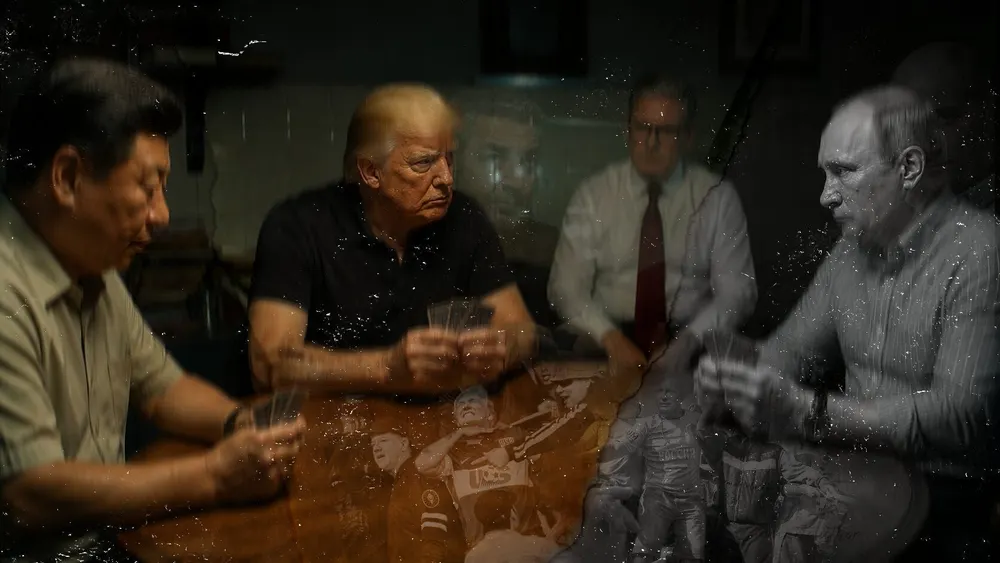
Let’s revisit the idea of Truco Gallo and think about the United States, China, and the Russian Federation. This mode stipulates a game where one player acts as the rooster (playing solo against the rest) and can have a fixed or rotating character. In the past (1971-1972), the United States oriented its foreign policy to favor a rapprochement with China to counter the influence of the Soviet Union; that tandem was transformed into a Sino-Russian relationship working together to undermine American power. In this way, states carry a fluid identity as a product of power exercises. Yesterday X was the rooster, tomorrow my partner will be.
Finally, within the six-player Truco mode, we have pica-pica. A bilateral contest, now immersed in a plurality. It’s a competition within a larger framework that allows, in the same hand, to triple the point offer by reproducing the same characteristics mentioned earlier. It’s a game within another, a subsystem.
One peculiarity is that the pica-pica repeats rivals. It's a relationship that, due to our position at the table (our geography), is fixed. We can't choose our opponent (our neighbors). And that position naturally allows for more iterations than with other players.
The analogy isn't perfect. But the next time they repeat an analysis using the chessboard analogy, call them out.
✦ Suscribite
Las notas de 421 no tienen paywall
Y a cada colaborador se le paga por su trabajo. Las dos cosas dependen de los suscriptores.
Analista internacional, diseñador, modder. Infobae, Página 12, Perfil, Télam, Panamá Revista, CNN en Español, Sputnik, RT, France 24, TN, C5N, La Nación +, Tv Publica, IP Noticias, Futurock, Mitre, Radio 10, CNN, Urbana, Radio con Vos, entre otros.