Argentina: The Origin of the First Dinosaurs
The first dinosaurs were born in Argentina and went on to conquer the planet.

The first dinosaurs were born in Argentina and went on to conquer the planet.
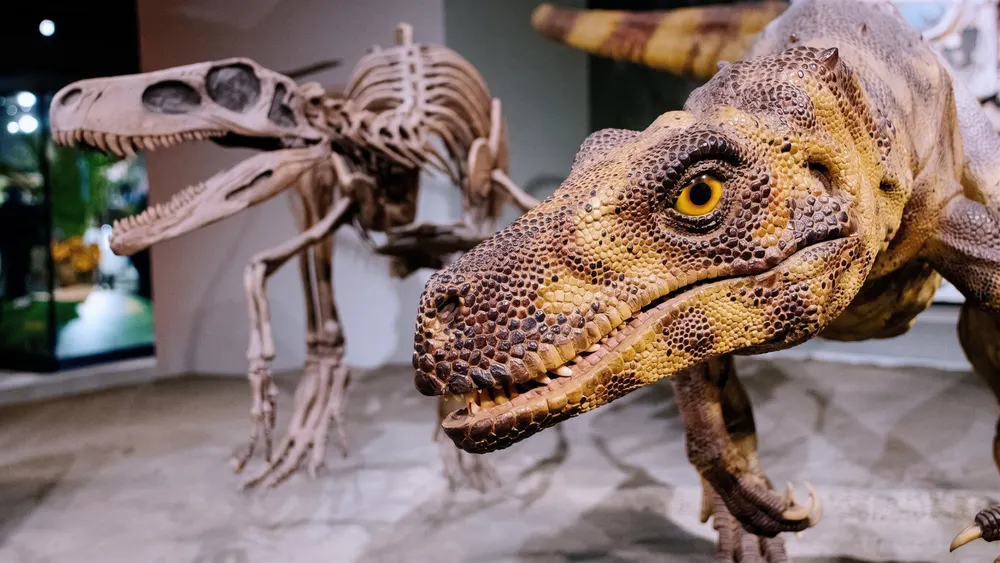
In previous articles we met the giants that ruled Patagonia millions of years ago: iconic carnivores, titanic sauropods and the pterosaurs that owned the skies. But our lands weren't just home to colossi, they were also the setting for the beginning of the dinosaurs' great evolutionary story. This time we won't be looking at the biggest specimens of their species, but at the first ones, the ancestors you may not have heard of.
To find the ancestral dinosaurs, this time you don't have to go to Patagonia. Although most of the best-known Mesozoic formations are there, they span the Jurassic and the Cretaceous, periods in which dinosaurs already dominated the planet. What you have to look for are the Triassic sediments, which are concentrated in San Juan and La Rioja. There, among the incredible landscapes and rock architectures of Talampaya and the Valley of the Moon (Ischigualasto), the beginning of these reptiles' story is preserved.
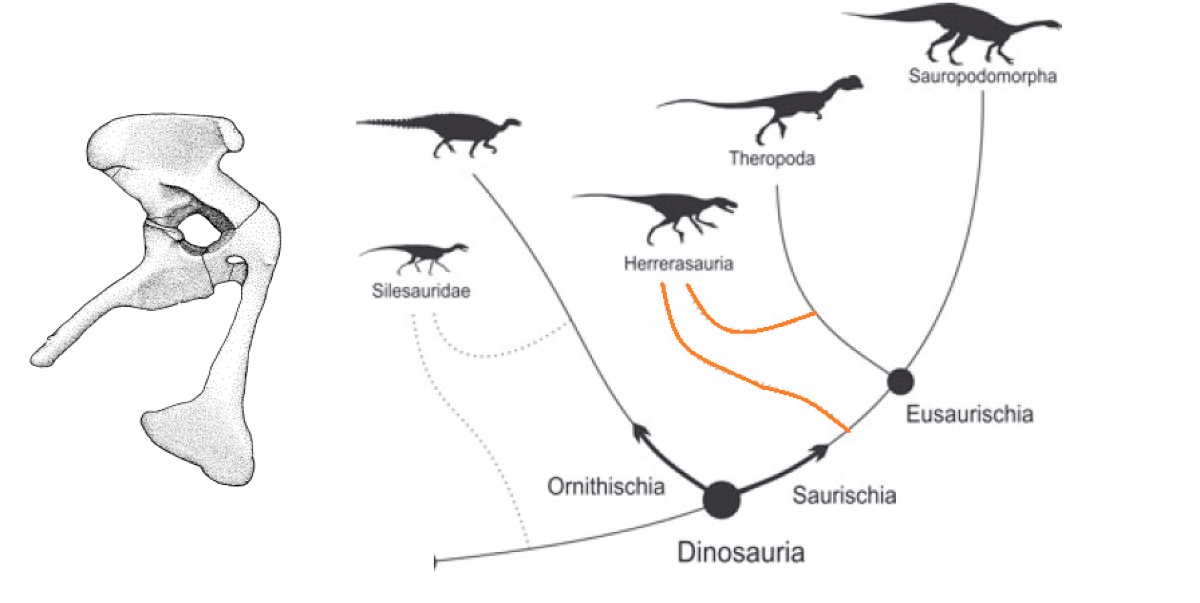
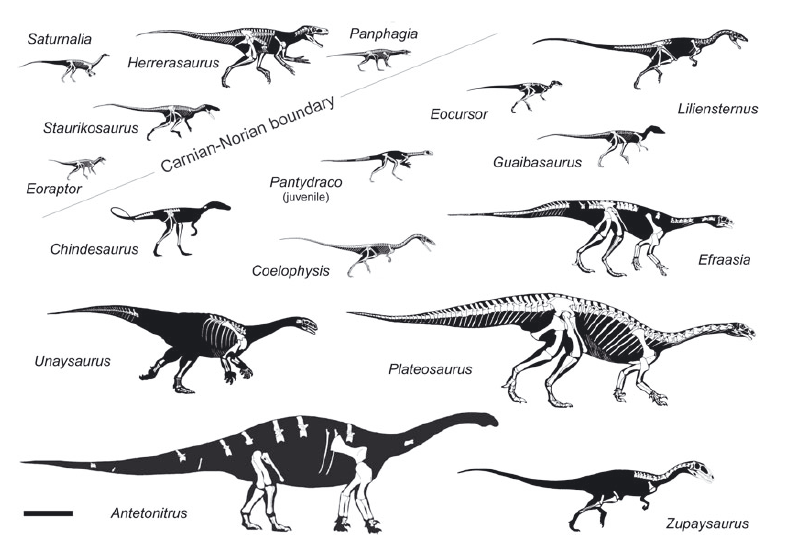
One of the dinosaurs that remains a matter of controversy to this day is Herrerasaurus ischigualastensis. The first specimen was discovered in 1959 in the Ischigualasto Valley by Victorio Herrera, a local guide who was part of the paleontological team from the National University of Tucumán. The specimen was studied and named by Dr. Osvaldo Reig, who, paying tribute to its discoverer and to the locality, initially considered it an ancestral carnosaur theropod (the group that would later include giants like the allosauroids or the carcharodontosaurids such as Giganotosaurus).
Our lands weren't just home to colossi, they were also the setting for the beginning of the dinosaurs' great evolutionary story.
Since that find, several specimens of this dinosaur have been recovered from the formation, including articulated skeletons, complete skulls and juvenile individuals. And it remains to date one of the most primitive dinosaurs on record: it was a bipedal carnivore of slender build, with a long tail and an elongated skull, an estimated length of between 3 and 6 meters and a weight of roughly 200 to 350 kg — that is, a considerable size if we bear in mind that it's one of the earliest forms of the group.
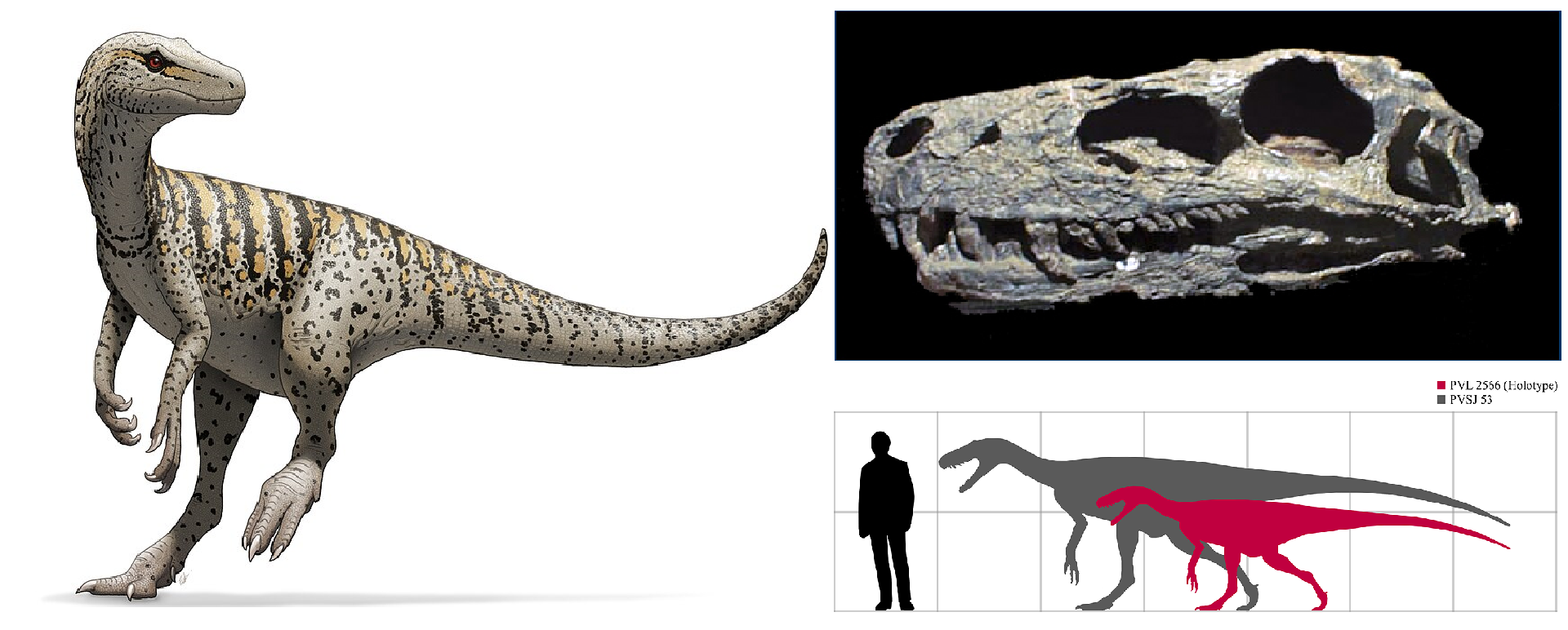
The main controversy lies in its position on the dinosaur evolutionary tree. Although it displays clear defining features (synapomorphies) of Dinosauria, it retains ancestral traits (plesiomorphies) shared with non-dinosaurian archosaurs. Its pelvis is of the saurischian type (with the typical triradiate arrangement, in which the pubis points forward and downward and the ischium backward), but its acetabulum (the joint socket into which the head of the femur fits) is only partially open. In addition, its ilium articulates with only two sacral vertebrae (the region of the spine that connects to the pelvis), a primitive condition compared with the three or more sacral vertebrae of more derived dinosaurs. At the same time it has advanced features such as a long pubis with a marked "pubic boot" at the end and vertebral centra with a narrowed waist (hourglass-shaped), similar to those of more advanced theropods like Allosaurus.
This combination of characteristics makes it far from easy to classify among the major dinosaur groups. We know it's a saurischian, but its position swings between being considered an ancestral theropod or a primitive divergent saurischian predating the split between theropods and sauropods. What are the implications of each hypothesis?
If it is interpreted as a true theropod, that implies that the three great dinosaur lineages (theropods, the bipedal carnivores; sauropodomorphs, the long-necks; and ornithischians, the ornamented/armored forms) had already diversified before the middle Carnian (~232 Ma), and that certain "advanced" features of the locomotor skeleton were acquired independently in different lineages, such as a more advanced ankle joint or an open acetabulum.
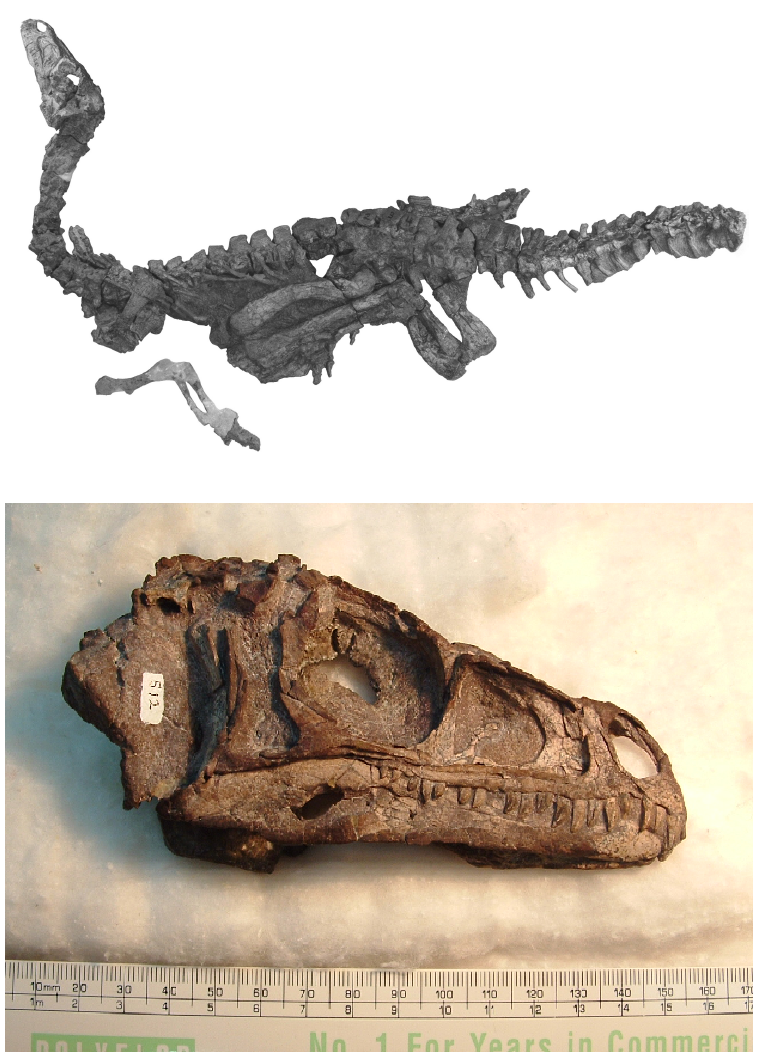
Another key player in the origin of dinosaurs is a small biped found in the Valley of the Moon in 1991, during a joint expedition by the Museum of Natural Sciences of the National University of San Juan and Chicago's Field Museum (led by Paul Sereno and Ricardo Martínez). This small, practically complete specimen, which included a preserved skull, was named Eoraptor lunensis, meaning "the first hunter of the Valley of the Moon." The "first hunter" label is well earned, because the formation in which it was found is dated to 231–228 million years ago (Upper Triassic, Carnian), placing it among the oldest known dinosaurs.
Eoraptor was a small bipedal dinosaur 1.3 meters long and with an estimated weight of 10 kg. Its anatomy shows primitive traits and an evolutionary state extremely close to the hypothetical ancestral condition of all dinosaurs. Unlike more derived carnivores, Eoraptor has a primitive five-fingered hand (of which only the first three had functional claws used to grab prey, while fingers 4 and 5 were reduced). It also lacked the mobile joint in the lower jaw that theropods used to swallow large prey.
This small, practically complete specimen, which included a preserved skull, was named Eoraptor lunensis, meaning "the first hunter of the Valley of the Moon."
A very distinctive feature is its dentition: it has recurved, serrated upper premaxillary teeth (typical of carnivores/theropods) alongside leaf-shaped mandibular teeth (typical of the ancestor of sauropods/basal herbivores). This suggests it had an omnivorous or opportunistic diet. For all these reasons, the position of Eoraptor has also swung in the scientific literature between being the most primitive known theropod and being one of the most basal sauropodomorphs, placing it very close to the very root of Saurischia.
As I've been explaining, these ancestral dinosaurs — even though their exact position in the evolutionary scheme is still debated — are considered full-fledged dinosaurs. But it's also important to understand the previous evolutionary step, what is called a dinosauriform. And to find these "almost dinosaurs" you have to go a bit further down the geological sequence and look at the Los Chañares Formation (La Rioja), whose rocks are slightly older than those of Ischigualasto (approximately 236 to 234 million years, in the Middle-Upper Triassic).
The next reptile I'm going to talk about was caught up in a taxonomic tangle for 50 years. Between 1964 and 1965, joint expeditions from Harvard University, the La Plata Museum and Argentine paleontologist José Bonaparte unearthed in the reddish sediments of Chañares the fossils of small reptiles barely 30 centimeters long. In 1971, American paleontologist Alfred Romer described the first specimen under the name Lagosuchus talampayensis, meaning "rabbit crocodile of Talampaya," a reference to its small size and agile appearance. At the time, Romer classified it among the "pseudosuchians," a group more closely related to crocodiles than to dinosaurs (I'll get to them: article pending).
Shortly afterward, in 1975, Bonaparte reexamined the material and proposed the hypothesis that Lagosuchus was not simply a primitive archosaur, but the crucial anatomical link between ancestral archosaurs and saurischian dinosaurs. However, in 1994 paleontologists Paul Sereno and Andrea Arcucci analyzed the original holotype skeleton (L. talampayensis, catalogued as PULR 09). They concluded that the fossil was too incomplete and poorly preserved for the diagnostic characters that define the species to be clearly observed, and declared it a nomen dubium (dubious name). In order to classify the better-preserved specimens held at the Miguel Lillo Institute in Tucumán, they defined a new genus and species: Marasuchus lilloensis. Marasuchus means "mara crocodile," a nod to the original name since maras are known as Patagonian hares. For 25 years, Marasuchus was the standard name in international scientific publications.
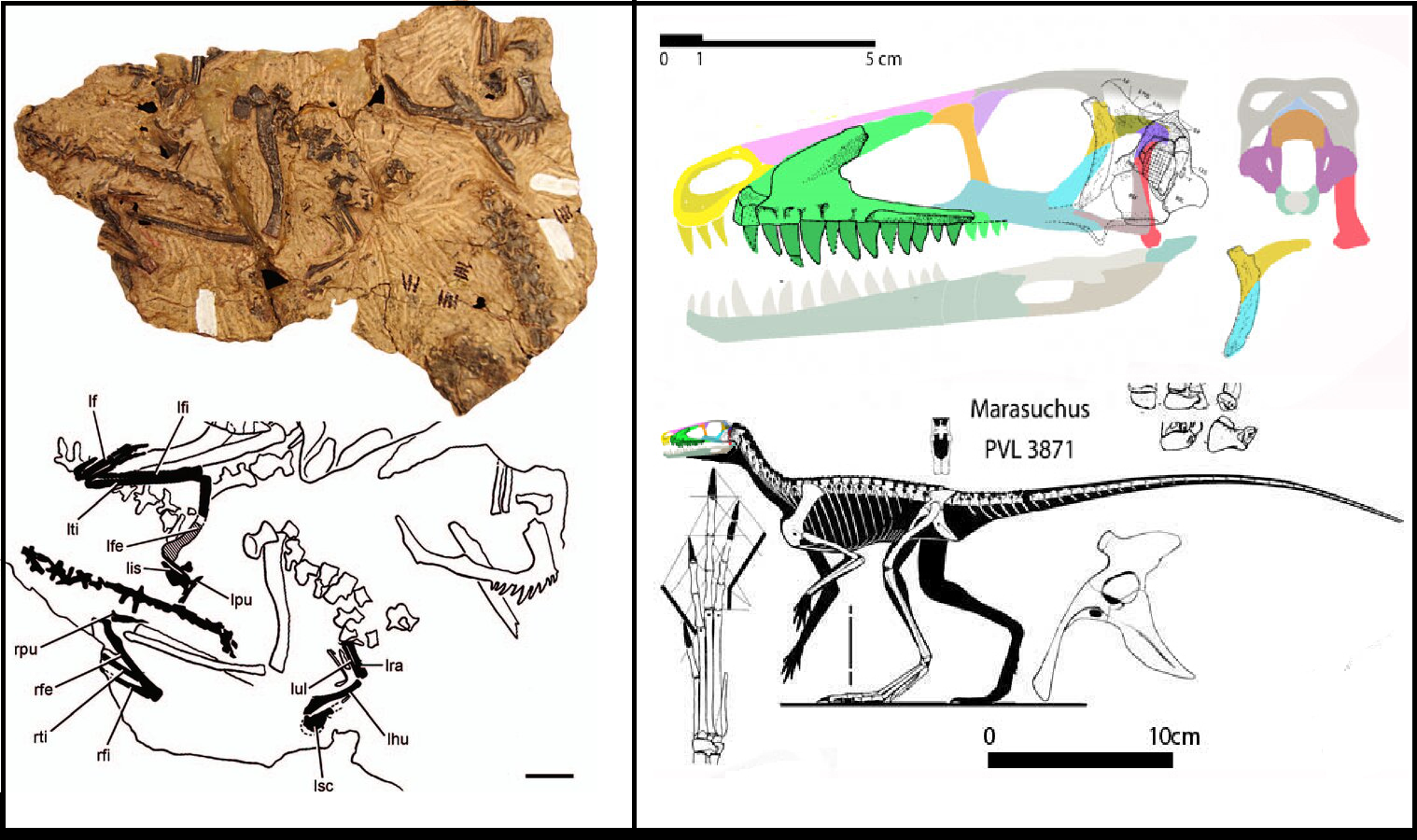
The debate seemed to close in 2019, when Argentine paleontologists Federico Agnolín and Martín Ezcurra reexamined the original holotype with modern techniques. Their study concluded that the first skeleton does have sufficient diagnostic features and is indistinguishable from the specimens assigned to Marasuchus. Applying the rules of zoological nomenclature, they restored the validity of Lagosuchus talampayensis by historical priority, although in the paleontological literature both names remain closely linked.
Marasuchus (or Lagosuchus) was a small animal roughly the size of a pigeon or a small mara, with a bipedal posture, a slender S-shaped neck, an elongated tail and carnivorous or omnivorous habits. Its maxilla bore serrated, blade-shaped teeth, while the posterior teeth were less curved and leaf-shaped. This small reptile also lacked the sliding intramandibular joint that is characteristic of theropods for handling large prey. The neck vertebrae were elongated and arranged so as to give the spine a curvature very similar to what you see in birds today. In the hip it retained only two sacral vertebrae (compared with the three or more characteristic of dinosaurs).
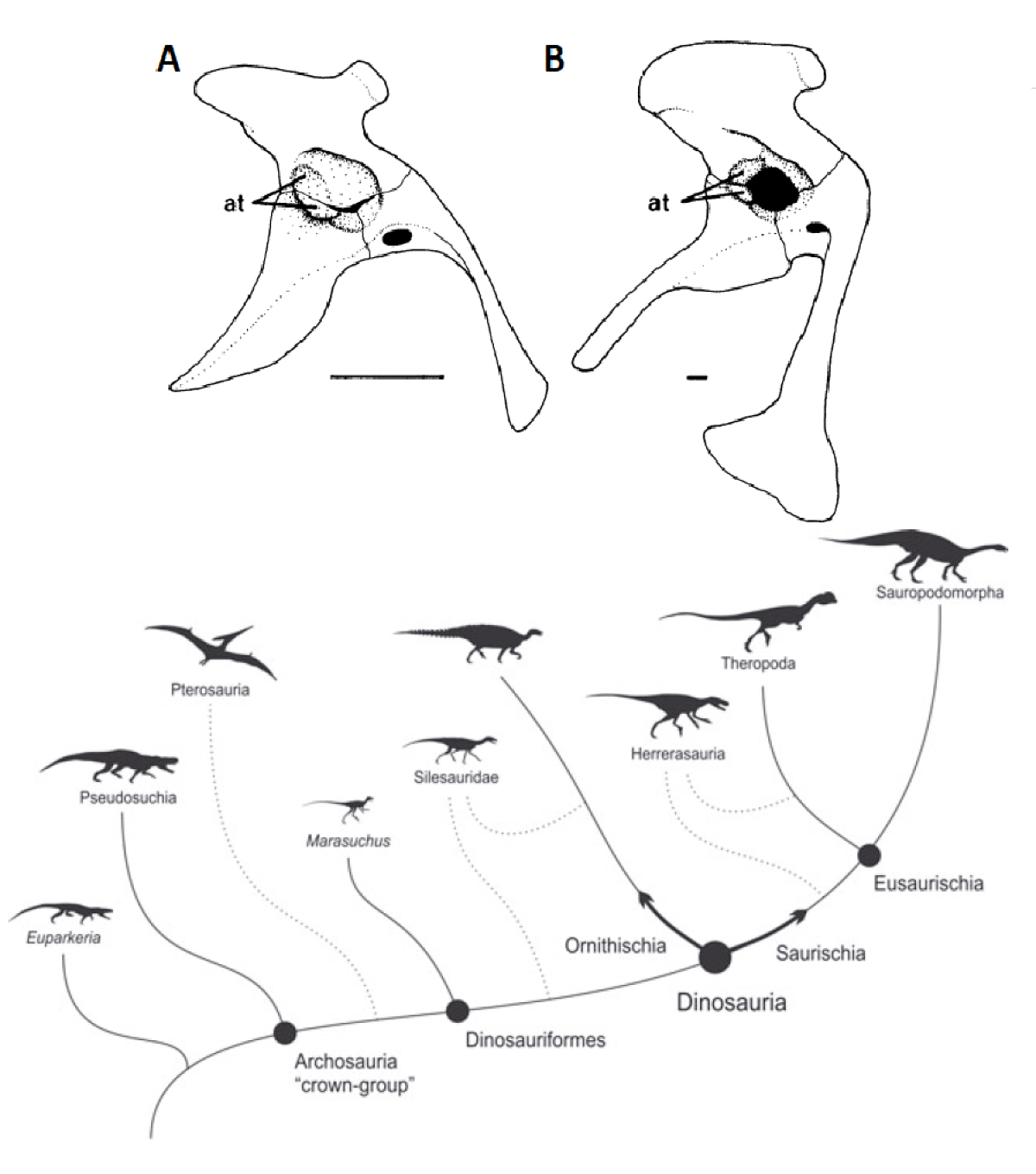
Although its body proportions and the head of its femur reflect bipedal locomotion adapted for running, it still retained a closed acetabulum (with a solid inner bony wall), unlike the open, perforated socket characteristic of dinosaurs. Hence it is considered a member of the Dinosauriformes, that is, a cousin of all dinosaurs. It also showed a transitional state in the hip: the contact between the ilium and the ischium along the edge of the pubis was beginning to shrink, foreshadowing the open joint socket that would define later dinosaurs.
All this emphasis on hip anatomy isn't some whim of paleontologists: the pelvis is the biomechanical key to this evolutionary revolution. Going from a semi-sprawling posture (legs out to the sides, like lizards) to an erect posture (limbs placed directly under the body) changes the way an animal moves. This restructuring gave them superior speed and agility to run, maneuver and explore their surroundings far more efficiently. And it also follows from this that such an active lifestyle demanded an enormous energy intake, which drove up their metabolic rate and probably led them to develop endothermy, or "warm blood."
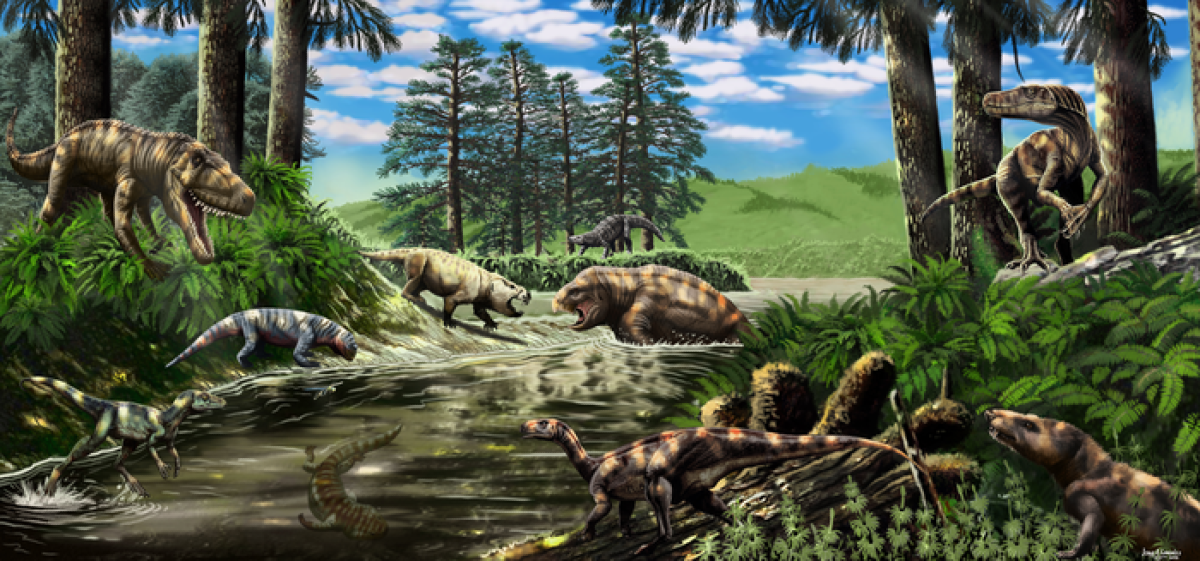
As we saw, the first dinosaurs and their ancestors were small, but they were also minor players within Pangea's ecosystems. The sediments of Chañares and Ischigualasto show that most terrestrial niches were occupied by pseudosuchians (distant relatives of crocodiles) and by various groups of synapsids (relatives and ancestors of mammals).
While the first dinosaurs scurried among ancient ferns, the top of the food chain belonged to their archosaur relatives, the rauisuchians — basically big land crocodiles with erect posture and robust skulls — and to semiaquatic hunters like the agile, meter-long caimans that already existed in the Triassic. The great mass of herbivores was more varied: rhynchosaurs, chunky archosaurs with parrot-like beaks they used to dig and root out food; aetosaurs, armored pseudosuchians 3 to 6 meters long with bony plates and spines and snouts like a pig's; and among the mammal relatives, dicynodonts, rhino-sized browsers with a toothless beak and just two tusks, which lived alongside cynodonts about the size of wild boars, with molars for chewing vegetation.
But if they were barely supporting actors in terrestrial faunas, how did they achieve global dominance? To pull it off, the dinosaurs needed a change of scenery on a planetary scale.
The first environmental jolt was what's known as the Carnian Pluvial Episode (CPE), between 234 and 232 Ma. At that time, the supercontinent Pangea was one huge desert. The event interrupted this arid climate regime with a hiatus of one to two million years of warm weather and intense rainfall. This new climate transformed the landscape and triggered a floristic diversification in which hygrophilous (moisture-loving) plants proliferated, such as conifers, ferns and bennettitaleans. The floral restructuring destabilized specialist herbivores: groups that had previously thrived, like rhynchosaurs and dicynodonts, saw their dietary versatility reduced and began to lose ground. By contrast, the more generalist herbivores benefited, and the ancestors of the sauropods went through their first major diversification. While this didn't turn them into the dominant forms in these faunas, it worked as the first catalyst of their evolution and let them gain ground while their main competitors lost versatility.
The next event finished consolidating the dinosaurs' position. Two hundred and one million years ago, at the end of the Triassic, a mass extinction occurred. Extensive volcanic eruptions from what is called the Central Atlantic Magmatic Province — the geological event that began the breakup of the supercontinent Pangea and the opening of the Atlantic — produced climatic and environmental changes on a global scale. Flora was significantly affected by these environmental changes, which put plant communities through a major ecological restructuring. The shift in vegetation type meant that the large terrestrial faunas that depended on it were hit hard, like the pseudosuchians and the large synapsids, which could not survive the crisis and went extinct.
If they were barely supporting actors in terrestrial faunas, how did they achieve global dominance? To pull it off, the dinosaurs needed a change of scenery on a planetary scale.
It was a definitive evolutionary opportunity. Being generalists with greater plasticity, the dinosaurs made it through the extinction filter. With the big terrestrial ecological niches vacant, they went through an explosive adaptive radiation, quickly diversifying and occupying every available habitat, becoming the dominant forms for the rest of the Mesozoic.
The sediments of our country show us an entire empire of great reptiles from its very beginning. Far from the huge, impressive titans that would dominate Patagonia for millions of years, their ancestors were modest creatures that might have come and gone without a trace if the Earth hadn't given them the little nudge they needed to become lords and masters. The Triassic teaches us that sometimes you don't have to be the biggest of all to leave the deepest mark on the history of life
Y a cada colaborador se le paga por su trabajo. Las dos cosas dependen de los suscriptores.