North Korean Hackers: A Matter of State Policy
With no civilian internet and under sanctions, North Korea trained some of the best hackers in the world. Then it put them to work stealing for the Crown.

The tech world can no longer be thought of outside its chains of interdependence with the geopolitical and commercial world. Lines of code, digital infrastructure and public and private software have for decades been critical systems for the day-to-day operation of governments, banks and health systems around the globe. We live in a world that is not only postindustrial and post-geographic, but one in which all the grand political narratives of the 20th century collapsed, to the baffling premature glee of the prophets of the end of history. At the same time, the post–Cold War narratives (the liberal West, the supposed infallibility of the global trading system) were also dismantled, not over decades but in just a few years, in the wake of events that twenty years ago would have seemed dystopian to us: Brexit, the trade war declared by Trump, the conversion of intellectual property into national security doctrine, and the declaration of the microchip industry as a critical industry subject to Washington's veto power, as if chips were weapons that could fall into the hands of existential enemies of the American empire.
The tech world can no longer be thought of outside its chains of interdependence with the geopolitical and commercial world.
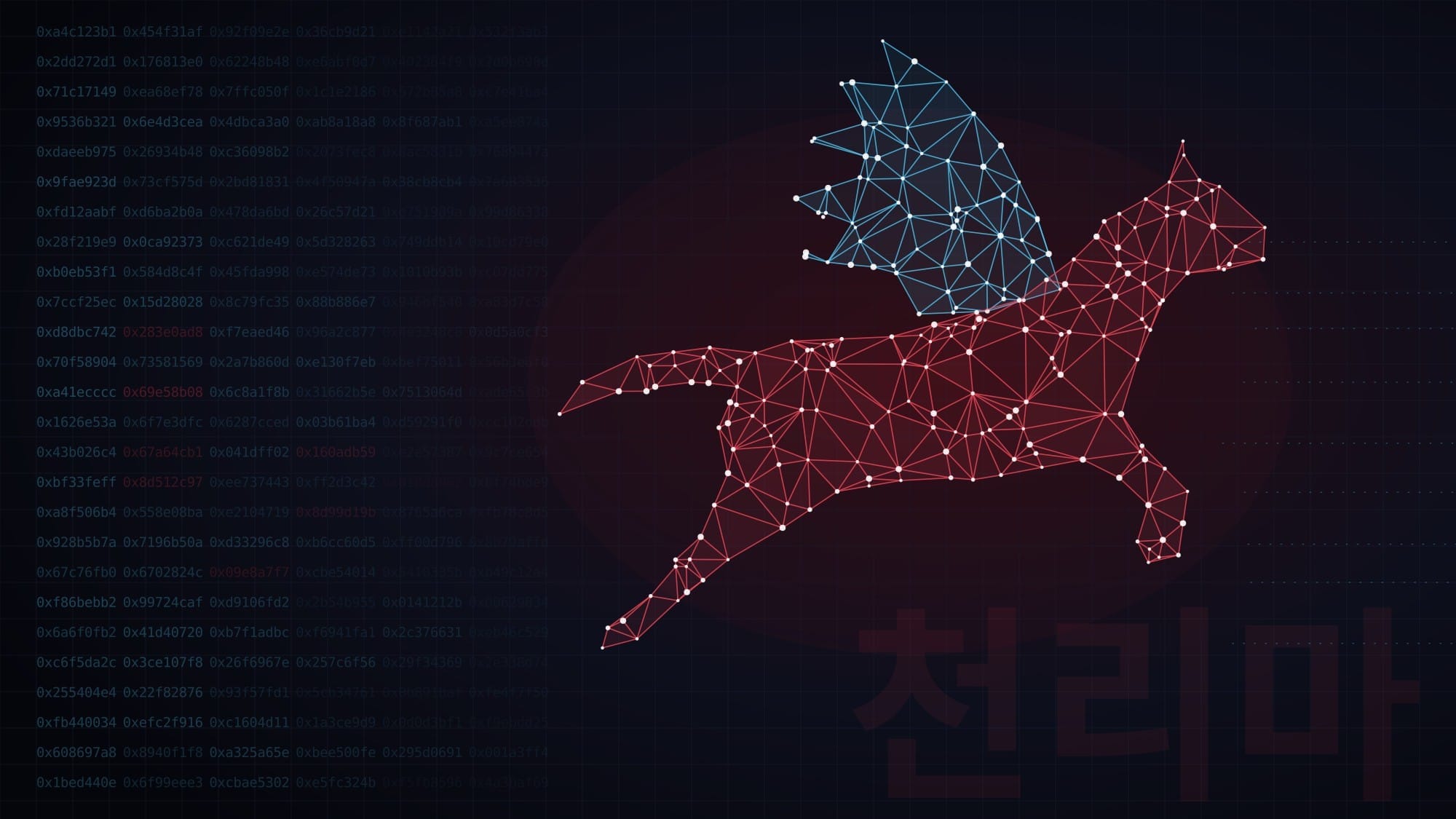
And yet, in this same digital, post-digital or whatever world we inhabit today, ad portas of AGI or whatever buzzword best suits the narrative of the moment, a cyberpunk holdover persists: the chollima. The Chollima is a winged horse from Korean mythology, able to cover a thousand li in a single day. In the late fifties the regime turned it into the emblem of its productivity movement, and the cybersecurity industry recycled it: CrowdStrike names every group attributed to North Korea "X Chollima." Here we use the term broadly, to refer to the various units or clusters of the state agencies of the Democratic People's Republic of Korea (DPRK), or, as we know it thanks to the Western press, North Korea.
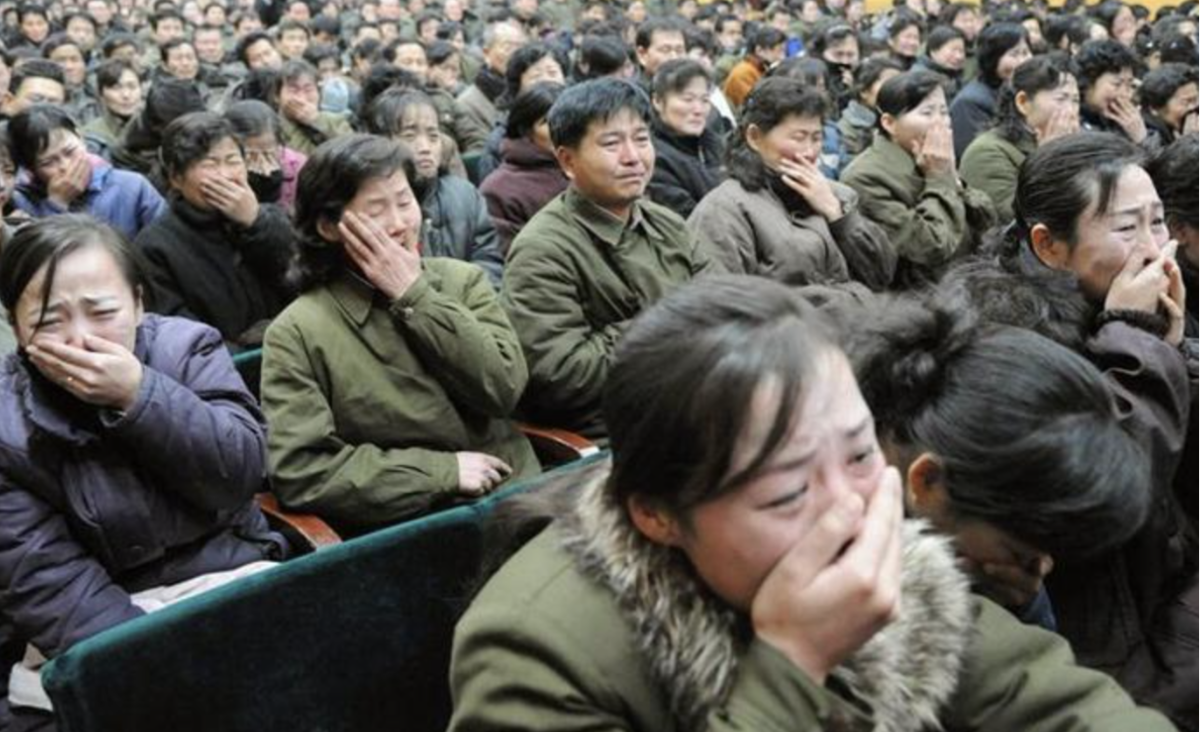
I call them a cyberpunk holdover because, thanks to the Western press's narrative and to the reality of life under a juche communist regime more than thirty years after the fall of the Berlin Wall, we assume that daily life in the DPRK is that of a country completely cut off from the cultural, commercial and technological circuits of the rest of the world (partly true). We also assume it runs on the quasi-slave labor of huge swaths of its population, who blindly trust their beloved Leader and who, given the choice, would gladly flee to the capitalist West or to Washington's ally in the South, across one of the most militarized borders on the planet. And that North Koreans are a kind of noble savage, shielded from Western thought by isolation, yet living ascetic lives of unpaid toil in gray regime-owned structures. A museum nation of what we imagine Hoxha's Albania, Pol Pot's Cambodia or Ceaușescu's Romania were like: yet another version of the Western habit of looking at Asia through stereotypes.
But any attempt to understand the regime runs into a few premises that North Korea's own national narrative puts front and center, and that are worth taking seriously even if you don't share them:
- Korea is a historically besieged nation. It was pressured and subjugated by neighboring empires (the Mongols, Chinese dynasties, the Manchus and, above all, Japan, which annexed it from 1910 to 1945), and for centuries it has been building, against all odds, a national and ethnic identity, an epic and a language related to but distinct from those of its neighbors.
- The split is recent. The 1945 division and the Korean War (1950-1953), which worked both as a civil war and as a proxy war between the United States, China and the USSR, are just a small fraction of a millennia-old history, however natural the partition may seem to us today.
- Juche and chollima have roots that predate the Kims. The juche doctrine (national self-reliance) and the chollima movement (workers' effort to push the boundaries of the possible without expecting individual reward) rest on a substrate of national thought older than the dynasty's socialism, even though it was the dynasty that turned them into state ideology.
- The collective outweighs the individual. As in much of Asia-Pacific, loyalty, individual sacrifice and the common project are highly prized traits. Individuals feel part of an epic and a civilization bigger than their own interests, and that message is reinforced by each state's media apparatus, regardless of ideology or latitude.
- To arm yourself is to survive. Since the 1953 armistice, the DPRK has bet on developing cutting-edge military, communications and technological capabilities. This is the premise that ties the others together: in the regime's reading, Korea is surrounded by hostile powers, it needs to arm itself to the teeth to defend its history and its way of life, and in that patriotic defense, anything goes.
Something less well known follows from these premises. The DPRK did try to plug into the global economy: in the early seventies it bought industrial plants and machinery from Japan and Western Europe on credit, and in 1974 it became the first country in the communist bloc to default on its Western creditors. Between the hostility of its ideological enemies and its limited inclination to pay its debts, it ran out of credit and quickly turned to less-than-kosher channels to fund its nuclear arsenal, buy weapons and even build civilian infrastructure. It used smuggling (as early as 1976 the international press was reporting contraband and drugs in the diplomatic pouch), piracy, theft and other criminal activities, and it got serious about creating entities devoted to asymmetric warfare, which increasingly brought the cyber domain into its conflict with its southern neighbor, with the West and, ultimately, with the rest of the world.
Kim Jong-il reached that conclusion early. In 2005, the electronic warfare reference manual from the Korean People's Army's military publishing house quoted him: "If the internet is like a gun, cyberattacks are like atomic bombs" (Kong, Kim and Lim, CCDCOE, 2019). Later, at a high-level meeting after the US invasion of Iraq, he offered this definition:
If until now war was about bullets and oil, in the 21st century it is about information. War is won or lost depending on who has greater access to the adversary's technical-military information in peacetime, how effectively they can disrupt its command-and-control information, and how well they use their own.
After the death of the Comrade Leader on December 17, 2011, control of the Workers' Party passed to his son, Kim Jong-un. Besides being the chubby guy from the memes (star of classics like Kim Jong-un looking through binoculars), Kim Jong-un modernized the cyber capabilities of the military and intelligence agencies and bet big on continuing to develop nuclear bombs and missiles. In 2013, according to a South Korean official quoted by the Chosun Ilbo, he said that with strong information technology and brave warriors like those of the Reconnaissance General Bureau (RGB), they could break through any sanctions and build a strong and prosperous country. That same year, according to South Korean intelligence, he described cyberwarfare as an "all-purpose sword." The RGB, created in 2009 by merging several agencies, included from the start Bureau 121, dedicated to cyberwarfare. In September 2025 it was expanded and renamed the General Reconnaissance and Information Bureau, and in July 2026 Kim ordered its functions expanded "in multiple directions."
This background explains how a nation supposedly cut off from modern communications, with no civilian internet access and no part in the usual networks through which academic and industry information circulates (no papers, conferences, seminars or known collaboration with the leading cyberdefense countries), came to have some of the world's best groups at destabilization, cyberespionage and, flat out, stealing and siphoning funds. Despite its self-imposed isolation, the regime saw building those capabilities, promoting its best students and forming elite units that steal for the Crown as a sacred mandate and a matter of survival.
The regime saw building those capabilities, promoting its best students and forming elite units that steal for the Crown as a sacred mandate and a matter of survival.
So units of the RGB and other DPRK military intelligence agencies formed APTs (Advanced Persistent Threats) that carried out operations of destabilization, sabotage, theft and money laundering, infiltration and intelligence. The most famous is Lazarus, though today that name works more as an umbrella: the industry is dropping it because it lumps together too many different teams. The rap sheet is long: the 2014 Sony Pictures hack in retaliation for The Interview; the theft of USD 81 million from the Central Bank of Bangladesh in 2016, which could have been nearly a billion if someone hadn't noticed "fandation" misspelled in a transfer order; WannaCry in 2017; the USD 625 million from the Ronin bridge in 2022. And their favorite target these days is crypto exchanges. In February 2025 they made off with about USD 1.5 billion in ether from Bybit, in a supply chain attack that went through a SafeWallet developer's compromised computer. Over all of 2025, according to Chainalysis, North Korean groups stole USD 2.02 billion, nearly 60% of everything stolen in the crypto ecosystem, with 74% fewer known attacks: fewer heists, bigger ones. And on October 29, 2026 came the all-time record: more than USD 6.3 billion left the hot wallets of Binance, the world's largest exchange (Elliptic puts it at 6.43 billion), and two days later the FBI attributed the theft to TraderTraitor. A single heist roughly equal to almost everything Pyongyang had stolen in crypto over the previous decade.
The problem is no longer figuring out who did it. Attribution keeps getting faster; the hard part is prevention and recovery. Since Russia vetoed in 2024 the renewal of the UN panel of experts that monitored sanctions, tracking has fallen to a group of eleven countries. Its 2025 report describes how Pyongyang uses stablecoins to buy military supplies and deploys IT workers in at least eight countries, hired under fake identities by companies that have no idea whose paycheck they're signing. It's hard to predict what an attacker willing to do anything will do, with the full backing of its government, whose sole motive isn't stealing or holding the information it finds for ransom, but who has the technical skill, the patience and the drive to act for a higher good and for the survival of its national project, without falling into the clichés of politically motivated cyberactivism or the logic of garden-variety cybercrime. That's what makes it so dangerous.
Because, as we'll see in other articles, artificial intelligence plays for that team too. In March 2025, according to Daily NK, Kim ordered the creation of Research Center 227 inside the RGB, dedicated to developing AI-based information theft techniques; the firm DTEX later documented its existence. In August 2025, Anthropic reported that North Korean operatives were using Claude to land and hold remote jobs at Fortune 500 tech companies, and that AI had eliminated what used to be their bottleneck: years of technical training. CrowdStrike called Famous Chollima the most skilled adversary when it comes to generative AI, after it placed operatives in more than 320 companies in a single year. And the Binance heist itself started right there. According to the exchange's report, in June an engineer downloaded a tampered installer while looking for an AI coding tool. In September, another engineer sat through a fake job interview and downloaded a "technical exercise" laced with malware. In October, the attackers pivoted through an internal AI tool until they reached the signing infrastructure.
Writing code is no longer the limit; the limit is the judgment to use it, and the DPRK has plenty of that to spare. AI opens the door to constant vulnerability scanning done not by hobbyists but by people who actually know how to scan for vulnerabilities. And when a nation's leadership is capable of systemic thinking and its plans don't hinge on two- or four-year political cycles but on a centuries-long battle for the national soul, it can afford the time to wait, the effort to infiltrate, and the risk of losing in the short term, when what's at stake in the long run is the greatness of its nation.
Las notas de 421 no tienen paywall
Y a cada colaborador se le paga por su trabajo. Las dos cosas dependen de los suscriptores.