Paula Maffía's “The Affective Republic”
Paula Maffía defies the algorithm with “The Affective Republic”: an organic, passionate album where desire serves as a refuge.
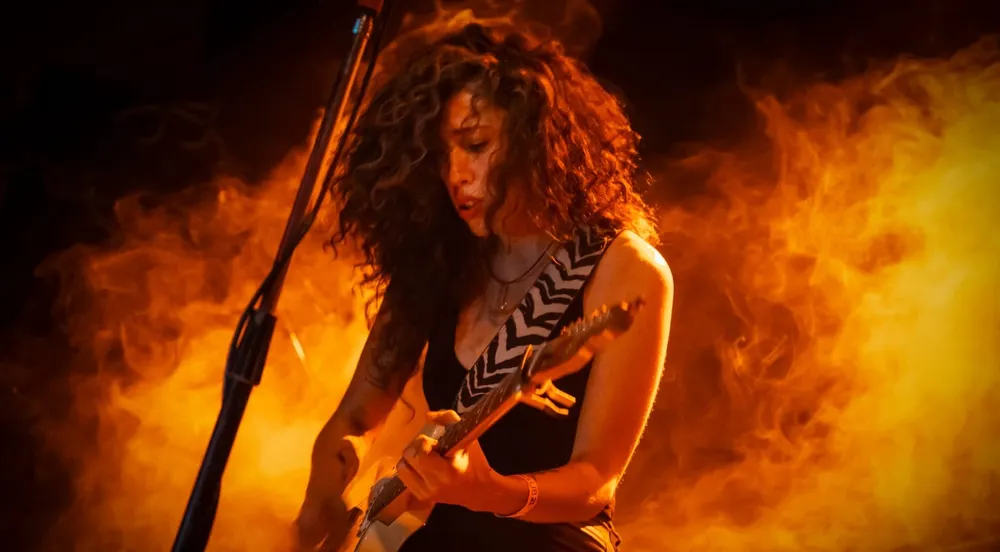
The first album by La Cosa Mostra, the band led by Paula Maffía alongside her frequent collaborator Lucy Patané, was titled Greatest Hits. Beyond the joke, in this case, success was synonymous with circulation, and circulation guaranteed that the matter had become irreversibly established. From that time, something more than a knack for wordplay remained: if back then it was a smart move to present themselves as the most queer mafia ready to, precisely, show themselves, a bit of that willingness to embrace ambiguity has always guided Paula's work. The early decades of the millennium found her collaborative in her projects, eager to form groups like Las Taradas, los Sons, la Orgía, and a few others. All the formations she proposed had warmth and a talent for executing with weight. Almost as if they embodied the very notion with which Led Zeppelin perceived themselves: the lead that knows how to resonate heavily but can also rise and float; starting in canzonetta and ending in an ensemble on the brink of decomposition. In Paula's live performances, the explosion has always been controlled, harmonized, with the melody mirroring its original arc.
Then came the album Orgía (2014), followed by Ojos que ladran (2015), and in 2019, Polvo, a defining album. Nominations for awards, opening for Patti Smith at Luna Park, word of mouth, and the solidification of one of the most important voices in the national scene. She then released Lesbiandrama (2024), another joyful collaboration with Lucy. And here we are, facing la República Afectiva (2026).
Nominations for awards, opening for Patti Smith at Luna Park, word of mouth, and the solidification of one of the most important voices in the national scene.
When we think about music that looks to the future, we often focus on those kinds of expressions that turn their backs on the comfort and guarantees of the industry, that break with the past and dare to imagine new horizons. This is an idea I explored in this space, approaching the works of Camionero and Indio Solari, after Simon Reynolds and Mark Fisher. But there’s another component to consider when thinking about the music of the future, and it would be foolish to overlook it: how it connects with the digital realm.
Like the rest of the arts, music has faced what we might agree to call a crisis of formats. The progressive and repetitive dynamics of these crises within the 20th century can be quickly understood: first, the phonogram itself becomes a commodity as it can be recorded; then a format emerges that consolidates for several years (the shellac record, then vinyl), along with its corresponding dissemination tools (studios, the conception of a song form that becomes popular when played on the radio, the radios themselves, television, etc.). Time passes, the cassette appears, then the CD, later the mp3, and finally, digital platforms come into play that govern this era, which will also have their decline.
The era of digital platforms inherits all the reflections of an industry inclined towards concentration. While this time presents some antibodies, such as the incessant traffic of P2P files or some platforms that offer artists a better deal, like Tidal, the truth is that, after a transition where piracy seemed to prevail, the industry found a way to institutionalize digital files and charge users a subscription to listen to a .wav file.
The internet thus invades the listener's body, mediating, to quote Ricardo Iorio, “between the reality of man and real life,” and imposes a way of listening.
Paula's music is on the platforms. But her work, in all its forms, is a stance against the demands of the most instantaneous and immediate part of the market. It’s not a spear; it’s a basket. We’ll get to that soon.
Analog to the last sound membrane, the integral proposal is so human in its execution that it’s very difficult to present it exactly as it was recorded. An assembly of instruments, the project was directed by Juanito el cantor, who also played bass and some guitars; Lucio Mantel arranged the strings, Martín León Benito played drums, and the album features trombone, trumpet, baritone sax, bombo legüero, violin, viola, cello, marimba, vibraphone, and the list goes on a bit more.
As numerous as it sounds, the assembly presented the album with all its musicians on May 20 at Niceto.
That night, the best thing that can happen to a new album occurred: its songs replaced those of its predecessor, Polvo, as the main numbers. The transition had already been hinted at in more intimate dates for Paula, like Boca de Buzón, a poetry and song project she shares with writer Mana Bugallo. “El Club de la pelea” and “Whisky,” the first two previews of the album, had their fixed place in the tracklist. But, before a packed Niceto, Paula showcased a narrative that allowed for her classic solo pieces from yesterday and today, but the climactic moments were almost all from the songs that had just come out a month prior. It’s a boldness that not all songwriters can afford: it requires an audience willing to set aside the comfort of the lyrics already known by all. The chorus, an undeniable verification that what happens live is anticipated by the audience, is a gratification that one, who doesn’t make music with words, can imagine as addictive. Or, in any case, pleasant. A song needs the chorus like a comedy needs laughter. And it’s very difficult for a new song to activate that collective neuron ready to sing.
Analog to the last sound membrane, the integral proposal is so human in its execution that it’s very difficult to present it exactly as it was recorded.
When in May of this year Fito Páez decided to play his album Novela (2025) from start to finish during the first part of a show, his audience booed him. The scene is not analogous to the show proposed by Paula, primarily because the albums are different. Novela is a conceptual album, quite distant from the type of song that won Fito his audience's hearts. But what serves to approach the state of reception by the audience, at least among the middle or upper-middle class porteños with access to a ticket for the Movistar Arena, is that Fito had announced he wanted to reserve the venue to play his album in full. And, oh, blessed consistency with what was announced, that’s exactly what he did!
The booing came from some sections of the audience, and the misunderstanding of the aesthetic event also reflects the blindness with which people sometimes attend events. The Movistar has become a venue with its own circuit: there are people who attend concerts held there not necessarily because an artist they longed to see is performing, but because the experience of attending turns music into an excuse to go out in Villa Crespo.
This isn’t a very enamored description of porteño culture, but I believe it’s faithful to what we see in the entertainment industry. While some artistic expressions of the highest quality have to settle for trying to fill venues of between 150 and 1000 seats, others of lesser quality enter a cultural itinerary established to provide all forms of accessibility, from urban to artistic.
In that sense, Fito's decision was a small transgression against the great prohibition of the national music machinery: don’t stray from your Greatest Hits.
Perhaps saving, once again, the differences between albums, that rift between the conservatism of an audience convinced of what it wants and the desire to rebel against those expectations reminded me of the reception Flaco Spinetta encountered during the first decade of the 2000s when he presented Silver Sorgo (2001) or Para los árboles (2003) and included maybe one or two classics from his repertoire at the end, as a complacent thank you to the attendees for their effort to receive the novelty.
The decision of Fito was, in that sense, a small transgression to the great prohibition of the national music machinery: don’t stray from your Greatest Hits.
We’re not very good at processing the synchronicity of art. Works pass with their context, and crafting explanations can be as futile as asking the authors for them. But capitulating in reflection or the exercise of thought is to hand over responsibility to a posterity that shouldn’t have to disregard, at the very least, the documentation that we were attentive. Opening the discussion, only to later regret it in healthy debate.
Fernando Bogado has a poem about literary criticism that I always think of and often misquote, urging us to think of ourselves before we are thought of. Or, at the very least, to present ourselves in some place where what will shape our nostalgia in a few years is happening.
This is what Rosario Bléfari was getting at in her Facebook post from November 20, 2014. It’s a manifesto that resonates with a certain group of people:
I always have the feeling that every moment we live is historic, which is why it’s important to be present, go to concerts, meet friends, read living writers, go to the theater, watch new movies, listen to albums, talk to people, walk around the city, attend a march, witness a congressional session, run errands, go to the market, have a project and pursue it no matter what, even if someone considers it a failure, participate in what’s happening, however you can, just be there, live the contemporary, without nostalgia, it’s the best even for when someone asks us if we have something to share.
The words, arranged this way, encapsulate almost everything one can say in response to the arrogance of discouragement. They seem like a kind of spell against nihilism, against the piercing feeling that everything is lost, that there’s no future, and that the only way to read the times or challenge the present is through a process of deconstructing reality, in a postmodern battle against the idea of building spaces from scratch, with the intuition that they might resonate in an uncertain future.
So, what about the album?
On a first listen, without fear of pleonasms, one might think that República Afectiva is an album about affection. Already wounded by literalness, the listener might double down on their listening, to see what they find. It’s possible that even with this approach to the album, beyond the song as a unit, one can start to understand that those sung syllables are signs and even words, and it’s possible that then the true theme of the album emerges: desire.
This note was proposed to 421, a collection of cool readings, a few months ago. The idea was to interview the album’s author. But it turned out that I interviewed Paula in another medium, the streaming program Cita a Ciegas, which airs on Posdata, and there live she confessed to me that explaining her work is not something she enjoys. Which, by the way, makes a lot of sense. Unfortunately, interviews with musicians often focus on the meaning of the songs and occasionally touch on the technical, material aspect of the music. Explaining a work is an exercise as old as art itself (I think, perhaps embodying it, of Mario Servio Honorato, a grammarian who walked the earth in the 4th century AD, whose commentary on the Aeneid, In Vergilii Aeneidem commentarii, is preserved in full and is a kind of required reading for Latinists). The exercise of commenting, which also accompanies the writings considered sacred, expands the word and encourages its study for anyone. In contrast, if when talking about music the conversation leans more towards the manipulation of the material that produces sound, it will inevitably seem directed towards a niche, nerdy audience. I’m not scared of that reader group, of course, and future interviews may present that approach. But I do think it’s relevant, if I’m going to discuss an album about desire, to listen to the author’s message and spare her, for once, the task of being an exegete of her own work.
I will quote a phrase she told me and will take into account some ideas she expressed in other corners of cultural dissemination. But from the solitude of my room.
The album, she said, speaks of desire, that crucial topic for a significant part of 20th-century thought and so politically relevant in a 21st century that deepens its usurpation of agency from individuals.
It kicks off with 'Fight Club.' A punch in the teeth that warns, 'I have what you’re looking for, whether you like it or not.'
The album speaks of desire, that crucial topic for a significant part of 20th-century thought and so politically relevant in a 21st century that deepens its usurpation of agency from individuals.
As an epigraph, the lyrical 'I' already becomes quite meta: if it speaks of persuasion when approaching another, that other could be someone with whom one might aspire to conspire in the realm of love or, why not, music. This album demands crossing the boundary of the pre-existing audience and reaching those listeners who, to know if it’s for them, must listen.
From the childhood of that overpowering desire, the album transitions, without any transitions, to 'Copper,' a song that allows itself to twist the capricious nature of desire, now in an adolescent stage, where libido emerges to break the calm of the latency period.
'I wish you would desire/ to open up to me' sings Paula, and the base is accompanied by string arrangements that contribute to the dramatization of the tone.
The phrasing, as in other songs by Paula, is long. The verses overlap and shape a strange syntax, filling the melody with syllables in an elastic cadence. It’s in this particular way of versifying by the author that the chorus 'a broken perfect thing is not a perfect broken thing' suddenly appears, like a cheeky logical structure that disrupts what kintsugi, the Japanese art of restoring the cracks of objects with glue mixed with gold dust, might repair. Or, at the very least, it establishes the difference: that which broken remains perfect is not the same as something perfect that broke. The former implies continuity, while the latter implies an end.
The phrasing, as in other songs by Paula, is long. The verses overlap and shape a strange syntax, filling the melody with syllables in an elastic cadence.
At this point, and faced with the possibility of being off-target, it feels good not to be asking Paula these questions, who gives us quite a lot. Right?
The third track on the album (we're about to make an inevitable ellipsis) is 'The Hand on the Heart in the Hand.' Juanito el Cantor has a sweet name, but the bass he proposes at the beginning of the song is of an aggressive darkness. It emerges from silence and introduces the poem. Paula opens her own lows, those of her voice, and approaches melodic modulations with semitones from foreign scales, composing, stanza by stanza, a miniature of the bravest nostalgia that is also defeated.
And then a drum roll from Martín Benito introduces 'Desire is a weapon that must be aimed well.'
In the streaming program Cita a ciegas, I asked Paula about desire, and she chose to respond with the image of a Chinese dragon holding a ball in its hand:
It’s beautiful, the determination of a mythical animal, so imperial, that has to hold onto something so it doesn’t fall. That act binds it to itself and conditions it to be a kind of vessel. It’s a mythical monster worried about not dropping something fragile and perfect.
Thank you, Paula, that's all.
Oh, no, one more thing, speaking of vessels.
The song “Affective Republic” (I had hinted at the ellipsis that would speed up the end of this pointless analysis you're reading, oh, hypocritical reader, my equal, my brother!, Baudelaire would say) marks the final stretch of the album.
“We enter a house/ with a present in hand,” it begins.
And I remember.
In her essay The Bag of Fiction Theory, from 1986 (recently published by Rara Avis, with a foreword by Donna Haraway), Ursula K. Le Guin starts from a time before agriculture, where hominids gathered and completed their activities in a week of 15 hours, which left plenty of free time. And those who didn't have a trade like singing or cooking decided to go hunt mammoths. Ursula says it wasn't the meat that made the difference. Nor the ivory. It was the story.
It's hard to tell a truly captivating story about how you pried an oat seed from its husk, and then another, and then another, and then another, and then another, and then I scratched my mosquito bites, and Ool said something funny, and we went to the stream and had a drink and watched salamanders for a while, and then I found another patch of oats. No, it doesn't compare, it can't compete with the way I hurled my spear deep into the hairy side of the titan while Oob, impaled on a massive tusk, writhed screaming and blood gushed everywhere in crimson torrents, and Boob was crushed like jelly when the mammoth fell on him while I shot my unerring arrow straight through the eye into the brain.
For the author, in that second type of narration, the figure of the hero stands out. And she says, after Virginia Woolf, that she wants the new hero to be the bottle. But not the gin bottle, rather the container in any of its forms: that artifact which constitutes one of the earliest human technologies, predating the sophisticated spear or knife, or axe. By the time of the essay, having already written a large part of her work, the author chooses to reclaim gathering over the directing of the spear.
In Affective Republic, Paula gathers images like seeds. It's not a detour because there's no concrete goal. If Paula speaks of desire, she also speaks of affection. And, possibly, affection is a political shield with universal pretensions to talk about that thing so hard to sing and so ridiculous to explain: love.
Paula, knowingly or blindly, goes in search of those things that are put in a basket and brought home to transform it forever.
If Paula speaks of desire, she also speaks of affection. And, possibly, affection is a political shield with universal pretensions to talk about that thing so hard to sing and so ridiculous to explain: love.
I think Paula made the basket, or the piece of bark that serves to carry something, her hero, as Ursula wanted. But the act of gathering should be understood as an act of rebellion. Affective Republic is a work standing up to fight and quite assertive in terms of thinking about desire. While its signs are shown open from binomials to binomials, the album is a battle against resignation and a defense of affection as militancy and territory to protect. To express the ideas and images that make up the discourse of the album, she cleared the weeds and said what she had to say. Hidden behind the music and its powerful, orchestral arrangement, the words group together, like grains, cereals, branches, or bones to write a story that is communal but also personal.
From the small to the immense, Paula also gathers, in the cracks that compose traumas, in the assembly of strings poised for beauty, in the contours of a melody, I imagine in the people she loves and in the future (which I trust she glimpses beyond this confusing fog), the clay for her work.
Las notas de 421 no tienen paywall
Y a cada colaborador se le paga por su trabajo. Las dos cosas dependen de los suscriptores.