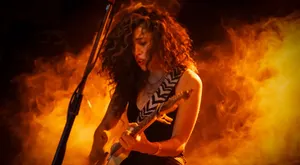
What is eternity? A journey through the legacy of Indio Solari: from Los Redondos to Los Fundamentalistas. Amid cryptic lyrics, the neo-baroque style of the River Plate region, and popular mysticism, the man who sang of the sorrows and truths of an entire generation.
I start with the end.
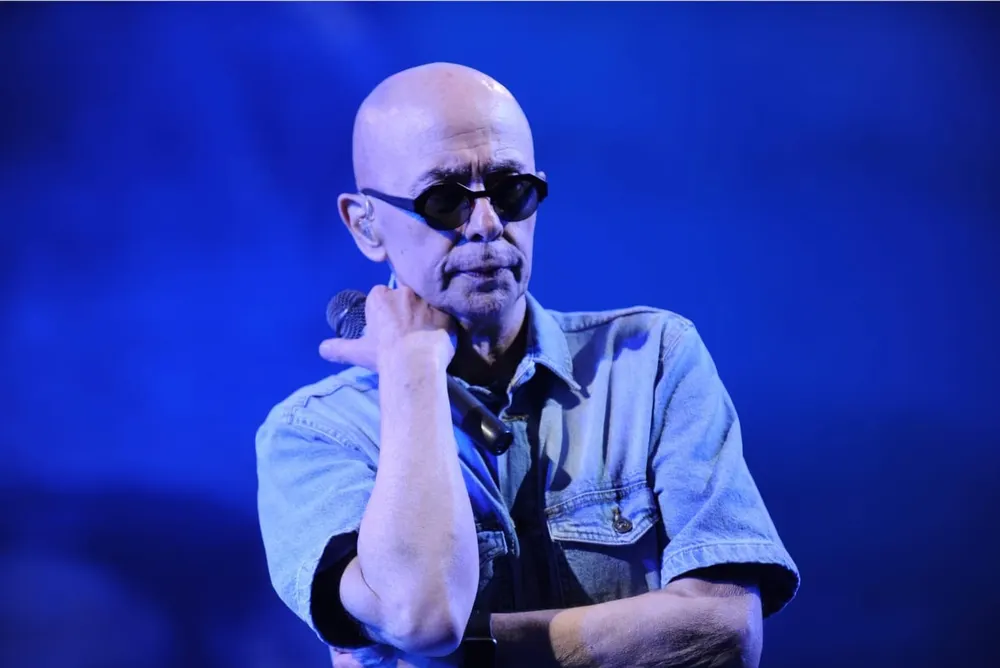
I'm watching the show by Los Fundamentalistas del Aire Acondicionado in Comodoro Rivadavia on YouTube. The Indio's escorts come on stage with tears in their eyes, gazing at the vast and faithful ocean that waves flags and prepares to toast alongside the band for a beautiful farewell.
In Yo Caníbal, the Indio appears, as is the recent and accepted custom, to sing a verse. Just like in Morel's machine, from Bioy Casares' novel, the camera didn't capture the Indio; it immortalized him in a record that, while it might sound like a grim simulation if one is on guard, in those moments, you can feel the vitality of the idol. It's something of greater dimensions: the eternity of the man who captured better than almost anyone the pulse of his time and what was to come, challenging time and folding it. How many eternities belong to his work? How do we quantify the revelations, the learnings, the pogos, the hugs, the blows, the grief, the reconciliations, the farewells, the encounters, the adolescences, the adult lives, the childhoods, the beers, the joints, the condolences, the defeats, the one-way trips, the returns, the families, the roads, the illnesses, the healings, the mud, the sky, the disorientation, the understanding, the metaphor, and the translation of so many feelings that accompanied his music? That time is all times and cannot be measured. Perhaps that is the only possible form of eternity, and we are mourning it. But at the show in question, the people are there, and as it progresses, tears give way to the night. Chorus and power, divine substance.
How many eternities belong to his work? How do we quantify the revelations, the learnings, the pogos, the hugs, the blows, the grief, the reconciliations, the farewells, the encounters?
Another question: How is it possible that the song Flight 965 starts with the line “It seems that in the end I won't get my way, my love”? The mourning had just begun when the first ricotero realized that the flight numbers matched 9 in the morning of the sixth month, on its fifth day. The day had started foggy and suddenly, terror. After that, we began to go through the stages of grief, until we melted into that strange thing that death uncovers, in our respective squares. I got the one in Mayo. It was one of the most beautiful moments of my life. The first person feels lighter in these moments, I feel. Like the plural 'I' of a single shadow from Poema de los dones, by Borges. Like the social being that shapes consciousness. In this land, which is a wound.
In this piece, we will tackle, as if it were possible, a part of the Indio's legacy. In reality, the two best things: the music and the lyrics.
Read this piece with this in the background.
Lyrics
“Sometimes language goes crazy,” Jacques Derrida used to say. And, analyzing the poetry of Néstor Perlongher, Jorge Panesi recovers the phrase and adds:
“Unless the madness of that crazy has always been there, like an agent that will act sooner or later at the least expected moment, and also, above all, at all moments. The regularity of the verses, their regulated recursiveness seems the opposite of madness, but precisely, the schemes of reason hide monsters.”
The poetics of Indio Solari represents one of the greatest tremors we have known. For its quantum reach. For its primordial contradiction: hermetic to outsiders and interpreter of the world for those raised in his love. And how can that be? I think the most foolish thing one can do in these hours is to try to understand. But I will do it anyway.
Indio's lyrics are many things. I believe they fall into the neobaroque category, an idea not often analyzed. I think.
The thing is, the matter doesn't end there: he knew how to craft some voluptuous spirals, as Néstor Perlongher called his verses, while at the same time nailing it into the corner of the popular sign. Piercing the hearts sensitive to his work not only with mysterious verses that one could spend part of the days deciphering, but also with statements that are finished syntheses of a barely tolerable world.
His insertion into the neobaroque tradition, combined with symbolist and beatnik influences, was the engine that housed a treasure so rioplatense it cannot be translated or exported.
I believe Indio is as (neo)baroque as he is popular. Which is quite unique. It depends on the verse, the song, even the album. But the most graffitied author of national rock is also the so-called cryptic one. Perhaps because the popular is complex. From symbolism to encoding the genome of Argentinian identity in emblems made of words.
Starting to speak in the catacombs of the last civic-military dictatorship is something that may have encrypted the poetic language. The baroque of the Indies, that is, the baroque of America, has that particularity.
Carla Fumagalli has valuable texts on this, and she recovers in a work about Picón Salas' work that, for the Venezuelan author, in the 17th century, the oppression of the Inquisition, which acts as an “intellectual police against culture,” forces colonial intellectuals into silence. Banned from local novels and stories, the Baroque presented itself as a “way out.”
His insertion into the neobaroque tradition, combined with symbolist and beatnik influences, was the engine that housed a treasure so rioplatense it cannot be translated or exported.
In his text “All About the Baroque,” Arturo Carrera says (or challenges) that in a certain period of Argentine poetry there is an attempt to incorporate “new dialects of unity: what the production leaves as a vestige in the reproduced.” There may be, in anyone who attempts a discourse on the neobaroque, a similar sensation. While the poetic corpus is fertile for analysis, all the facets of its literary and linguistic web, its micropolitical origins, and its place in Argentine poetry seem precisely covered. Even the criticism has brought the debate to metacriticism (Kohan-Panesi), such is the influence of those “fragments of childish speech” that could be neobaroque poetry.
It's legitimate for you to be wondering what the hell neobaroque is.
It was, above all, a nomination. It included several poets from Latin America, some residing far from their countries of origin. It was the Brazilian poet Haroldo de Campos who first articulated the term, and in 1972, Severo Sarduy popularized it. For many years, José Lezama Lima was the lyrical beacon and, at times, the intellectual hub where the successive poetics inscribed in the neobaroque converged. And it is Arturo Carrera, one of the main figures of this collection of poetics or aesthetic schools gathered under that label, who insists that it was more of a nomination than a movement. “There weren’t people working around the irregular stone or pearl called ‘barrueco,’” he says in the aforementioned “Everything about the Baroque,” highlighting the absence of linearity and then the consequent “happiness” of the current. In the late 1980s, Perlongher adopted the term “neobarroso”:
I would call it “neobarroso,” because there’s a kind of illusion of depth that the writers from the Río de la Plata always owe to that, to the product of the “cough of tango.”
El Indio presents that neobarroso cough of tango, and at the same time, a kind of unstoppable viralization. The verse hides a pearl, the chorus can be a flag. Or the other way around. His language must have gone crazy at some point.
There’s an anecdote. Gloria Guerrero recounts it at the beginning of Indio Solari, the Enlightened Man. I paraphrase. It turns out that El Indio, along with Andrea, Pity, and Silvia, three very close friends from the La Plata era, had gone to work on the coast. They left a sweet potato on top of the fridge in the apartment they shared. When they returned, the sweet potato had grown, possibly sprouted. When they came back, the germination had spread to the point of embracing parts of the fridge, even the handle (literally). Then El Indio started the joke. Someone would ask: “Open the fridge.” And they would reply: “What fridge? The sweet potato?” The joke grew along with the sprout. If someone said anything, for example, “I’m cold,” the response would follow the same structure. “What cold? The sweet potato?” It was madness. The carnival laughter that destroys the authority of meaning and allows for new perceptions.
Music
Did you see how simple the riff of Ya nadie va a escuchar tu remera is? And how the verse comes in, dropping four gears, reminding you that this is ephemeral. In the midst of the fun, like what happens to Greta Gerwig's Barbie, you realize that you are mortal. On this day and every day. And how it’s worth surrendering to what happens, the famous happening, as if there were no reason to fear that tomorrow that will inevitably come. The writer Juan Francisco Moretti told me, over a beer, that the prophetic dimension we sometimes hear in their lyrics is the product of the imagination of a possible future. El Indio’s poetics is also the courage to build representations that can make themselves real. Yes, the hyperstition of the youth from the CCRU (Cybernetic Culture Research Unit), chanted by 300,000 people.
I will finish with the beginning.
El Indio was born in Paraná, Entre Ríos, on January 17, 1949. At the age of 12, he was playing hide and seek when he was hit by a taxi, resulting in an exposed fracture of his tibia and fibula. Between surgeries and recovery, he discovered literature. Then came the military service, and he enrolled in Fine Arts. He met Skay. During the dictatorship, four police officers entered his house in City Bell. They applied electric shocks and then released him. His friend Luis María Canosa was taken away and became a victim of the Seventh Pavilion massacre. El Indio evoked him in Toxi Taxi, in Pabellón Séptimo, and in who knows how many allusions we will be deciphering forever.
You already know the story of Los Redondos: after the experience of the Brotherhood of the Solar Flower, El Indio and Skay met in 1976 in La Plata, which was thriving. The floor was lava, and a huge troupe emerged. There were many, but let’s name La Negra Poli, El Doce, who would dress up as a sultan and hand out ricotta fritters, the monologuist Mufercho, later replaced by Enrique Symns, Rocambole, who translated the circus into images, Pepe Fenton on bass, Bernardo Murphy on rhythm guitar, and “Turco” Isa Portugheis on drums. They debuted in Salta and played intermittently, and in December 1981, they recorded demos at RCA, released in 1982. Namely: Mariposa Pontiac, re-recorded and included in Luzbelito; Superlógico, included in Gulp!;Un tal Brigitte Bardot, Nene Nena, and Pura suerte.
La Negra Poli, in her role as manager, began circulating the songs and reached 9 PM, a program aired on Radio del Plata, hosted by a certain Lalo Mir, who started playing their tracks on the show.
During the dictatorship, four police officers entered his house in City Bell. They applied electric shocks and then released him. His friend Luis María Canosa was taken away and became a victim of the Seventh Pavilion massacre.
In ’84, they entered Lito Vitale’s studio to record Gulp!, and things started to grow. This means they are a band formed during the dictatorship, whose official debut album came in democracy.
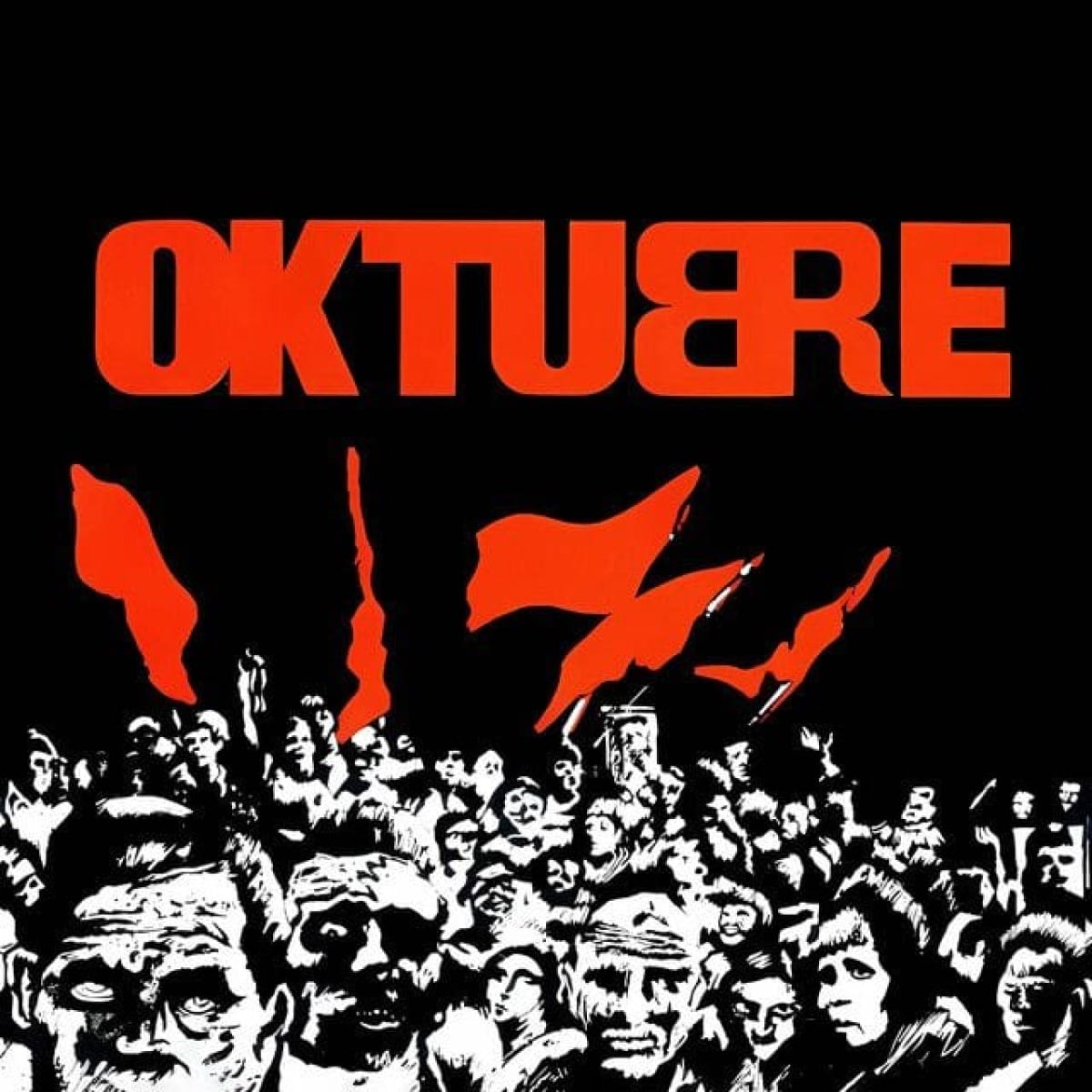
The second album is Oktubre (1986), about which I should write a separate note, although fortunately, everything has been said and will continue to be said. Then comes Un baión para el ojo idiota (1988), where I believe the turning point occurs. It starts with an epigraph: the intro of Masacre en el puticlub is an emulation of Wild Honey Pie, a song included in the White Album (1968) by the Beatles. It lasts less than a minute and is one of those transitions that seem like filler, which McCartney recorded during downtime. I suppose it’s still worth asking why Los Redondos opened the album this way. I think it’s a declaration of their aesthetic insertion. They break with the Argentine rock tradition and reset. Like Charly in the sixties, they go to the Beatles, but to the other Beatles. To the part that expects nothing from the market. That gesture reestablishes national rock, alongside other countercultural movements, which had Sumo as comrades. Rock was an international movement of inherent political commitment.
One of the most interesting controversies surrounding the artwork of the twentieth century is the one Adorno embodied against Sartre's conception regarding intention. For Adorno, in a surely insufficient synthesis, works of art cannot contain any judgment unless, for example, their meaning dissolves in fiction. Thus, Beckett's works “produce the anguish that existentialism merely talks about.”
It could be said that El Indio resonated with those ideas.
Interviews, throughout the career of Los Redondos and after El Indio's solo phase, became scarce. They maintained that the work was enough. However, there is a conversation with Tom Lupo in mid-1987, before their first performance at the Teatro Coliseo Podestá in La Plata, where he shares some definitions. I highlight:
“We have lost our fear of words and a lot of things. Because we believe that mystery begins with explanation and doesn’t end there. Generally, people are afraid because they think they can unveil secrets and mysteries by talking and explaining. I believe that as we explain it, the mystery grows. So I don’t feel guilty about anything. We don’t have an ideology. We don’t have a political ideology (…). Los Redondos somehow group a bunch of rockers. And rock culture, its greatest ambition was a new culture, not a different way or a scratch on the surface of democracy. It’s a new culture. Not a change of model or a change of characters in the power situation.
El Indio held that conversation with Lupo and gave a few more interviews until he chose to speak at a press conference alongside the group in ’97, framed by the tension over the alarms of violence surrounding the group’s shows. The police had killed Walter Bulacio a few years earlier, and it would still take a long time for the sentence to come.
Baión is a Brazilian dance music genre that was in vogue in the late eighties. The title of the album doesn’t appeal to synesthesia: seeing music. Rather, it criticizes a genre that is not meant to be listened to but danced to. Today it sounds a bit snobbish, yes. The era required positions, and Los Redondos chose to combat the market armed to the teeth. The album is, among other things, an aestheticization of violence. From Masacre en el puticlub, which contains the only music video of the group, made by Negro Beilinson, Skay's brother, to the closing with Todo un Palo, which contains that line “I ride trains: I have nowhere to go,” possibly alluding to Charly's “I don’t ride trains, I fly.”
In that assimilation of violence as a constitutive part of their artistic project, Los Redondos lay the foundations for a mythical reestablishment of national rock. Again: the era. The positioning against market demands led them to insert themselves into the market, in that will that sounds so contradictory, but which signifies a strategy of entryism. Doing what’s possible to show themselves, from independence and conviction.
The journey of the Redondos would continue, heading towards mass appeal and dissolution.
They would release ¡Bang! ¡Bang!... You’re finished (1989), La mosca y la sopa (1991), Lobo suelto / Cordero atado (1993) - Double album (released as Volume 1 and 2), Luzbelito (1996), Último bondi a Finisterre (1998), and Momo Sampler (2000).
After a break, El Indio would release with the Fundamentalistas del Aire acondicionado The treasure of the innocents (Bingo Fuel) (2004), Porco Rex (2007), The perfume of the storm (2010), Little birds, brave little boys (2013), and The nightingale, love, and death (2018).
In the interview with Mario Pergolini in the documentary Tsunami: An ocean of people (2016), El Indio talks about Blackstar, Bowie’s farewell album. He says he always wanted to do something like that. In his virtuoso ability to imagine the possible, he was ahead of his time by a few years.
Comodoro Rivadavia, June 6, 2026
Fading to black after The treasure of the innocents. The song Encuentro con un ángel amateur plays, his testament. He says, “I can no longer fulfill / the feats I promised / just keep singing.”
Once again, as almost always, all times. Time. The feats have been accomplished. No promise was left unfulfilled, and the gerund “singing” hangs suspended in a future that will outlive us.
In all the squares (the generalization is intentional) that self-convened on Friday, there were children who already felt the thrill of mystery. It’s possible that in those beginnings of Argentinians lies the continuation of the ricotera species. A people destined for ambiguity, marching and singing in the face of everything that seems possible or impossible.
One more question. Just keep singing? As if that weren’t a lot. El Indio gave us the tools to try to decipher the world with a good handful of verses that speak a vast language and contain that hope and pain that reached us a while ago.
The toast “Funny and brave” was also a spell: a wish. The verb must be intuited: “let’s be.” El Indio had called us not to take ourselves too seriously, as much as possible, in the face of the unavoidable news of death. Circulated since forever, viralized since the death of Martín Carrizo, his drummer and penultimate conductor, at the hands of an equally absurd illness, the spell, like many of the poet's verses, hid another layer. The one we need to understand today. To fill ourselves with grace and gratitude, and to be brave in the face of grief. Because something that was so immense doesn’t end, if we have the courage to see the world as something possible. The miracles that will be on our side, even when we feel bad.
✦ Suscribite
Las notas de 421 no tienen paywall
Y a cada colaborador se le paga por su trabajo. Las dos cosas dependen de los suscriptores.
Un entusiasta nacido el 17 de octubre de 1992. Es licenciado en Letras (UBA), magíster en Escritura Creativa (UNTREF), productor discográfico y periodista.
Escribe todo lo que puede: poesía, ficción y notas como las que podés leer en 421.