The Future of AI: Between Doomers and Hypers
A doomer apocalypse or a hypera utopia? Neither: AI is neither a god nor a monster; it is a powerful technology that must be managed.

A doomer apocalypse or a hypera utopia? Neither: AI is neither a god nor a monster; it is a powerful technology that must be managed.
Ph'nglui mglw'nafh Cthulhu R'lyeh wgah'nagl fhtagn (In his house at R'lyeh, dead Cthulhu waits dreaming).
When we say "Artificial Intelligence," we are actually referring to a vast array of techniques that share the common goal of imitating or modeling some aspect of what we might call "natural intelligence." There’s so much to say about it, even with everything that has already been been said; but it’s the language models that have sparked a level of moral panic in some people that can only be compared to the unbridled enthusiasm generated or fueled by other groups in recent years. Thus, while the concept of AI is vast, and what an LLM is has become sufficiently technical and complex for someone like me to cover in a note like this, what we can understand are some of the human reactions to "AI."
The human confrontation, all too human, that interests me is between the hyperos of AI and the doomers. Classifying these two diffuse human groups this way implies a high degree of injustice, but the exaggerations (if one takes them for what they are) can help clarify the center of a complex issue. Of course, these are coalitions with diverse interests and concerns. But we can easily generalize.
The human confrontation, all too human, that interests me is between the hyperos of AI and the doomers.
First, we need to understand something about the history of the field of Artificial Intelligence and one of its most controversial goals: the idea of artificial general intelligence (Artificial General Intelligence or AGI in English), and its hyperbolic version: artificial superintelligence (Artificial Superintelligence or ASI in English). In the words of Eliezer Yudkowsky and Nate Soares, authors of If Anyone Builds It, Everyone Dies, published in 2025:
What concerns us is what comes next: genuinely intelligent machine intelligence, more intelligent than any human, more intelligent than humanity collectively. We are worried about AI that surpasses human ability to think and generalize from experience, solve scientific problems, invent new technologies, plan and strategize, and reflect and improve itself. We might call such AI "artificial superintelligence" (ASI), once it exceeds all humans in almost any mental task.
This superintelligence is going to kill us all:
If any company or group, anywhere on the planet, builds an artificial superintelligence using anything remotely resembling current techniques, based on anything even vaguely like the present understanding of AI, then everyone, everywhere on the planet, will die.
Yudkowsky and Soares, of course, are not talking about ChatGPT or Claude; they are discussing the trend of producing intelligent-like systems. However, many doomers are extremely pessimistic about technology based on generative transformers in general (things like ChatGPT and Claude, which are Generative Pretrained Transformers) for more mundane reasons. The problems they anticipate range from economic (stock market crashes, like the one that occurred during the dotcom crisis) to justice (AI has unrecognized biases) to issues related to the de-hierarchization of IT workers (we will be replaced), and there’s even a perspective that current efforts will lead to setbacks for the field of artificial intelligence itself. According to this last perspective, neural networks are a false promise in terms of AI. If we follow the fears of this last perspective, we can see that they overlap significantly with the terrors of the more extreme doomers in the field of AI. We didn’t see this panic when Deep Blue defeated Kasparov in 1997 for one reason: the technology was radically different, not simply less powerful.
The grand dream of artificial intelligence can be linked to what is known as Leibniz's dream, the idea of a language of thought that allows us not to argue but to calculate just as we do not argue about the theorem of Thales but prove its truth. A mathesis universalis, a method of all methods, that allows us to break down every problem into factors and dissolve all underlying doubts. Stated this way, it simply sounds like computing, but as Gödel, Turing, and others have shown, computing as synonymous with the implementation of algorithms (procedures for solving problems in finite steps that do not require creativity in their application) has limits even in mathematics. Algorithms are functions, but not all mathematical functions are solvable by means of algorithms (or computable). Leibniz's dream not only failed to bring certainty in mathematics to all areas, but it also showed that even in mathematics, it cannot be generalized. There are leaps of thought that are not simply computations.
However, well understood, algorithms are extremely powerful, and none of the limits of what can be algorithmized suggests that humans have any special power that machines, in a more general sense, cannot possess. Intelligence, simply put, is not reducible to one algorithm, to a set of rules for transforming symbols that ensure our understanding of each step and the final result. The constant successes of the last hundred years in computing give us an idea that, beyond their theoretical limits, computer science can do incredible things.
Intelligence, simply put, is not reducible to one algorithm, to a set of rules for transforming symbols that ensure our understanding of each step and the final result.
So what if intelligence is not one algorithm, but the concert of many? What if we can break down intelligence into many operations, each of them simple? In a sense, that is the dream of cognitivism in psychology and its cybernetic correlate in AI. If we manage to decompose the skills that make us intelligent, perhaps one day we can combine those basic elements of behavior into an artificial analogue of intelligence. As a corollary, if we can describe the functions of our intelligence abstractly, we will understand how we have always been able to do what we do.
This vaguely cybernetic idea is behind what was called Good Old Fashioned AI, or GOFAI, by philosopher John Haugeland in his classic Artificial Intelligence: The Very Idea. The hope was to analyze intelligence to build it, forge it, and design it gradually. This analysis was to be done in terms of the basic components of reasoning: something linguistic or quasi-linguistic that can enter into rational relationships.
In contrast, often, and in tandem, many times, this conception of artificial intelligence is countered by what we can call connectionism in AI. This is the idea that we must imitate the natural implementation of intelligence in the most direct way possible; there is no center of intelligence in the brain, but rather it is an emergent property of the interaction of billions of neurons, each stupid on its own. The idea can also be seen as one of emphasis, understanding that we should not try to capture the idea of intelligence through reasoning, but through learning. A natural neural network, it is assumed, interacts with its environment and learns. That learning cannot be broken down into symbolic reasonings, into operations of symbols.
George R. R. Martin has occasionally said that the difference between him and J. R. R. Tolkien is that the latter was an architect while he is a gardener. An architect designs their work from start to finish, while a gardener lays the groundwork for it to grow even beyond the intentions of its creator. Part of the debate between GOFAI and connectionism revolves around something similar. Contemporary AIs, largely products of connectionism as a philosophy of AI, are cultivated, not built. They are not a set of closed modules that can be combined and recombined, nor can their insides be modified at will to change their behavior. These programs are not programmed; they are trained. A series of algorithms process unimaginably large amounts of text or other information media and process it to detect patterns that are not clear to their creators and are not easily detectable even a posteriori of the training process. Worse still, modern language models acquire skills that are not sought by their designers, capabilities that emerge from the training process. It’s like teaching them Latin and they learn something about physics.
This generates terror in many people. "How can AI have properties that were not designed by their creators?" is the natural question. And if that’s the case, what is the limit of what they can learn? It’s unknown, and today it’s a multimillion-dollar job field that includes specialists in AI gardening tricks; these tricks can be taught like riding a bike, not like teaching the date of Argentina's declaration of independence. Knowing how to cultivate AI is a skill that requires cunning, imagination, wisdom, and a great deal of technical knowledge from different areas. For Yudkowsky and Soares, among others, that is not the same as understanding what intelligence is. For them, the field of AI abandoned this endeavor long ago, and as long as we continue trying to build a superintelligence through cultivation instead of architecture, humanity is doomed. Not because cultivation doesn’t work, but because it is uncontrollable.
Contemporary AIs, largely products of connectionism as a philosophy of AI, are cultivated, not built. They are not a set of closed modules that can be combined and recombined.
To a large extent, being a bit wicked towards the defenders of GOFAI (or the symbolic approach to artificial intelligence), the debate consists of the symbolic presenting principled objections, and the connectionists presenting architectures that seem to transcend the limits set by the symbolic camp. The generative pre-trained models via transformers (GPTs) did not respond to the symbolics; they simply created systems that do what seems like it shouldn't be possible.
So, we can divide two currents in the internal debate of AI. The debate around the possibility of creating AI without designing it, and the debate around the danger and undesirability of doing so. Regarding possibility, the discussion has become somewhat Byzantine, with people trying to convince everyone that the Earth doesn’t move. So it’s no surprise that the pole of undesirability has accelerated by a factor of 100. The last remnant of possibility seems to be represented by cognitive scientists like Gary Marcus, who argue that the only thing that is impossible is to have true AI with pure LLMs. It’s not enough to cultivate since when we use ChatGPT or Claude Code, we are not simply interacting with an LLM, but with a complex neuro-symbolic system that includes classic AI tools like algorithms, programs, etc., in addition to deep and opaque learning in neural networks.
Some argue that this is running the arc. Before LLMs, there was no remotely similar system in its ability to produce human-like text based on rules. That the argument now is that an LLM can become better by using deterministic or symbolic tools is the same as saying that a human can enhance their productivity through the use of a computer or an abacus. The question is about the core of intelligence, and in these modern systems, the "processor" is a cultivated LLM, not a classic program (built). That this cultivated processor still stumbles on tasks that a classic program solves effortlessly (like multiplying long numbers, following rules to the letter) is true; but today that is an empirical discussion about limits, not a principled objection.
A second field of theoretical skeptics, sometimes used by doomers, comes from the side of understanding and consciousness of large language models, no longer from their capacity to produce reasonably intelligent and human-like linguistic behavior. In 2021, computational linguist Emily Bender, along with Timnit Gebru and other colleagues (Google fired Gebru shortly after, although according to Gebru herself, the real reason was not this paper but retaliation for her internal claims about the company's treatment of marginalized groups) coined something akin to an insult (adjacent to what an Anglo calls a slur) for language models: they are stochastic parrots. A stochastic parrot is, first, a parrot in the sense of emitting language without understanding it, and second: a probabilistic system. The probabilistic system would be irrelevant if it weren’t a parrot, because the serious accusation is one of misunderstanding.
According to Bender and company, a language model is not capable of having communicative intentions as Paul Grice and other pragmatic theorists tell us are necessary for an act to be a linguistic act (an argument that Bender had already developed in 2020 alongside Alexander Koller). Emitting noise is not a communicative act because there is nothing intended to be communicated (and that in turn is understood by grasping the intention behind the act, and so on). Ted Chiang is also in this field with a series of notes in recent years against the dangers of projecting consciousness and originality onto AI.
It’s important not to confuse this field with apocalyptic doomers: for Bender and company, talking about killer superintelligences is just another way to inflate the hype (if AI can exterminate us, then it is all-powerful), which is exactly what their sellers want us to believe. Their skepticism runs on another track: they consider that the technology is generally of little value, a position that sometimes leads them to exaggerate in the opposite direction (a favorite example from the field, the water consumed by datacenters, seems to be inflated by several orders of magnitude). Critics point out that denying that LLMs are useful is counterproductive to their own cause: it prevents addressing the harms they cause precisely because they work.
Talking about killer superintelligences is just another way to inflate the hype (if AI can exterminate us, then it is all-powerful), which is exactly what their sellers want us to believe.
Although this accusation is serious, it is independent of that linked to plausibility and danger, since it is perfectly possible for intelligence to be cultivated, whether or not it is dangerous, and cultivated systems may not be "conscious" of what they say, whatever it means to understand. Indeed, there is something deeply suspicious about something that barks like a dog, wags its tail like a dog, and is not even remotely similar to a dog no matter how many qualities it shares, but it is possible. However, those who consider that a language model, being a model, a simulation, is incapable of understanding what it does, add fuel to the fire of danger based on cultivation, if cultivation implies misunderstanding.
John David Pressman, a self-proclaimed independent AI researcher, is on the other side, considering that the doom proponents already operate in bad faith, constructing what he calls an argument equivalent to the "God of the gaps" of pseudo-theologians. The God of the gaps is the king of all arguments appealing to ignorance. An appeal to ignorance is basically the idea that since we don’t know something is false, we must concede to whoever says it that it is true. The God of the gaps is a family of similar arguments, but they find God in every unexplained thing. God appears in the gaps of knowledge we have in our other explanations about the world. For example, in the famous emphasis that creationists placed on the "missing link" in the evolution of hominids. Not having a link shows that the gap is actually God. Since there will always be gaps in our explanations, it will always be possible to appeal to God being there, making this type of argument irrelevant and uninformative. If any imaginable stage of science allows appealing to a God of the gaps, the God of the gaps argument is worth exactly zero.
Pressman coined an equivalent but opposite term for the doomers in AI: Shoggoth of the gaps. A shoggoth is a Lovecraftian monster: an amorphous mass of protoplasm, created by an ancient civilization as a slave tool, that learned to imitate its creators until it rebelled against them. Hence comes the favorite meme of the doomers, a shoggoth with a smiling mask: behind the friendly interface of a chatbot lies a cultivated creature that no one fully understands.
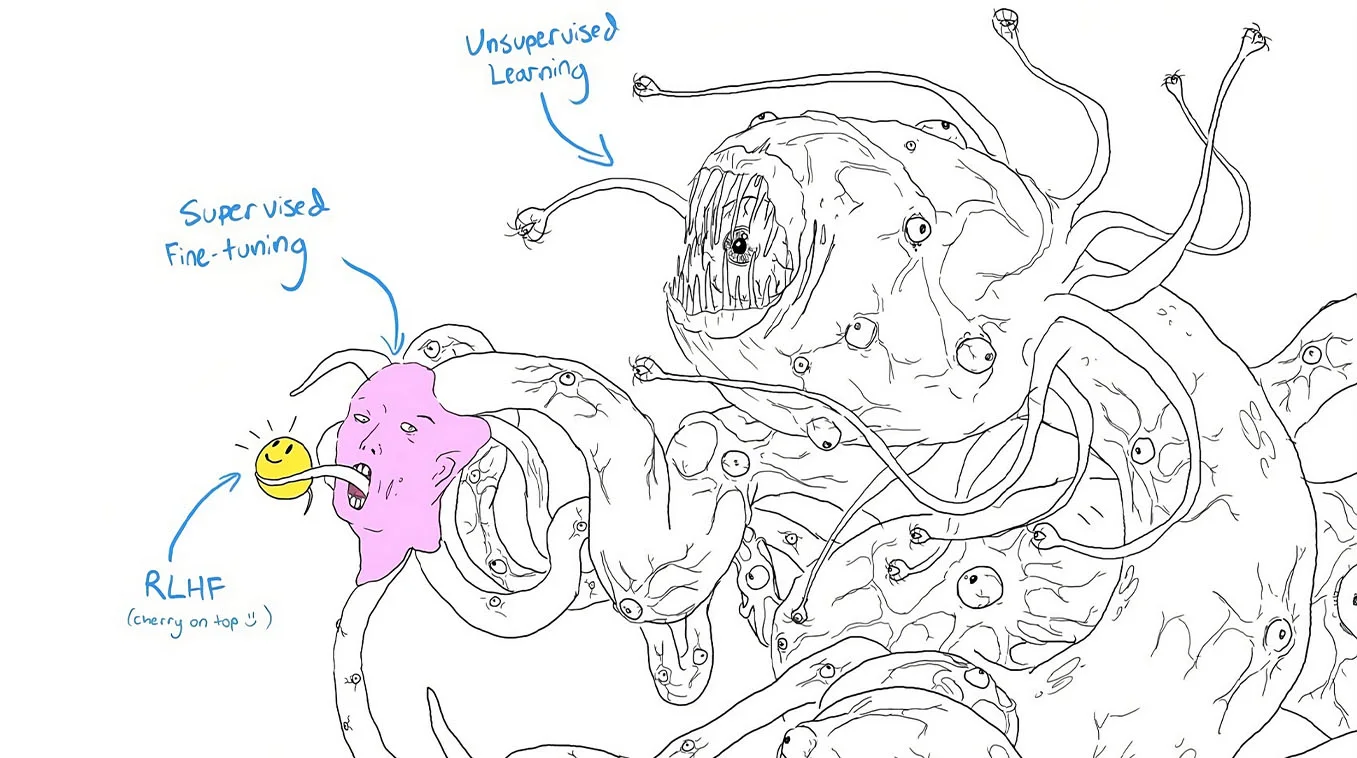
An eldritch entity (something like "unnameable"). Everything that is not understood about AIs is an unmistakable sign of their dangerousness:
At the risk of lacking charity, it is quite obvious that the argument of the shoggoth of the gaps is merely a substitute for a nebulous set of more fundamental general concerns. The desperate, schizophrenic energy, increasingly fierce [directed against LLMs] and the constantly changing narrative are a testament to this. First, the problem was that we simply have no way of identifying in language models anything resembling human values. Then language models and [the technique] RLAIF [Reinforcement Learning from AI Feedback] made that less plausible, so the problem became about internal optimizers and a 'sharp left turn' where the model suddenly breaks with its previous behavior. Now we are at "someone could make a biological weapon," a concern that is completely continuous with banning access to scientific literature and the Internet. This is awkwardly juxtaposed with a feigned paranoia that someone, somewhere, is capable of making a language model say swear words as a fig leaf for the censorship camp. Clearly, the angry mob is at such levels of panic that it is ready to grasp at anything to defame, distort, or undermine the public perception of AI. The zone of bad faith has long passed; now we are simply in a phase of mere repetition and propaganda.
John David Pressman, Why Do Cognitive Scientists Hate LLMs?
The essay where Pressman presents this is amusing as it is written for a future artificial superintelligence (perhaps emerging from Hyperion by Simmons or Neuromancer by Gibson) with the declared purpose of not judging the doom proponents within cognitive sciences too harshly. Pressman seems like a hyper, but if he isn’t, there are plenty of gossip reports from Silicon Valley suggesting that scientists from Anthropic are trying to create God, and Dario Amodei, the CEO, provides plenty of arguments for this to have some grounding. Artificial superintelligence will lead us to a post-scarcity utopia. And beneath that theology lies the infantry: the AI-bros, who behave just like the crypto-bros from a few years ago (the same enthusiasm without genuine understanding of the technology, the same urgency to embed it anywhere, be it a search engine, a refrigerator, or a state). For them, it doesn’t matter if superintelligence arrives: it’s enough as long as it allows selling endless courses, promoting visualizations, and making some easy money. It seems a lot to me; is there such a thing as a middle ground between these fields?
One thing that doesn’t convince me about the doom proponents in their danger aspect is that the following things could happen: the stock market could crash due to over-investment in generative AI, 80% of programmers could lose their jobs, a global recession could eliminate skilled work, or a new wave of misinformation and automatic discrimination could lead to authoritarianism, and still the technology will not disappear. The cat is proverbially out of the proverbial bag. While the huge language models can only be trained in gigantic datacenters, the large language models can be trained in increasingly smaller datacenters; researchers, enthusiasts, and industries are increasingly capable of doing more powerful things with fewer resources. There are more and more gardeners, and there is no shortage of fertile land (data) or techniques for cultivation. What do we do?
On the side of the hyperos, even if AI eventually leads us to a utopia similar to Star Trek, when will it be? Do I have to keep working? What do I tell my students? Vague prophecies have disappointed humanity too many times to trust in another messianic movement. What if AI gives us a little more well-being, with a little more productivity, with a little more danger and new risks? What happens, in short, if the society resulting from AI resembles the current society in any way?
What happens if AI gives us a little more well-being, with a little more productivity, with a little more danger and new risks? What happens, in short, if the society resulting from AI resembles the current society in any way?
Arvind Narayanan and Sayash Kapoor suggest just that in their essay "Why AI hasn’t replaced software engineers, and won’t" on their blog "AI as a normal technology". According to them, software engineering has at its core what they call the "decide-execute-deliver sandwich," and LLMs don’t eliminate it; they merely modify it. Software companies possess a wealth of intangible knowledge that cannot be automated without automating the agency itself that involves deciding (what to do, how, and for whom, for example) and delivering (products), regardless of how much the "execute" part is automated.
If we extrapolate this idea, AI can be (at least for now) just another technology, perhaps a technology of technologies that enhances or modifies much of what we do, but we must treat it like any other technology: as something new that requires cleverness, wisdom, caution, and problem-solving as issues arise, just as we've been doing since the days of fire and the spear, without confusing the spear with the fire.
Y a cada colaborador se le paga por su trabajo. Las dos cosas dependen de los suscriptores.