Neon Genesis Evangelion: Mechas and Existential Crisis
Neon Genesis Evangelion: Mechas and Existential Crisis
You're on your way to school when suddenly you start hearing explosions, and you see a monster peeking over the hills of Hakone. Before you can get scared, a sports car pulls up, a stunning girl gets out, and tells you to come with her. She takes you to a military base where your dad built a giant robot and tells you that only you can pilot it. In another series, the protagonist would be excited. Here, it's different.
The mecha genre has always been a bit of a fantasy of power, technology as an extension of humanity that allows for impossible feats. The pilot is always ready to fight, the battle is fair, and courage is enough to win. Having a robot is, above all, cool. Evangelion starts a bit differently: with a crisis of anxiety. How could your dad ask you to drive a robot? Does he know how dangerous it is? Did he only call you after years of not seeing you for this? This was the premise with which Gainax studio and director Hideaki Anno launched the 26-episode series in 1995. But let's start from the beginning.
The story of mecha
The “mecha” genre (pronounced “meca”) refers to giant robots with a human pilot. This distinction is useful to differentiate Astro Boy, Mega Man, or Ghost in the Shell from Robotech, for example. Before Evangelion, mecha had two major traditions, both originating in the seventies. Mazinger Z (1972) invented the concept of the pilot inside the robot, the “monster of the week” format, the hero who defeats the monster and returns to the garage to be greeted by friends. It was pure entertainment, a factory for toys, post-war Japanese optimism.
Evangelion suggests that even without enemies, pilots fight terrible battles against themselves.
In contrast, later came Gundam (1979), which added a layer of sophistication to the genre: robots as military weapons, politics, and factions that weren’t strictly good or evil. This is the same tradition as Robotech/Macross, or more modern works like Escaflowne or Nadesico. The common thread was the epic tone, action, with the hero delivering a speech that changes everything and inspiring with courage.
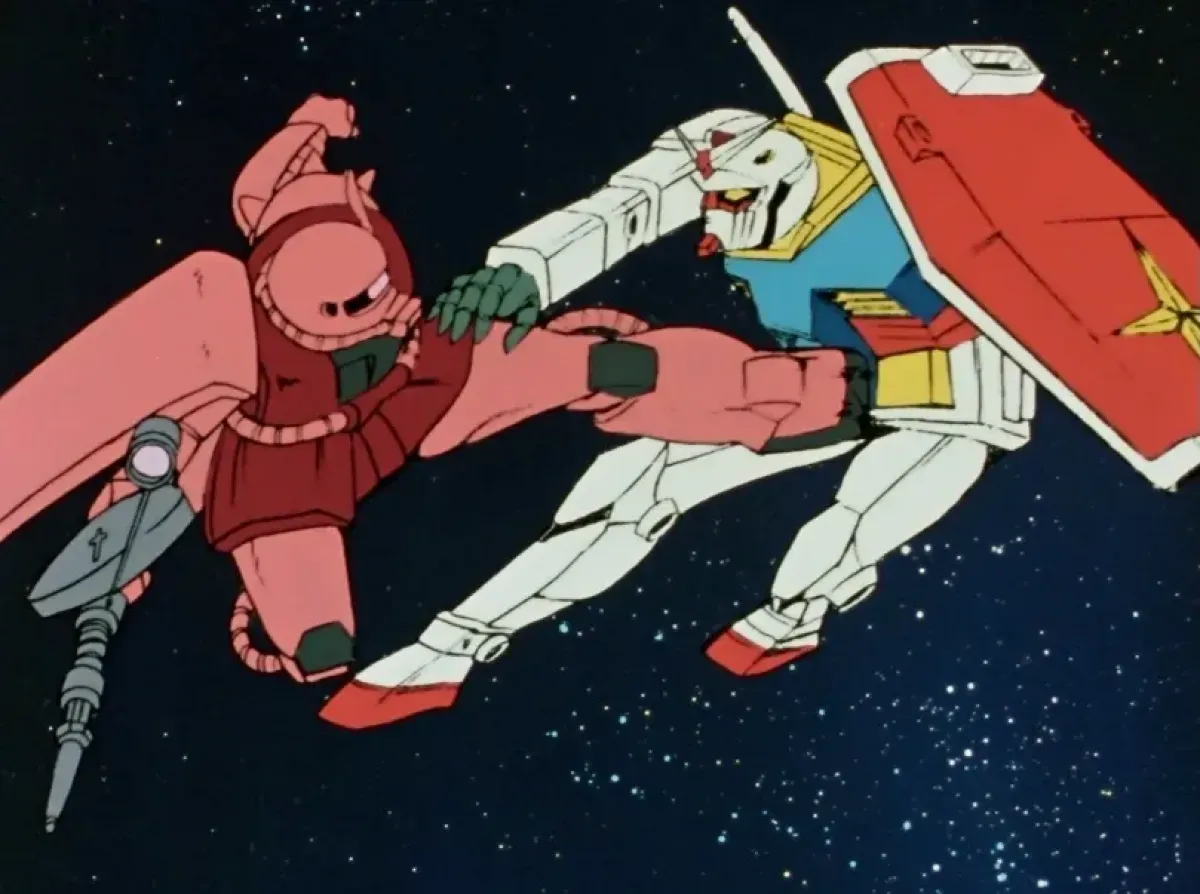
What both traditions had in common was the conflict of the pilot against the invader or the pilot against the system. The enemy was the Emperor of Darkness, Axis, the Zeon, the Zentraedi, the aliens. The robot was the power the hero needed to defeat them. There could be dark moments, but at the end of the day, the enemy was the one disrupting peaceful life. Evangelion suggests that even without enemies, pilots fight terrible battles against themselves.
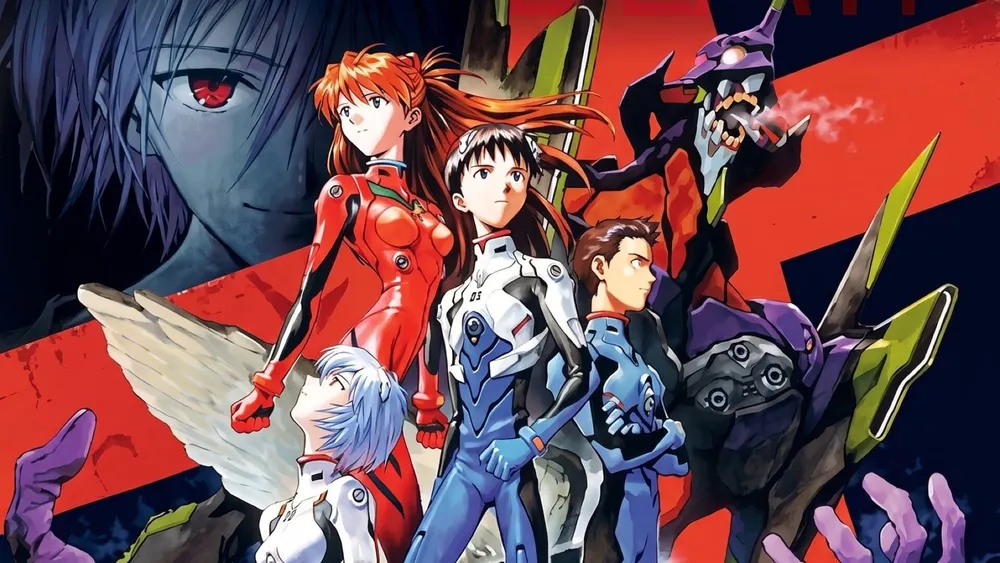
The Evas in question are not machines but biological entities that form a psychological bond with the pilot. When the Eva takes hits, the pilot feels them physically. If the pilot isn’t in the right mental state to pilot, the Eva simply won’t start. Shinji doesn’t pilot Unit 01; he literally lends it his body and soul. This is a conscious subversion by the series creator, Hideaki Anno, who honed his craft animating sequences in Macross, Gundam, and others, and knew all the rules of the genre.
The depressive tone of Evangelion
The tone of Evangelion wasn’t accidental. Hideaki Anno was clinically depressed when he made the series, and this is neither a cute anecdote nor a minor detail. It’s the reason the series is the way it is. It’s not a “whimsical” darkness.

This directly permeated the characters. The hero, Shinji Ikari, is offered the dream of anyone: to pilot a cool robot, be surrounded by girls, and have an iconic pet. But he is terribly introspective and thinks that piloting the robot is the only thing that makes him worthy of a place in the world because he feels he’s worthless.
The supporting characters, Misato, Asuka, and Rei, have almost as much screen time as he does, and they are archetypes of similar characters in other anime, but with their own specific traumas. Their captain and adoptive mother figure, Misato, has a complicated relationship with her deceased father; Asuka needs constant validation from others to function; and Rei is essentially a girl without an identity, more like a soda siphon than a person. What they all have in common is not just that they are orphans (from which many of their traumas derive), but the terrible loneliness they experience. In terms of the anime itself, hell is individuality, the physical barrier that separates us from others, and the absolute sense of loneliness we go through at different moments. The series refers to this concept as the “AT field,” or “absolute terror field,” a manipulable spatial limit capable of forming a literal barrier that stops attacks.
In terms of the anime itself, hell is individuality, the physical barrier that separates us from others, and the absolute sense of loneliness we go through at different moments.
And, somewhat ironically, the Human Instrumentality Project that the “villains” want to implement is the dissolution of that limit. To stop being individuals and transform into a collective mind. Oh, did you think the enemies were other “robots”? Because they are too. They are the Angels, the strange biological creatures they face in each episode, but they are not villains. It would be a bit like thinking of a tornado or an earthquake: they simply happen, and you have to deal with the consequences. The touch that adds to the series' despair is that they inevitably come, no one knows why, and the best that “the good guys” can do is be prepared (a bit like Godzilla).
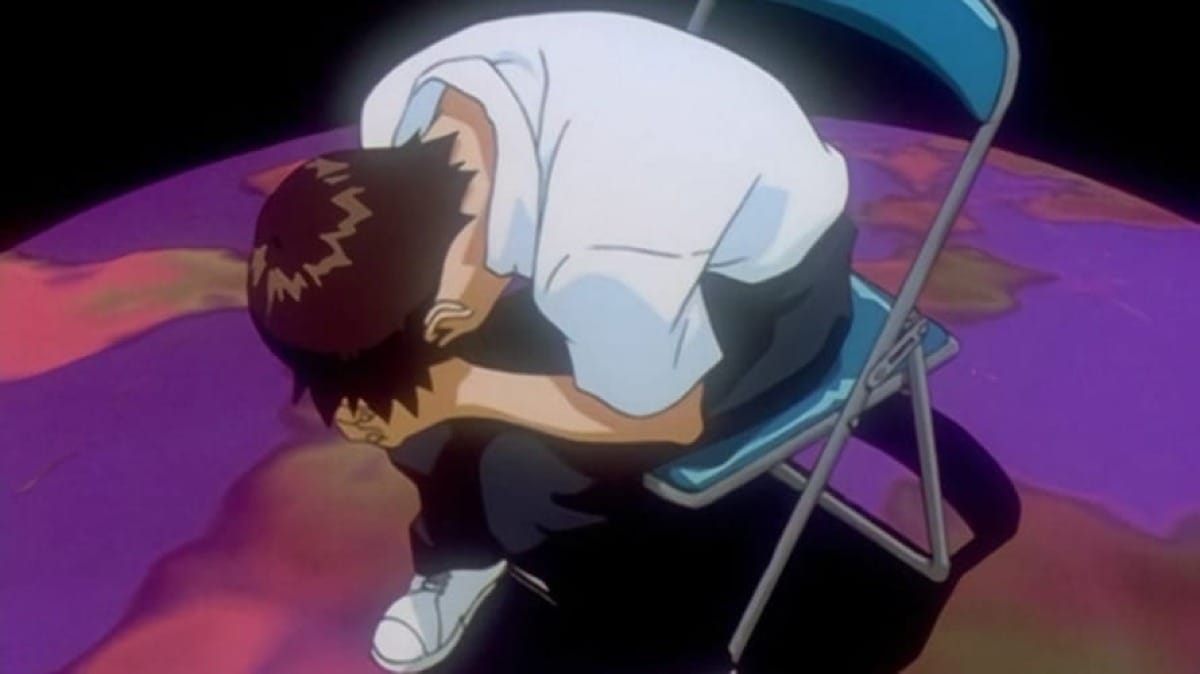
With all this said, it’s important to highlight that Evangelion is not bitter. Especially with Asuka's arrival in episode 8, the series finds its rhythm. There’s action, battles, and a fine balance between science fiction, teenage shenanigans (let’s not forget that the protagonists are 15 years old), and genuinely dark and chilling moments. The real power of the series lies in those contrasts, in how the conventions of the genre clash with a darkness that, by contrast, is much more devastating than other introspective works.
What’s interesting is that while it presents all this pain in the world, the conclusion of the series isn’t something dark meant to look cool for dark teens to wear on t-shirts (spoiler: we wear it anyway). Evangelion is not nihilistic. It’s a work that takes despair, delves into it, and after 26 episodes and the movie The End of Evangelion, chooses life.
An interesting detail: while the series ends with this powerful and hopeful message, the truth is that Anno mentioned in interviews that throughout the creation he was “almost on the brink of mental collapse.” Art didn’t cure him; it was part of what he was going through, although it inspired many otaku to reflect on themselves.
Japan in the nineties
The art of the nineties in Japan was incredibly subversive compared to the naive optimism of the eighties. This isn’t solely the merit of Evangelion, although it was part of this wave of postmodern works that used their respective genres to say something very different from what the viewer expected.
The advent of this movement was linked to a series of coincidences in the context. To think in Argentine terms: it’s no coincidence that Okupas and Los Simuladores came out relatively close together. In Japan’s case, the trigger was the end of the economic bubble of the eighties in 1991. The archipelago went through a decade of stagnation known as “the lost years.” Optimism had run out, and Japanese entertainment began to reflect that.
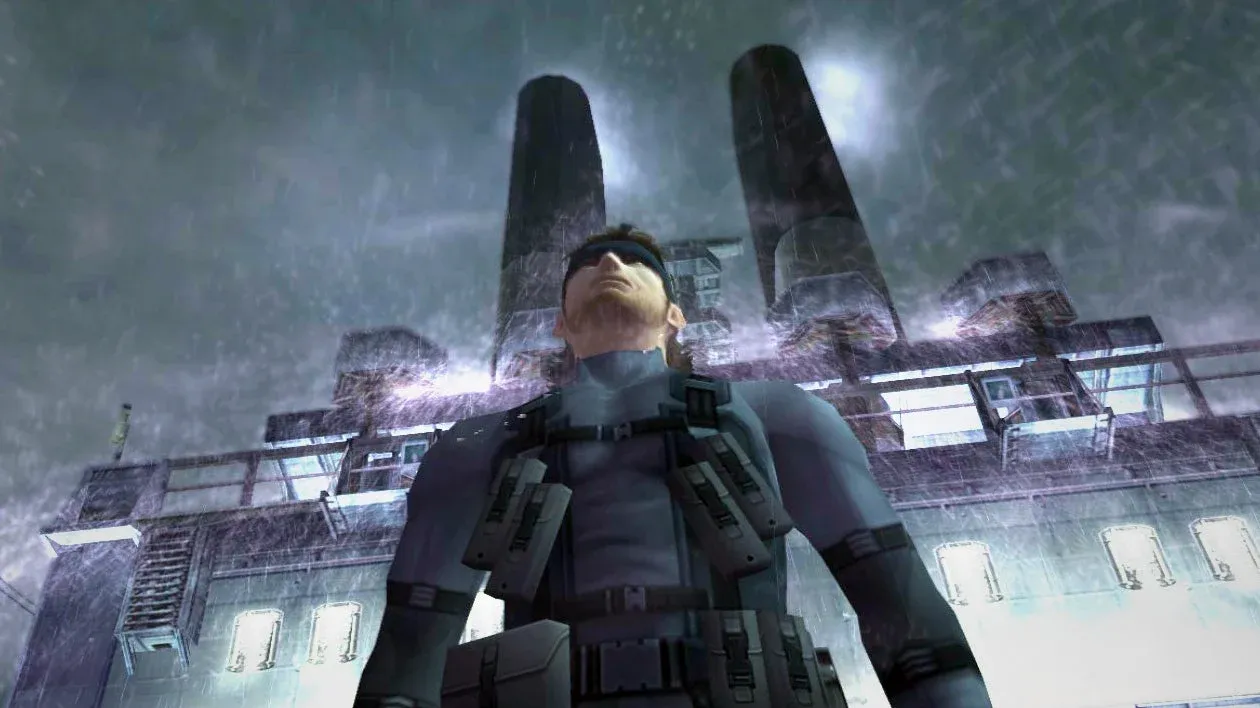
In video games, we can talk about Final Fantasy VII (1997), a JRPG where the protagonist has such a deep identity trauma that he rewrites his own story to avoid collapsing. The final boss doesn’t want to conquer the world; he embodies pure nihilism, a man who decided that life has no value and wants the planet to become a dead vessel that takes him to a better world. Metal Gear Solid (1998) and Metal Gear Solid 2 (2001), as espionage and action games, feature a protagonist who emulates Bond and Russell's Snake from Escape From New York, but both head straight into a final arc with endless cutscenes about philosophy, free will, identity, and social control.
As for anime, this was also the time when Berserk aired. Although the manga is from 1989, the 1997 anime specifically chooses to adapt an arc that is among the darkest you can see on screen. Epic sword fantasy turns into a brutal exploration of trauma, betrayal, and the question of whether it makes sense to fight when the world is designed to crush you.
The Magical Girl genre, primarily represented by Sailor Moon, also had Revolutionary Girl Utena (1997). Here, a young girl fights with her sword against the system and the way her school operates. Looking for subversion? Here you have sex, betrayal, manipulation, and a soundtrack that sounds like Deep Purple with choral arrangements.
All these works use the same trick: they disguise themselves as a genre full of conventions to present broken characters that the audience doesn’t expect. You can’t sell a work about depression and social conflict to anyone without it sounding heavy-handed. But you dress it up with two robots and three guns, and your fans unwittingly end up reading Jung.
30 years later
On October 4, 2025, Evangelion turned 30. In Japan, all the movies were re-released, there was an exhibition at the Tokyo City View, and merchandise with McDonald's, Sanrio, Transformers. Over the years, Evangelion stopped being an auteur anime to become a franchise that makes money. It even had a sequel/reimagining in the form of Rebuild of Evangelion (four movies between 2007 and 2021), where they retold the story with a bigger budget and a different, more explicitly hopeful ending.
What’s interesting is that this “remake” was more of a soft reboot: it could be viewed in isolation, but it also functioned as a “sequel” to the original. This is exactly what Final Fantasy VII is doing with its Remake trilogy. Time is a flat circle, or the cultural weight of franchises hasn’t diminished.
And so, on February 23, 2026, at the closing of the 30th-anniversary festival at the Yokohama Arena, Hideaki Anno took the stage and confirmed something no one expected: there’s a new anime series in production.
Evangelion remains relevant because the world still hasn’t solved the existential crisis it faced 30 years ago.
This time Anno won’t be the main responsible party, but he has assembled a team of successors forged in the fire of his creations. The screenwriter is Yoko Taro, the creator of the action RPG NieR: Automata, which uses the genre to talk about the value of existence while showing you the backside of an android. The choice is quite poetic: the work that in 1995 used mecha to discuss depression and trauma is continued by a creator who in 2017 used the language of video games for something quite similar.
The music is by Keiichi Okabe, another veteran from Nier. Meanwhile, the animation will be done by CloverWorks (Fairy Tail, Darling in the Franxx, Persona 5: The Animation, and more) and Studio Khara, the same team behind Rebuild. The plot of this new series hasn’t been revealed yet, but the choice of team already sparks conversation and initially leaves the impression that the beast is in good hands.
Evangelion remains relevant because the world still hasn’t solved the existential crisis it faced 30 years ago. The series sells figurines, models, posters, games, and is a consumer product that fascinates. However, the true power lies in its continued resonance. It pulls you into the mud, rolls you around, and when you think there’s no way out, it tells you that there is. It’s what everyone needs to hear. Shinji chose to continue existing, and luckily, so did the franchise.
Las notas de 421 no tienen paywall
Y a cada colaborador se le paga por su trabajo. Las dos cosas dependen de los suscriptores.