GTA VI: Keys to a Launch That's Already History
Memes, clips, streamers and moral panic: the GTA VI launch works as a magnifying glass for seeing where video games are headed today.
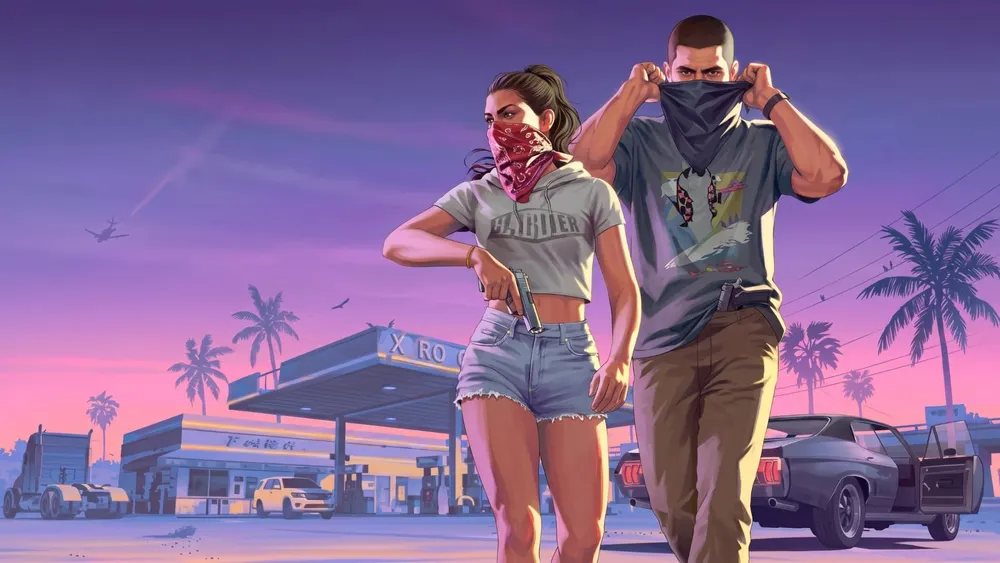
On Thursday, November 19, Grand Theft Auto VI went on sale. We knew it was going to be huge, so before it dropped we asked ourselves a question: what do we think is going to happen when it comes out?
Here's what we found. We think of it as a snack-sized investigation: a document-slash-article with some keys for reading how the game is received, how it circulates and how people make it their own. It's not an exhaustive report or a tour of everything being said online; we didn't do any social listening. What we did was go back to the hypotheses we'd kicked around before the launch, see which ones hold up, and build categories from there.
The underlying bet is that an event of this scale works like a magnifying glass. If something that until now seemed niche starts showing up in other spheres, this is where you'll see it. We want to find out whether phenomena that were already on the rise, like the clip economy, hold up and expand toward the current frontiers of this cultural industry.
An event of this scale works like a magnifying glass. If something that until now seemed niche starts showing up in other spheres, this is where you'll see it.
Questions, ideas, boundaries:
- “Hype”: what happens with the advertising machine built around a video game so far in advance, and whether it matches the reception.
- Creator economies, the peripheries around the video game: the whole economy that springs up, sustains itself and expands around one specific video game.
- Graphics and processing power: these games present themselves as the avant-garde of audiovisual technology.
- VG as a social experience: thinking beyond a kind of cultural consumption centered on a single person-user. Types of consumption within a social fabric that gets reached from the periphery, with debates about the game's violence.
From the surface to the depths
In this section we want to show how, on the most superficial layer, we see highly engineered marketing campaigns, and how, as you scratch that surface, gaming communities start showing up, creating their own languages off the back of the new game's release. There are memes you'd swear were paid for and others that weren't, and a whole memetic structure around the launch. What's organic and what's prefab?
The first thing you see is the classic ad campaigns. Rockstar wrapping all of Miami so it reads Vice City, a way of bringing the game's city back to life in the real world. Trying to break the diegesis and make Miami (FL) into Vice City for a few days.
Along with that come the influencers tagging PlayStation Latam and name-dropping the brand. We can assume they're paid, or that at the very least someone gifted them the game's 80 bucks. Nothing that doesn't happen every single day of our lives.
Then the viral memes start showing up. These too, we can assume, are part of a “viral” campaign, or were dreamed up and produced in some marketing mill in the Global North. The funny thing is that these meme campaigns always manage to universalize any topic. In this case it's a comparison between what was going on when GTA V came out and where we're at as GTA VI comes out. It can be the jersey Boca wore in 2013, when the previous GTA came out, versus the one Boca wears now in 2026. Or, in the same way, Carrie Bradshaw's look in 2013 and in 2026. Plain and universal, a “trend” that had been living online for months before the release.
Scratching the surface a little more, some internet workers start showing up to talk about GTA, often about what they plan to do once the game comes out. They're tied to a corner of the not-so-new gig economy or creator economy: they know they're going to make money streaming the game or making on-demand videos about it on YouTube. Whoever gets there first seems to be the one who matters, as is almost always the case online. There's a latent anxiety about being the first to show it, play it, weigh in on it, and give everyone else something to weigh in on.
Further down, more viral phenomena start popping up, having to do with how certain figures in the internet atmosphere talk about the game and feed the hype that way. Short videos start circulating, and among them are clips of basketball players saying they're going to play badly or show up tired because they'll be busy playing the new game. The general reaction is laughter and total permissiveness about this stuff. Thinking about it that way is basically a running gag: the game is a wildcard for acting differently IRL.
But what lies at the very bottom, and what fills up everything else, is the clip. It's the most organic phenomenon of all. First come these viral videos and, underneath them, the clip: the clip is what's fundamental, and that's what we're getting at.
To understand what the clip is, you have to talk about the clip economy. To stream, you have to put in a massive number of hours to find a moment, a clip, that goes viral and puts you on the map. Streaming is what makes you money, because it's the platforms, Twitch and Kick as well as YouTube, that pay. So what you have to do is land a clip to get visibility and then make it onto a platform that monetizes you.
What lies at the very bottom, and what fills up everything else, is the clip. It's the most organic phenomenon of all. First come these viral videos and, underneath them, the clip: the clip is what's fundamental.
You have to have this game, you have to play it because everyone's playing it, simply because you have to generate clips about it, since the clips that happen these days are going to be exactly that. It seems like today the only video game in the world is GTA VI. In that sense, if you're a streamer who plays other kinds of games, or who maybe doesn't even care about it, you've got no choice but to make clips about it. It matters.
Creator economy
The perimeter economy of video games, also known as the secondary, gray or peripheral economy, refers to all the monetary transactions and commercial activity that happen outside developers' official channels but depend directly on the game's universe (see Heeks, 2008).
Unlike the internal economy (buying skins or battle passes in the in-game store of titles like Fortnite or League of Legends), the perimeter economy is driven by the players themselves, content creators and third-party markets. It breaks down into several main activities:
- Gray markets for skins and digital goods: external platforms (like Skinport or the Steam Community Market) where players buy, sell and trade cosmetics from games like CS:GO/CS2 or Rust. In many cases, these items are used as “currency” or investment assets.
- The black market for accounts (account trading): selling accounts that already have high-level characters, high competitive ranks (like “Radiant” in Valorant) or cosmetics that can no longer be obtained legitimately.
- Boosting and coaching services: hiring an expert player to raise your character's rank or level, or paying a pro to teach you how to improve your mechanics.
- Esports betting and skin gambling: traditional sportsbooks that let you bet real money on tournaments, or third-party sites (often unregulated) where people wager in-game cosmetics.
- Modding and paid custom content: creators who develop unofficial mods, maps or expansions (for example, for The Sims or Minecraft) and sell them through platforms like Patreon.
To wrap up this section, back to the clip economy: how you have to generate the product (the clip) to break into that market. At least at first, that's what it is; the rest of the perimeter activities will grow gradually as not only more people get the game, but more opportunities open up to do things around it. So the first thing that shows up is carving out a spot on the internet, going mass: scale creates the phenomenon.
Frontiers of simulation
In the debate over these games' technical capabilities, the subject of FPS came up (frames per second, not the shooter games). GTA VI ships locked at 30 frames per second, and that was a problem for some users. It was a relatively small, very nitpicky debate that nobody cared much about. That's why what interests us is something else: the world-building capacity, the processing power these games have.
It's no longer about how many polygons are on screen, but about the beauty of what gets shown with that capacity to generate and display polygons in real time. And beyond that, about what the processing makes possible in terms of the world created: the details, the NPCs. Everything seems alive even when you're not playing. It's a universe with a staggering amount of detail, and detail seems to be the key issue of this new technological frontier.
Everything playable and observable we'd seen in Red Dead Redemption 2 is now flat-out maxed out. The level of detail is brutal, and so is the number of things that happen, or seem to happen, even when you're not there: it seems like they'd happen anyway. It seems like the game was designed and built on the idea that the world has to look like the real world at all times. Everyone has free will. There's something there that makes it feel like you're not the protagonist. And maybe that's the biggest myth in video games: they always cast you as player one, the lead, but what this game says is that there's a world beyond you. You're not the main character, or you are, but only in this story. It's completely individualized, right down to the design.
Put the guns down, it's just kids hooked on a game
Carmageddon came out in 1997. When it was released, several countries started legislating to ban it because they saw that what the cars did was kill civilians. What's interesting is that the debate was almost never about violence itself, but about how it's represented. In the case of Carmageddon, nobody touched the gameplay: what changed was the victims' skin, and that was enough for the very same game to go from scandal to sellable product.
Mortal Kombat had already shown something similar in the early nineties, when the controversy ended in hearings in the US Congress and the creation of an age rating system (the ESRB). Every time a mass-market title pushes the limit of what can be shown, moral panic comes back with the same script, and the launch of GTA VI is reviving it on an unprecedented scale. The question that interests us isn't whether the game is violent (it is, like its predecessors), but what's different in the public conversation today. With clips circulating outside the game, stripped of context and in short form, violence gets discussed less as a gameplay experience and more as content that pops up in the feed of someone who's never played it (see Henry Jenkins, 2008).
Back to where we started: an event this massive puts issues on the table that didn't come up before. One of them seemed like a cliché, a years-old debate we thought was settled: the idea that video games incite violence. A game of this scale puts the medium back on the agenda, and with it the old conversations return. We are, literally, dusting off debates that had been filed away. What we're seeing is the history of video games on replay, and there are even people legislating in reverse: just look at what's happening in Santa Fe.
No 421 article is behind a paywall
And every contributor is paid for their work. Both things depend on our subscribers.