Philosophy of History: How the Fictions of the Past Shape Our Future
Under new fictions, the Philosophy of History keeps shaping politics, the economy, and how we imagine the future. From Hegel to Nick Land.

The starting premise is the same one that recently got me writing about the apocalypse: our imagination of the future is neither ours nor free. It's encoded by big fictional structures that hand us a template, which we then fill in with cute little characters and set dressing. Today we're going to talk about the forgotten queen of the structures we use to imagine the future: the Philosophy of History. Declared dead time and again, but, for better or worse, still running full throttle in our historical imagination. This piece is meant as a quick-and-dirty introduction. Let's go.
We exist in time. So far, so good. Now, it turns out that as humans who accumulate culture across generations, form communities and keep records of what happens to those communities over time, we've agreed that we exist in something that's a bit more than time, something we decided to call history. The Greeks had the noun histor, which designated an eyewitness to some situation, someone who had seen something and therefore knew what it was about. When Herodotus interviewed witnesses in his eagerness to document the Persian Wars, he reached for the verb form historein to describe that activity of inquiring among witnesses and writing down what they know because they saw it. His inquiries, once systematized, took the name historíai. Many centuries went by before "histories" in the plural, as narratives of past events, gave way to "History" as a collective singular, which isn't some trippy hippie commune but a singular noun that encompasses and subsumes a plurality of things. It's fun to historicize the notion of history to remind ourselves that nothing has always existed. But we'll come back to that: for now, this detour was so you'll grant me that, at least as members of a society to which things happen, we exist in history (at this point it doesn't matter whether we feel like a heroic part of it or we're just a bunch of schmucks trying to survive while the real action happens somewhere else).
So it happens that we relate to history in many ways. In general, we pick a past to identify with. Are you a Roman centurion forced to live in these postmodern times? Sure you are, champ. Are you an heir of Alberdi? Are you the terrible shadow of Facundo? Are you the grandchild of the workers they couldn't kill or of the witches they couldn't burn? Are you Túpac Amaru or are you Hispanidad? Are you Rucci or are you Tosco? Are you the voice of the fallen or the spoiled child of the victors? We build a big part of our identity by identifying with some historical past that moves us. And we care about that past almost always because of what we want to do in the future. The argument over whether you're an heir of Alberdi or the shadow of Facundo is, clearly, much less a fight over Argentina's past than over its future.
We build a big part of our identity by identifying with some historical past that moves us. And we care about that past almost always because of what we want to do in the future.
Our relationship with history, then, is also a question of the future. Specifically, of a political fight over the future. Hey, you'll say, but if history is an academic discipline with serious epistemological standards, isn't it a total mess for it to deal with the future too? Yes, of course. That's why in its heyday, in times of guillotines and headless aristocrats, the question about the history of the future took on its beautiful name: "Philosophy of History."
Why's that? Well, because instead of asking about the events of history, it asks about the underlying dynamics or forces that push it in one direction or another. The thinking consideration of history, as Hegel puts it, as distinct from pragmatic history. Or the search for general laws that would let us, as Kant wanted, find a regular course in what at first glance looks like a total mess. This is where us epic-loving nerds get all worked up, because we're talking about the thundering forces of history that set cities ablaze, make armies perish, and from their watchtower guide the destinies of everlasting empires and forgotten neighborhoods alike.
Unfortunately for us, the philosophy of history has been declared dead over and over. In a sense, fair enough: there probably are no forces of history. And yet this discipline counts itself among the ranks of the undead, because no matter how many times academia signs its death certificate, it keeps coming back disguised as science fiction, as political theory or as economics. At the end of this piece I want to point out that the relevance of the philosophy of history is especially clear in two areas that dominate today's agenda: the accelerationist debates and economic theory. What's the use of the little life hack I'm proposing, understanding these discussions under the anachronistic label "philosophy of history"? If we're going to spend all day arguing with anons about the future, it's at least nice to understand that this debate belongs to a tradition, and that our super wild takes on it are almost always just a reformulation of the great fictional models we bought, gift-wrapped, without even knowing it.
But before we get back to the internet age, if you'd like to tag along with this historical-imagination junkie, we're going to take a quick stroll through the rise and fall of the philosophies of history. If you want to go straight to the current debate, jump right ahead to the section "The dead don´t die." Choose your own adventure.

The circle or the line? Future and hope
Before the philosophy of history got its name, theological and metaphysical debates were already busy turning figures of temporality into metaphors. As Robi Chuit Roganovich points out in a column on the films of Lucrecia Martel, two historically opposed models have been the circle and the line. The first, which exists in a great many worldviews and largely matches our perception of nature, implies that everything starts over, that what is destroyed rises again, that things happen again in the same or a similar way. In the line model, there's a beginning and an end.
Each has its advantages, and they often overlap. The pre-Platonic Greeks had a cyclical conception of the natural world and a linear one of individual life. In a world that regenerates itself, we're the only thing that dies. Christian theology, with its Genesis and its Revelation, leans toward the linear. Sure, in Revelation something starts over, but it won't be an identical repetition, and here I want to bring in an argument by Augustine of Hippo (Saint Augustine to his friends) that I really like: hope. His case against cyclical time goes:
If the soul, which is never again to return to its miseries, is set free as it had never been before, then something happens in it that had never taken place, something truly great, namely that it will never again lose eternal happiness. And if in an immortal nature so important a novelty occurs, one not repeated in any previous or subsequent cycle, why deny this same possibility in mortal beings? (The City of God, Book XX, Chapter XIII).
For there to be hope, something has to change once and for all; there's a desolation in thinking that every torment overcome will happen again. There's a very strong echo of this argument in slogans like "Nunca Más," and in the common notion of studying history so it doesn't repeat itself. The hope that the torments suffered collectively can't happen again. Of course, in dystopian times the line model also brings us fear. That's possibly why it's hard for us today to think of nature cyclically: we're convinced that the messes we make stick around forever. The circle and the line coexist in our everyday imagination, whether we claim that our boring political reality repeats itself every X number of years, or that our dizzying political reality is leading us INEVITABLY AND SWIFTLY toward destiny X.

Medieval debates about temporality and history are a beautiful rabbit hole. Another debate I love shows up in De divina omnipotentia, from the 11th century, by the Italian Peter Damian. The argument went that if, by his omnipotence, God can change anything in the present or the future, then he can also change anything in the past, since it doesn't seem very omnipotent to have God constrained by the linear succession of time. So, in the boldest versions of the dialectical philosophers of the day, God could decide that Rome had never been founded, which makes the entire past contingent. God can take back the dances you've already danced. This gorgeous debate, which in my head connects instantly to Doctor Who, is resolved by Damian rather unconvincingly by saying that God can change the past, but doesn't want to. A little gem dug up by medievalist Silvia Magnavacca: Borges plays with this debate in his story "The Other Death," when a gaucho from Entre Ríos named Pedro Damián (duh) manages to bend his shameful past and die heroically at the battle of Masoller.
For there to be hope, something has to change once and for all; there's a desolation in thinking that every torment overcome will happen again.
The missing link between Christian apocalypticism and the philosophy of history may well be Joachim of Fiore, a 12th-century Calabrian abbot. Good old Joachim joined the two worlds that in Augustine were still separate: the earthly city and the city of God. If before human history was a series of outrages that might well be more or less cyclical while awaiting the meaningful event, for Joachim of Fiore the events and figures of secular history could be interpreted as figures and fulfillments of the total history of the world. The historical agents of his time become playing characters in biblical history. With Joachim of Fiore's thought, now we're talking: we don't exist waiting for history, we exist in history.
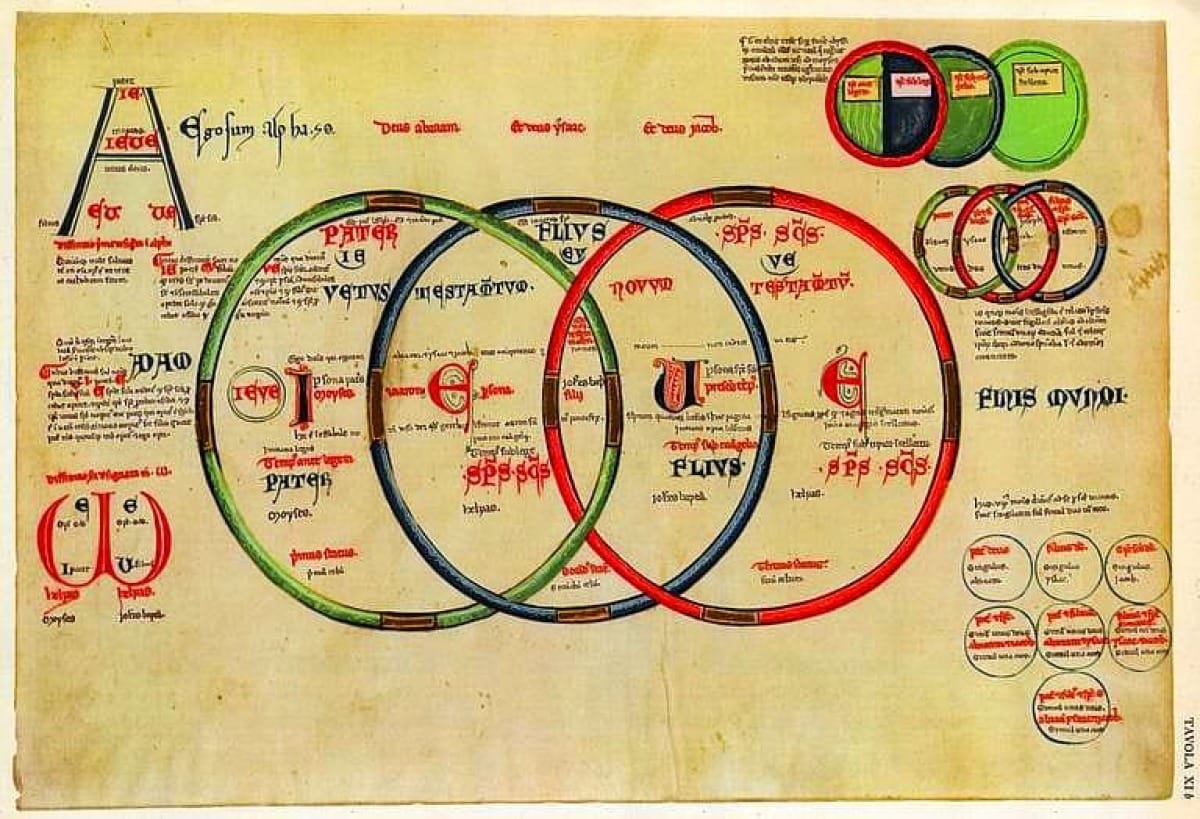
What interests me about this medievalist digression is seeing that, in the form of theological debates, all the discussions that give rise to modern debates about history were already there: Is there novelty in the future or repetition? Is there necessity in history, or can anything happen? Do our actions and those of our contemporaries really matter, or is the apocalypse coming no matter what we do?
Hyperstition before hyperstition (you Kant always get what you want)
Having already brought up Doctor Who, let's take another time jump to the late 18th century. By this point, the philosophy of history already has a name of its own, taken from a section of Voltaire's Essay on the Customs and the Spirit of Nations. These are complicated times: Frederick the Great rules in Prussia, but in France things are looking grim for Louis XVI, whose neck is starting to hurt and he doesn't yet know why. Kant's proposal, which appears in 1784 with his Idea for a Universal History with a Cosmopolitan Purpose, already lays out the structure of what we recognize as the philosophy of history proper. An analysis of what the universal laws acting on history might be, laws that would let us find some line of continuity and progress in the escapades of States that otherwise seem to be pulling all kinds of random crap, militarily and diplomatically.
The general story of the philosophy of history can be put together from here, and we'd better get it out of the way: strongly rationalist visions that presuppose a constant collective subject moving through history with cumulative progress, toward a meaningful goal where everything will be better and whatever happened before can be read retrospectively as what had to happen so that in the end we could all live happily ever after. Put like that, it's pretty untenable, mostly because we lost faith that there's anything like a Reason guaranteeing the meaning of things. But that's the classic critique by which the philosophy of history is pronounced dead. I want to rescue other, more interesting aspects.
The first is that quality of hyperstition avant la lettre. In An Old Question Raised Again: Is the Human Race Constantly Progressing? (now that's a title), Kant proposes that the point is to write a prophetic history of the time to come, and no, it's not that the old man had tried mushrooms and forgotten his old tribunal of the limits of reason. So how is a history a priori possible? “If the prophet himself makes and contrives the events he announces in advance.” In that same text, he distinguishes three possible ways of imagining history: the first, which he calls the “terrorist conception,” imagines history as a pile of misfortunes leading to ever greater degradation. The second, the naive conception that we progress morally without obstacles. The third, which he calls abderitism, is the image of Sisyphus's stone, in which humanity makes some progress only to slide back again, in a meaningless cycle. That's why I'm less interested in how Kant solves the problem of progress than in pointing out that he understood perfectly well that if he had to write an essay like that, it was for its performative effect. At the root of the modern concept of history, the one that breaks away from the account of past events and becomes History with a capital H, the universal history of past, present and future, there is an enormous awareness of the modeling power of fiction, which operates politically on the world, from the world. If our notion of history is terrorist or abderitist, we'll tend to do just that. So Kant understands that he needs to write something else.
In History with a capital H there is an enormous awareness of the modeling power of fiction, which operates politically on the world, from the world.
The second element I want to rescue: the philosophy of history as a spell against meaninglessness. At the opening of the Idea for a Universal History etc., etc., Kant speaks of the discouragement one feels at the thought that “the human tapestry is woven from threads of folly, childish vanity and, often, malice and destructiveness.” Hegel, in his lectures on the philosophy of history, says:
What oppresses us is that the richest figure, the most beautiful life, meets its decline in history. In history we walk among the ruins of the illustrious. History tears from us the noblest and most beautiful things, the ones we care about. The passions have made them succumb. It is perishable. Everything seems to pass and nothing to remain. Every traveler has felt this melancholy.
And Marx, arguably the zenith of modern philosophy of history insofar as his is philosophy of history openly calling for action, wrote:
The criticism of religion is, therefore, in embryo, the criticism of the vale of tears of which religion is the sacred reflection. Criticism has plucked the imaginary flowers from the chain, not so that man may drag a chain that no longer consoles, no longer embellished by fantasy, but so that he may throw off that slavery and pluck the living flower.
I chose to quote at length because the set of metaphors they use matters for understanding the construction of a philosophical and historical system as a great hyperstition, a great set of metaphors proposing a new way of understanding history. The anguish of meaninglessness for Kant, the sadness of what disappears for Hegel, and the rage that life is a total piece of shit for most of humanity in Marx. The philosophy of history imagines a meaning for history because it wants to do something in the face of that void. It's also modernity rejecting skepticism. So Kant imagines that there is a natural disposition in humans that makes us tend toward the realization of freedom; Hegel proposes that Reason guides the course of things like Providence, and so the fall of the great shouldn't make us sad, since it's a necessary renewal toward something better. For Marx, who criticizes the religious element in that Hegelian explanation, we shouldn't trust Providence but take matters into our own hands.
Nietzsche sees both of the aspects I wanted to rescue right when the philosophy of history begins its fall from grace. Go check out that killer text, On the Uses and Disadvantages of History for Life. Like the Greeks, who could escape chaos into a metaphor, we too can escape meaninglessness into a fiction that moves us to act. It's no coincidence that the philosophy of history emerged in the decades surrounding the French Revolution. The exhaustion of one historical model, the violent change proposing another, and the strong sense that, as a worried Tocqueville put it, “now that the past no longer illuminates the future, the mind walks in darkness.” Modernity's philosophy of history isn't just a positivist conception of the future; it's a humanist call to action, to take charge of the transition between past and future. Often aware that installing a new imaginative model takes a lot of firepower, which is why we identify in Marxism a philosophy of history that calls on us to storm the heavens.
The dead don´t die
The twentieth century was hard on the philosophy of history. It was blamed for Nazism and Stalinism, pointed out as pure prophecy in disguise, its metaphysical foundations were dynamited and it was condemned epistemologically. By the sixties it was a straight-up theoretical corpse for any respectable academic. What's interesting is that this corpse's soul now animates other systems of thought, where it sometimes goes unnoticed. We'll consider two cases here: accelerationism and economic theory in its free-market version.
I'll start with the second, about which I can say less. It's not a subject I research, but I do share spaces with people who do, and they convinced me enough that I want to borrow their arguments here and take the chance to plug their work. So go read Nicolás Lavagnino's essays on economic fiction and Ezequiel Gatto's latest book, with its chapters on money and the future.
Economics is largely a discourse about the future (something very well addressed in this episode of Fio and Ruocco's podcast). In debt? Well, you sold your future capacity to make money; there's one certain thing in your future, and it's that you'll have to pay. Scale it up to nations: geopolitics rests on speculation about the future and on whether each player involved will be able to keep its promises to pay. In a very strict sense, the present is being determined by the future. The key point here is that economic discourse, which some like to pretend is an exact science, is a fiction with the same claim to totality as a religion; it casts itself as the giver of meaning to all social relations. So every decision we make, studying one thing or another, having kids or not, living here or there, must be made in observance of how our silly little will takes part in the laws of the market. Money is assigned the role of regulating all other values; the original meaninglessness is papered over by the market's capacity to decide what is and isn't desirable, what is and isn't possible.
In an economic philosophy of history, the free market is the telos to be reached, financial freedom is the force of history that guarantees our movement, and any obstacle placed in its way is inevitably a mistake, because all it does is hinder the necessary march of things. Maybe it wouldn't be such a problem if state intervention were simply a matter of charging Galperín a couple of taxes; the problem is that by doing so we'd be going against manifest destiny. If the road to that destiny breaks something we thought was valuable, we appeal to the concept of creative destruction, where the destruction of the old is the condition for the strengthened emergence of the new in a ceaseless march toward the future. Or, as a strange speculative philosopher of history put it in a recent speech:
we will not be able to return to paradise, because we have been expelled from paradise, but yes, as the Rebbe said, what we can do is bring paradise, that is, whereby what we are going to prove is that capitalism is a divine machine for generating prosperity and for being closer to paradise.
Is the engine of history the State or the market? You decide. Only now, sure enough, we don't think we're talking about fictions but about the hardest, ultimate reality: cold hard cash. “Facts, bro, not narratives.”
Economic discourse, which some like to pretend is an exact science, is a fiction with the same claim to totality as a religion.
The second current discourse where the philosophy of history is more alive than Mirtha Legrand is accelerationism. I won't explain much here, because it's a topic 421 has covered a lot, both accelerationism in general and its star poète maudit Nick Land in particular. As Dante Sabatto rightly said in the piece linked above, all of accelerationism can be seen as a very heterodox Marxism, so it clearly has a philosophy-of-history foundation. But in Land's case, it goes much further. Marxism can survive perfectly well without historical determinism, and in fact it has increasingly leaned that way since the early twentieth century.
But Nick Land, with his peculiar adaptation of cybernetics in which he holds that capitalism as a whole can be defined by a positive feedback circuit that reinforces deviations, simply captures all of futurity in a loop. It doesn't matter if this or that event can't be predicted; the movement of the future has been described, if we believe him, once and for all. Land's philosophy, as Fisher noted in “Terminator vs. Avatar”, is the Hegelian-Marxist engine of history turned inside out: it's not about humans freeing themselves from the capitalist trap, but about pure capitalism peeling off its mask of flesh. If in the liberal economic philosophy of history market freedom leads to homeostatic order, in Land's it leads to deepening deviations to the point of paroxysm. The lack of a determinate end explains why there's no telos, but it has been swapped for teleoplexy: movement is the end, capitalist deterritorialization is the end of history in itself.
Land's way out of meaninglessness was to crown it, to give meaninglessness the role of Universal Reason and raise it to the rank of a historical invariant. His comrade in neoreaction, Curtis Yarvin, complements this with a rereading of American and modern history aimed at restructuring the concept of the present (with the basic premise: we owe nothing to ideas like “democracy” that we thought we were heirs to) in line with his monarchical proposal for the future.
Left accelerationism is a philosophy of history in a much more obvious sense: from Srnicek and Williams's Manifesto for an Accelerationist Politics on, it presents itself as a continuation of the modern Enlightenment project; it's a modern philosophy through and through, technologically updated but with the same kind of humanist teleology. If neoreactionary philosophies of history have proved more attractive, it's because, let's admit it, they've also been far more creative.
If in the liberal economic philosophy of history market freedom leads to homeostatic order, in Land's it leads to deepening deviations to the point of paroxysm.
With all this I'm not trying to make an ironic reduction of the current versions, “forget them, they're just philosophy of history,” nor to rescue the modern ones so we can all become rationalists and the whole damn thing. What I really care about is putting the concept back on the table, because if we lose it we're losing a powerful tool for understanding what's at stake. When we argue about Land, Yarvin, Sloterdijk, we're not just arguing about politics, we're arguing about grand historical narratives, and that has a name and a tradition. And doing so from a strong theory of fiction isn't about denouncing them as “lies” either; it's about understanding what's contingent in the models of the world that compete to be the image of the real.
In the case of the liberal philosophy of history, it seems to have won that battle. And it isn't fiction in any dumb sense: people die over it, people get rich off it, all sorts of things happen. But that doesn't make it the structure of some mysterious thing called reality either; it's one possible configuration of things that happens to be doing very well for itself. Those of us who disagree usually complain about the exhaustion of the imagination, and we seem to ask it to be, instead of a fairly limited faculty that makes collages out of experience, a machine for creation ex nihilo with the performative power to change the world. So we go around in circles between voluntarist humanism ("Imagine faster, they're beating us!") and satirical antihumanism ("You can't imagine anything, you dumb primate, the future is on the march and you, moron, just got in its way"). Hopefully, remembering how the fictions that shape our political and historical imagination actually work will help us find some path in between.
Las notas de 421 no tienen paywall
Y a cada colaborador se le paga por su trabajo. Las dos cosas dependen de los suscriptores.