The Day James Bond Fought Alongside the Taliban
The Living Daylights (1987), the fifteenth James Bond film, and the ideological construction of allies and villains in Hollywood.

The Living Daylights (1987), the fifteenth James Bond film, and the ideological construction of allies and villains in Hollywood.
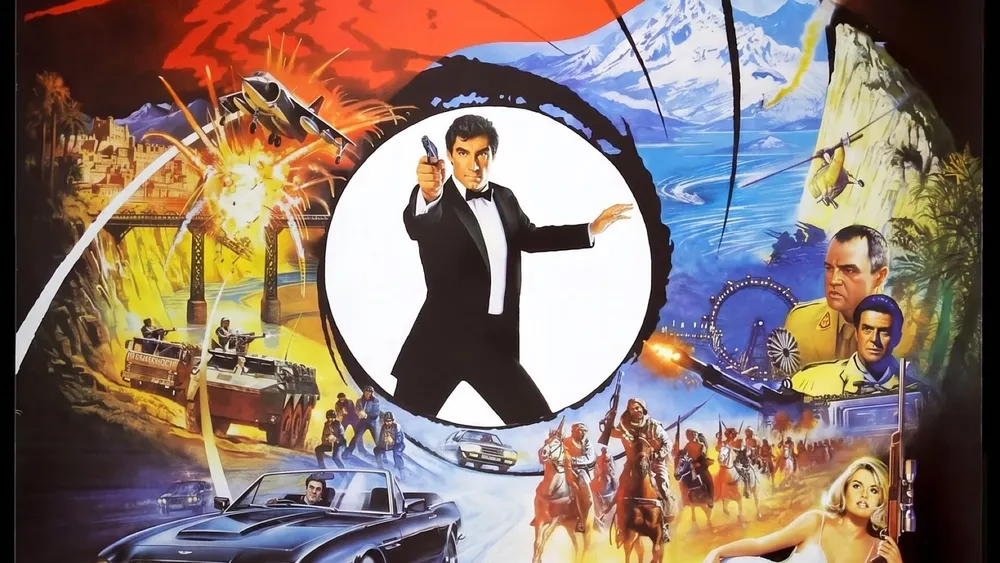
Some movies age poorly. Others age strangely. Not because they are poorly made or because their special effects clash with today's standards, but because the passage of time strips away their ideological mask. Suddenly, they reveal something that seemed completely trivial when they were released. The Living Daylights (1987), one of the lesser-remembered James Bond films, falls into that second category.
The film features a scene that today creates an uncomfortable tension that's hard to ignore: James Bond fights alongside Afghan guerrillas portrayed as noble freedom fighters. Bond, to put it bluntly, ends up on the side of those who would later be viewed by the West as part of the vast repertoire of Islamist terror. In other words, for a moment, James Bond was friends with the Taliban.
The film features a scene that today creates an uncomfortable tension that's hard to ignore: James Bond fights alongside Afghan guerrillas portrayed as noble freedom fighters.
The phrase simplifies, yes. But not entirely. The interesting part isn't the cinematic anecdote but what that scene reveals. Because it prompts us to think about something much broader than the saga of Agent 007: how the enemy is constructed in mass culture, how the great villains of each era mutate, and how Hollywood manages to dictate narratives that reflect the political climate of the moment. A gigantic cultural machinery that designates heroes and villains based on the context.
There’s a comfortable temptation: to read this as a grand conspiracy. But what's interesting, at least for our purposes, is almost the opposite. Sometimes, it’s not necessary for anyone to explicitly dictate a line for a representation to be reproduced: it’s enough to have an established common sense and a film industry that perpetuates that narrative. Sure, sometimes with a little help along the way.
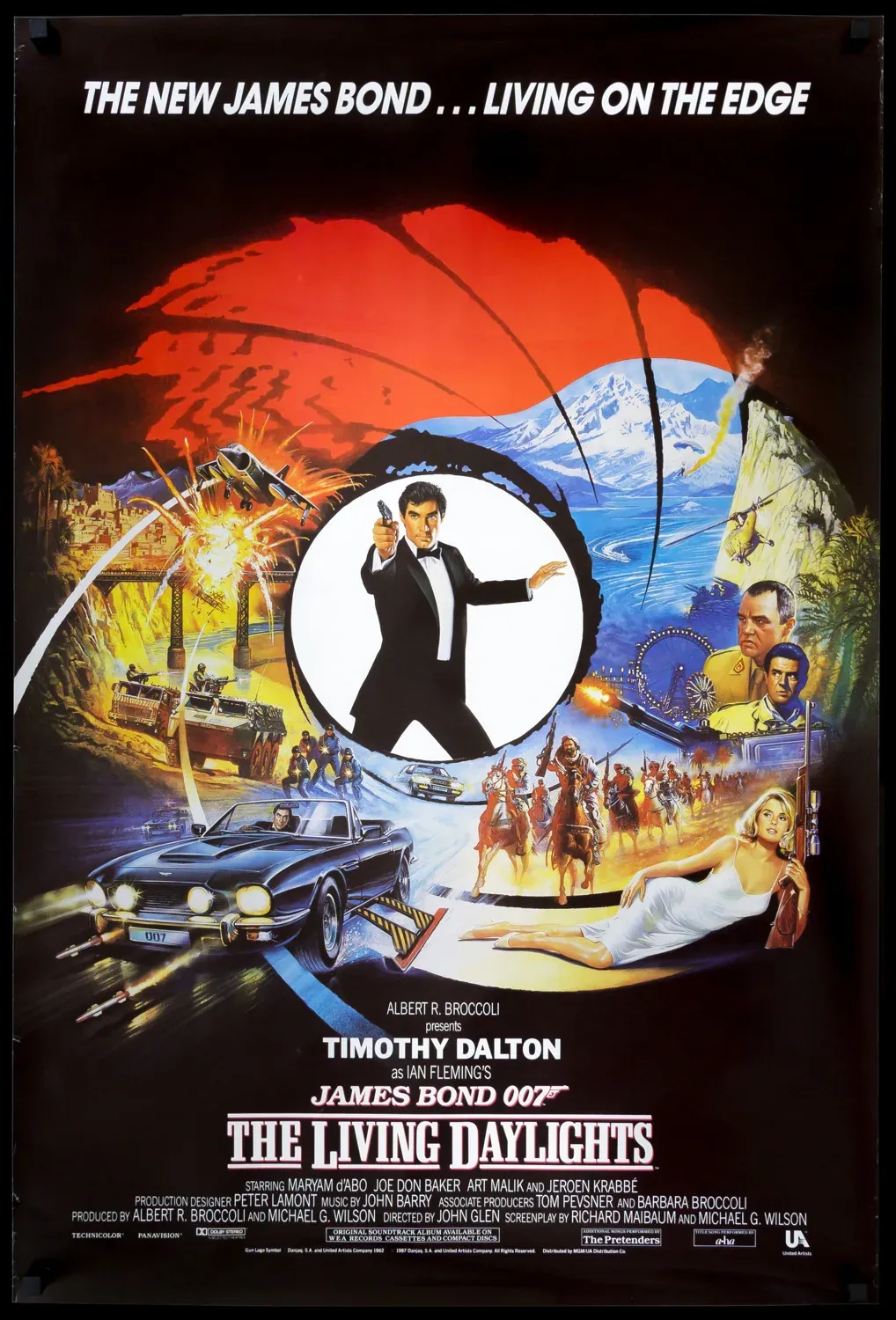
To understand James Bond, we need to step back from the films for a moment. Eric Hobsbawm once proposed a brilliant hypothesis: James Bond was, among other things, an imaginary compensation for a declining United Kingdom. When the British Empire could no longer think of itself as the center of the world, 007 came to offer a reparative fantasy. If global politics was now played out between the United States and the USSR, the English spy allowed the illusion that Britain remained a decisive piece on the board.
This is not a whimsical reading. During the first half of the 20th century, especially after World War II, England had to accept something brutal: it was no longer in charge. The retreat from Dunkirk in 1940, the definitive rise of the United States, the consolidation of the USSR as a superpower, and, a few years later, the independence of India made it clear that the old empire was entering a new phase. It was still important, of course. But it was no longer the sun around which the rest of the world revolved.
In this new bipolar universe marked by the confrontation between two blocs, NATO and the Warsaw Pact, James Bond offered an elegant escape. England may have lost material weight, but it still retained something the British myth always attributed to itself: refinement, intelligence, cunning, composure, and phlegm. If the muscle was now American or Soviet, the brain could still be English.
James Bond was an imaginary compensation for a declining United Kingdom. When the British Empire could no longer think of itself as the center of the world, 007 came to offer a reparative fantasy.
That’s why James Bond is not just an action hero. He is also a geopolitical fantasy. The fantasy that the world is not defined so much by large economic structures, by industrial wars, or by mass social movements, but by fine operations: a password, an infiltration, a state secret, a well-dressed man entering the right place at the exact moment. A perfect nod to the logic of the Cold War, the ideal setting to believe that history depended less on long processes and more on exceptional men with a license to kill. There’s undoubtedly some truth behind that.
Of all the films in the saga, The Living Daylights holds a special value for examining this issue. Not because it’s the best, far from it, but because today it can be read almost as an involuntary document of its time.
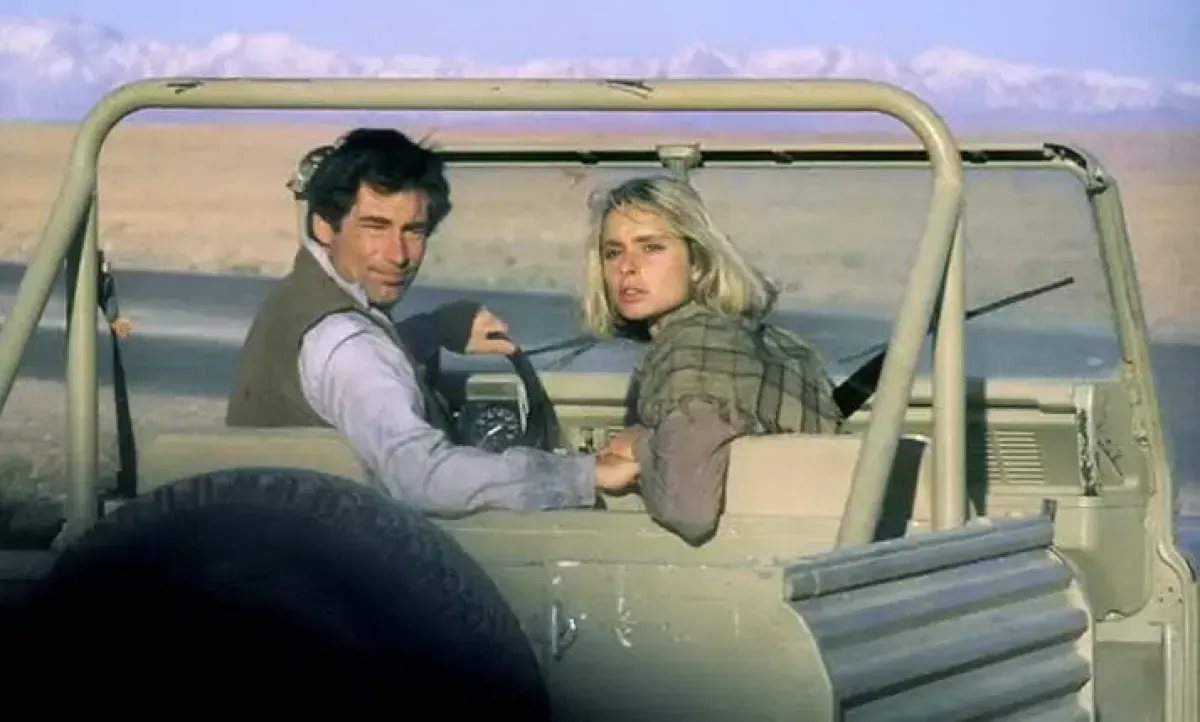
The plot, quite classic, revolves around a network of arms traffickers, covert operations, and deceptions between blocs. The important part emerges when the film shifts to Afghanistan and Bond comes into contact with the armed resistance fighting against the Soviets. It’s 1987. The USSR has been bogged down in the Afghan war for years, that “Soviet Vietnam” that drained the Eastern bloc. On the other side, various Islamist groups receive support, funding, and arms from the United States. In the political language of the time, those fighters are presented as anticommunist resistance. In practice, many of those groups would later feed into the most reactionary and violent forms of political Islam in the region.
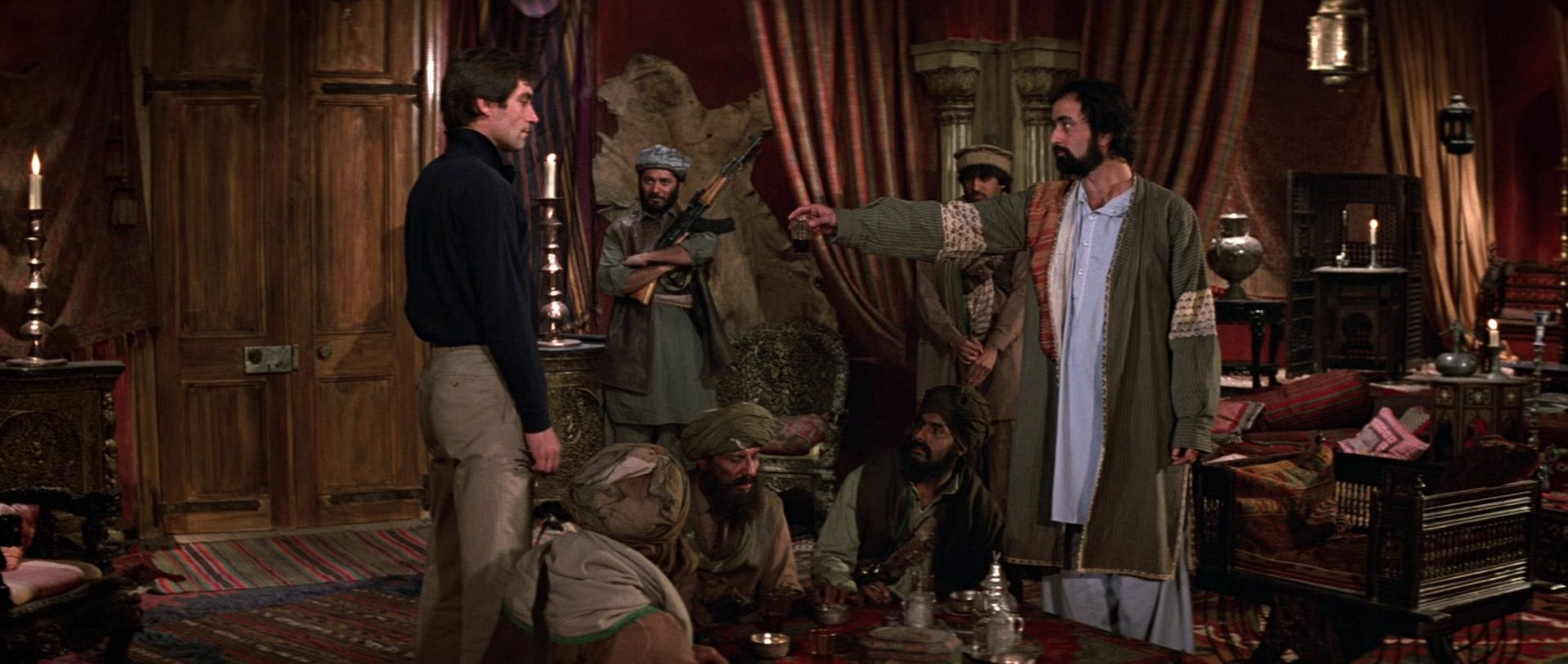
The film does not engage with any of those complexities. It does something much simpler: it orders the world morally. The Soviets appear as brutish, cruel, and clumsy. The Afghans allied with Bond, on the other hand, carry all the attributes of epic dignity. There’s honor, courage, sacrifice, loyalty. One of them, Kamran Shah, is also a refined commander, educated at Oxford, almost British in his manners. He is the other who is correct: foreign, yes, but recognizable; exotic, yes, but on the right side of history. The message is crystal clear. At that moment, for the dominant Western sensibility, the absolute enemy remains Soviet communism. Anyone fighting against it can be easily integrated into the realm of good.
Viewed from today, the scene has a spectacular irony. Because what would later be shown as the very face of barbarism had been, not long before, a perfectly acceptable tactical ally. And this did not happen because those forces suddenly deviated or because one day they woke up turned into monsters. Reactionary fundamentalism, theocratic authoritarianism, and extreme violence were already there. What changed was not their nature but the strategic reading of the West towards them.
In light of this, the most tempting explanation is often: Hollywood lies, power dictates the line, everything is scripted from above. There’s some truth to that, obviously. No gigantic cultural industry is politically innocent. There are undoubtedly people with enormous power who dictate the fate of entire industries. But the idea of an all-powerful conspiracy, of a group of enlightened individuals designing who will be the villain of the next decade, has a problem: it oversimplifies. Allow me some pragmatism: even if the world operates this way, it might not be the best way to approach it.
Conspiracy theories are seductive precisely for that reason. They offer a readable and simple world. If the images change, someone changed them. If the enemy mutates, someone decided to mutate it. If millions of people repeat a representation, there must be a secret center coordinating the operation. And for that reason, those who can detect the conspiracy risk falling into the mirror of Narcissus: the illusion that they understand everything. For that reason, it might be more useful to think that societies produce common senses, climates of the era, and available repertoires of interpretation. When a worldview becomes dominant, many of its operations reproduce almost automatically. That’s the key. Hollywood doesn’t need to invent each enemy from scratch. It’s enough to translate an existing one into the language of mass storytelling. It gives a face, accent, wardrobe, and music to a threat already present in society. If we’re talking about pedagogical exercises, it’s more stimulating to untangle the knots of our ideology than to search for names of hidden leaders scheming in the shadows.
That’s why names change, but the structure repeats. Yesterday it was the Nazis. Then the Soviets. Later the drug traffickers, the Arabs, the North Koreans, the terrorists. The historical differences between them are immense, but on screen they often serve a similar function: embodying a demonized otherness, a figure of evil that simplifies a world that is, in reality, anything but simple.
The theorist Edward Said wrote that in the United States, there is a persistent tendency to dehumanize the other, turning them into a demonic presence. This observation remains useful because it points to something deeper than a specific prejudice. When a culture needs to reaffirm itself, it often does so through absolute contrasts. It’s not enough to say who we are; we also need to clearly invent who we are not.
Hollywood doesn’t need to create each enemy from scratch. It’s enough to translate an existing one into the language of mass storytelling. It gives a face, accent, wardrobe, and music to a threat already present in society.
Here appears the ideal enemy: cruel, fanatical, irrational, backward, impervious to dialogue. The other without nuances. This mechanism not only organizes foreign policy or media discourse. It also provides comfort. Because a world filled with clear-cut villains is a world that’s easier to understand. If there are monsters on the other side, then on this side we have us: the reasonable, the human, the civilized. The operation is childish, but effective. It reduces complexities, erases shared responsibilities, and offers a rather comfortable moral excuse.
James Bond fits perfectly into that machinery. His films promise that global chaos has a secret shape that can be deciphered. There’s always a central threat, always a malignant core, always someone who wants to destroy the order of the world. And always, of course, there’s an elegant hero capable of detecting evil, isolating it, and neutralizing it. It doesn’t matter much if that evil wears a Soviet uniform, a turban, has a scar, or a foreign accent. What matters is that it is recognizable as such.
That’s why revisiting The Living Daylights isn’t just about watching an old movie. It’s about observing a form of political sensitivity in action. Seeing how an ally from yesterday can become tomorrow’s monster without the narrative machine needing to change its structure too much. The names change. The setting changes. The villain’s language changes. But the logic remains.
The lesson isn’t that we were fooled before and now we understand everything. Quite the opposite. There’s probably always something about the present that we are reading through similar simplifications. Even today, we have our enemies ready for quick consumption, our great global villains, our moral categories served on a platter so we don’t have to think too much.
Maybe that’s why it’s wise to watch these films with a little less nostalgia and a bit more suspicion. Bond will continue saving the world with flair, irony, and Martinis. The problem was never Bond. The problem is the comfort that comes from a narrative where the bad guys are always clearly identified, far from us and on the right side of the moral border. When the world is too easily divided between heroes and monsters, something is functioning poorly.
Y a cada colaborador se le paga por su trabajo. Las dos cosas dependen de los suscriptores.