The Hidden Science Fiction of Indio Solari: Androids and Dystopia
Street rock or cyberpunk? The most futuristic, dystopian side of Los Redondos, on a journey that links Indio to science fiction.

Los Redondos came into my life early, through my friends, when I was a teenager of no more than 13 or 14. But unlike them, who listened with devotion, I never fully adopted them: I liked a handful of songs and knew a lot of the lyrics by heart, but I didn't feel they were “my band.” Back then (the late nineties) I was more drawn to music that was fast, aggressive or lyrically violent (hardcore, grunge, rap), and Los Redondos didn't fit any of those categories. So I listened to them secondhand, sideways, whenever one of my friends put on Luzbelito, Un baión para el ojo idiota or En directo, that live album with a faint whiff of bootleg.
El Polaco Goyeneche once said, “Grow up, kid, tango is waiting for you.” My case was peculiar, because a band like Patricio Rey y sus Redonditos de Ricota, which usually wins you over as a teenager, didn't win me over until I was older. Let's say I started to understand it and adopt it (for real this time) as one of my go-to bands once I grew up. And Los Redondos, like tango, waited for me.
In the time between my early teens and adulthood, I was convinced that Indio Solari's lyrics were almost exclusively about street-corner scenes, neighborhood accents, drugs and outcasts, the working class and politics. In other words: the poetics of the street. But when I started diving deep into Los Redondos' songs and the Indio's lyrics, I discovered there was something more, something that had always been there but that I failed to spot at the time: dystopian science fiction and cyberpunk, key elements of Solari's poetics and of the imagery of one of the most important rock bands in our history.
I suspect I'm not the only one who missed it at first: even though the Indio may well be the Argentine singer and lyricist who has drawn most often on the imagery of science fiction, for some reason this side of his lyrics never quite sinks into the collective memory.
The Indio may well be the Argentine singer and lyricist who has drawn most often on the imagery of science fiction
Using the aesthetic and narrative tools of science fiction, Solari didn't just write lyrics to give the songs a narrative frame; he created something vaster and more ambitious: an expandable project that slips out of music's corset, breaks the limits of visual language and turns the Indio into a demiurge of fantastic worlds.
The genesis of this fictional universe lies in the making of an experimental feature film, and the axis around which his entire imaginary revolves is an unfinished, eternal novel, a myth of Argentine pop culture and literature, the Solarian holy grail titled El delito americano.
The dawn of a myth
Dystopian science fiction has been part of Los Redondos' imagery since before the band was even born, when they were just a group of restless friends eager to experiment with the arts. In 1976, Carlos “Indio” Solari and Guillermo “Negro” Beilinson embarked on an audiovisual adventure: shooting an experimental film on Super 8, whose title they borrowed from the I Ching: Ciclo de cielo sobre viento. This feature, written by and starring Solari, directed by Beilinson and shot between Valeria del Mar and La Plata, is what internet jargon now calls lost media, meaning material that was once seen by the general public but is now lost because it was banned, destroyed or simply vanished. Only a measly nine minutes of the footage survive, from which it's impossible to reconstruct the plot, but there's at least one written source from the time (a piece published in La Plata's newspaper El Día in October 1976) that gives us a few clues to at least imagine what Ciclo de cielo sobre viento is about: in a dystopian future where pollution on the planet's surface has reached catastrophic levels, humanity has been forced to take refuge in underground cities called “subcities.” The film presents a cybernetic society organized and controlled by a computing center that provides both material and psychological well-being and puts a computer in charge of each subcity. The conflict arises when these computers start fighting one another in an internal war for living space, which leads them to neglect their assigned tasks, plunging the subcities into decay and chaos. That's when a group of rebels appears, suspecting that the planet's surface might not be as polluted and destroyed as they've been told, and they try to escape the machines that control them and make it outside.
Ricky Rodrigo (multi-instrumentalist, member of the first lineup of Los Redonditos de Ricota back in the seventies, and an extra in the film) recalled that in the third act the rebels manage to get outside and discover that the world wasn't actually devastated and the planet's surface was habitable, just as they had suspected.
Of course, outside Argentina none of this was new or original by the mid-seventies. Speculative fiction had been imagining dystopian, apocalyptic and underground worlds since the late nineteenth century, and cinema had been doing it since the early twentieth (I'm thinking of Metropolis, from 1927, as the first great example), so it wouldn't be off the mark to call the underground dystopia just another subgenre of science fiction. But in our country, few dared to bet on dystopian, experimental sci-fi cinema during a military dictatorship, which shows that the young Carlos Solari was already a daring artist, shaped by his cultural tastes.

One likely influence when it came to imagining his own dystopian, post-apocalyptic world might be E. M. Forster's prophetic and unjustly forgotten story The Machine Stops (1909), which depicts a future in which humanity lives underground, completely dependent on an omnipotent computer that satisfies its material, spiritual and psychological needs. Another influence on Ciclo de cielo sobre viento could have been the short story The Defenders (1953) and its expansion into a novel, The Penultimate Truth (1963) (both by Philip K. Dick), in which, because of radiation and lethal gases, humanity lives sheltered in underground tanks while robots fight an endless Third World War on the surface, though the hidden truth is something else: the war ended years ago and people scrape by underground, deceived by fake news cooked up by the elites of the warring sides, who live full lives in a green, habitable outside world. Finally, we could think of George Lucas's debut feature THX 1138 (1971), a dystopian sci-fi film that depicts the world turned into a vast underground society, hyper-surveilled and pacified with drugs that suppress social behavior, a cold, dehumanized community whose conflict arises when one of its inhabitants (THX 1138, played by a magnificent Robert Duvall) decides to rebel against the system, first by daring to have a love affair with a young rebel woman and then by escaping to the planet's surface to see the sunset with his own eyes.
Few dared to bet on dystopian, experimental sci-fi cinema during a military dictatorship, which shows that the young Carlos Solari was already a daring artist.
But the real importance of Ciclo de cielo sobre viento for the future of Los Redondos (and of Argentine culture as a whole) lies not in its plot, its originality or its influences; what truly mattered was the moment when, in the middle of the shoot, Guillermo Beilinson introduced Indio Solari to his younger brother, Eduardo, better known as Skay. And since Skay was a musician, they invited him to help create the film's soundtrack, for which (as the Indio recalls) they started mixing noise with music and the sound of the electric guitar with voices and echoes, resulting in a kind of “strange, universal folk music.” The soundtrack of Ciclo de cielo sobre viento was the first collaboration between the Indio and Skay, or put another way: the Ricotero Big Bang. It's also worth noting that the film's costume designer was Carmen Castro (better known as La Negra Poli), Skay's life partner and the band's future manager.
In other words: Patricio Rey y sus Redonditos de Ricota exists thanks to science fiction.
New Wave
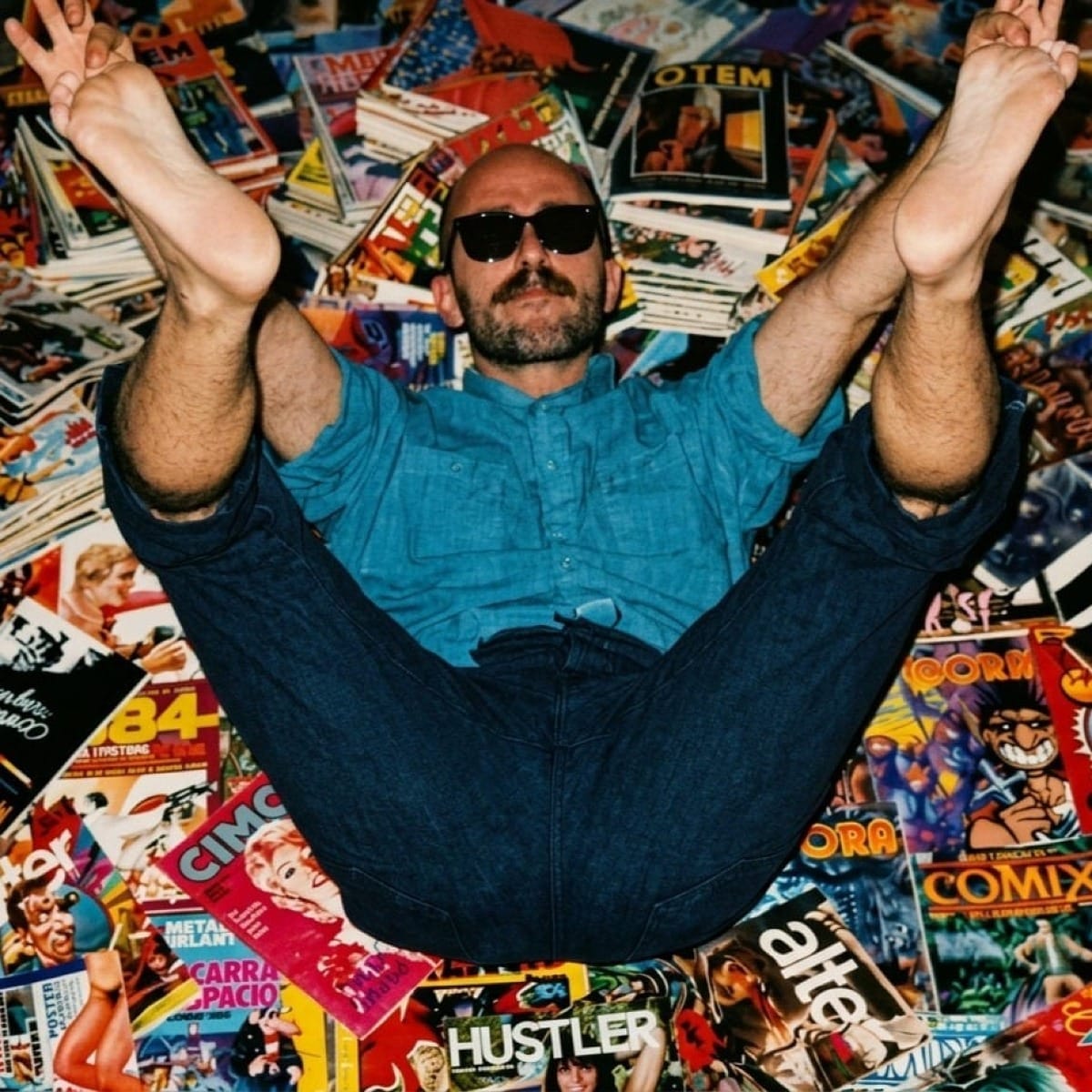
Ten years after the film's premiere, on the release of Oktubre (Los Redondos' second album), Indio Solari gave an interview to the legendary Argentine journalist Enrique Syms for the magazine Cerdos & Peces. The conversation, Syms notes in the standfirst, took place at the singer's own home, “among his comix collection” (another name for underground, countercultural comics), where they talked about several topics he cared about, among them science and technology, power, corporations that rule through technocracy, mental health and fiction: “We live fiction through comix and film; man will be the cowboy of space and the ship his horse,” he told Syms.
In the Indio's biography there's a very particular photo of him lying on the floor surrounded by countless magazines, most of them European comics: Tótem, El Víbora, Cimoc, Comix Internacional, 1984 (Spain) and Metal Hurlant (France), which makes plain the Indio's obsession with this specific strand of the ninth art: adult, dark, violent, countercultural comics.
Unlike what happened in the golden age of science fiction (1938 to 1950), when faith in progress and devotion to science and technology were the narrative engine of most stories and novels, the authors of science fiction's New Wave in the sixties, disillusioned by political violence and war and influenced by the cultural revolutions, the avant-garde and experimental literature, chose to question the benefits of science and progress by imagining dystopian futures, avoiding outer space to retreat into humanity's “inner space,” and bringing into their stories subjects considered taboo for the genre, like drug use, sex and religion. The comix and comics Solari read in those European magazines were direct heirs of science fiction's New Wave, so they inevitably took a rather pessimistic view and laid out dark sci-fi scenarios, dystopian futures and outcast antiheroes. All that imagery seeped into the Indio's lyrics and helped shape his particular fictional universe, whose core is, as we mentioned, that infinite canvas he called El delito americano.
El delito americano
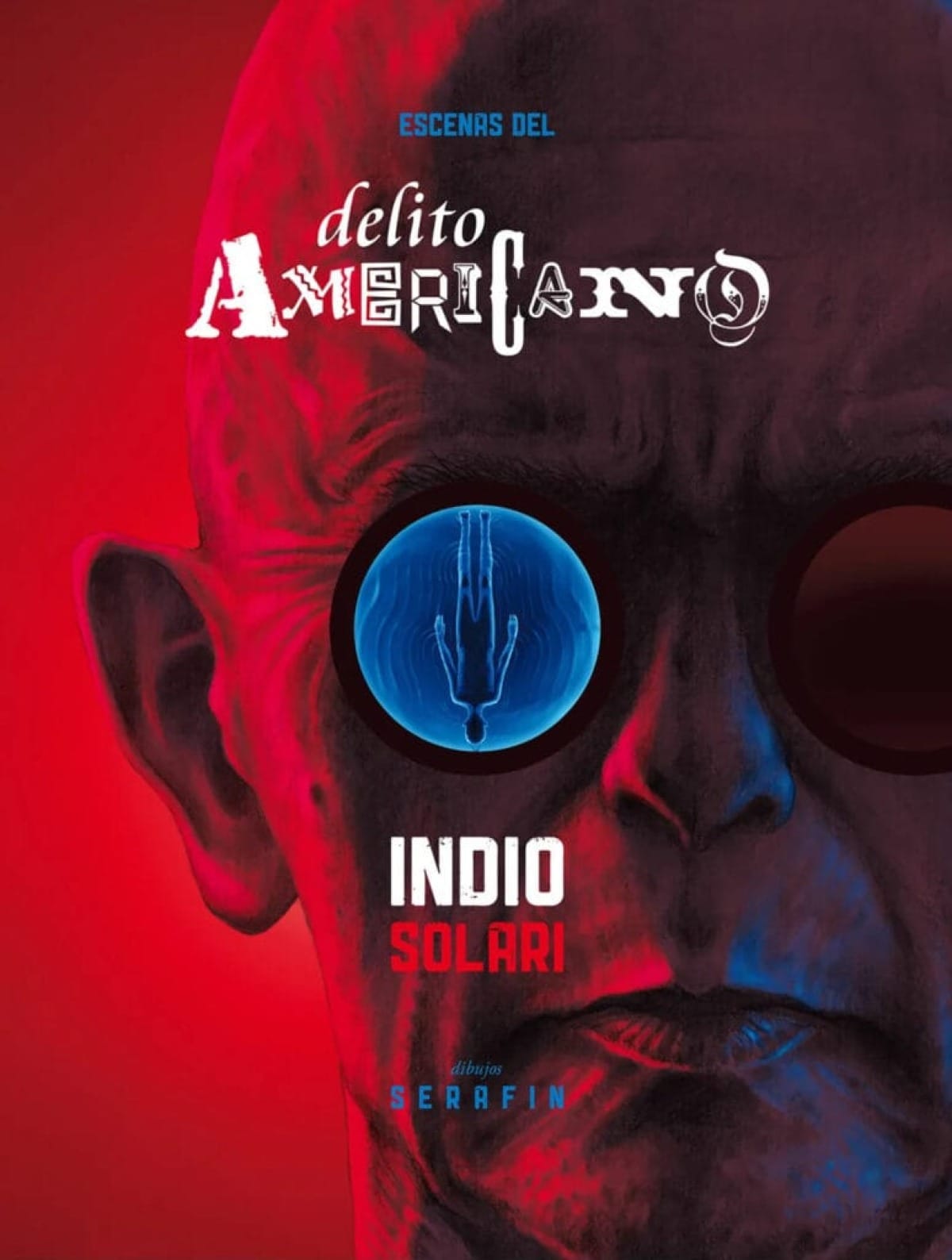
The documentary Jodorowsky’s Dune (Frank Pavich, 2013) tells the story of the greatest science fiction film never made (the adaptation of Frank Herbert’s novel by the eccentric director and writer Alejandro Jodorowsky) and leaves you with the feeling that we missed out on a work that could have shattered every paradigm of the genre and changed the lives of every film buff out there. Reading the comic Escenas del delito americano (2017) produces a similar feeling, but from a literary angle: it turns out that this comic, written by Solari and magnificently illustrated by Serafín, is made up of fragments of a larger work the musician spent many, many years writing (thirty, maybe more), an experimental, avant-garde science fiction novel he hoped to publish someday, an unfinished work from which he finally decided to let a few fragments loose in graphic novel form. Many Los Redondos songs fed off this endless text: phrases, characters and places emerged from its pages and went on to become part of Solari’s lyrics.
The Indio’s passing leaves us orphaned not only of music but of literature too: it hurts to think that we may never get to read what might be the best (or, at the very least, the most daring) Argentine science fiction book of all time. The total novel among total novels.
Anyway: all we can do is settle for Escenas del delito americano, which is no small thing.
I find it somewhat impossible, even ridiculous, to try to summarize this comic, given its non-linear, fragmentary, experimental and allegorical nature. In my experience, the best option is to dive into it knowing and expecting nothing; but so as not to be stingy, here are a few clues: let’s say it’s a science fiction story that narrates flashbacks of the apocalypse, memories of lost futures, possible dystopias; a Ricotero cyberpunk tale largely starring El Peregrino (an alter ego of the Indio, the way King Mob is for Grant Morrison in The Invisibles), a non-time saturated with designer drugs and altered states of consciousness, sensory experiments, bacteria, body horror, outlandish characters, subversive wars, social criticism, religion, politics, prose poetry and philosophy. In the Indio’s words, Escenas del delito americano is “a syntactic and grammatical game that uses ambiguity to conceal its aim of confronting the reader with the sense of an atomized and cruel future, in which science has stopped stealing time from eternity.” This central work of Solari’s is where the influence of the New Wave of literary science fiction and of European underground comix is most clearly visible: Moebius, aka Jean Giraud (who, with Dionnet and Druillet, founded Metal Hurlant magazine and illustrated the storyboard for Jodorowsky’s failed adaptation of Dune), was the mandatory aesthetic reference Solari gave Serafín.
Solari’s poetics
There’s a terribly Ricotero line attributed to cyberpunk writer William Gibson: “The future is already here — it’s just not very evenly distributed.” I like to imagine Gibson listened to Los Redondos, especially when I listen to Todo un palo (1988) and the Indio sings: “The future’s already here, it came in a way you didn’t expect, what a blow, you see.” The Indio’s lyrics are those of a pop poet attuned to technical progress, a techno-shaman interested in technological evolution and in the changes it brings about in human beings.
The songs of Los Redonditos de Ricota talk about digital Adidas, injectable Pepsi and a test to go to space; there are techno-dukes, psychoheroes, little big internet thugs, digital gods and even an Alien Duce; they’re crawling with sony samurai, drogocops, lawless robocops and Japocops made in Detroit; there are smart streets, wanderings through cybersiberia and crazy little birds of cyberbabel.
The Indio’s lyrics are those of a pop poet attuned to technical progress, a techno-shaman interested in technological evolution and in the changes it brings about in human beings.
In the songs of his post-Redondos solo career there are telegames with shamans, birds singing over the jungles of the internet, sleeping robots, technohumans, protohumans and technobios, sleeping automatons, chronodrugs, cyberclouds, virtual depths, smart houses and subcutaneous chips.
In the songs of Los Redonditos de Ricota, the neighborhood accent lives side by side with the vocabulary of science fiction, and cyberpunk imagery blends with the aesthetics of Buenos Aires’ fringes. Solari smuggles data and cultural information into his lyrics, and often slips into his verses not only his musical influences but also his cinematic ones (Andrei Tarkovsky, Werner Herzog, Ingmar Bergman) and literary ones (Jack Kerouac, William Burroughs, Kurt Vonnegut, Philip Dick). Let’s take a clear example with a lesser-known song that was inspired by a short story. In 1969 Philip K. Dick published his story The Electric Ant, which tells the story of Garson Poole, the CEO of the prestigious firm Tri-Plan Electronics, who after an accident with his craft wakes up in a hospital and discovers that he’s missing a hand, though he feels no pain. The doctor reveals that he isn’t actually a man but an electric ant, an organic android programmed to live among humans and believe it is a human being. Poole realizes he was just a figurehead, that he had never really run the company, and calls himself a “mechanical slave.” He discovers he has a panel in his chest with a control module and a reel of punched tape mounted over the heart mechanism, and that, perhaps, by tampering with it, he can alter his reality. From this discovery on, Poole begins to question the nature of his existence: Who is he? Why was he built? What is reality? Can it be changed?
In an unreleased Los Redonditos de Ricota song (which they only played a handful of times between 1983 and 1987), popularly known as El hombre eléctrico (though it was registered as Soy un perdido eléctrico), the Indio sings:
I’m an electric lost soul,
the electric universe,
one of the multitude
lost and without identity.
I tend my tunnel tube
with galactic DDT
and though it may seem a crime
the monster doesn’t bite me anymore.
I am nobody.
DDT (dichlorodiphenyltrichloroethane) is the main component of insecticides: isn’t Garson Poole a lost being with no identity, an electric ant with a tunnel tube in his chest, a nobody lost in an electric universe?
By the end of the millennium (twenty-two years after the premiere of Ciclo de cielo sobre viento), Patricio Rey y sus Redonditos de Ricota had fully embraced dystopian science fiction on their ninth album, Último bondi a Finisterre (1998), giving it packaging that evokes a spaceship and a futuristic aesthetic, with the whole band (for the first time on a cover) turned into digital characters in the style of PlayStation 1 cutscenes, lyrics with cyberpunk overtones and a rock built on loops, samplers and machinic textures that push it toward electronica.
In the book Díscolo. Desobediencias creativas del packaging discográfico (2013), Rocambole (the artist behind this and every other Los Redondos record) explains that his intention in creating the cover of Último bondi a Finisterre was “to reflect a kind of journey across the border that divides the past from the future. As an attempt to defy the limits of space and time. A journey toward what was being presented to us as the future: the technological ordeal.”
In 2010, with his new band Los Fundamentalistas del Aire Acondicionado, the Indio released El perfume de la tempestad, which contains one of his most sci-fi songs: Submarino soluble. In an interview with Marcelo Figueras, Solari said this song “works on ambiguity; you never know whether the black sea it talks about is virtual or the cosmos. But it says tin, and that isn’t virtual, so it seems to be about some kind of astronaut. The point isn’t what kind of traveler he is, but how alone he is while he serves as the spearhead of a culture, going off to take over another place or being a seed.” In hindsight, many believe they can detect in these lyrics an allegorical premonition of his illness: the ship it refers to is his own body. Either way, Submarino soluble is written like a classic science fiction story and is one of the most beautiful songs he wrote in his final period:
The ship I’m in won’t obey me anymore!
(I wonder why it won’t obey me anymore…)
Planetary is my fortune
but sunk in an ocean.
Abandoned here in Cybercloud
in the virtual depths of a black sea
Planetary creature…
my eyes never learned
to cry.
What you have to suffer in this tin can!
Heading for my death… motionless… Hallelujah!
I wonder if I’d be more at ease out there
I look at the screen: Hallelujah!
Control is hounding me bad
so many commands make me see I’m alone
Planetary is my fortune
but sunk in an ocean.
My neural capsule doesn’t work on me anymore!
And the red joystick doesn’t steer a thing anymore!
The ship I’m in won’t obey me anymore!
I’m running out of air! The light flickers…
Control insists that what’s happening
is normal
that being so alone, like this, can do you harm…
Planetary creature
my eyes never learned
to cry.
I drag myself very slowly
on my belly… Hallelujah!
Hallelujah!
I sense more than I see
a sunlit field inside me… Hallelujah!
Hallelujah!
On June 5, 2026, this earthly plane lost not only one of the finest singers and lyricists but also one of the finest writers of speculative fiction this incredible country has ever produced.
Cheers, Indio! Thanks for the music and for the science fiction.
Playlist: Solari Cyberpunk
Las notas de 421 no tienen paywall
Y a cada colaborador se le paga por su trabajo. Las dos cosas dependen de los suscriptores.