The 19th-century novel The Great God Pan and the anime Lain. Two stories about how technology shapes our identity.
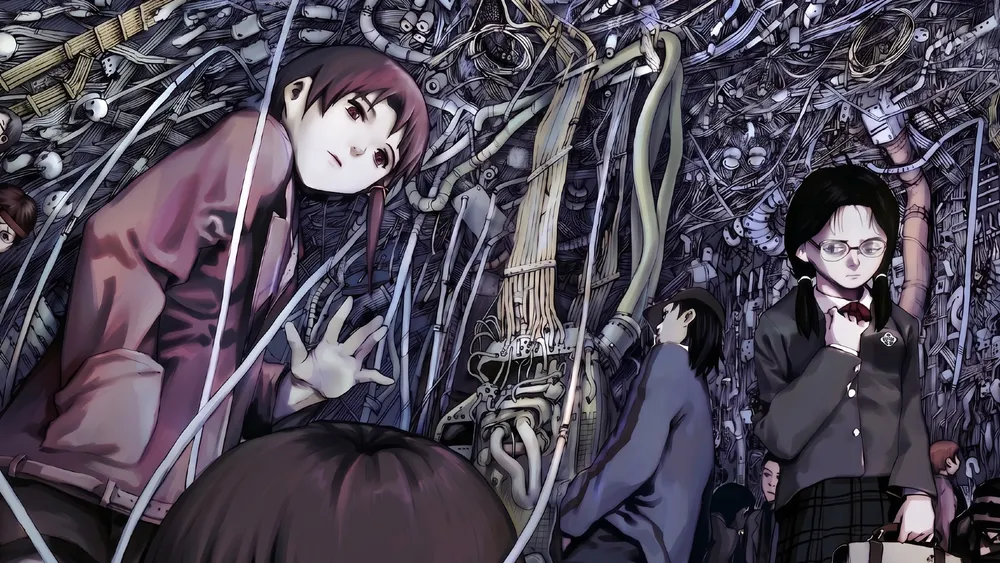
There are possible intersections between Serial Experiments Lain, the anime by Ryutaro Nakamura, Tositoshi Abe, and Chiaki Konaka, and The Great God Pan, a novella by Arthur Machen. They occur in a game where one reality attempts to enter or overlap with another. While the material reality, first concrete and later plastic (embodied in various types of hardware), is presented as a rationalized set, the bodies of the protagonists in both narratives emerge as their potential fractures. These breaks represent the abyss of the spiritual world (The Great God Pan) and the virtual world of the Net (The Wired in Serial Experiments Lain).
A little over a hundred years separate one story from the other. Machen published his novella in 1894, during the final stretch of Victorian England. Lain was first aired in 1998. Both are tales from the end of the century; in both, technological changes and modifications are the result of a process of social transformations. For this reason, scientific experimentation triggers the narratives. In The Great God Pan, Dr. Raymond claims to have found the door to the spiritual world; that place where an irrational, ancient, and wild totality resides. By connecting certain neural bridges, Raymond has discovered a way for us to lift the veil and see the reality inhabited by the god Pan. To achieve this, he uses a woman named Mary, performing an incision on her head, leading her to witness that abyss. In Lain, a scientist and developer named Masami Eiri steals information from an experiment called K.I.D.S., hoping to harness the mental energy that, according to the anime's narrative, humans possess at their most intense state during childhood. With this, Eiri creates Protocol 7, seeking to leave the physical reality behind as it is invaded by the virtual.
Both are tales from the end of the century; in both, technological changes and modifications are the result of a process of social transformations.
From the first of the experiments will be born a girl named Helen Vaughan; a human hybrid (on her mother Mary's side) and of Pan. Helen is the consequence of a scientific violation. Lain, on the other hand, will be the creation of Masami Eiri before he commits suicide. In her, Eiri will implement Protocol 7 while providing her with a human body. Both serve as bridges: the first half-goddess/human and the second half-human/software. In both stories, experimentation on human beings unleashes forces that aim to alter and conflict the normal state of things. The first experiment takes place ad portas of the 20th century, the age of electricity; the second, ad portas of the 21st, the age of the digital. Both narratives also propose the ghostly quality of electricity. In Lain, for example, the presence of cables and light poles is constant. They suggest voices that traverse it, the constant presence of a second reality that can invade the first; always present yet contained.
In The Great God Pan, electricity appears as an analogy in the first chapter, titled The Experiment. There, Dr. Raymond speaks to Clarke, the character through whom Machen provides the point of view:
Yes. A small lesion in the gray matter, that's all; an insignificant rearrangement of certain cells, a microscopic alteration that would escape the attention of ninety-nine out of a hundred specialists. Clarke, I don't want to bother you with my profession; I could give you many technical details that would sound impressive, but you would remain as enlightened as you are now. […] You might think this is just allegorical language, Clarke, but it's so hard to be literal. And yet, I don't know if what I'm hinting at can be put into simple and isolated terms. For example, our world is currently completely connected with wires and telegraph cables; and with something less than the speed of thought, they cross like lightning from dawn to dusk, from north to south, through floods and deserts. Suppose that a modern electrician realized that he and his colleagues have merely been playing with pebbles, confusing them with the foundations of the world, suppose that a man like that glimpsed the infinite space opening up before the current, and the voices of men traveling at the speed of thunder towards the sun and beyond the sun, towards the farthest systems, and the echo of the articulated voice of men in the desolate void that confines our thought. In terms of analogies, this is a very good analogy of what I have done; you can now understand a bit of what I felt here one afternoon; a summer afternoon like this and the valley looking as it does now. I was here and, before me, I saw the ineffable and unimaginable abyss that opens deep between two worlds, the world of matter and the world of spirit; I saw the void and great abyss extend lifeless before me, and, at that moment, a bridge of light leaped from the earth to the unknown shore, and the abyss was joined. You can look in Brown Faber's book, if you wish, and you will realize that even today scientists are incapable of accounting for the presence, or specifying, the functions of a certain group of neurons in the brain. That group is, as it were, no man's land, just a waste of space for imaginative theories. I am not in the position of Brown Faber or the specialists, I am perfectly aware of the possible functions of those nerve centers in the scheme of things. With a touch, I can make them come into play, with a touch I say, I can release the current, with a touch I can complete the communication between this world of the senses and… we can finish the sentence later. Yes, the knife is necessary; but imagine what that knife will do. It will completely level the solid wall of the senses and, probably, for the first time since man was created, a spirit will contemplate a world of spirits. Clarke, Mary will see the god Pan!
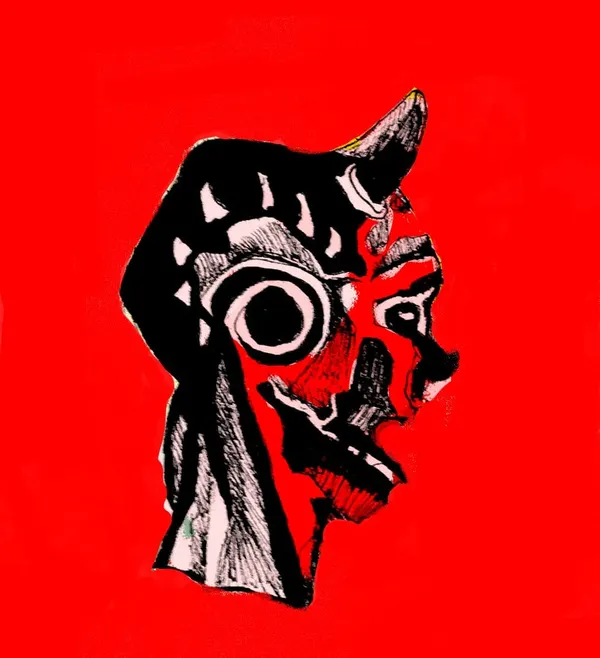
Helen and Lain will begin to be the bodies that alter everything around them; their presence and contact will lead to various consequences for those around them. Helen, for example, is sent to Wales by Raymond, and in that village, she will cause the death of a girl and a boy who have become her friends. They will say of her that she stayed in the woods, playing with a creature resembling a Satyr. Helen is surrounded by mystery, she will be a character narrated by witnesses; unlike Lain, whose point of view and internal confusion is always assumed by the viewer. Helen grows up to become a beautiful yet repulsive woman, maintaining a certain sexual freedom that is transgressive and controversial for Victorian morals. Those who interact with her will end up affected for life; they are men who end up committing suicide, and whose bodies wear a horrible grimace of terror, the vision of panic. Being the daughter of Pan, Helen's existence brings chaos, but not because of her liberated sexuality; rather, because she embodies the vision of the god, wild and largely unaware of the sometimes necessary human restrictions. Lain (13 years old), on the other hand, is a shy teenager with good intentions, who discovers other versions of herself, with different personalities. The second Lain, for example, has a sly smile and acts with a certain malice, her actions in the digital world cause deaths and madness in the material world. As she delves deeper into virtuality (which she initially appears apathetic towards), in a transition that evokes images of a junkie who locks herself away to sleep more and more in her drug, Lain will gain more power over the network and even modify the memories of people in the physical world.
There is a quote from Roger Caillois that leads me to think about the first idea that prompted the writing of these notes. In The Great God Pan, an ancient world can burst into the present; in Lain, a world parallel to the present seeks to accelerate it towards the future. The keys are two bodies resulting from experimentation-violation. The first is purely irrational, but the second is the product of applied reason. However, both bodies are the crack in the rational world. In Lain, accepted rationality states that the physical and virtual worlds cannot coexist, that the former is real and the latter is merely information. Some cross-pollination from one world to another. In Machen's novella, one reality seeks to burst into another to bring it to an ancient and bestial state; in the latter, a supposed evolution is projected, proposed from the disappearance of the body, the opposite of the first, which is carnal and spiritual, without division between soul and body. Still, both narratives propose the invading reality as a totality. The god Pan, whose name etymologically means All, leaves in those who see beyond the veil the totality that surpasses mere human existence (which leads to madness). On the other hand, the union of consciousness in the virtual is the goal that Protocol 7 aims for.
In The Great God Pan, an ancient world can burst into the present; in Lain, a world parallel to the present seeks to accelerate it towards the future. The keys are two bodies resulting from experimentation-violation.
Caillois's quote is from the preface to his Anthology of the Fantastic Tale and proposes a definition: (The fantastic): reveals a scandal, a rupture, an unusual, almost unbearable irruption in the real world […]. [It deals with] what cannot happen and yet does happen, at a point and in a precise instant, in the midst of a perfectly known universe from which mystery was believed to be definitively expelled.
Towards the end of the novella, Dr. Raymond says the following: I forgot that no human eye can contemplate such a vision with impunity. […] I played with forces I did not understand. There is something of Viktor Frankenstein in Raymond. The complaint, that is, the confession of having fallen into hubris, unites Frankenstein with Raymond and leads to that gothic lament (and, why not, moral and characteristic of a suspicious and romantic view of science). In Lain, that is more blurred. Its cyberpunk aesthetic makes what happens there observed with less negativity. Although, on the other hand, the scientist of the K.I.D.S. project will also show some regret. Lain will tell him that he should not have experimented on children.
In The Weird and the Horrific, Mark Fisher speaks of the weird as a disturbance; it is the erroneous existence of what should not exist, at least, here. In Freud, the uncanny occurs when the boundaries between fantasy and reality fade; when what we had considered fantastic appears before us as real; when a symbol takes the place and importance of what it symbolizes. In Lain, the limit begins to break as Lain becomes aware of her presence in the network and realizes that her physical life is a lie, when she discovers that her father is a worker at the company that led the K.I.D.S. project. Lain is a girl who has had the memories of a false family past implanted in her. This leads the anime to provide a sense of confusion and a complex narrative, which is due to the protagonist's personality disorder; she does not know who she is and which of her personalities is the true one or in which of the two realities she resides, as such. The uncanny is expressed in the suicides of Chisa, at the beginning of the anime; but also of the boy who shoots himself in Cyberia, the cyberpunk bar that is a recurring setting. With Helen, on the other hand, that limit that blurs is not perceived as much since, as I mentioned earlier, she is a character narrated by witnesses. It is often said that one of Machen's narrative successes was not to directly describe the actions or scenes in which Helen appears. Much more importantly, not narrating the moments when the men around her die or commit suicide. That limit, therefore, is marked in the corpses of those who are found after being with her; in their expression of fear and bewilderment: of panic in their eyes and mouths. The limit is announced from the first chapter, in the description Clarke makes of the expressions and eyes of Mary, just after seeing the other reality:
Suddenly, while they were watching, they perceived a long sigh and, suddenly, the lost color returned to the young woman's cheeks and her eyes opened. Clarke shrank back before them. They shone with an impressive light, looking into the distance, and a great astonishment was drawn on her face, and her arms stretched out as if to grasp the invisible; however, in an instant, the astonishment dissolved and was replaced by the most abominable terror. The muscles of her face convulsed horribly, trembling from head to toe; her soul seemed to shudder and struggle within that fleshly home. It was a frightful vision, and Clarke rushed forward as she fell to the ground, trembling.
Three days later, Raymond led Clarke to Mary’s bedside. She was completely awake, shaking her head from side to side and gesturing expressionlessly.
11. Helen will end up committing suicide and Lain, in her own way, will too. In the first, the motives are difficult to unravel, but in the second, it is clear that Lain eliminates her physical body, along with the memories of humanity (in a reset so they do not live with the events of the narrative), to live in the network, isolated. Both bodies, at the end of the narratives, cease to inhabit the physical world. It seems as if they are expelled or that rationality, the normative state of things, ends up imposing itself. Towards the end of both stories, the morbid enters the scene. It is curious how both narratives, with just over a hundred years apart, propose climaxes in which the body loses its natural form and transforms into viscous amalgams. Towards the end of The Great God Pan, Matheson, another scientist, witnesses Helen's death, described as follows:
Although horror and nausea surged within me, and a stench of decay choked my breath, I stood firm. I was then privileged or cursed, I dare not say which, to see that which lay upon the bed, black as ink, transforming before my eyes. The skin, the flesh, the muscles, the bones, and the firm structure of the human body that I had believed to be unchanging and permanent as diamond began to melt and dissolve.
I know that the body can be divided into its elements by external agents, but I would have refused to believe what I saw. For there was some internal force, of which I know nothing, that caused the dissolution and change.
Here too was all the work through which man was created, recreated before my eyes. I saw that form oscillating from sex to sex, dividing itself from itself, and then reuniting again. Then I saw the body descend towards the beasts from whence it ascended, and that which was on high descend to the depths, even to the abyss of all being. The principle of life, which creates the organism, remained constant while the outer form changed.
I looked and in the end saw nothing more than a gelatinous substance. Then it ascended the ladder again… [here the manuscript becomes illegible]… for a moment I saw a Form, outlined before me in the darkness, which I will not describe in detail. However, the symbol of this form can be seen in ancient sculptures and in the paintings that survived the lava, too obscene to be named… like a horrible and indescribable figure, neither man nor beast, it changed until it took on human form, when death finally arrived.
Both bodies, at the end of the narratives, cease to inhabit the physical world. It seems as if they are expelled or that rationality, the normative state of things, ends up imposing itself.
12. That gelatinous substance brings to mind "The Facts in the Case of Mr. Valdemar" by Poe, or "The Colour Out of Space" by Lovecraft, who also considered Arthur Machen as a precursor father of cosmic horror. In Lain, the morbid appears in all its glory towards the penultimate chapter of the series, 12. Masami Eiri, who stored his personality and information online before committing suicide, appears in his digital version, calling himself God. He supports this claim by stating that he has millions of followers in the physical world, those who support his idea of transitioning the material world into the digital. However, Lain tells him that he cannot be a God, as he has no presence in the physical world, since he has no body. This leads Eiri to become upset and try to prove to her that he does have one, that he has influence over physical reality. Eiri, as if simulating a ghost taking shape, transforms into a being with many eyes and mouths, a horrific, tentacled creature that ultimately destroys itself. In this sense, I believe that the relationship between cyberpunk and Japanese body horror stands out and deserves greater attention and development. It occurs in Akira, as well as in Ghost in the Shell or Evangelion. Technology becomes bodies of terror; the impact of the digital has a greater visual effect when it takes the final form of the morbid body.
✦ Suscribite
Las notas de 421 no tienen paywall
Y a cada colaborador se le paga por su trabajo. Las dos cosas dependen de los suscriptores.