Are deepfakes the end of “truth” or the beginning of a new era in politics? Should we embrace alarmist rhetoric, or does AI offer greater democratization? Citizen tools that can be implemented ahead of the upcoming Argentine elections.
It seems we've finally reached a point in history where seeing is no longer necessarily believing. Reality, at least the part that unfolds in the media and on social media, is starting to become something blurry and slippery, and our "cognitive diet" risks being poisoned by an excess of synthetic content that increasingly emulates the narrative of what is “true.” Even if deepfakes (videos created or modified with artificial intelligence intended to deceive viewers about a person's words or actions) do not become widespread, their potential is disruptive to our way of life, which is increasingly shaped by the consumption of audiovisual content. If this poses a challenge to the multiple dimensions of social life worldwide, it seems even more so in democratic regimes like ours, which operate on an increasingly scarce fuel that this new technology could erode: political legitimacy.
Public debate is losing its deliberative nature, and the winner is whoever has the greater ability to impose their version, not necessarily the one who argues their point of view with evidence.
To understand the specific impact of deepfakes on politics, we need to start from a distinction that the usual diagnosis of misinformation tends to overlook. The problem is not that deepfakes generate more convincing lies (political lies are as old as politics). The problem is deeper: deepfakes further erode the possibility of evidence functioning as the basis for public debate. When audiovisual evidence ceases to fulfill that role, public debate loses its deliberative character, and the winner is whoever has the greater ability to impose their version, not the one who argues their point of view with evidence.
Nor is it the intention to fall into an alarmist scenario, much less an apocalyptic one. The impact of these videos on democracy is sometimes exaggerated. And even for those who see the glass half full, this type of phenomenon can offer solutions to the credibility crisis that Western democracies have been dragging for years.
But let's take it step by step.
The beginnings of deepfake
It all started almost as a joke, with satirical videos and enhanced imitations through post-production (see below). But as early as 2018, a BuzzFeed video titled “You Won't Believe What Obama Says in This Video” alerted us to the dangers that were coming (see below). "We are entering an era where our enemies can make it seem like anyone is saying anything at any time," announced a fake Obama portrayed by comedian Jordan Peele. The quality of the editing was not what it is today, but it was enough for us to understand where it could lead, and many of us fell prey to a new collective paranoia.
Quickly, this novelty became a headache for politicians. In 2019, a digitally manipulated video circulated showing Nancy Pelosi, then Speaker of the House of Representatives, seemingly slurring her words during a speech (the video was slowed down to about 75% of its normal speed, which specialists at the time called a cheap fake). In March 2022, Ukrainian President Volodymyr Zelensky appeared in a fake video urging Ukrainian troops to surrender. In January 2024, a fake call from Joe Biden to Democratic voters urged them not to participate in a primary election in New Hampshire (the author was Steve Kramer, a Democratic consultant working for Dean Phillips' campaign, Biden's internal rival).
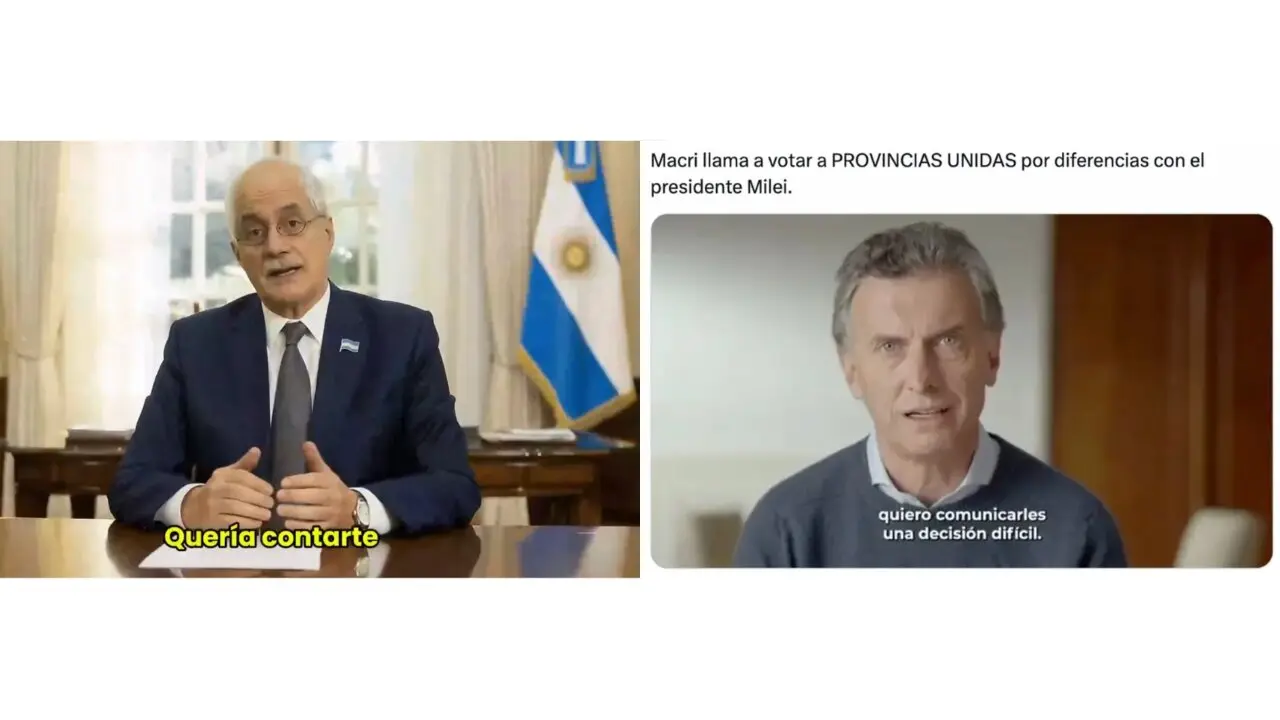
Given the history of dirty campaigns, it was to be expected that Argentina would not be an exception. During the campaign silence period for the 2025 legislative elections, the circulation of two videos raised alarms in the PRO: Mauricio Macri and Silvia Lospennato announced the withdrawal of the party's candidacy, something immediately denied by the protagonists themselves, but already impossible to stop. The impact on the campaign, something almost impossible to measure, was a topic of discussion for weeks, but within the former president's party, there was no doubt that it was the cause of the poor results obtained (Lospennato came in third with 15.92%).
In October of that same year, Macri fell victim to another fake video in which he called for votes for Provincias Unidas. But the PRO were not the only ones to encounter a virtual doppelgänger. In a less polished video, where his teeth suspiciously changed shape between frames, Jorge Taiana, a candidate for Fuerza Patria in the Province of Buenos Aires, was made to say that he was resigning his candidacy. The National Electoral Prosecutor's Office registered 31 complaints related to those two videos. There were also complaints about fake videos featuring Axel Kicillof and Javier Milei. In June of that same year, a video of Governor Llaryora created with AI was disseminated by radical deputy Rodrigo de Loredo, which also sparked controversy in Cordoba's politics.
The problem of legitimacy
Deepfakes do not affect all political actors equally. They disproportionately impact those who rely on evidence, data, and traceability of facts to support their positions, and structurally benefit those who base their legitimacy on personal faith and emotional ties with their followers. In the classic terms of Max Weber, charismatic legitimacy gains ground over rational-legal legitimacy when the common ground of facts becomes slippery. If everything can be false, the only thing left is to see whom to believe (and generally, people believe those they already wanted to believe). When the PRO denounced Macri's deepfake in May 2025, their defense line was institutional: a presentation to the Electoral Tribunal, intervention by the Public Prosecutor's Office, invocation of Article 140 of the National Electoral Code. Javier Milei's response was of another order: "Macri is just being a crybaby and is very fragile," he said after voting. The same style is observed, on different scales, in figures like Trump, Bolsonaro, or Bukele: the factual scandal bounces off a layer of emotional identification that evidence fails to penetrate. It’s not that deepfakes produce that type of leadership, but they are very functional to it: the more confusing the landscape of facts, the more decisive the personal and emotional connection becomes.
However, the apocalyptic perspective also has its detractors. In an article published by the journal Synthese titled “Deepfakes and the epistemic apocalypse,” Joshua Habgood-Coote questions the alarmist view of deepfakes as a catastrophic event that will destroy our ability to know reality. The author argues that the impact of these videos is exaggerated due to a false historical interpretation, as image manipulation through post-production has existed and been socially managed since the dawn of photography. Instead of viewing the problem as a purely technological challenge, the author proposes understanding it as a crisis of social norms and institutional practices: “If we focus our attention on the social practices related to the production, processing, and dissemination of recordings [...] we can see that the idea of a golden age where recordings represented the world with absolute precision is a fiction. Of course, we should not replace an overly optimistic view of history with widespread pessimism: the issue is that the history of recordings is complex and encompasses both reliable and unreliable social practices,” writes Habgood-Coote.
A deepfake within a framework of months of memes, coordinated accounts, minor fake news, jokes that set narratives operates on a more subtle level, building atmosphere, setting agenda, and producing opinion trends.
On the other hand, a more comprehensive look at the Macri-Lospennato case allows us to analyze these types of phenomena and how they operate in shaping votes. According to a report from the consulting firm Enter Comunicación, by the time it was taken down, the video had already garnered 14 million impressions and the interaction of 85 thousand users. The number is striking, but the PRO's position on the case underestimated its own voters and their ability to discern the falsehood of what was said. The video was quite crude for anyone who watched it closely. But while an isolated deepfake can have a marginal impact on vote formation, attention must be paid to the overall ecosystem to trace the impact. The credibility of the message generates background noise, a residual effect. It doesn't need to be believed, but it needs to be credible to function. A deepfake within months of memes, coordinated accounts, minor fake news, jokes that set narratives operates on a more subtle level, building atmosphere, setting agenda, and producing opinion trends.
The glass half full
Just as it's undeniable that AI has opened a Pandora's box, perhaps deepfakes could also bring solutions to the credibility crisis that Western democracies have been facing for years. As the well-worn metaphor of the hammer illustrates, which can be used to drive a nail or crack a skull, falling into extreme alarmism ignores that every new technology always has its positive aspects. If we set aside the paranoia, generative AI offers innovations that could make the political system more accessible to people.
First of all, the leap in political accessibility could be radical. Imagine for a moment that you are voters from a historically ignored ethnic minority in a country with a multitude of languages or dialects, accustomed to hearing political candidates speak in languages that neither represent nor engage them. The possibility for those minorities to hear a leader present their proposals in their native language, in real time, means a much deeper change than just form. It may sound like fiction, but it isn't: in India, politicians are already using digitally manipulated audio and video recordings to speak in the country's 22 official languages and more than 700 unofficial ones, sending personalized messages to different communities. Prime Minister Modi himself (BJP) has been using a tool called Bhashini, integrated into his NaMo app, since 2022 to translate speeches into 8 regional languages.
AI could also become a bridge that allows overcoming the physical limitations that distance representatives from the represented. With current advancements and the prospect of future developments, it’s not far-fetched to imagine virtual avatars of real politicians conversing with each of us in personal video calls, answering our questions in real time.
On the other hand, the same mechanisms of deepfakes seem to present an interesting opportunity for political organizations to spread their ideas and engage young people in civic education or history teaching in a more interactive way, allowing historical figures or events to be brought to life to explain processes, concepts, or events with greater empathy and relevance to the present.
Especially in authoritarian regimes, digitally manipulated videos are becoming a powerful tool in the political struggle against authorities, as well as a way to protect the identity of dissidents through the use of synthetic faces and voices that allow them to maintain their anonymity while denouncing abuses of power. The most documented case is the documentary Welcome to Chechnya (HBO, 2020), directed by David France, about the systematic persecution of LGBT people in Russia. France needed to show the testimonies of survivors on camera (the face, gestures, emotion), but exposing them would condemn them to death. The solution was to use consented deepfakes: the faces of 23 volunteer activists were digitally superimposed onto the bodies of Chechen survivors, preserving full facial expressiveness while hiding their identities. In Venezuela, some human rights groups began using synthetic avatars so that family members of political prisoners could testify about torture without suffering repercussions.
Finally, the difficulty in confirming statements and facts could motivate citizens to demand more information. The challenges that digitally manipulated videos pose to our democracies are significant, but the flip side could be a more informationally active society, more skeptical but equipped with better tools for fact-checking.
What can be done for democracy
In recent years, a consensus is starting to emerge: regulating this is difficult, but not doing so is worse. The temptation to delegate the problem to the platforms (to decide what to take down and what to leave) has already shown its limits: Facebook refused in 2019 to remove the manipulated video of Pelosi, and its vice president Monika Bickert justified it to CNN by saying that the company's priority was for users to be able to "make an informed decision"; in other words, label what is false but not remove it. X, under the management of Elon Musk, dismantled much of its moderation team. And in the Buenos Aires case in May 2025, it took two hours for the videos of Macri and Lospennato to stop circulating (two hours that, in the middle of a ban, is an eternity).
The conclusion is that private self-regulation, without a binding state framework, is insufficient. What instead appears in different jurisdictions (with varying speeds, scopes, and philosophies) is the same movement: that the State sets clear rules on transparency, accountability, and response times, and that platforms operate within those rules, not above them.
The most advanced model today is the European one. The European Union's Artificial Intelligence Regulation (the so-called AI Act, effective from August 2024 and with its transparency obligations fully applicable from August 2, 2026) establishes in Article 50 an obligation that changes the floor of the debate: all content generated or manipulated by AI must be labeled as such, in a format visible to the user and in a machine-readable format (through watermarks, metadata, or cryptographic provenance systems). The obligation falls on two complementary actors: the providers of AI systems, who must incorporate the imperceptible technical marking at the source, and the deployers (i.e., those who use those systems to generate and disseminate content), who must apply the visible labeling. The philosophy behind the scheme is important: responsibility does not rest solely on the end user who must "learn to detect" a deepfake (an increasingly impossible task) but on the entire value chain that produces synthetic content. Those who manufacture the tool and those who use it professionally share the burden; the citizen remains the recipient of labeled information, not an amateur journalist.
The most advanced model today is the European one (...): all content generated or manipulated by AI must be labeled as such, in a format visible to the user and in a machine-readable format.
Argentina enters this discussion with a fragmented and reactive framework, but not from scratch. Article 140 of the National Electoral Code, enacted long before the era of deepfakes, already foresees penalties of two months to two years in prison for anyone who deceives others into voting or abstaining from voting, and it was precisely this provision that the Buenos Aires Electoral Tribunal invoked in the Macri-Lospennato case. The National Electoral Chamber, for its part, issued a resolution that recognized the challenges posed by digital platforms to electoral integrity, and in 2025 promoted the "Digital Ethical Commitment", a voluntary pact among parties, tech companies, and journalistic entities. Federal judge María Servini, in the context of a lawsuit filed by constitutional lawyer Andrés Gil Domínguez, demanded that the Executive Branch report on what concrete actions it had taken to prevent the malicious use of AI in the October 2025 elections.
In the Congress, projects are piling up: Silvia Lospennato proposed fines of up to 130 million pesos for anyone who disseminates misleading synthetic content during campaigns. Oscar Agost Carreño pushed another to disqualify as candidates those who participate in these maneuvers and expedite judicial action to reduce the impact. Juan Brügge proposed amendments to the Penal Code with penalties of four to eight years in prison for the non-consensual generation of deepfakes. And perhaps the most interesting due to its procedural focus, Gisela Marziotta presented a bill that creates a special amparo action so that anyone affected by false content can demand its immediate removal: the judge must resolve within a maximum of 24 hours, even on non-business days, and can order the blocking, removal, or de-indexing of the content while the ruling is processed, with daily fines and even temporary suspension of the platform in case of non-compliance.
Unfortunately, none of these projects have progressed to date. The general feeling, as is the case with almost all aspects related to AI, is that of a State that is lagging behind the facts.
Looking ahead to 2027, there are three things that the Argentine public debate could stop postponing. The first is the most urgent and simplest: a specific norm that mandates the labeling of AI-generated content during campaign periods, with effective sanctions not only for anonymous authors (who are almost always untraceable) but also for the parties, leaders, and public figures who share that content knowingly. The existence of a legal framework does not guarantee, by itself, that the cost falls on the offender. Locally, the aforementioned case of Rodrigo de Loredo, and that of Manuel Adorni, disseminating a manipulated and out-of-context video of an interview with Kicillof on Futuröck in August 2025 (replicated by Javier Milei from the presidential account an hour later) show that it is also necessary to reach those who amplify from an institutional position. Any norm that does not consider that chain of responsibility will be cosmetic.
The second is structural and requires reforming electoral justice with a real-time focus. The Buenos Aires Electoral Tribunal responded by requesting the removal of the videos of Macri and Lospennato, but the damage was already done. Marziotta's project points exactly in that direction, but the 24-hour deadline can be long when a deepfake circulates on the eve of the election. We need to think of mechanisms that operate in minutes, not hours: digital guard rooms during the ban, pre-existing agreements with platforms for the immediate removal of content judicially declared false, and a system of official public replication (from the electoral justice itself, not from the affected party) that reaches the same audience that saw the original piece. The standard cannot be that the rebuttal appears in a press conference the next day: it must be in the same feed where the voter saw the deepfake, before they enter the voting booth.
We need to think of mechanisms that operate in minutes, not hours: digital guard rooms during the ban, pre-existing agreements with platforms for the immediate removal of content judicially declared false, and a system of official public replication.
The third is the slowest, but no less important: media literacy as a sustained public policy, not as an institutional campaign spot two weeks before the election. The European AI Act included since February 2025 a specific obligation of "AI literacy" for member states, aimed at both the educational and labor sectors. In Argentina, the National Electoral Chamber began timidly in September 2025 with campaigns for "civic training and digital education", but the effort is marginal compared to the scale of the problem. A citizenry trained to distinguish what can and cannot be believed is not a technical solution to the deepfake problem (there isn't one) but rather a fundamental defense against the issue of widespread delegitimization. When citizens know that there are tools to verify, and are familiar with at least some of them, the excuse of "everything is false" loses its power.
The question that arises as we approach 2027 is not whether we will have deepfakes in the campaign: we will have them, more and better. The question is whether we will arrive with an institutional, judicial, and civic framework capable of absorbing them, and with a society prepared to process them without our political system losing more legitimacy along the way. However, it is worth not being swayed by the fears that these (like many other) new technologies awaken. As Habgood-Coote pointed out, deepfakes are merely the latest version of an older problem, and studying these phenomena in the past may bring us some answers.
Mg en Ciencia Política (Universidad de Brasilia) y comunicador especializado en política y cultura. Colaboró con publicaciones en Cenital, Revista Debate y Revista Panamá, entre otros. Fue coordinador de Planificación de la Comunicación en INCAA.