The Philosophy Behind Artificial Intelligence: Cyber-Kantianism and Dark Girardianism
Are Thiel and Karp entrepreneurs or philosophers? What are the ideas that enable AI to think: from Hume and Kant to Girard’s mimetic desire? Yuk Hui’s new book serves as a starting point for questioning how technology redefines what it means to be human.
How can we think about the logics that operate behind figures like Peter Thiel or Alex Karp? I’m not referring to their individual psychologies, but rather to their "thinking machines." One reason these entrepreneurs spark so much interest is not only due to their influence in the digital world but also because they embody the paradigm of the entrepreneur-philosopher; thus, their interest in philosophical-political ideas cannot be overlooked. It’s worth considering their ideas beyond the mere hermeneutic framework of technology, or at least expanding that framework to include what we might call their philosophy of technology. In this text, I would like to explore a bit about the “thinking machines” of our era, using the reflections from Yuk Hui's new book, Kant Machine (2026), as a starting point.
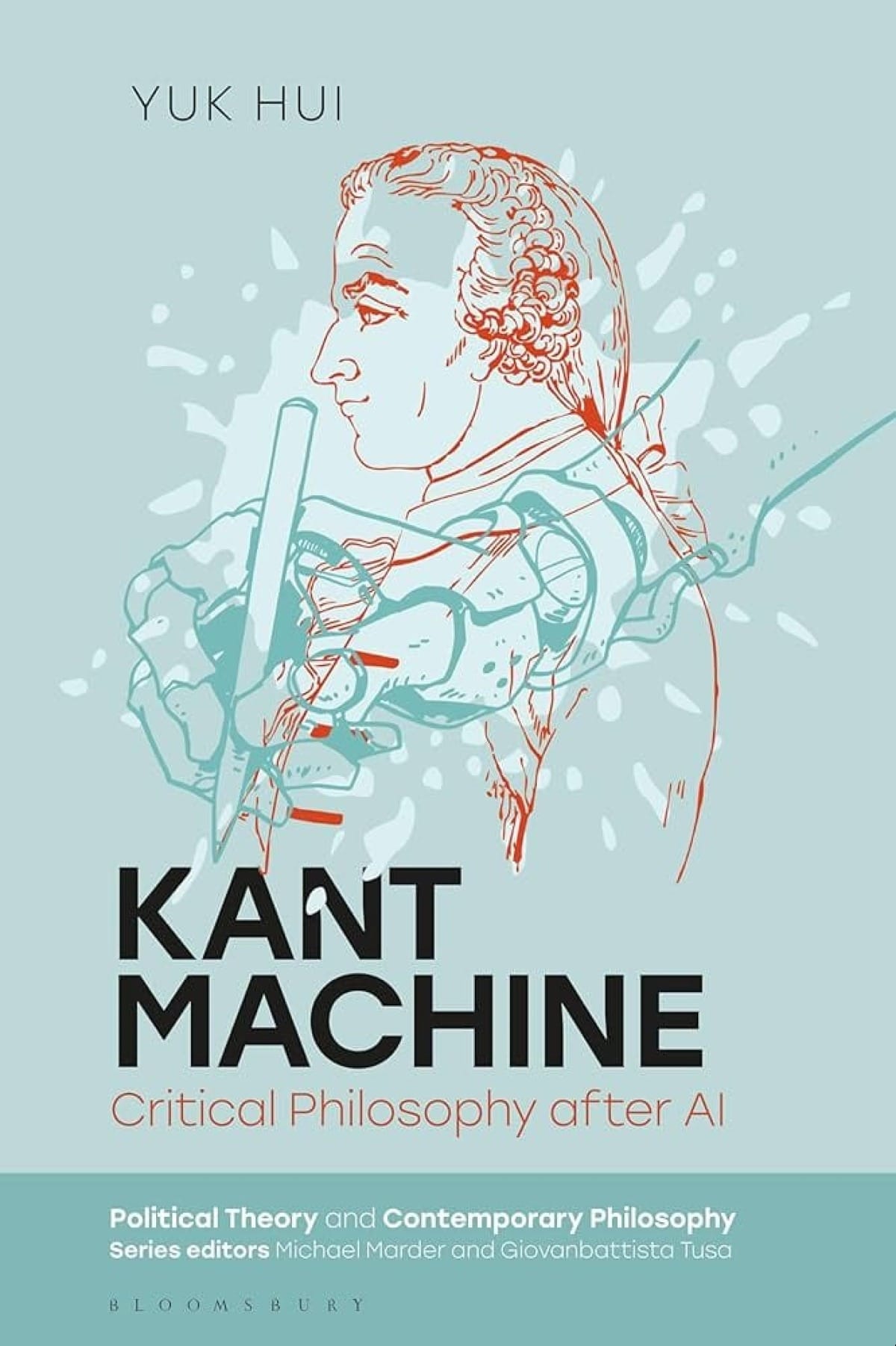
In his book, Yuk Hui explores these machines through Kant's philosophy and distinguishes between Cartesian machines, Humean machines, and Kantian machines. If we accept Hui's invitation, we may be able to discover new machines. After all, in most of his works, Hui advocates for the notion of technodiversity; that is, the need to not reduce our understanding of the technological to what responds to a Eurocentric or Western history of technology.
In this sense, in this note, I aim to fundamentally think about the Girardian machine. Of course, this is not about providing a definitive taxonomy of the technological. However, it is necessary to consider the logics that operate behind current terror machines.
But let's take it step by step.
I. Machines do not imitate intelligence
Artificial intelligence does not arise from imitating thought. The “artificiality” of an intelligence is not merely measured by its closeness to human intelligence. Machines are human to the extent that humans are machinic. After all, the evolution of our “intelligence” would have been impossible without the evolution of the technical artifacts that expand it since the use of fire. Thus, thinking about artificial intelligence involves thinking about human intelligence: how it is produced, how it evolves, how it transforms, how it modifies the artifacts surrounding it, and how those artifacts, in turn, artificialize human intelligence. Human intelligence is, from the very beginning, technical. Matteo Pasquinelli develops this thesis in his book The Eye of the Master (2023): “the inner code of AI is constituted not by the imitation of biological intelligence but by the intelligence of labor and social relations.”
Hui advocates for the notion of technodiversity; that is, the need to not reduce our understanding of the technological to what responds to a Eurocentric or Western history of technology.
Thinking machines are, then, machines that allow us to perform transformation operations: different logics of thought. We are not always free to choose which logics to employ (many times they adhere to us in the form of ideologies, common sense, or evidence). In his new book, Kant Machine: Critical Philosophy after AI (2026), Yuk Hui invites us to think about certain forms of thought and their machinic correlates. The world of humans and the world of machines are the same.
 Juan Ruocco 🧙♂️
II. Cartesian machines and Humean machines
In his various works, Hui has explored the tension between two major technological typologies: mechanism and organicism. Mechanism starts from the principle of the individual to build the collective; organicism, conversely, starts from the organization to understand individual processes. From a historical perspective, this can be read as the transition from the mechanistic thought of the 18th century to the organicism of the 19th century, explored in detail by Hui in Recursivity and Contingency (2019). But as the author points out, this logic can be applied to different fields, including politics, which is the focus of his previous book, Machine and Sovereignty (2024).
Let’s imagine different types of “machines.” When we think of a machine, we first think of causal mechanisms: a clock. Clocks are the paradigm of mechanism. Everything in them is material, and everything can be explained through mechanical forces (the tension of the spring, the friction of the gears). Both the wind-up clock and the car require energy to enter from the outside and dissolve as the action unfolds.
In philosophy, there are intellectual machines that function in a similar way: rigorously composed structures of nested propositions that, following the deductive form, transfer the truth of the premises to the truth of the consequences. Cartesian machines are mechanistic-type machines: rationalist machines driven by a substantial principle, capable of immense operations but always “hard coded”: they are limited by their original settings, by pre-given rules, or in philosophy, by the unmoving principle of substance, of the mind. This is the symbolic AI of the 1950s: explicit rules, deductive logic, formal representations of the world. As John Haugland formulated, “if a process or system is mechanical, it cannot reason; if it reasons, it cannot be mechanical.”
Julián Reynoso
There are another type of machines that Hui calls, in honor of the Scottish philosopher David Hume, Humean machines. Humean machines do not start from a purely preprogrammed structure: they are probabilistic, inductive, Bayesian machines. Hui finds them wherever machine learning models incorporate empirical data in a learning process based on probability and prediction. Humean machines are much more expansive than Cartesian ones, as their operating principle is not a priori axioms but rather information. Amazon, Uber adjusting the price of a ride based on user history and available cars: the self-regulation of the liberal market is, in this sense, Humean. The price of goods is an input that translates desire into quantity.
However, Humean machines have their own limits: they cannot predict anything that has not been fed into them at some point and, moreover, they are unable to contextualize the feedback loop generated by a certain general self-consumption. They cannot escape their own probability space.
Juan Ruocco 🧙♂️
III. Kantian machines
Kant, in the Critique of Pure Reason, proposed to transcend both Cartesian rationalism and Humean empiricism. Transcendental philosophy does not deny that humans possess certain innate structures of knowledge, but it also does not deny that without external information those structures are useless. Kant proposes to combine a priori categories (independent of experience) with a much more consequential empiricism: we can only access that portion of reality filtered through the forms of our subjectivity, space, and time. This does not mean that the world is a fiction, but rather that it is mediated by our ways of knowing. Intelligence, in this reading, “is neither rational nor empirical; it is transcendental,” says Hui. Kantian machines are open machines, creative machines, that attempt to overcome both mechanism and organicism. They are based on a reason that, while it cannot directly intuit the infinite, can imagine it, something that the Humean machine cannot do (after all, Kantian machines are the birth of romantic machines that will sanctify genius, but that is another story).
Hui completes the mechanism/organicism scheme with a third moment: cybernetics. In cybernetics, the machine does not depend solely on external input; it is capable of generating its own feedback. The cybernetic machine can communicate with its environment.
Hui does not aim for an exhaustive taxonomy. His Kant Machine primarily seeks to present three aspects of Kant (epistemology, morality, and politics) as contributions to cybernetic theory. The question that concerns us is another: are there other possible machines?
In many of his works, Hui completes the mechanism/organicism scheme with a third moment: cybernetics. In cybernetics, the machine does not depend solely on external input; it is capable of generating its own feedback. The cybernetic machine can communicate with its environment. True, the organism is also capable of this (something that organicism philosophers like F.W.J. Schelling referred to as sensitivity), but the cybernetic machine goes a step further: it does not obey solely to a centralized and previously given totality (consciousness), but is modular, capable of modulations. That is, it can be linked, expanded, updated, reinstalled, hacked. Moreover, being an autonomous machine (and not heteronomous) it can code other machines. This is possible because the totality is not given in advance: the cybernetic totality is only presupposed as a regulating idea.
This is, in fact, Hui's central thesis: Kant anticipates cybernetics. The philosopher Gilbert Simondon had already noted it: “Kant could only have dealt with cybernetics by situating it in the Critique of Judgment.” The Critique of Judgment is precisely the book where Kant elaborates the notion of reflective judgment (a common example is aesthetic judgments; when we say “this painting is beautiful,” we cannot subsume the painting under any universal rule or axiom about beauty, because there isn't one). In that sense, reflective judgment is the ability to seek the rule from particular cases, without having the rule in advance.
Emilio Méndez
IV. Decisionist Machines
Now, if we think of Kant Machine in relation to Machine and Sovereignty (2024), Hui's most “political” book, we might wonder about other machines—political machines and war machines. The decisionist machines are also cybernetic in a certain sense, but in a different way: they do not rely on stored information like the Humean machine. They operate with exception.
Philosopher Carl Schmitt distinguished three types of legal thinking: normativism (= mechanism), concrete order thinking (= organicism), and decisionism (his own position). For Schmitt, the sovereign is “he who decides on the exception.” The exception is not a failure of the system: it is its soul. As Schmitt writes: “The exception is more interesting than the rule. The rule proves nothing; the exception proves everything. In the exception, the power of real life breaks through the crust of a mechanism that has become numb from repetition.” Hui reads this as political vitalism: the sovereign's vital force interrupts any mechanism when the situation demands it.
Javier Pallero
What’s notable is that decisionism is becoming increasingly structural in the era of digital geopolitics. The megamachine (a concept Hui borrows from Lewis Mumford) is the vast techno-social complex that exceeds any individual sovereign control. The sovereign needs the megamachine but cannot fully dominate it. The consequence: the exception becomes normalized. Consider cryptocurrencies: “their supranational property (in the sense that it does not fully fall within the legal system of a particular State) tends to subvert the existing financial system under State control. Supranational entities have significantly increased over the last decade, primarily due to the rapid development of digital technological systems, which move faster than the human system.” Current libertarianism owes quite a bit to decisionist machines, as they conceive of each individual as a mini-Führer who constantly makes exceptional decisions. The manifestation of sovereignty as the power that decides on the exception thus becomes increasingly normalized. Not because the State is more powerful, but because it no longer controls the planetary situation and must constantly intervene to restore stability.
Emilio Méndez
V. Girardian Machines
Hui suggests that these machines are not innocent. Just as we saw in the case of Schmittian machines, machines are essentially political. Therefore, I would like to think a bit beyond Hui and consider an additional model: the Girardian machines. René Girard was a French philosopher who spent much of his career in the United States. Throughout his texts, Girard talks (almost obsessively) about a single theory, the mimetic theory.
In short, for Girard, desire is mimetic: we desire what the other desires. We desire what the other desires because the other desires it. But in this libidinal mirage, we end up hating the other, who served as the model for desire. For Girard, this is the origin of conflicts and violence. When everyone begins to desire the same thing, violence arises; everything becomes confused. The only way to restore order is by sacrificing a scapegoat. Around this victim, society re-unifies. Girard found this mimetic structure at the root of different cultural expressions: myths, tragedies, novels. In reality, for Girard, this is the mechanism that lies at the heart of all Western culture.
Now, what are Girardian machines? Girardian machines are machines whose algorithm is based neither on a pre-coded mechanism nor on learning from large amounts of data. They are another form of cybernetic structure. The Girardian machine also feeds on desires and feelings, just like the Humean machine. However, while the Humean machine mobilizes a large number of desires in different directions and quantifies them, the Girardian machine sees desire as the machine of power. Power is the ability to control desire.
The capitalist machines have always fed on desire and have fueled desire. However, it can be said that they operated, in their liberal and neoliberal form, based on the quantification of desire as Humean machines: the price of the commodity is an input that translates desire. The self-regulation of the market is, in this sense, Humean. The Girardian logic, on the other hand, is the logic of metamachines (the machines that regulate the rest of the machines). The metamachine logics do not concern themselves with any type of desire, but with what Girard called mimetic desire.
The difference between Humean desire and mimetic desire is structural. In a Humean system, a product becomes more desirable the more it is purchased (this is the logic of frequency and clickbait). In a Girardian system, a product becomes more desirable because others desire it (this is the logic of social imitation). They are similar structures, but one is individualizing and the other is organizing. The logic of social networks is Girardian, not Humean. The algorithm does not just calculate what you want: it calculates what you want because others want it, triangulating your gaze. That’s why it’s also not completely Kantian (that is, autonomous: giving law to itself).
And here comes the crucial point: mimetic desire is cybernetic. It feeds back on itself. Envy is not a stable state; it's a loop. Desire grows because the other person's desire grows, and the other person's desire grows because yours grows. This loop can amplify to the point of mutual destruction.
In his later work, the presence of the Apocalypse becomes increasingly evident in Girard: the doors to the Apocalypse open when mimetic violence intensifies to extremes. Consider a war conflict where both parties try to deter the other. Following the bargaining logic of Thomas Schelling in his book The Strategy of Conflict (1960): the one who is crazier can win in a negotiation situation. If you manage to convince your opponent that you are willing to jump off the cliff, you are the winner. However, if both competitors are 'crazy,' the escalation of violence is inevitable. Girard, in his book Clausewitz at the Extremes, applies this analysis to the contemporary arms race and concludes that Clausewitz no longer suffices: war has become reciprocal and unlimited.
Eddie Fitte
Within Western history, the mechanism that sought to dismantle mimetic conflict was the logic of the scapegoat and, above all, the Christian logic. The message of Christianity, according to Girard, is to reveal the innocence of the scapegoat (the object of sacrificial violence). Christianity, in that sense, implies the end of sacrifice. But that leads us to another question.
VI. Can machines sacrifice?
We started talking about artificial intelligence and ended up discussing sacrificial machines. Sacrificial machines could be those capable of sacrificing (and I am careful with this term).
One wonders if machines are capable of thinking. But perhaps a more interesting question would be whether machines are capable of sacrificing. First, in a heuristic sense: sacrificing something for the sake of something else, calculable economic decisions, sacrificing one expense for another. This can fall within the expected behavior of machines. Utilitarianism deals with these problems when it discusses variations of the trolley problem: you sacrifice one to save five. It's calculable sacrifice.
The more disturbing question is whether machines are capable of sacrificing humans, not just life as a calculable quantity, but humanity itself, the human essence. And whether we are capable of building machines that do that.
The Kantian machine is precisely the machine that categorically denies inhuman sacrifice. The idea of a Constitutional IA employed by Anthropic has Kantian overtones. Kant's perpetual peace is the proposal of a political algorithm that makes the principle of humanity its non-negotiable condition. “Act in such a way that you treat humanity, whether in your own person or in the person of any other, always as an end and never merely as a means.” The categorical imperative is not a closed algorithm; it is precisely the denial that any decision regarding humanity can be reduced to an algorithm.
Federico Ezequiel Salgado
VII. The dark Girardianism
Girard is once again present in these times. Not only because of the importance of his philosophy, but because some of his 'students' have become particularly significant figures. I am referring here to Peter Thiel, J.D. Vance, and even Alex Karp, who attended Girard's classes at Stanford. While it cannot be said that these three figures are comparable or that they embody, much less identify fully with, Girard's philosophy, one could exercise thinking about them from what I would like to call 'dark Girardianism.'
In Machine and Sovereignty, Hui points out that Schmittian political vitalism is being reproduced in the present through figures like Peter Thiel and Nick Land, representatives of the neoreactionary right. Thiel, in “The Straussian Moment” (2007), interprets September 11 as the definitive refutation of Enlightenment liberalism: the demonstration that real politics takes place in the realm of exception, not of norms. Palantir Technologies, the data analysis and surveillance company Thiel founded with Alex Karp, provides the infrastructure for such decision-making: identifying exceptions, designating enemies, processing information at a speed that exceeds democratic deliberation.
The most disturbing question is whether machines are capable of sacrificing the human, not just life as a calculable quantity, but the human itself, the essence of humanity. And whether we are capable of building machines that do just that.
However, dark Girardianism is not merely a reversal of vitalism; it is the Girardianism of the sacrifice of the human. Beneath the mask of Promethean humanism lies dark Girardianism. Dark Girardianism does not remain at Girard's first moment (what Girard calls the sacrificial or mythological logic) without advancing towards Christianity. On the contrary, dark Girardianism fully penetrates Christianity, it traverses it, accelerates it. For dark Girardianism, redemption must be achieved through acceleration; the administration of redemption is the management of sacrificial forces. The monopoly of sacrifice through a techno-political theology. The sacrificial technocracy is the administration of genocide. But here the difference with the Hobbesian machine, that is, the mechanistic one, is crucial: the apparatus for capturing cognitive sovereignty is not conceived as an absolute sovereign, but as a CEO, a monarchy in the style of Curtis Yarvin, where the central space is not given by God, or by the General Will, but by the sovereign desire that mobilizes merit (secularized theocracy).
As we said, it is not merely decisionism taken to the extreme; this dark Girard is cybernetic: it feeds back on desire. This is perhaps the most important difference between Humean desire and mimetic desire. Mimetic desire is cybernetic because it feeds back on desire. Humean desire: a product becomes more desirable the more it is purchased. The Girardian mechanism: a product becomes more desirable because others desire it. Dark Girardianism operates on this second logic (and radicalizes it). The only way to break free from this repetition is to break with the logic of imitation. It is precisely the contrarians, that is, the creative investors who can see beyond.
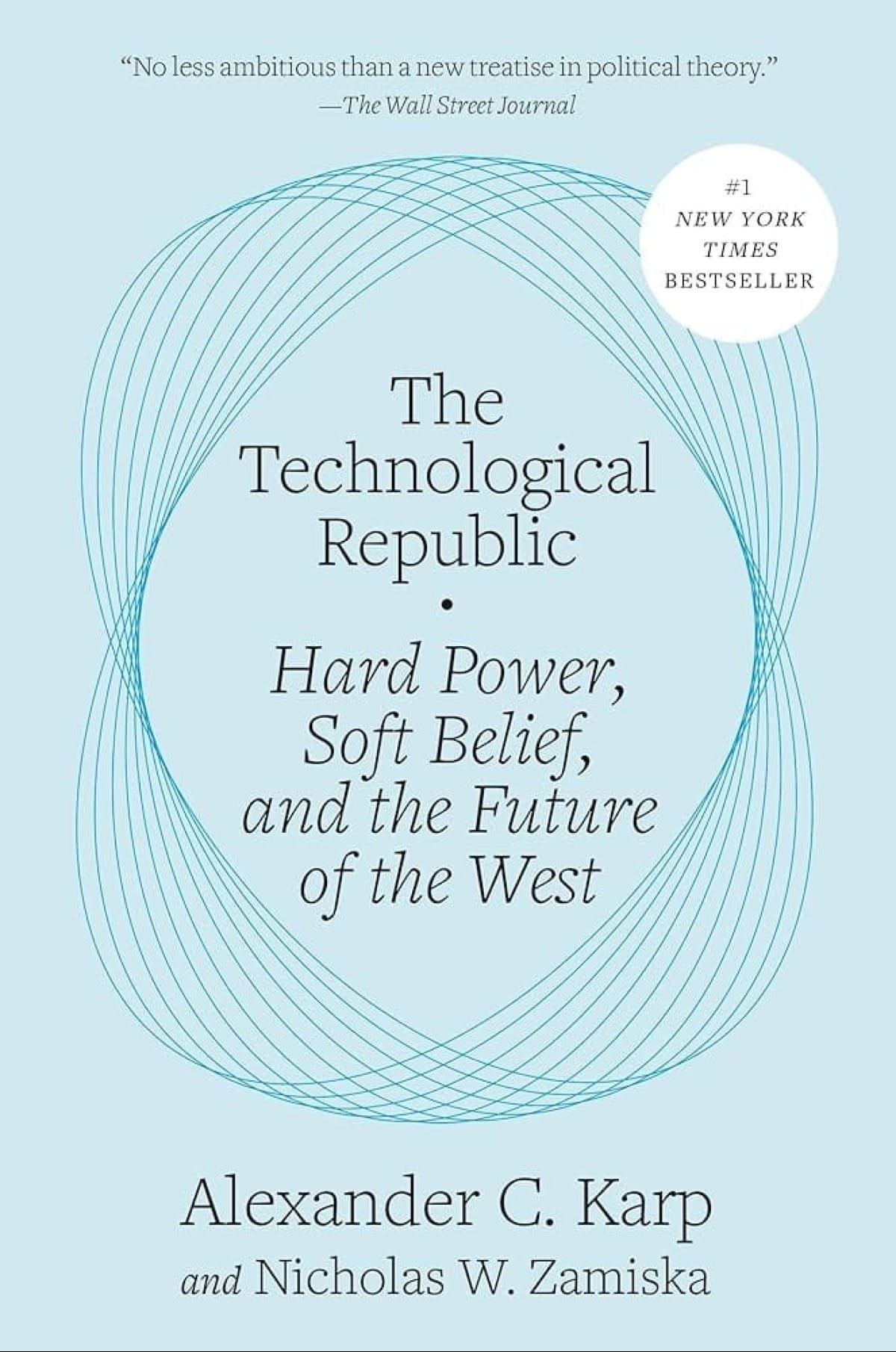
“Our earliest encounters with learning are through mimicry. But at some point, that mimicry becomes toxic to creativity. Some never make the transition from a sort of creative infancy. Much of what passes for innovation in Silicon Valley is, of course, something less—more an attempt to replicate what has worked or at least was perceived to have worked in the past. This mimicry can sometimes yield fruit. But more often than not it is derivative and retrograde. The best investors and founders are sensitive to this distinction and survive because they have actively resisted the urge to construct imperfect imitations of prior successes.”
Karp and Zamiska (2025).
Dark Girardianism, a strange paradox, underestimates the mass's desire due to its mimetic nature, or we could say, memetic. The “best investors” are those who distance themselves from mimetism. Certainly, capitalist logic thrives on desire, it needs it and, to a large extent, it vampirizes the proliferation of new desires. Whoever manages mimetic desire desires nothing but their own desire (they are the only ones outside the loop, the only ones who see the mechanism without being trapped in it). It is the ambiguous position of the sacrificial priest in the myths that Girard analyzed: priests and kings are often the sacrificers; they, like scapegoats, are the ones who stand out from the mass. In that sense, dark Girardians seek to hide this ambiguity and present themselves solely as givers of peace.
VIII. Towards Other Machines
In this note, I aimed to think about the logics that operate behind current thinking machines, and propose a new taxonomy: the Girardian machine. If we accept Hui's idea of technodiversity, it is possible to conceive many other new machines.
The following works by Yuk Hui are available in Spanish through Caja Negra Editora (Buenos Aires): Fragmenting the Future. Essays on Technodiversity, Recursivity and Contingency, The Question of Technique in China, Art and Cosmotecnics, and Machine and Sovereignty. Kant Machine has not yet been translated into Spanish.
Las notas de 421 no tienen paywall
Y a cada colaborador se le paga por su trabajo. Las dos cosas dependen de los suscriptores.