The Roblox Model: Monetizing Children's Attention
Roblox is the latest step in the evolution of video games: a social network that captures children's attention through voracious monetization.

Roblox is the latest step in the evolution of video games: a social network that captures children's attention through voracious monetization.
In the nineties, there was an unavoidable question on every survey form, in every sociological test, and in every professional or school demographic study: "How many hours of television do you watch per day?" I spent my days glued to the idiot box. Even before cable TV became popular in our country, with its varied 24/7 channel offerings, I knew the programming of ATC inside and out, the reruns of Hijitus on channel 13, and the pirate broadcasts of movies not suitable for minors on regional channels like Sur TV or Telecreativa. But what specialists claimed was the definitive formula for dumbing down and corrupting young minds, at least in my case, ended up leading to an adult life fundamentally dedicated to reading and writing. That's why I find it somewhat embarrassing to take a catastrophic stance regarding the relationship between children and media, now that I find myself on the other side of the counter.
We must be cautious when it comes to catastrophic judgments or oversimplifications regarding the unknown. Especially when the epistemological trap of knowledge tends to bias us: when we approach children's media consumption, it is often us adults who ignore the nuances and specifics of the content. It makes no sense to repeat the judgments or the satanic panic that were poured over the violence in Doom or Carmageddon.
I find it somewhat embarrassing to take a catastrophic stance regarding the relationship between children and media, now that I find myself on the other side of the counter.
Critiques of mediation are as old as Western culture itself. In his book Why Fiction?, Jean-Marie Schaeffer reconstructs how, since Plato's Republic, every time a technique alters the relationship between the audience and representation, accusations of alienation, quixotism, and lobotomies fly back and forth, often relying on the same arguments. Once poets were outside the polis, now it's kids without screens. At its core, these are the problems of mimesis and readers: Can fiction provoke forgetfulness or distortion of the world? Are the stimuli of representation harmful to health? Is there continuity between the imaginary and the real? Clearly, the line is clearer than the apocalyptic critics insist on drawing, but that doesn't mean there isn't a close relationship between the technical media of fiction in a historical period and the particular ontogeny of the subjects exposed to it.
Recognizing these apocalyptic arguments does not mean that the relationship between childhood and media hasn't transformed over the last 30 years; in fact, there's ample evidence to the contrary. The first thing we need to try to understand is the change in the service industry and how it has transformed what we understand as a video game.
The initial business model for video games was the arcade. At that stage, games were tragically tied to the heavy casing of a cabinet with its tube, joysticks, wiring, and circuit board. To play a game, you needed an entire setup that made them very expensive, so the only way to play was to go to a dedicated venue that "rented" the machines for a while at the price of a token. In this ecosystem, several key elements stood out. On one hand, players' skills allowed them to "stretch" the duration of the tokens, so there were various incentives to develop expertise in a particular game, dedicating time and effort to mastering certain mechanics and even memorizing scenarios and gameplay patterns. A noteworthy detail: the gaming experience was public and generated a particular type of sociability. Video game arcades were spaces for competition (the high score) and learning (looking over the shoulder of someone who played well). Plus, there was a lot of smoking, and if you weren't careful, you could get pickpocketed.
This changed with the arrival of personal computers and, above all, consoles. With the entry of video games into homes, the business also changed. The cost of games was lower and they were generally sold through cartridges or CDs. While the price wasn't exactly low (except thanks to delicious piracy), the gaming experience and sociability changed. In living rooms or PC rooms, video games moved into the intimacy of relationships between friends and family, reducing learning opportunities (limited to your schoolmates and gaming friends), but at the same time expanding possibilities for refinement and excellence thanks to continuous play and the ability to save a game. In the same movement, it opened the door to other less arcade-like genres with different simulation experiences and narratives. The downside was that there was no longer anything to keep you in check, and being a computer nerd was never looked upon favorably.
Perhaps up to this point is what is most recognizable as a "video game" for the boomer or Gen X audience, as they financed or experienced the rise of this ludic-economic system. But millennials lived through the transition to another paradigm: that of free to play (F2P) games. With the popularization of the internet, video games became more capillary, reaching devices in small continuous doses through simpler but much more massive experiences. First, with the boom of Facebook games, and in a second phase with the arrival of iOS and Google Play stores, a new avenue opened in the field of mobile video games, establishing a new business model.
 Axel Bosso
In the prototypical case of this model, the game is available from minute 0, and you don’t need to open your wallet to hit play. It’s not about freemium models where you get a free sample and then, after one or two levels, you need to pay to see how it continues. No, the F2P model offers you the entire game without spending a dime. What’s the catch? The gameplay is filled with multiple and small frictions that slow down the development of the experience unless you start spending money. The next level unlocks in 12 hours; do you want it now? For a few cents, you can. Didn’t manage to get the golden skin this season because you didn’t rank high enough? For a price, I can fix that. Ran out of packs but want to keep collecting cards to improve your deck? Just a little cash will do. One of the keys to this model is that money is obscured by a plethora of mediations. Generally, the game doesn’t directly ask for dollars for these advancements, but often operates a dual economy with two “currencies,” a soft one (easily accessible and with limited application) and a hard one (which is usually paid with dollars and allows access to the most desirable goods). Money, but fun.
The development of this system is not coincidental; it exploits very basic and effective psychological processes to facilitate the completion of purchases and make the relationship between desire and money extremely opaque. Draining a few cents for every childish interaction within the game leads to large accumulations and encourages impulsive spending, while also muddying the relationship between the value of goods and the actual cost they incurred.
The development of this system is not coincidental; it exploits very basic and effective psychological processes to facilitate the completion of purchases and make the relationship between desire and money extremely opaque.
You don’t need to be a specialist to recognize all these fraudulent mechanisms because, since their success in the world of video games, they have become the paradigm of the service industry, and thus the same market logic has been imprinted on any web tool, digital service, and even social media (which have started monetizing beyond ads for some time now). Gamification and the tokenization of the economy are already phenomena of the global economy.
Needless to say, this model is closely tied to connectivity, and just as the gaming experience transformed from the arcade to the home, the intimate relationship with smartphones has made these mobile experiences extremely individual, and what used to happen among kids sitting on the carpet while tethered to the joystick can no longer occur in the same way among a group of teens connected in a voice chat.
The industry took note of Roblox one forgotten afternoon in 2016, when the business model I just described was experiencing its moment of expansion. The game officially launched on September 1, 2006, but its breakout took 10 years and caught everyone by surprise. In an industry that provided quality experiences (especially when compared to today's standards), under the watchful eye of UX as a guarantor of value, Roblox showcased low-poly characters, broken textures, and a super basic interface design. Frankly, it looked like a pretty shabby game. So what was the novelty that allowed it to balance that first impression?
Roblox is basically a game for making games. It’s not just a single predefined experience but more like a catalog of games that is constantly being created by its users. David Baszucki and Erik Cassel started the project in 2004 (then under the name Dynablocks) as an edutainment tool, specifically as a platform for generating educational experiments in physics and biology. But during development, they realized the concept had more potential and pivoted towards creating a sort of game generation tool. In the meantime, the launch of Minecraft and the boom of building, exploration, and large community games began to shape the direction the project should take.
From 2007 to 2013, Roblox quietly grew among online communities, primarily supported by young developers who began to see it as a showcase to create games and share them with others (it’s no coincidence that this happened just as Flash was starting to fade away; it used to be THE tool for making "little games"). A key factor during this stage was the introduction of robux, the in-game currency that allows players to buy accessories, create private servers, and basically facilitate all interactions within the experiences. The other key element was the launch of Roblox Studio, a package of user-friendly tools that enable game creation within the platform.
This is how the basic ecosystem of the game was formed: content creators use the tool to create “experiences” (that’s the official name for games within the platform), while players enter those experiences and spend robux, which in turn leaves a percentage of profit for the creators. This back-and-forth between The Roblox Company, content creators, and players generated a unique culture that grew in forums, fan pages, memes, etc. While match-3 games and Flappy Birds came and went from the public eye, Roblox was simmering slowly and cultivating a community with its own codes and behaviors.
The next significant step in its business model occurred in 2013 with two fundamental milestones. First, the launch of its mobile version, both on the Google Play store and on iOS, allowed it to reach a new audience outside the web ecosystem and, arguably, one that fit its proposal much better: children. Second, it launched the DevEx program for select creators. This allowed content creators to exchange their robux for real cash. In this way, the platform (and the community) began to transform, shifting from a sandbox for hobbyists to a space where monetization and experience generation could take place.
The launch of its mobile version allowed it to reach a new audience outside the web ecosystem and, arguably, one that fit its proposal much better: children.
It’s important to contextualize: while today this program may seem very similar to what hundreds of thousands of content creators use to make a living creating content for TikTok, YouTube, Kick, or whatever platform, in 2013 it was truly a novelty. By mid-2016, interest in the DevEx program was so great that Roblox established a series of rules and standards for applying, and the number of creators soared. It was a smart move: from that moment on, the platform's engagement practically doubled every subsequent quarter. As a major milestone, in 2017 “Adopt Me!” was released, an experience where players can adopt and care for pets, which remains immensely popular today, boasting over 11.6 billion total hours of gameplay among all users.
Since 2017, this trend has continued to deepen, and Roblox has grown year after year in its user base, and with that growth, the monetization strategies and the platform's profile have also transformed. The Roblox Company has had numerous collaborations to create interactive experiences with brands and artists like Nike, Netflix, Gucci, Lil Nas X, David Guetta, BLACKPINK, and Elton John. After explosive growth during the pandemic, in 2021 the company went public and began trading on the stock market, debuting with a valuation of over 40 billion dollars. This is not surprising when you look at the data: in 2020, Bloomberg published a report estimating that 2 out of 3 American children aged 9 to 12 were users of Roblox.
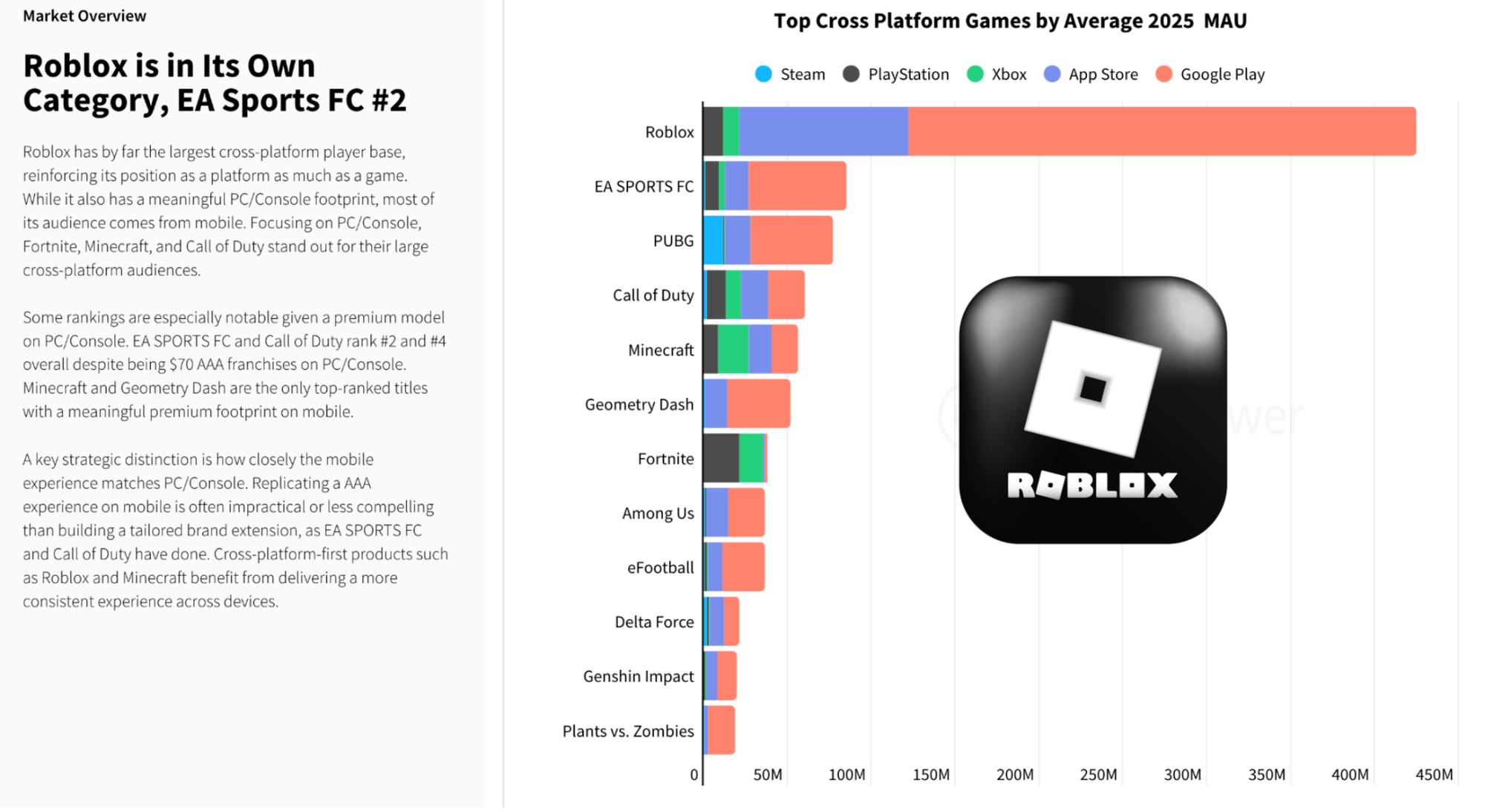
Today, Roblox has around 120 million daily active users (DAU) and an average session length of 2.6 hours per day. According to Sensor Tower, these numbers positioned it to be the most played video game in the world by 2025. Among all platforms, it is estimated that between 420 and 450 million unique users log into Roblox every month (of which nearly 400 million come from mobile devices). To put this figure into perspective, the second and third in the field (EA Sports FC and PUGB) do not reach 100 million.
There are, roughly speaking, three main criticisms of Roblox regarding the health and safety of minors.
First, the fact that the platform operates under a user-generated content (UGC) paradigm ends up being a covert form of child exploitation. The label may sound a bit alarmist, but the reality is that The Roblox Company stopped creating its own experiences around 2013, and today the bulk of the content that users play is generated by other users, meaning that what keeps the platform alive comes from the work of the players themselves, most of whom are children. If we add to that the fact that the compensation from the program is minimal (just like all creator programs on any social network), the exploitation becomes much more pronounced. For children who can’t get their parents to give them money to buy robux, this program may seem tempting, but if they wanted to extract that capital generation through the DevEx program, the exchange would be devastating. Buying 1000 robux might cost around 10 USD, while 1000 robux obtained through the creator program is exchanged for about 3.8 USD. This asymmetry (a spread of about 3:1) is quite perverse in itself, but even more so when considering that it serves as an entry into a sort of completely unregulated child labor market.
The fact that the platform operates under a user-generated content paradigm ends up being a covert form of child exploitation.
Linked to this, monetization for players on Roblox is extremely aggressive. Developers earn robux as other players spend robux on their experiences, so all the incentives are designed for the games created within the platform to constantly ask you for coins, not only to customize your avatar or add cosmetic items to your character (which is common across all experiences you play) but also to charge you for purchasing virtual goods that only serve within that experience. Being decentralized and in the hands of other user content creators, that experience is much less controlled than what happens in other games, making it much harder to hold The Roblox Company accountable for regulatory bodies. All of this creates a breeding ground for so-called dark patterns, design patterns made to manipulate users into taking certain actions (in this case, purchases). Your usual fraudulent apps, now for kids.
Finally, and undoubtedly most importantly, grooming is a huge problem on Roblox. While there are mechanisms to segment user experiences by age groups and supposedly these prevent minors from interacting with adults (or even that teenagers can play with young children), there is evidence that this restriction is not strictly enforced. Adults are able to participate in experiences with children, chat with them, and use voice messages during gameplay. Currently, Roblox is facing several lawsuits regarding this issue, and various activists are pressing the U.S. government to intervene.
Considering all this data and all these problems, it’s clear that a change in approach is necessary. If Roblox breaks all molds regarding video games, it might be because it’s not really one. The evolution of the platform since its inception, its way of handling both content and monetization, and its cross-section within the child audience bring it much closer to a social network than to a video game. Perhaps the only platform that has managed to fulfill some of the promise of the metaverse, where interactions occur temporally and spatially through avatars. Yet, the dynamics it proposes and the role it plays in children's lives resemble much more what teenagers and adults experience on Instagram or TikTok.
The dynamics it proposes and the role it plays in children's lives resemble much more what teenagers and adults experience on Instagram or TikTok.
In this scenario, today forbidding a child from playing Roblox is like opposing them watching The Simpsons or Chiquititas in 1995. It’s not impossible, but it puts us in a strange position. As adults, our responsibility should be to make the effort to understand how it works and provide limits and good tools for kids so that Roblox doesn’t interfere with their healthy development. Guidelines not so different from those we should have with the internet in general, particularly in dealing with other people whose faces we can’t see and we don’t know who they might be.
Even so, one might think that the biggest risk isn't grooming. Yes, the existence of pedophiles posing as other children and seeking personal information about your kids is monumentally disturbing, and the mere possibility of that happening is a violation of children's rights that the platform needs to address immediately. But there's a much less sensationalist harmful effect. There exists a silent corruption that lies in the perversion of another sacred mantle: the normalization of monetization friction in what should be a gaming experience. Of course, games have always cost money, and we all begged our parents for a Scalextric or the latest Mortal Kombat when we were kids. But in Roblox, the economy is omnipresent: it's no longer the game that costs money, but the very possibility of enjoying it. The in-game currency becomes an object of desire and saturates every little action, both within the game and projecting into the rest of the kids' lives. That's why our task as adults should be to return financial autonomy to children when it comes to playing. No kid should be asking for robux for their birthday.
Y a cada colaborador se le paga por su trabajo. Las dos cosas dependen de los suscriptores.