Demoscene: the art of working magic with bytes
How the demoscene was born, what techniques its artists use, and how to code our own worlds in 4 KB.
You'd download a cracked program, it would ask you for a key, and to get one you'd end up running a file of dubious origin. Double-click on keygen.exe and the screen would suddenly explode: a chrome logo, letters warping like they were made of rubber, text scrolling from right to left at a barely readable speed, and 8-bit-style music that kicked in without warning and blasted louder than anything else that had ever come out of those speakers.
Keygen by CORE, a cracking group active since the mid-nineties.
Not that many years ago this was business as usual: subscriptions didn't exist, and if you wanted to try out a game or a program, paying for the license wasn't really an option, so it was super common to go hunting for pirated versions and run into this kind of executable. If it ever happened to you, you probably wondered: who were all those names? And what was all that stuff doing in a program whose only job was to give you a key?
These screens were called cracktros (crack + intro), and they started showing up in the early eighties, as groups dedicated to pirating games and software began to form. There were plenty of ways to protect software: back then, physical copy protection on floppy disks and manual lookups were common; later on, serial numbers and activation keys took over. Through reverse engineering, they'd take the executable apart and write a keygen, a little program that churned out those keys so anyone could use the pirated version.
Cracking groups talked back to each other from one intro to the next, competing for the flashiest signature on machines with very little memory and very few colors.
Both the pirated game and the keygen could come with an intro, and the groups poured an enormous amount of time into programming the graphics and composing the music, adding the signature that made them famous. On the Commodore Amiga, for example, there was a whole type of intro designed to fit in the floppy's boot block, the first thing the machine reads when it powers on: one kilobyte, 1,024 bytes, for some moving text and not much else. To give you an idea, an empty Excel file can weigh about nine times that.
Skid Row cracktro for the Amiga, 1990.
Most of us grabbed the key to activate the game or the program and closed the thing without paying it much mind. On the other side, cracking groups talked back to each other from one intro to the next, competing for the flashiest signature on machines with very little memory and very few colors.
Limitation that defines an aesthetic
All these intros share a certain vibe; the same goes for the games of the era, the loading screens, the music: there's something there you recognize in two seconds.
The original reason lies in the hardware: the Commodore 64, for instance, came with a sound chip with three oscillators (the SID), so all that music was written by juggling three voices and deciding which one had to give way when you needed four. The screen had 16 fixed colors, and you couldn't even mix them freely: the image was split into cells, and each cell had its own color quota. Text scrolled sideways because the machine had registers for shifting the image horizontally, which cost the processor almost nothing. Any other kind of movement meant redrawing everything on screen, and that could slow the whole program to a crawl.
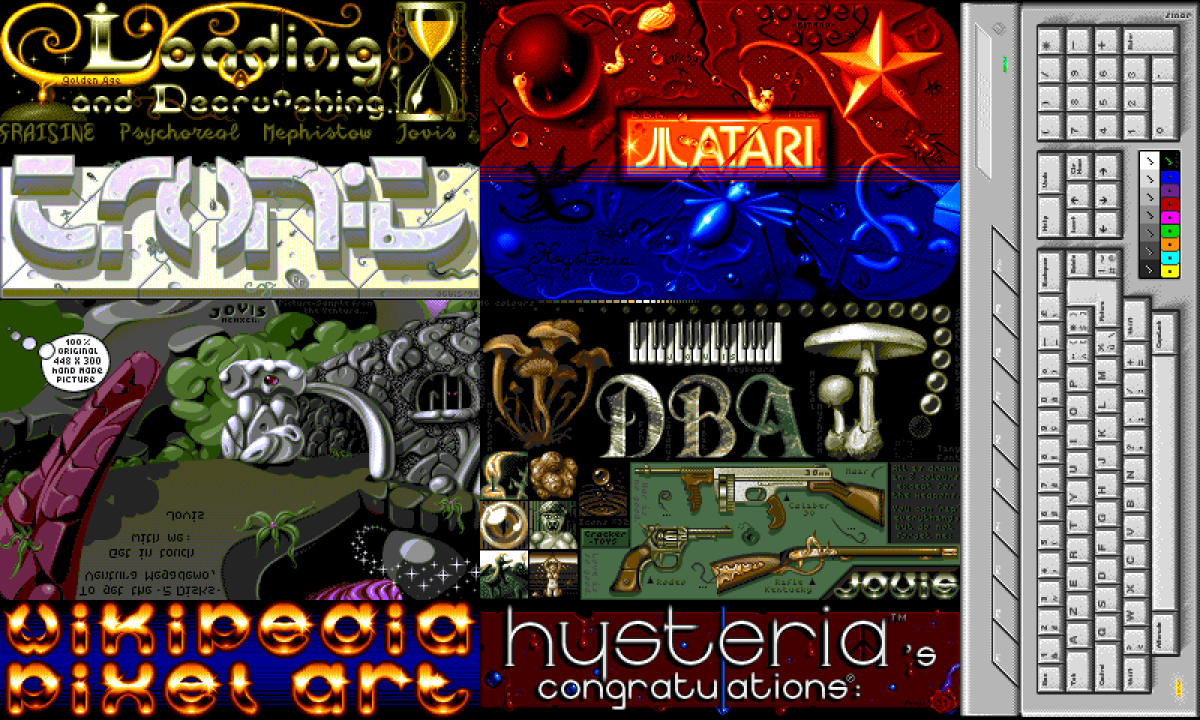
And mind you, this happens every time: every technological era has its own derived aesthetic, and, case in point, today anyone can spot an AI-generated image. The difference is that back then the limits were much tighter, and not just anyone had the know-how or the access to that technology; that forced people to find workarounds, and creativity went hand in hand with technical skill.
Code to look at
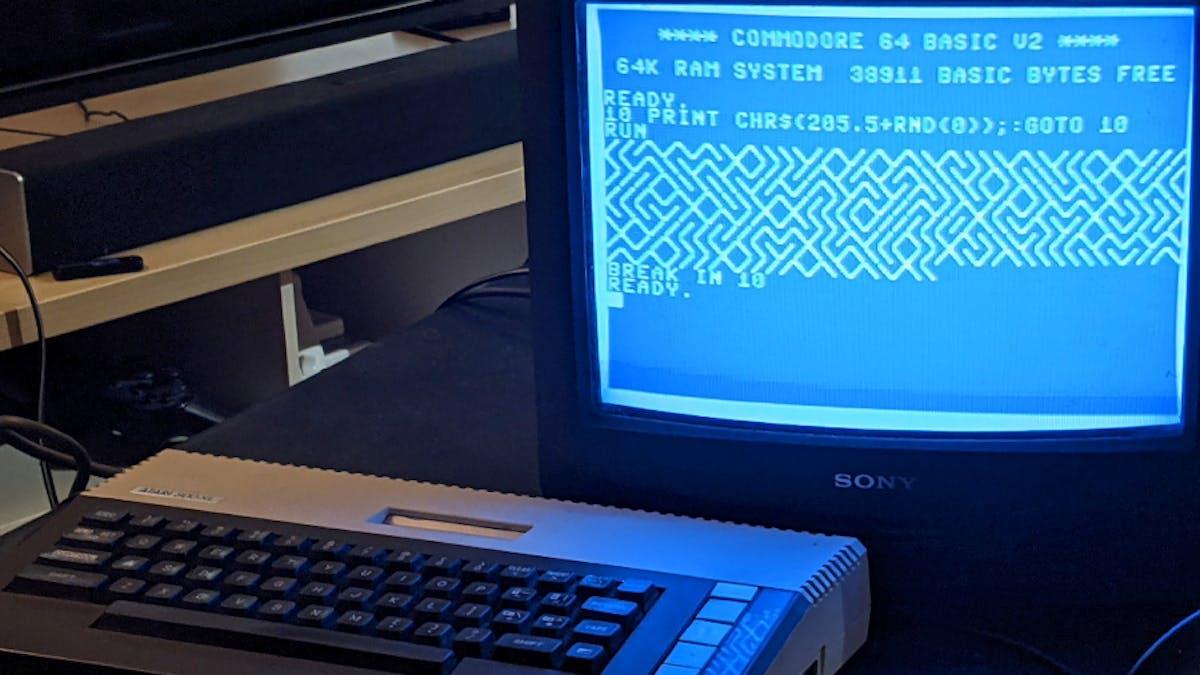
If we go back a bit further, almost since computing has existed there have been people writing programs that do nothing but draw something on the screen, out of sheer curiosity and the fun of seeing what comes out. A very famous one is 10 PRINT, which fits on a single line:
10 PRINT CHR$(205.5+RND(1)); : GOTO 10
It's BASIC code for a Commodore 64. The program randomly picks between two diagonal characters, one leaning each way, prints them one after another, and never stops. What appears is a maze that draws itself, different every time you run it, and that can keep going until you turn the machine off. It doesn't solve anything for you. You type it, hit RUN, and watch.
There's a nearly three-hundred-page book about that one line of code, written by ten researchers; MIT Press published it in 2012 and you can download it for free as a PDF. They explore randomness and regularity in computing and in art. Also the history of BASIC, the place the Commodore 64 earned in the culture, the print publications that line circulated through for years, and the history of the maze.
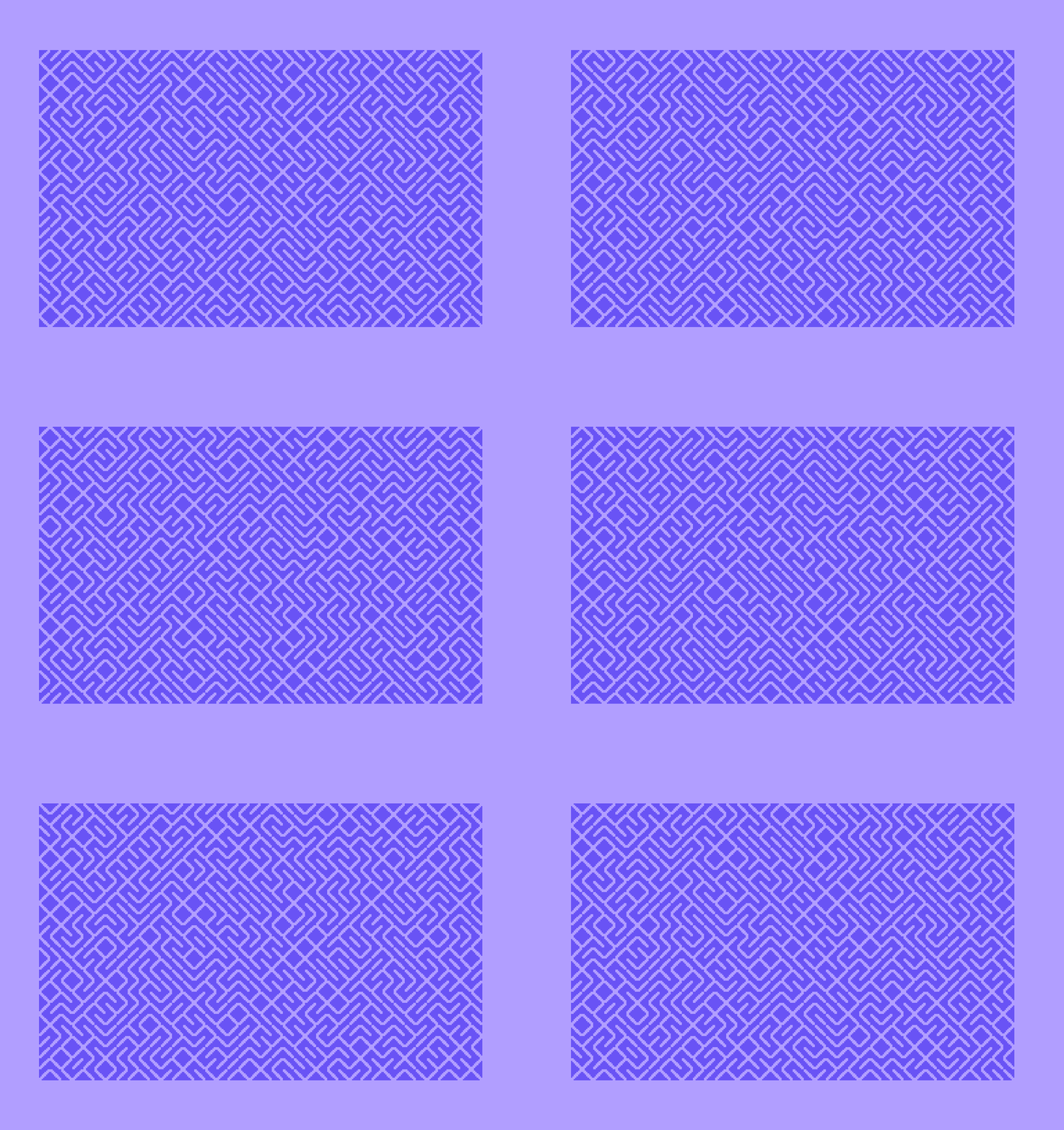
The first time I saw that book I wondered: 300 pages about a single line of code? The thing is, this kind of visual exploration pulls you into a back-and-forth: you write, you run it, you look at what came out, you change a number, you run it again and something you didn't expect shows up, you tweak and try once more. Since the program picks at random, you never fully know what you're going to see, and a tiny rule with two options is enough for thousands of different images. You don't design the image: you write the rule, and the machine makes the image by flipping a coin.
That's how, out of that digital craftsmanship, repeated by lots of people over the years, the best-known demo techniques emerged: faking three dimensions even though the hardware wasn't designed for it, playing entire songs, moving text around the screen, and many others that, without anyone meaning to, were shaping an aesthetic.
Out of that digital craftsmanship, repeated by lots of people over the years, the best-known demo techniques emerged.
Developing them, sharing them, and even competing with them became an activity in its own right, and that's how they gradually split off from cracking.
The beginnings of the demoscene
During the eighties, many of these groups started making demos and nothing but demos. A demo is a program that runs on its own, with no game or keygen behind it: you open it, it lasts a few minutes, shows what it has to show, and ends. It's the graphics-and-music part of the cracktro, spun off into its own executable. The signatures remained, but now inside a computer subculture of its own, which produced its own big names: Razor 1911, Fairlight, Kefrens, and Future Crew, to name a few.
Amusing IV, by Razor 1911 (Amiga, 1988).
The epicenter was Europe, where demos traveled by snail mail, on floppies stuffed into envelopes, often with a handwritten letter. Groups had people dedicated solely to that, the swappers, and it stayed that way for years because dialing up over the phone was expensive.
I don't know if one thing directly explains the other, but I like to think that, once again, a limitation ended up shaping the scene: those exchanges also gave rise to in-person gatherings, the demoparties.
In-person competitions
A demoparty is more like a film festival than a computer event. There's a big screen, the entries are projected one after another, and the audience votes. It's unclear which one was first, but what's certain is that the thing grew fast. The Party, in Denmark, drew more than a thousand people in 1991; Assembly, in Finland, started in 1992 and became one of the biggest; and today Revision, in Germany, is one of the main events on the scene.
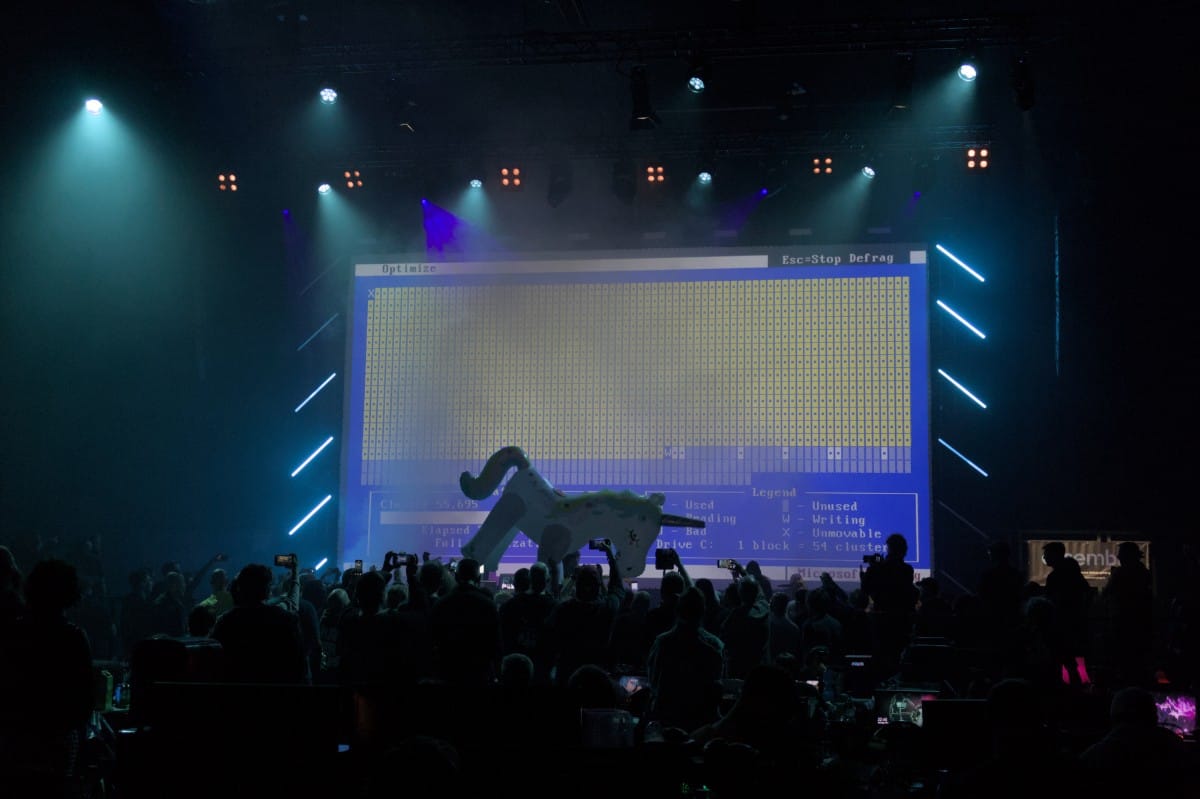
It's not all about programming or demos: there are categories for still images made especially for the event, sometimes with the requirement of working on a period machine, for music composed right there in a few hours, for video games, for animated GIFs, and for photography.
There's also art made entirely out of characters: ASCII, which builds images using letters, numbers, and symbols; ANSI, closely tied to BBS culture, which adds color and block characters to achieve much denser images; and PETSCII, the character set of Commodore computers, which is where, among many other shapes, the diagonals used by 10 PRINT come from.
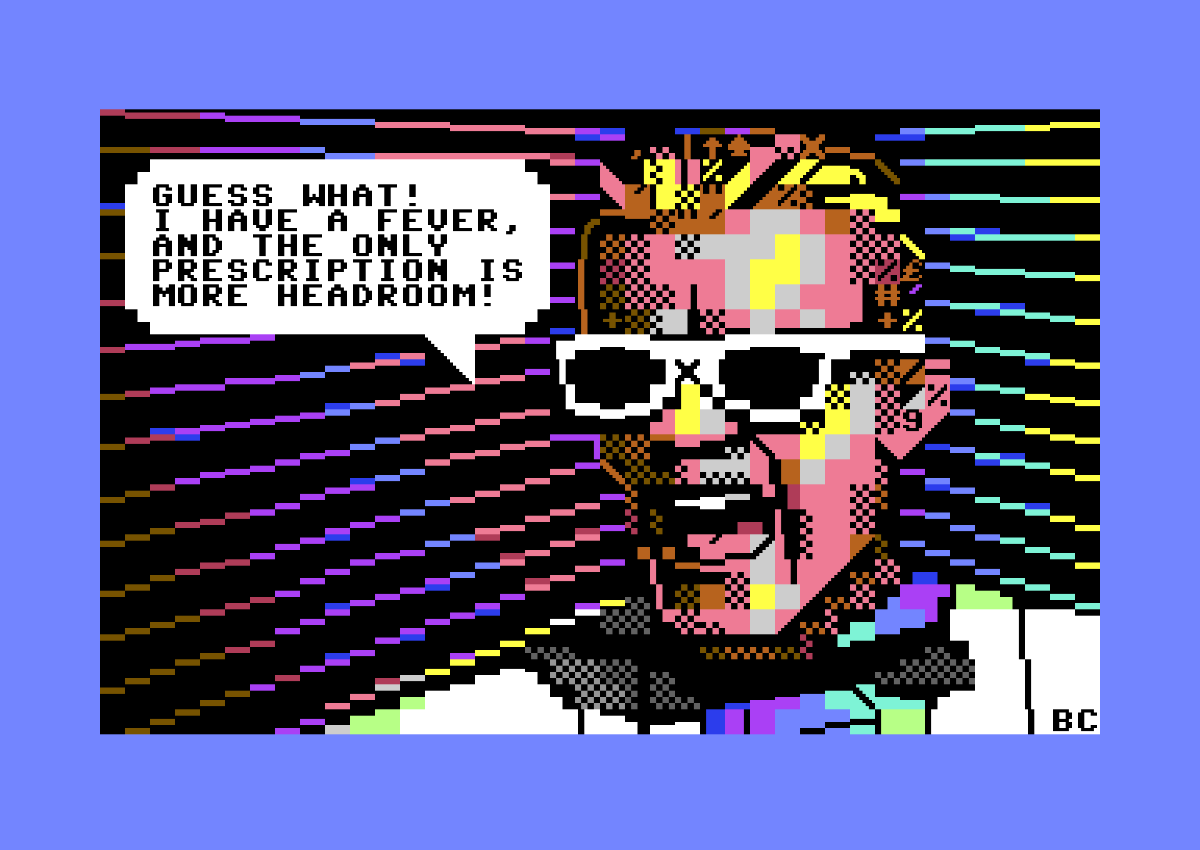
And finally there are the intros, one of the crown jewels of the event. What you submit is an executable that can't exceed a size set in advance, and if it goes over by a single byte, it's out. The categories are split precisely by that limit: 64K, 8K, and 4K, which is 4,096 bytes. There are several more, some even smaller.
Astraeus Project, by LJ and Virgill. 4 KB intro that won the PC 4K Intro category at Revision 2022.
And here it's worth pausing for a second to grasp the magic involved in pulling something like this off: the little 421 icon you see in this page's browser tab weighs around 3.5 KB, almost the same as those 4,096 bytes of the intro. Into that same space goes the code with the instructions that draw an entire animation and play the music.
Over the years, these intros stopped being just graphic effects. Some play with narrative, use techniques that allow for camera movements, and don't even get me started on the music, which counts toward the same budget: it's code, and it takes up space within those same 4 KB. All of it fighting to stay under the limit, up against people who are working the same magic.
Any sufficiently advanced technology is indistinguishable from magic.
Arthur C. Clarke, 1968.
Talk about a worn-out quote when it comes to technology, but it's still beautifully accurate once you fall down a rabbit hole like, in this case, the demoscene, where doors open onto all kinds of artists, code wizards, and programmers with a technical level that seems out of reach.
The local scene
In my case, there's one person who not only introduced me to this universe but also shared all his knowledge with me, with a generosity that's very typical of this world: Pablo Andrioli, aka “Kali.”
4 KB PC intro by LIA, presented at Revision 2020 Online. Code: Kali. Music: Uctumi.
I'd go so far as to say Kali was our very own Messi of intros, a standout figure at international demoparties with Latitude Independent Association (LIA), the demoscene group he was part of. Before that, he was already well known on old forums dedicated to fractal exploration for having found a formula the community started calling “Kaliset.” The formula was short, but it could generate incredibly complex visual structures, and other users quickly started testing it, tweaking it, and posting their own variants.
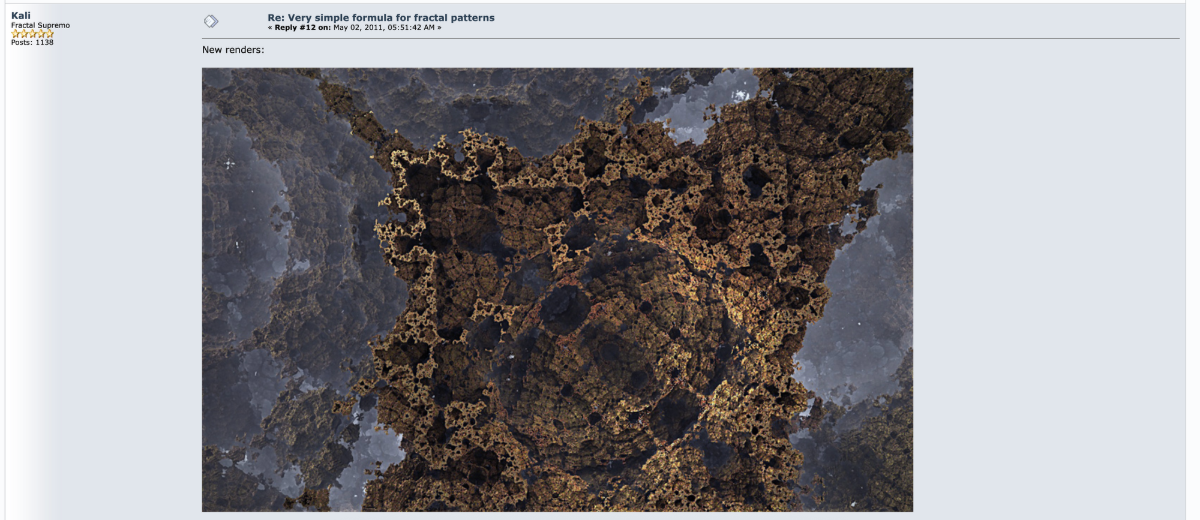
Over time, the Kaliset became hugely popular among shader programmers and started popping up in all sorts of experiments and variations. One of his most iconic works was Star Nest, which is built on that very formula.
Star Nest, by Kali. Shader generated from his “Kaliset” formula in just 65 lines of GLSL, around 1.9 KB of code.
He was also the one who took me to the most important demoparty in Argentina: Flashparty. It's been around since 1998 and is considered the first demoparty in South America. It went on hiatus between 2007 and 2018, but it's been held every year since then, and the latest edition took place on October 31, 2026, in Buenos Aires.
It's open to any digital artist and isn't limited to demos: it has as many categories as the international parties, so you can run into musicians, poets, graphic artists, programmers and all kinds of creative people. It's moved around over the years: it started in a warehouse in Villa Crespo, went through a radio club in Burzaco and also the Centro Cultural General San Martín. A single edition can screen close to a hundred works.
Highlights from Flashparty, 2022 edition.
Going to a demoparty doesn't necessarily mean going to compete, either. For me it was a door to a ton of things I didn't know about: workshops, talks, live coding performances, video game demos, drawing and programming techniques, and friendly communities like Cybercirujas, which is more focused on salvaging hardware and fighting obsolescence. I'd never have discovered a lot of those scenes if it hadn't been for that first invitation.
I find it more and more valuable that there are still spaces where code is shared, debated and transformed between people.
Sadly, Kali passed away in April of this year, leaving an immense legacy as an artist and as a person, along with countless works he presented over the years at demoparties like Flashparty. Just a few days earlier he had released Aenigma, an 8 KB intro made with LIA together with composer Uctumi, which took first place at Revision 2026, one of the most important demoparties in the world. His work is still available on Shadertoy and in LIA's productions, where you can see in action his knack for creating entire universes in a few lines of code, with a subtlety almost nobody achieves.
Rest in peace, my friend. You'll always be an inspiration to the whole community.
Aenigma, by Latitude Independent Association (LIA). An 8 KB intro with code by Kali and music by Uctumi, winner of the PC 8K Intro category at Revision 2026.
Shadertoy
If all this has gotten you excited so far, there are plenty of ways in: pixel art, music composition, poetry, ASCII art. But like any good programmer, my recommendation is to experiment with shaders. The language is pretty complex, but these days making your first visual effects is a lot more accessible if you let any AI guide you.
The term shader might ring a bell from the world of video games, and that's because it's exactly the same technology. There, a shader is the program that defines how everything looks on screen: the one that gives a 3D model its material and lighting, the sheen of metal, the movement of water. What changes is the purpose: instead of being applied to models inside an already built scene, the shader is applied to an empty plane that fills the whole screen, so the shapes, the depth and the light are all calculated by that single program.
All these works have had different venues, but today the mecca of programmed art is Shadertoy, a website created by Pol Jeremias and Íñigo Quílez that became home to the leading artists working in GLSL, one of the most popular languages for intros.
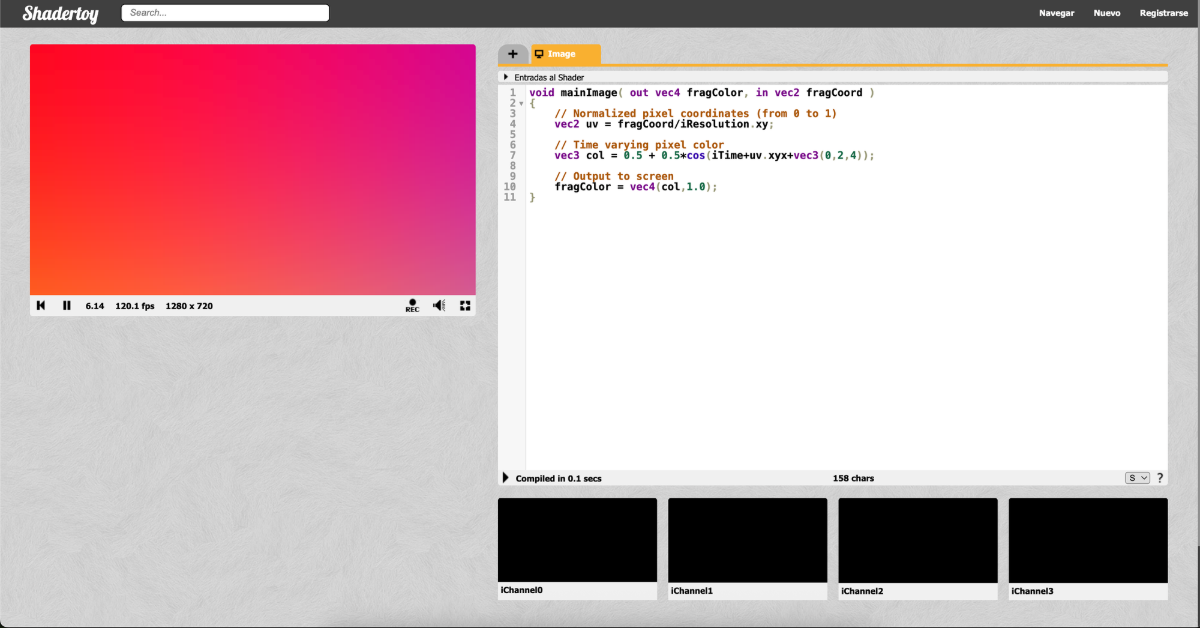
The premise is very simple: you write the code, it runs once for every pixel on the screen, and that produces a visual output. At first it seems practically impossible to render anything more than a color gradient (it's not a simple language at all), but just by going to the homepage and browsing users' creations you can grasp its potential.
Happy Jumping, by Íñigo Quílez. An animated scene generated entirely with mathematical formulas in GLSL, with no imported 3D models and nothing pre-processed in other software.
I'd say that in the world of generative art it's maybe one of the last platforms that firmly holds on to its handcrafted spirit, because language models, while they pick up this syntax fast, still lack the subtlety (or the necessary training) to properly use the techniques the demoscene has mastered with its intros over all these years.
With the rise of AI, which has sped up production in almost every field and especially in software, I find it more and more valuable that there are still spaces where code is shared, debated and transformed between people. Someone tries out a technique, someone else takes it further, someone else finds a way to do the same thing with less.
And that's what interests me most about the demoscene: an entire community trying to figure out how much art can fit in a byte.
No 421 article is behind a paywall
And every contributor is paid for their work. Both things depend on our subscribers.