Final Fantasy VI: The Human Drama That Outshines the Graphics
This 1994 video game proves that emotions stem from a good, classic melodrama, not from hyper-realistic graphics.
Currently, Triple A games are caught up in a race to see who can create the most realistic graphics. Who can add more movement to hair, who can reflect light better in a puddle, who can capture Messi's face more accurately. My gaming journey ended with the PlayStation 2, so my heart still belongs to those games that can move you and hook you with just a couple of pixels.
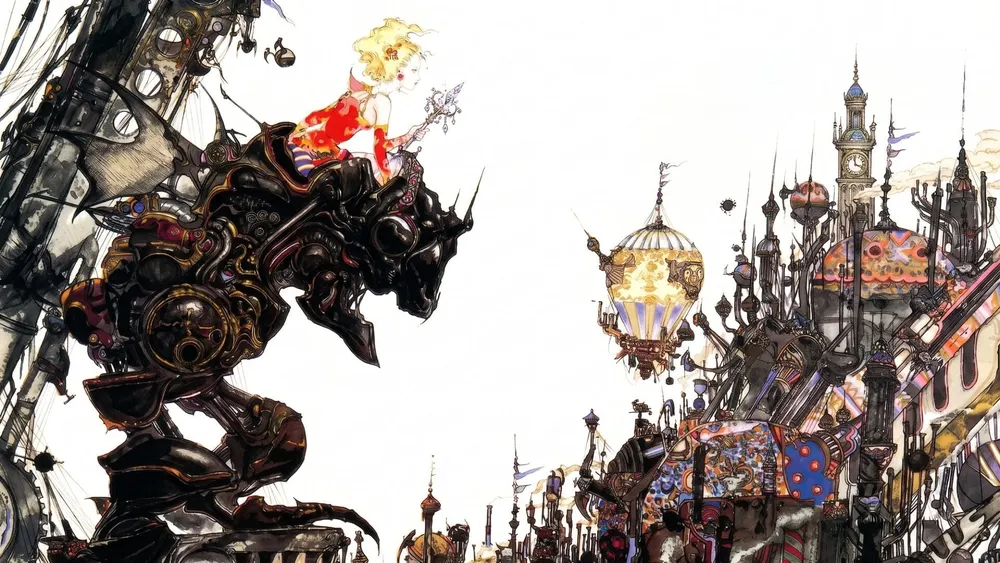
Final Fantasy VI (Squaresoft, 1994), for example, is one of the favorite video games of the author of this note. And not just out of nostalgia or aesthetics, but because it is a classic melodrama, the kind that would have been performed in plazas and alleys centuries ago. From the designs of Yoshitaka Amano to the music of Nobuo Uematsu and every game mechanic, everything serves to build a grand melodrama. The epic crescendo, the twists, and above all, the emotional development of each character linger in memory. In an industry where technique often takes precedence, this game continues to remind us that melodrama is a powerful attention-grabber.
From the designs of Yoshitaka Amano to the music of Nobuo Uematsu and every game mechanic, everything serves to build a grand melodrama.
In fact, the Final Fantasy saga has a significant lesson to teach us. Like the myth of Icarus, Hironobu Sakaguchi, the father of the saga, wanted to get too close to the sun when he blew the company’s budget making a “hyper-realistic” animated film, with the wild idea of creating not just a cinematic universe, but also digital actors. The result was a technically advanced work for its time, but a dull, gray story lacking the charisma that video games had.
Realism isn’t found in perfectly animating a face. We see that today in the countless advertisements made with artificial intelligence. Alfred Hitchcock, one of the greatest film directors of all time, understood very well that realism is achieved through emotions: “My greatest desire is to be realistic. Therefore, I make use of what is called melodrama, but which could just as well be called ultra-realism. After much thought, I have come to the conclusion that it is the only path to cinematic realism that could still be considered entertainment.”
Final Fantasy VI leverages all the elements of melodrama to construct a grand theatrical work. If Super Mario Bros. 3 played with that idea, Final Fantasy VI makes it explicit. It features a choral cast of protagonists, almost all of whom are touched by some personal tragedy. There’s romance, war, betrayals, family abandonment, inheritances, kingdoms, jesters, opera, death, sex, yetis, bahamuts, and talking octopuses.
The game adopts a steampunk aesthetic to make us believe it will be a cold, dehumanized dystopia. Its secret lies in its characters, in taking the time to get to know them, to delve into their dramas, longings, and worries. Final Fantasy VI touches every fiber of human sensitivity to convey what it cannot express with its graphics. It uses music, dialogue, silences, and mechanics to build a story that keeps you glued to the screen. It invites you to explore every corner of its world. Tomoe Inazawa, one of the game’s designers, explained that “we tried to give the maps a touch of realism, as if people lived there and inhabited those spaces.” When the game was released, Nintendo Power magazine described the story as “a bit cheesy” and claimed it “wasn’t made for American audiences.” Yes, Final Fantasy VI is cheesy. And it’s precisely because of that cheesiness that it’s a great video game.
 Agustín Zalazar
Locke and Celes: Their fate in our hands
Locke Cole is the charismatic bounty hunter who teams up with the revolutionary group “The Returners” to defeat Emperor Gestahl. Celes Chere is a general of the imperial army who is imprisoned after being declared a rebel for opposing Kefka. Locke finds her being tortured in a cell in South Figaro and decides to rescue her disguised as an imperial soldier. When she sees him for the first time, she says, “Aren’t you a bit short to be a soldier?” This line is a reference to Star Wars, the space melodrama created by George Lucas, as it’s what Princess Leia says to Luke Skywalker in a similar situation to that of Celes and Locke.
Melodramas are about castration, romantic failure, death. It’s the romance where the protagonists, despite being madly in love, cannot live happily ever after. The love that develops between Locke and Celes seems to be doomed from the start due to their circumstances, their ideals, but above all, their pasts. Celes, although she realizes the evil of the army, is still viewed with suspicion by many of her comrades. She cannot simply erase what she was. Her conflict revolves around her search for identity, to be herself and not just a war instrument. Meanwhile, Locke is still haunted by the guilt of his ex-partner Rachel. His heart isn’t ready to let her go and make room for the blonde warrior.
One of the most important moments in their relationship (in the saga and even in video game history) is the night at the opera. Celes must replace Maria, a singer who is going to be kidnapped by Setzer Gabbiani, who owns the only airship, so they must reach him and convince him to put her in the show. This entire scene is a meta-reference. The game strips itself bare and shows its guts: I am a classic melodrama. Here we delve deeper into the relationship between Celes and Locke. At first, the proud general refuses (“I’m a former general of the empire, not an opera floozy”).
Melodramas are about castration, romantic failure, death. It’s the romance where the protagonists, despite being madly in love, cannot live happily ever after.
Nobuo Uematsu's music resonates with our most sensitive fibers as we play an interactive cutscene (we have up to three failures; otherwise, it’s like dying in battle) in which we must remember Maria’s dramatic dialogues and declare her love to Draco, a soldier from the rival army who died in the war. We, the players, immerse ourselves in their silences, letting ourselves be carried away by Uematsu’s crescendo music, and with just the press of a button, we see how Maria dances one last tango with the ghost of her beloved before throwing a bouquet of flowers to the stars. Broken in tears.
Maria and Draco represent the tragic future that seems to await Celes and Locke's relationship. Their love will not survive the war. After Kefka's triumph and the beginning of World of Ruin, Celes knows nothing of what happened to her friends; she is trapped on an island with Cid, a scientist from the empire who represents a father figure for her, but he is very ill. After a few days, Cid dies. Celes has nothing left in the world. Her mind is engulfed in deep darkness, so in desperation, she decides to take her own life. When she is about to do it, throwing herself from a cliff (in a parallel to the opera scene, where Maria climbs to the top of the castle to throw the bouquet), a white dove releases a blue bandana. Celes receives it and recognizes it as Locke's bandana. There is a glimmer of hope: Locke may be alive. Just that small spark activated Celes's will to live, prompting her to embark on a journey to find her friends, especially her beloved.
Here the game offers us two paths: to be a melodrama where the romance remains unfinished or to give our beloved couple a better ending. It is us, the players, who will finish writing the script, as if Clint Eastwood were giving us the chance for Meryl Streep to get out of the car and run into his arms in A Bridge of Madison County.
Celes and Locke share the same ending. Their fates are intertwined, but reuniting with Locke is optional. If we don’t do it, while escaping from the crumbling Kefka's tower, Celes drops her bandana and risks falling to avoid losing it, but she is rescued by Setzer (a mandatory character), while if we have Locke in our party, it will be him who saves her. As journalist Federico Lo Giudice explained in his newsletter Fantasía Inicial: “Celes loves every aspect of Locke, whether he’s a thief or an adventurer, and he was able to close the cycle of Rachel by finally rescuing the woman he loves before she falls into the abyss.”
Final Fantasy VI rewards us for our decision to embark on side quests to reunite with Locke, removing the tragic end from their romance. Now they are together to move forward in a world that needs to be rebuilt just as much as they do. But Final Fantasy VI is not the teenage love story that Final Fantasy VIII is. Here, we don’t end up at a prom laughing. This is a melodrama. We come to FEEL. The game is not so benevolent with other couples.
Maduin and Madelein
Madeline is a girl who accidentally crosses the portal into the Realm of the Espers, a land where fantastic beings with magical powers live. There she meets Maduin, a humanoid esper with horns. He feels no fear or distrust towards humans. He likes Madeline. Despite the clear differences and the initial rejection from the villagers, Maduin and Madeline fall in love.
Their love story draws heavily from the quintessential melodrama: Romeo and Juliet. Two young lovers from opposing families, worlds, and races. Their love manages to overcome those initial barriers, and everything seems to go well in their daily lives. They even conceive their half-breed daughter, Terra. But war knocks at their door.
The imperial army invades the land of the Espers to kidnap them and absorb their magical power to create Magicites. The game allows us to control Maduin throughout this sequence. We experience firsthand his desperation to save his beloved and daughter while the rest of his village fights to drive out the invaders and seal the portal they came through.
We know the outcome. We know we won’t be able to change the story. We play only to feel the helplessness of Maduin, who is captured, unable to prevent Gestahl from killing Madeline and taking Terra from his arms. Both lie on the ground: she lifeless, he unconscious, while the portal closes before our eyes like a curtain.
Locke and Rachel
Rachel is Locke's great love from the past (our protagonist) and the reason he lives obsessed with protecting those around him. Before the events of Final Fantasy VI, they had a romantic relationship. While escaping from pursuers in the mountains, Rachel fell off a cliff. Although she survived the accident, she lost her memory and forgot who Locke was. Unable to accept this situation, he left the village hoping to find a way to restore her memories.
Years later, when Locke returned, he discovered that Rachel had died during an imperial attack. The news emotionally shattered him. Since then, he has carried a deep guilt, convinced that he failed to protect the person he loved most. That wound explains much of his personality throughout the game: his constant drive to rescue others, his tendency to act impulsively when someone is in danger, and his difficulties in opening up emotionally to Celes.
In World of Ruin, if we choose to do so, we will find him in a cave searching for the Phoenix magic to bring her back to life. Upon obtaining it, he goes to the basement where his beloved's body lies to perform the miracle, but he can only bring her to this plane for a few seconds, just enough for her to remember him, say goodbye, and free him from his guilt. It is not Rachel who comes back to life but Locke, who is reborn as a man who no longer carries the guilt of not having saved the one he loved, with Celes on his horizon. Living alone costs a life, and Locke decides to do it without regrets.
Setzer and Daryl
When we meet Setzer, he is already one of the most extravagant characters in Final Fantasy VI. Owner of the only airship in the world, a compulsive gambler and bon vivant, he seems to navigate life without worrying too much about the consequences. However, behind that facade lies a wound that the game keeps hidden for much of the adventure: Daryl.
Unlike other romances in the game, the story between Setzer and Daryl was not marked by guilt, betrayal, or irreconcilable differences between worlds. They shared the same passion. They constantly competed to see who could go further, who could fly higher, and who could perform the riskiest maneuvers. Daryl was obsessed with pushing her own limits. Her dream was to reach horizons that no one had explored before. During one of her expeditions, she disappeared forever, leaving behind only rumors, memories, and an airship, the Falcon.
Daryl is already dead when the story begins. She exists only through Setzer's memories, the tales shared by other characters, and the objects she left behind. However, the most interesting part of this story is not the tragedy itself, but the way Setzer coexists with it. Unlike Locke, who remains trapped in guilt and spends much of his life trying to correct an unrepairable past, Setzer has already gone through that process. His mourning has already occurred. He has accepted that Daryl will not return.
 Nehuen Vazquez
Although he never found definitive proof of her death, he neither denies nor tries to escape that tragic fate. He even visits an empty grave where he hid the Falcon, as if he has accepted that the aircraft is the only tangible remnant of her. Setzer lives with melancholy. He never stops missing Daryl, although he learns to carry that absence without letting it destroy him completely. While Locke receives a final farewell from Rachel and finds a new opportunity with Celes, Setzer never gets a similar closure. Daryl does not return. There is no scene of reconciliation. The recovery of the Falcon during the World of Ruins carries a much greater emotional weight than it appears at first glance. Practically speaking, it’s about acquiring a new aircraft to continue the adventure. Narratively, it means reclaiming Daryl's legacy. In a way, Daryl accompanies a Setzer who moves forward and remembers her with every sip of whiskey he drinks at night.
"Death is not such a real verb"
For Spanish journalist José Altozano, in video games, "dying is not such a real verb." The phrase seems simple, but it describes one of the fundamental characteristics of the medium. We die in a level, respawn a few seconds later, and try again. Death is often an opportunity to learn. A mechanism that forces us to correct mistakes, memorize patterns, and improve our execution. As various studies on video games point out, death often functions more as a pedagogical tool than as a tragedy.
Final Fantasy VI perfectly understands this logic. For dozens of hours, it teaches us that any obstacle can be overcome. If a boss defeats us, all we need to do is train more, get better weapons, or rethink our strategy. Death is part of the game. It’s reversible. But precisely because it knows this convention so well, Squaresoft's RPG manages to break it when it hurts the most.
The most striking example is the death of General Leo.
Leo is one of the few honorable members of the empire. An upright man who begins to understand just how far Gestahl and Kefka have led the world into disaster. During the conflict in Thamasa, a possibility of reconciliation seems to arise. Perhaps there is still a diplomatic solution. Perhaps it is still possible to avoid catastrophe.
Then Kefka appears. The weight of the sequence is that we do not observe the events from the outside. The game gives us control of Leo. We are the ones fighting. Leo has impressive stats, powerful abilities, and seems perfectly prepared to defeat his rival. Leo inflicts an absurd amount of damage. He is far above the level of the characters we have been using. It feels good, being in control, to see his attacks flow. We think he will be a permanent member of our group from now on. We win. We exit the battle screen. However, Kefka reappears and treacherously kills Leo before our incredulous eyes, leaving us powerless to prevent it.
The developers use the very language of the video game to produce tragedy. A novel can describe a character walking toward their fatal destiny. A movie can show it. Final Fantasy VI does something different: it forces us to participate. We try to prevent death and fail.
Here, Altozano's phrase takes on an inverse meaning. Death ceases to be an opportunity to do better. There is no possible learning. There is no second chance. All that remains of Leo is a gravestone to pay tribute to him. Final Fantasy VI transforms playful death into narrative death. It reminds us that there are losses that no player can reverse.
A novel can describe a character walking toward their fatal destiny. A movie can show it. Final Fantasy VI does something different: it forces us to participate. We try to prevent death and fail.
The tragedy continues with Cyan Garamonde. When Kefka poisons the river of Doma, he doesn’t just destroy a kingdom. He condemns Cyan's wife and son. Unlike most RPGs, where magic can heal impossible wounds and bring heroes back from the brink, here no miracle exists. Cyan arrives too late.
What follows is one of the most moving sequences in the entire history of video games: the Phantom Train. Cyan, Sabin, and Shadow travel on the train that carries souls to the afterlife. After performing a “suplex” on the train, we discover that it carries the recently slain citizens of Doma, including Cyan's wife and son. We cannot revive them. Phoenix Downs (items to revive characters in battles) do not work here. The Phantom Train serves as a mourning ritual. Final Fantasy VI stops asking how to defeat death and starts asking how to live with it. Cyan does not achieve a victory. He receives no reward. He finds no solution. He learns to say goodbye.
And that is one of the great virtues of the game. In a medium where death is often reversible, Final Fantasy VI finds a way to restore its weight. Most of its characters are marked by the loss of a loved one and carry wounds that cannot be healed with a continue screen.
After Kefka's triumph and the beginning of the World of Ruin, we traverse the same towns and cities that once had a pastoral and welcoming appearance, but now appear devastated. Cracks run through the streets, destroyed houses remain inaccessible, and many people survive in the open air, trying to warm themselves around makeshift campfires. Everything feels hostile, harsh, and tragic. However, when we talk to those who inhabit these places, we discover that they don’t just speak of what they lost. They also talk about how they move forward, the plans they have for when things improve, the places they want to visit, and the people they hope to reunite with. Final Fantasy VI understands that grief is not just about mourning an absence. It’s also about learning to live after it.
The two faces of Kefka, the perfect villain
Melodrama builds manichean worlds. Good guys versus bad guys. This duality allows for quick empathy with the heroes and instant hatred for the villains. Exaggerated virtuosity on one side and absolute evil on the other. The Final Fantasy saga has always worked with these archetypes. It’s no coincidence that the franchise's first protagonists were directly called "Warriors of Light."
If Disney villains have their own fandom and amusement parks, Final Fantasy villains are no different. Sephiroth, with his sword as long as his silver hair, is probably the most popular, but Final Fantasy VI boasts one of the greatest psychopaths produced by the craft of villainy: Kefka Palazzo.
Before the events of the game, he was used by the empire as a test subject for the first experiments in magical infusion. The procedure worked partially: he gained extraordinary powers but destroyed his mental stability. Decades later, we would meet enhanced soldiers like Celes, but Kefka was the imperfect prototype. The first attempt. The failed experiment.
Final Fantasy VI boasts one of the greatest psychopaths produced by the craft of villainy: Kefka Palazzo.
The theater has two faces, and Kefka embodies both. He is a jester. His colorful clothes, painted face, exaggerated movements, and shrill laughter make him seem more like comic relief than a real threat. When he first appears, he seems to occupy the same role as characters like Gilgamesh in Final Fantasy V: an extravagant figure meant to provide humor amidst the adventure. While Emperor Gestahl appears to be the true antagonist, Kefka gives the impression of being merely a histrionic subordinate who prances around the stage throwing tantrums.
But jesters were never as simple as we tend to imagine. In popular imagination, they are ridiculous characters dressed in bells and bright colors to entertain the king. However, historically, they held a unique position within the court. Thanks to their humor, they could say things that no one else dared to utter. They could mock nobles, advisors, and monarchs. They pointed out contradictions, hypocrisies, and uncomfortable truths. Their apparent insignificance granted them a freedom that others did not possess.
Behind the makeup and the jokes lies a completely broken man. He believes in nothing—no ideals, no love, no friendship, no sacrifice. All he sees is suffering, destruction, and death. And he never stops being theatrical. His exaggerated laughter announces his arrival as if it were the leitmotiv of an opera. His gestures seem those of an overacting actor. Even his last name, Palazzo, feels like it was pulled from the cast of an Italian opera company. Kefka turns each of his appearances into a spectacle.
Something extraordinary happens for a video game from 1994: the villain wins. All our efforts fail. Kefka causes a planetary cataclysm, destroys the balance of the world, and becomes a twisted God. The continent fractures. Entire cities vanish. Millions of people die. We lost, and we must deal with our failure.
The inevitable comparison for Kefka is with the Joker from Batman. While they share obvious similarities, I would like to draw a closer parallel with Tyrion Lannister from Game of Thrones (or at least from the series). Like Kefka, the youngest Lannister starts as an archetype of the jester. No one takes him seriously because of his stature; he is belittled by his own family, but his intelligence, wit, and sarcasm elevate him above the other characters. He transitions from comic relief to a political strategist who ultimately decides the fate of the kingdoms. Both are underestimated, but behind that facade lie extraordinary minds.
The difference is that each takes an opposite path. Tyrion retains his humanity. He can be cynical, sarcastic, and deeply disillusioned, but he still believes in people. He continues to seek affection, friendship, and meaning. His response to an absurd world is to cling to life. If everything is fleeting, then we must enjoy it while it lasts. We must drink, love, laugh, read, make mistakes, and try again. Tyrion embodies a philosophy close to carpe diem. Seize the day because he knows that one day there will be no more days to seize.
If Tyrion is carpe diem, Kefka is memento mori. We are going to die, and therefore, for him, nothing makes sense. And if it doesn’t make sense, it’s not worth existing. Kefka holds the world in his hands as if he were Hamlet holding Yorick's skull. As he cradles the skull, Hamlet asks, "Where are now your jests, your leaps, your songs, and those brilliant jokes that brightened the table with cheerful uproar?" Kefka, from the heights of the tower, touching the sky like a deity, asks: "Why do people insist on creating things that will inevitably be destroyed? Why cling to life knowing that one day they will die?" If everything ends up reduced to dust, then nothing has value. If death is inevitable, then nothing deserves to exist. If everything will be destroyed someday, why build, love, create, or fight?
Kefka observes the same reality as the heroes, but while he concludes that nothing makes sense, for our protagonist group, death does not appear as a negation of life, but rather as what gives it meaning. Connections matter. People disappear, and memories hold value. One day we will cease to exist, so our choices matter. Yes, death is inevitable, but that does not render life useless. On the contrary, it is precisely what makes it valuable. And nothing makes us feel more alive than getting swept up in a good melodrama.
Las notas de 421 no tienen paywall
Y a cada colaborador se le paga por su trabajo. Las dos cosas dependen de los suscriptores.