In the 1990s, a group of young Norwegians pioneered one of the most radical genres of metal. But then they burned down churches and committed terrible crimes. What drove them to do all that?
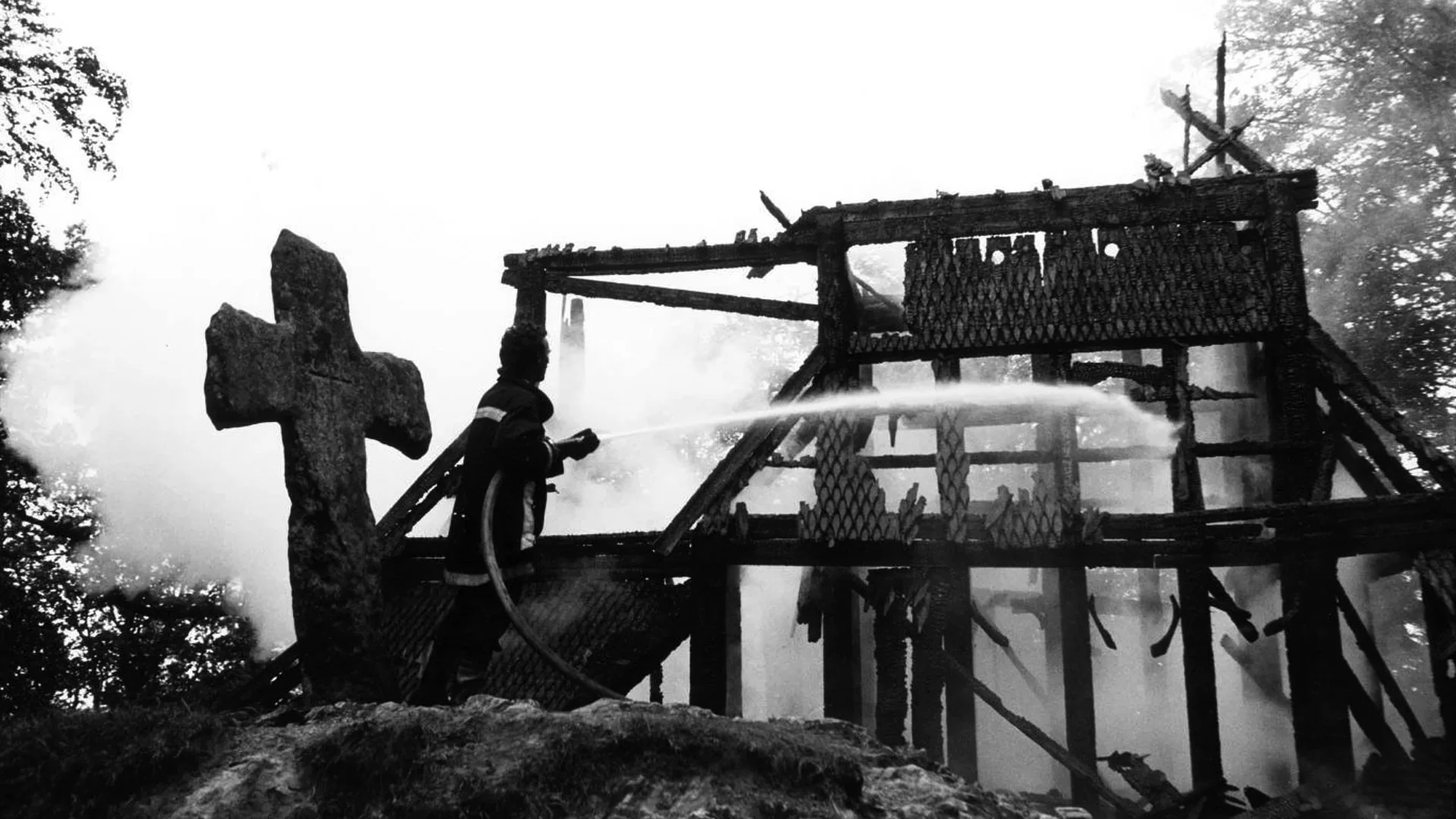
On the spring night of June 6, 1992, the wooden church of Fantoft burns. I’m not talking about religious fervor—far from it. It literally burns. Its structure is reduced to ruins. From that point on, more than twenty Norwegian Christian churches become victims of the flames. A teenage fire that boasted of coming straight from hell.
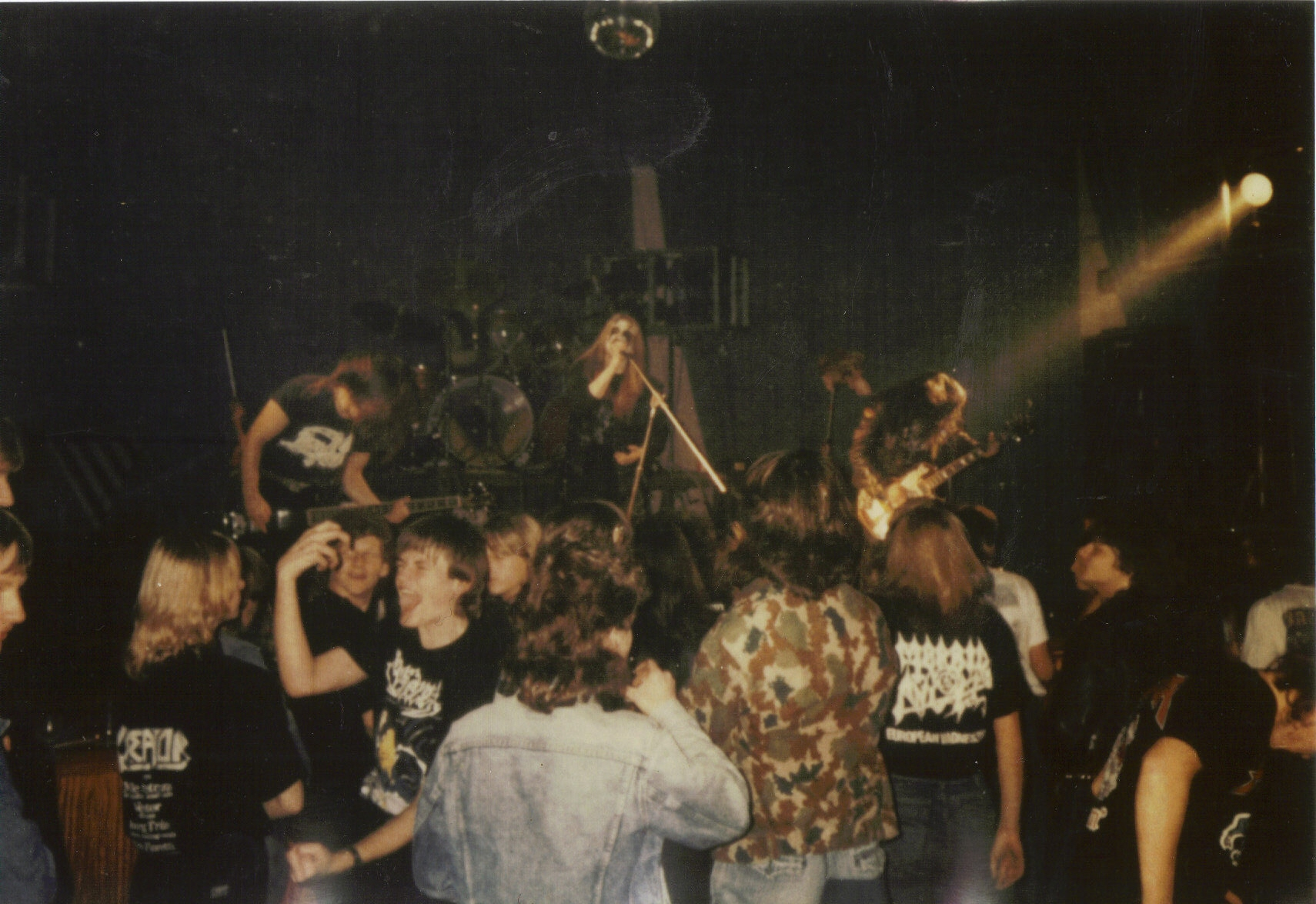
In this context, one of the most significant musical styles of metal will take shape. The frantic tremolo picking was standardized, the blast beat became a storm from the underworld, and the screams were heart-wrenching. There was also corpse paint, spikes, and medieval weapons.
How can we explain that in a country where nothing was happening and which enjoyed the highest economic prosperity, such an aggressive musical style in aesthetics, philosophy, and action was born?
All these elements will come together to define black metal, a genre born in the name of Satan.
How can we explain that in a country where nothing was happening and which enjoyed the highest economic prosperity, such an aggressive musical style in aesthetics, philosophy, and action was born?
The first wave
Norwegian black metal of the nineties didn’t emerge from a Scandinavian potato.
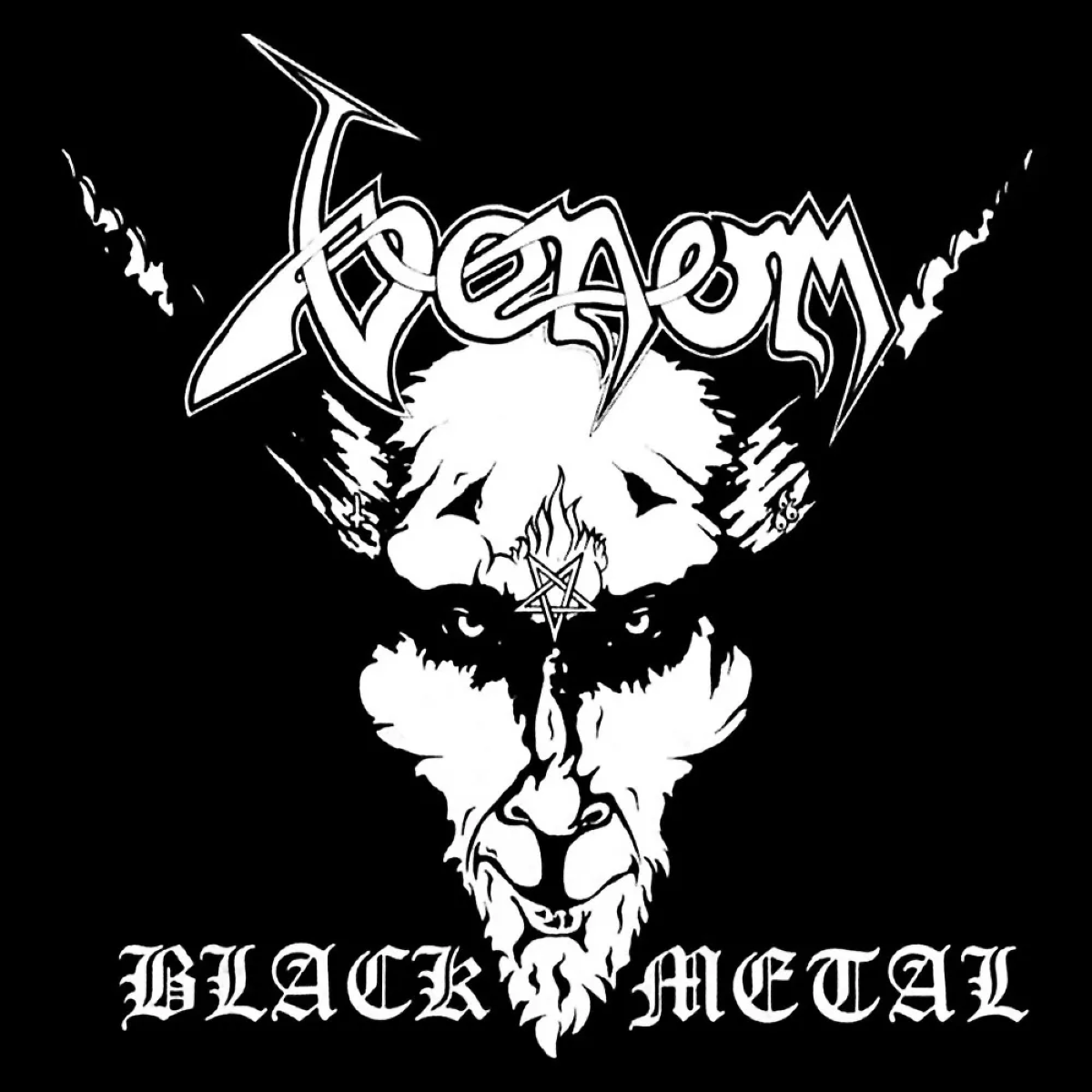
Since 1981, the cult of Venom, one of the most influential bands in the history of the genre, began to spread worldwide. In Welcome to Hell (1981) and the essential Black Metal (1982), the British created a sound that took the foundations of Motörhead and pushed them into a new horizon of darkness and technical grime. Moreover, they were the first to stage an aesthetic based on the satanism of Anton Szandor LaVey's Church of Satan.
Black Metal of Venom.
In Denmark, Mercyful Fate also began to define a sound close to English heavy metal, marked by occultism. The singer King Diamond drew inspiration from bands like Kiss and Alice Cooper to create a theatrical persona on stage. He painted his face and used satanic paraphernalia like inverted crosses made of bones. Just like Venom, he adopted LaVey's ideology: a hedonistic individualism that views Satan not as an entity but as a symbol of self-assertion, carnal desire, and rejection of Judeo-Christian morality.
These two bands influenced others like Slayer and Metallica. But for black metal, the emergence of Hellhammer in Switzerland, a direct precursor to Celtic Frost, and Bathory in Sweden would be crucial.
Led by the prodigious Thomas Börje “Quorthon” Forsberg and inspired by Venom's song Countess Bathory, the first three albums of the Swedes — Bathory (1984), The Return (1985), and Under the Sign of the Black Mark (1987) — defined the sound of the most primitive stage of black: speed, raw production, screams, and epic satanism.
Perhaps it’s the first true black metal album.
On the other hand, in 1982, Tom Gabriel Fischer (better known as Tom G. Warrior) and Martin Eric Ain formed Hellhammer. It was a project so primitive in conception and execution that critics completely dismissed them. They disbanded in 1984 to form Celtic Frost. With Morbid Tales (1984) and To Mega Therion (1985), they helped expand the sound textures of extreme metal: they added influences from gothic rock, orchestral arrangements, and more elaborate occult lyrics. Still, the work that Hellhammer did would be embraced by the kids who didn’t let themselves be swayed by the press’s opinions.
On the other side of the Atlantic, in Brazil, Wagner "Antichrist" Lamounier (who had a brief stint with Sepultura) would found Sarcófago. With I.N.R.I. (1987), the Belo Horizonte band brought unprecedented sonic violence, supported by the frenzied blast beats of drummer D.D. Crazy, and a stage presence marked by corpse paint, spikes, and leather, which would have a direct influence on the aesthetics of the future scene.
But the most important band for this story was born (how could it not?) in Norway. A bunch of kids from Oslo got together in 1984 and also named their group after a Venom song.
A branch of hell in the center of Oslo
Why Mayhem?
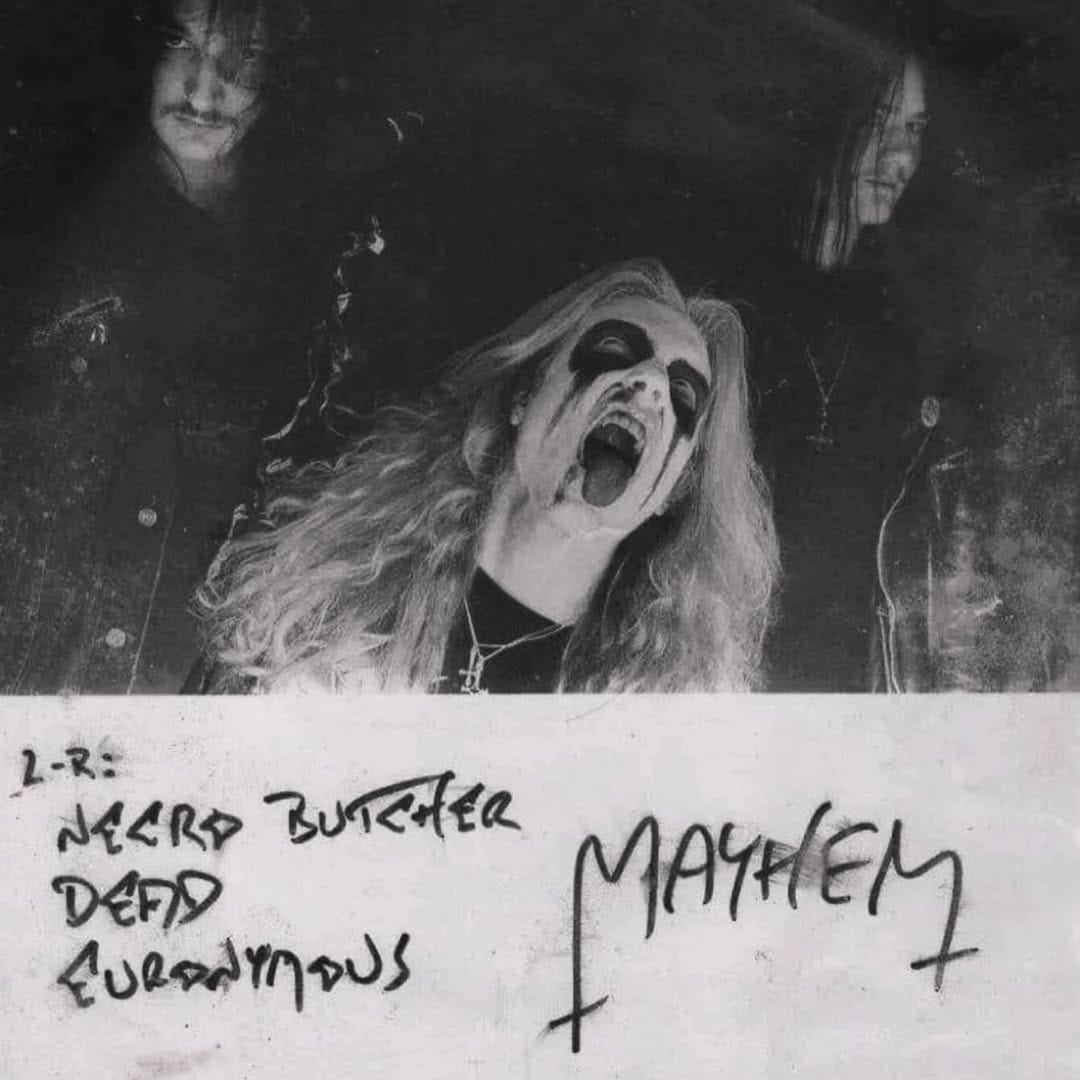
First of all, for being pioneers. In 1987, Jørn "Necrobutcher" Stubberud, Kjetil Manheim, and Øystein "Euronymous" Aarseth released the mini-LP Deathcrush through their own label, Posercorpse Music. With that record, they took Scandinavian metal to another level of rawness, speed, and audacity.
Secondly, because from that milestone, they positioned themselves as the most important references in the local scene. The one who took the most advantage of that momentum was Euronymous, who, from a strategic position, reserved the baptismal power to define which groups were “trve” and which were not.
After the niche success of Deathcrush, Mayhem had two important additions. Jan Axel “Hellhammer” Blomberg, a prodigious drummer from the underground, joined to replace Kjetil Manheim. On the other hand, Per “Dead” Ohlin, a Swedish vocalist from the band Morbid, moved to Oslo to change everything.
His appearance was crucial. His style of performance introduced a radical mystique to the scene: he would mutilate his arms on stage until covered in blood; he carried a bag with a rotting crow and would open it before singing to "smell the death"; and he buried his clothes to wear them later with the stench of the earth.
Dead committed suicide in April 1991. This event is one of the foundational moments in the tragic mythology of black metal. That night, he cut his wrists, his throat, and shot himself in the head with a shotgun. "Sorry for the blood," he stated in the letter that Euronymous would read when he found him. The guitarist's reaction was also memorable: he arranged the scene and photographed his bandmate's body before even calling the police.
I'm not posting the photo Euronymous took because I don't want to subject you to that. If you're curious, just Google “Dawn Of The Black Hearts.” The image was used for that bootleg in 1995.
As if Dead's suicide were an initiatory sacrifice, Euronymous opened Helvete ("Hell") just a few months later. Through that record store, the guitarist established the gravitational center of the entire burgeoning Norwegian black metal scene. He founded his label, Deathlike Silence, from which he aimed to dictate which bands were legitimate according to his aesthetic, philosophical, and attitudinal standards.
By mid-1991, an impressive array of names revolved around Helvete: Darkthrone, Burzum (Varg Vikernes), Immortal, Thorns, Emperor, Enslaved. Euronymous dubbed them, in a propagandistic maneuver, the "Black Circle." Although its members do not agree that this entourage had the structure he promoted, Euronymous's influence was undeniable. He imposed a very strict logic of authenticity on the young people orbiting around him. To be part of it, one had to demonstrate coherence and loyalty to a worldview. Euronymous proclaimed a radical opposition to Christianity and embraced a form of Satanism different from that of Venom and Mercyful Fate. What he proposed was a cult of evil as a metaphysical principle. Whether posed or not, he promoted the adoption of a theistic Satanism, an active misanthropy, a celebration of death, and a hatred of life as existential positions.
Dead committed suicide in April 1991. This event is one of the foundational moments in the tragic mythology of black metal. That night, he cut his wrists, his throat, and shot himself in the head with a shotgun.
What matters is not so much whether he was coherent with his own preaching. In Nacidos para arder, the essential chronicle by Matías Gallardo, there are several moments that reveal that Euronymous was actually less radical than he projected to the press and his followers. Despite this, it is undeniable that without his influence, black metal would not be what it is today. And the escalation of violence probably would never have happened.
So, why was Euronymous so successful? What made hundreds of young Norwegians feel drawn to the aesthetic and lifestyle proposed by black metal?
The cage of well-being
In Norway during the 1980s and 1990s, the Church was everywhere. The problem was that it meant nothing to anyone. 88% of the population was affiliated with the Den norske kirke ("Church of Norway"), the official state religious institution. Only between 2% and 3% attended mass or any other ceremony regularly. Membership was a default setting. Moreover, the church tax was paid alongside general taxes.
We can think of Norway as an extreme case of what Max Weber described as routinization of charisma. The transformative experience of the sacred had become a mere bureaucratic apparatus. By the time black metal emerged, the Church of Norway no longer mediated between the individual and the sacred; instead, it managed births and deaths as if they were mere paperwork. The temple was just another office of the state.
This secularization was reinforced by the economic, political, and social reality. The welfare state model absorbed the functions that once gave meaning to the idea of community life in the Church. Social assistance, education, health, and containment were matters of the state and were provided with solvency.
By the 1990s, Norway had fewer than four and a half million inhabitants, one of the highest per capita GDPs in the world, and a monolithic social protection system. Despite the brief Nordic banking crisis between 1988 and 1993, the country had no structural poverty or homelessness. There was no room for chaos.
The youth that formed the black metal scene did not come from particularly religious or oppressive families. They were not rebelling against fanatical parents or material misery. They were, in fact, children of the more or less well-off middle classes, with access to excellent quality of life and education. The problem was rather different.
Norwegian society had resolved the material question. Yes, but it offered nothing in return on the spiritual front. In that sense, prosperity acted as a kind of anesthesia and turned into a cage. Material well-being was guaranteed by the state. There was no institution or authority that covered the spiritual dimension or addressed the fundamental questions.
Black metal, through its aesthetic and lifestyle, offered Norwegian youth a place from which they could rebel against that void.
Terrifying and sacred
If Weber helps us understand the consequences of the bureaucratization process of the Church of Norway, Rudolf Otto helps us understand what was lost along the way of extreme secularization.
For Otto, the sacred experience (the numinous) has two inseparable moments: the mysterium tremendum, the terror before what exceeds comprehension; and the fascinans, the irresistible attraction to that which terrifies. Bureaucratization incapacitated the Church in its mission to allow access to that which exceeds the subject, which terrifies and compels one to feel like a creature. It lost the tremendum. Without that quality, ritual as a vehicle for the sacred loses its meaning and becomes mere decoration.
Black metal, with its extreme staging, its numinous sounds, corpse paint, and violence managed to create what did not exist in the prosperous and secularized society of Norway: the tremendum. Georges Bataille, in L'Érotisme, explains that transgression does not deny the taboo but completes it. The sacred world and the profane world are not opposites but complementary. The problem in Norway at the time was that the prohibition of sin existed nominally, but no one felt it was real; no one felt the urge to break the taboo. If the taboo is weak, then transgression does not need to be weak; on the contrary, it is more effective the more extreme it is.
Euronymous's project was popular among the young people and teenagers who followed him because it struck a chord with the Norwegian trapped in an anesthetized and "perfect" society.
Many bands in the scene would opt for technically inferior productions compared to their contemporaries in death or thrash metal. The lo-fi sound of Burzum or albums like Darkthrone's Transilvanian Hunger (1994) was a conscious choice rather than a result of material scarcity, which, by the way, did not exist. It was a kind of rebellion against the technical imposition of modernity.
Beyond the influence of Mayhem and Euronymous, it's worth mentioning Snorre Ruch, guitarist of Thorns (formerly of Stigma Diabolicum), in terms of sound. In 1991, he recorded the demo Grymyrk, a rehearsal intended as working material for his band members to learn the songs. The demo consisted solely of guitar and bass. The angular riffs, dissonant chords, and convoluted structures became a blueprint that was copied to exhaustion, helping to define that special sound of black metal.
Get comfortable, light some candles, turn off the lights, and crank up the volume.
The search for the lost tremendum helps explain several of the genre's aesthetic differentials compared to its cousins: the production and compositions focused on creating atmospheric and numinous spaces; the blast beat and sharp tremolo picking as techniques to impose chaos; the occasional appearance of keyboards as an epic cushion; the possibility of alternating between anguished vocals and operatic style in albums like Mayhem's De Mysteriis Dom Sathanas (1994); the corpse paint and the use of fictitious names related to the world of evil mythology or fantasy literature.
It also explains the ease with which transgression was accepted as moving into the material realm and becoming crime. In other countries, where the problem of secularization existed but not as deeply, the transgression of the local metal scene did not have to resort to widespread violence. Sweden had an equally extreme scene, but it didn't go as far. In Norway, transgression had to be strong to make a real impact.
Darkthrone was one of the bands that embraced a low-quality, shrill, and difficult-to-listen-to sound.
The rebellion against the state and ecclesiastical order that destroyed the sacred mystery found its most concrete expression in the burning of stavkirker.
The only church that illuminates
Stavkirker are medieval wooden churches built between the 12th and 13th centuries, after the Christianization of Norway. Their columns are made of solid wood, with steeply pitched roofs, carvings of dragons and serpents that blend Christian and pre-Christian Nordic elements.
In Denmark, the conversion was led by the aristocracy, without a significant level of widespread popular violence. In Sweden, the conversion was a fairly consensual process. In Norway, Christianization came with blood and fire.
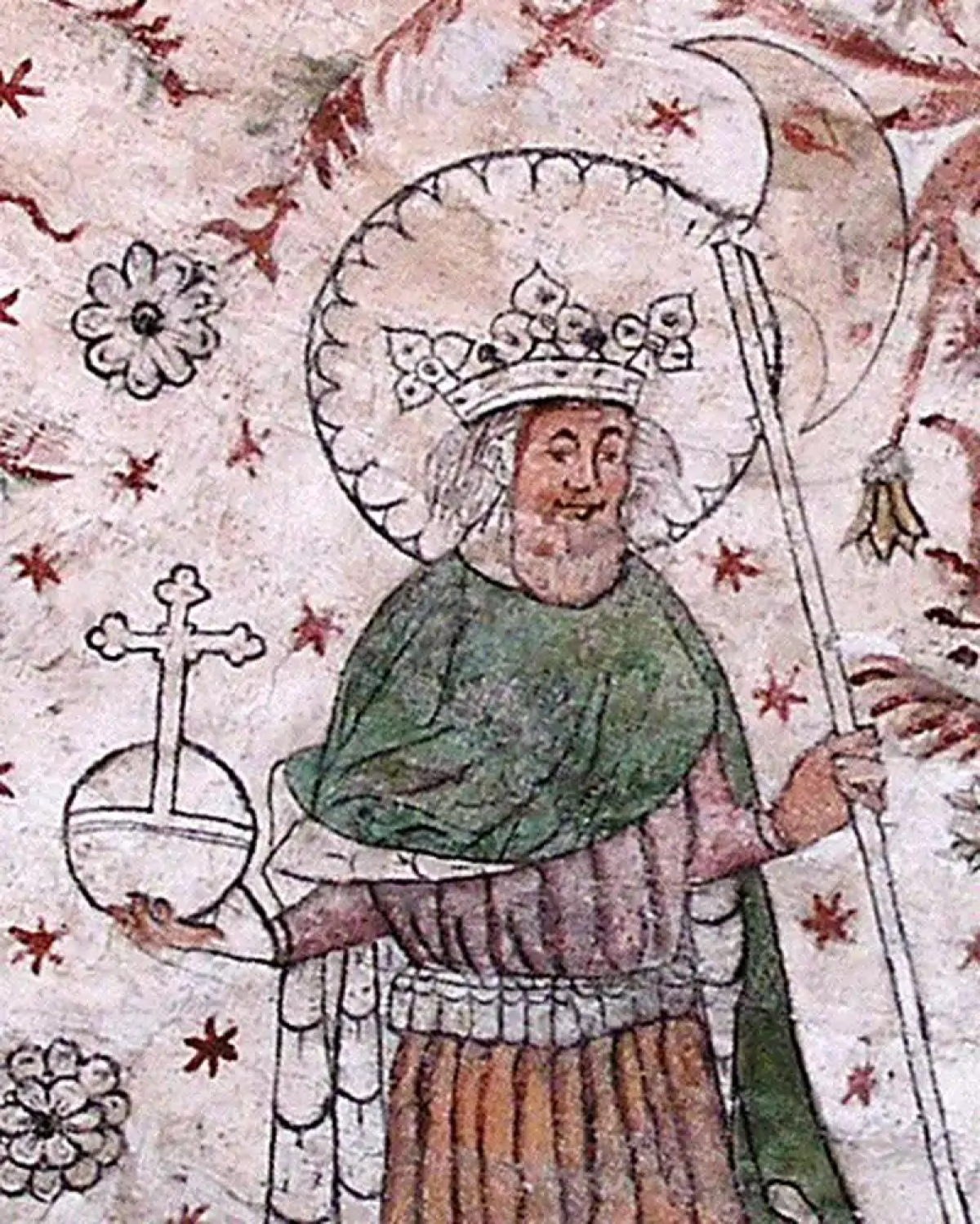
The Christianization of the common people was a project of the “missionary kings”: Olaf Tryggvason at the end of the 10th century and Olaf Haraldsson at the beginning of the 11th. The main method to achieve this was the choice between baptism or execution. They took hostages and looted pagan sanctuaries. Resistance was strong, and consequently, so was the violence.
Olaf II, the Saint.
The stavkirke materialize the capture of the pagan sacred. They are symbols of that absorbed, domesticated, and integrated religiosity within the apparatus of the new religion.
The burning of these churches, which occurred by the dozens starting in June 1992, can be conceived, in terms of Bataille, as a sacrifice. This act of pure destruction removes the object from the world of utility and returns it to the realm of the sacred. Whether with a theoretical framework or out of pure rebellious energy (many of the kids did it out of a sense of belonging), these vandalistic acts expressed an attempt to restore the religious experience that institutionalization had canceled out.
As the scene developed, many of its artists transitioned from satanism to pre-Christian Viking paganism. The first was none other than Quorthon, who founded viking metal. But this transition is clearly visible in Burzum, fragmented in Darkthrone, and from the very first album of Enslaved. This change maintained a certain continuity: if the bureaucratized Church of Norway had closed off access to the sacred, then what existed before became an object of desire. Satanism attacked Christianity from within, by inverting its symbols. Neopaganism now attacked it from the outside, from a previous and more 'authentic' sacredness.
From its covers to some of its lyrics, the Filosofem (recorded in 1993) begins to show the narrative shift in black metal.
Both gestures are children of the same void.
The truth is that the reclamation of the Viking past made by the youth of black metal draws from a tradition that dates back to the 19th century.
Norway gained independence from Denmark in 1814, and, like in other states of the time, its intellectual elite aligned with the romantic project of nationalism: to build a national identity that is both unique and essentialist. Norwegian artists looked far back into their history to construct it. They sought to differentiate themselves from the Danish heritage and found that differentiation in the peasantry, in the landscape of the fjords, in folk tales, and in the Vikings. They collected stories from oral tradition, developed a national language from rural dialects, and represented peasant customs and wild landscapes as symbols of the Norwegian national essence.
While here in Latin America we had a process of conversion to Christianity not without violence, it is worth noting that it operated differently than in Norway. In America, national identities (like the Argentinian) emerged later and, in general, were not built upon the reclamation of the pre-Christian past (with exceptions and nuances; Argentina is not the same as Mexico, for example). In Norway, those forcibly Christianized and the Norwegians who built the modern nation are, broadly speaking, the same people. The wound of Christianization is their own, not foreign.
Therefore, for both the romantics and the Norwegian black-metalers, the pagan, the Viking, and the pre-Christian became the paradigm of national essence. When Vikernes or Fenriz from Darkthrone write about Nordic paganism, they are repeating an operation constructed a century before them, of which they are heirs, whether they realize it or not.
The Church of Fantof has been reduced to its foundations.
Where there was fire, ashes remain
The burning of the Fantoft Church sparked a series of increasingly violent crimes. The first murder occurred on August 21, 1992. Magne Andreassen, a gay man, was stabbed by Bård Guldvik "Faust" Eithun, the drummer of Emperor. But the peak of the violence would come on the night of August 10, 1993: Varg Vikernes, then the bassist of Mayhem, murdered his bandmate Euronymous with 23 stab wounds.
Following this event and the subsequent trials, the escalation of violence was interrupted. Faust was sentenced to 14 years in prison. His bandmate, Samoth, was arrested for burning churches. Vikernes was sentenced to 21 years.
With Helvete permanently closed, the original core of the scene disintegrated. However, the media notoriety served as global publicity. Norwegian black metal became a genre with an international market. Bands like Satyricon and Dimmu Borgir, heirs to the movement, went from releasing demos with photocopied covers to signing with increasingly larger record labels.
The burning of the Fantoft Church sparked a series of increasingly violent crimes. The peak of the violence would come on the night of August 10, 1993: Varg Vikernes, then the bassist of Mayhem, murdered his bandmate Euronymous with 23 stab wounds.
Still, there were those who resisted the growing commercialization of the genre. The underground hardened as they perceived these changes as a betrayal of the original spirit. The French Black Legions, Judas Iscariot in the United States, Moonblood and Nargaroth from Germany took up that mantle. They opted for limited releases, rejected promotion, and produced intentionally low-quality productions.
In another direction, the Swedish band Watain, formed in Uppsala in 1998 by Erik Danielsson, took the philosophical torch of the Norwegian scene and carried it further. In their work, they conceive black metal as a genuine ritual and uphold uncompromising theistic satanism, even as their audience expanded on a global scale.
Musically, the Norwegian scene diversified. Enslaved became more progressive. Ulver abandoned black metal after three albums. Emperor became more sophisticated. Darkthrone maintained some loyalty to the raw sound but began composing music closer to classic heavy metal (I recommend The Underground Resistance, a gem).
I can't help but recommend, for a deeper dive into these historical issues of the genre, the book Nacidos para arder by Matías Gallardo. It's not only the best specialized chronicle available today, but it's also 100% homegrown.
Conclusion: the romantic tragedy
The spirit of the Norwegian black metal scene, with its youthful energy, burned bright and fast. Despite this, it helped build a unique aesthetic that combined the most extreme elements of the metal of the time with a radical stage presence and a numinous sound.
Black metal is the most romantic subgenre of all. Unlike death or thrash, the Norwegian scene conceived itself as a bearer of a truth, of spiritual or metaphysical order. It sensed the void of bureaucratized religiosity and responded with an attempt to reclaim the numinous. In the most brutal sense, the young Norwegians found themselves trapped in a gesture that was undoubtedly romantic: the confusion of the spheres of the aesthetic and the religious. They sought to reclaim traditional signs in a context devoid of that traditionality. Through the use of pseudonyms, corpsepaint, and a radical stage presence, they replicated the dandyism of the double life typical of the romantic artist of the 19th century.
And in repeating that gesture, they also repeated the tragic fate of romanticism. Norwegian black metal aimed to be a religious act, a spiritual act, a real transgression. But it produced the opposite: a musical genre with codified conventions, a reproducible aesthetic, and a market. What was meant to be ritual became style.
✦ Suscribite
Las notas de 421 no tienen paywall
Y a cada colaborador se le paga por su trabajo. Las dos cosas dependen de los suscriptores.