Requiem for Accelerationism
Accelerationism shambles along like a zombie. The genealogy, battles and ruins of a philosophical current.
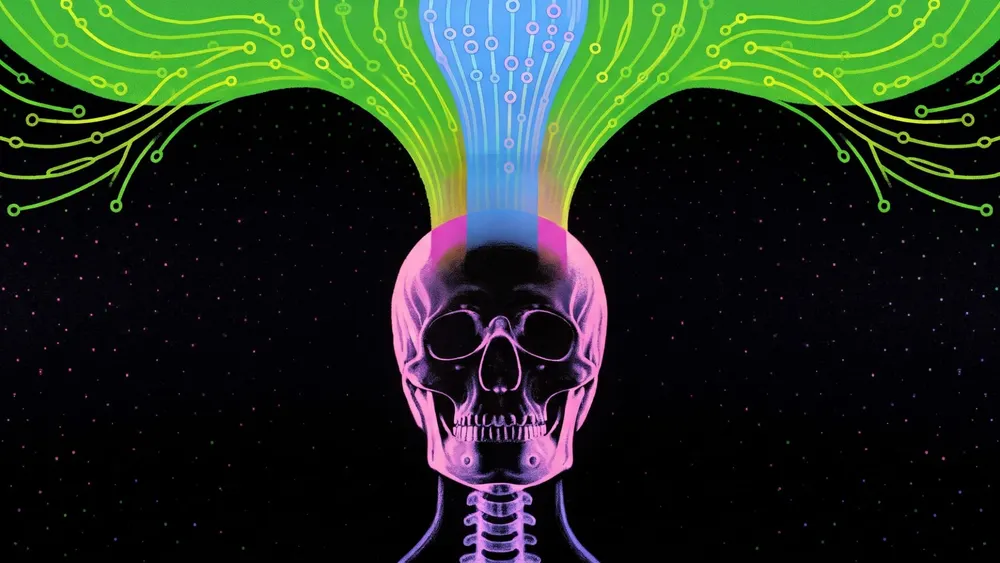
And great Cronos swallowed them one by one, as each came forth from the sacred womb of their mother to his knees.
Hesiod.
The scene
In 2017, Caja Negra published in Spanish a collection edited by Armen Avanessian and Mauro Reis titled Accelerationism. The subtitle was "Strategies for a Transition to Postcapitalism," and it brought together a series of names that would go on to form a cultural milieu: Nick Land, Mark Fisher, Nick Srnicek, Alex Williams, Reza Negarestani, Ray Brassier, Tiziana Terranova, Laboria Cuboniks, among others. The already familiar Antonio Negri and Bifo Berardi were there too. A word, certain names, a subtitle: a certain scene.
True to its old modernist tradition, Argentine academic and cultural debate produced a spellbound reading. One of those names built a key for reading the present that fueled interpretations of current events and university syllabi: Mark Fisher. The methodical publication of his essays formed a bridge between two eras: akin to the cultural studies of the late twentieth century as well as to poststructuralist philosophy, it was in dialogue with a moment that was bringing in new names. You could start reading him through Lacan or through Meillassoux, through an interpretation of science fiction films or through his meticulous analysis of contemporary music. And yet the force of his arrival was due to something else: the spread of a phrase whose clarity seemed to explain the entire era. And so we found ourselves repeating over and over, like a mantra, that it was easier to imagine the end of the world than the end of capitalism.
And so we found ourselves repeating over and over, like a mantra, that it was easier to imagine the end of the world than the end of capitalism.
Certain books and not others—some of them, for reasons that aren't entirely clear—tie into the sensibility of an era and generate frameworks for reading what's happening. This history of the local accelerationist sensibility has been written up with precision by Juan Ruocco. Mark Fisher managed to give the era a name, capitalist realism; to offer an interpretation that, while harking back to postmodernity, went one step further, defining our era by exhaustion and political sterility in the absence of political alternatives (something Silvia Schwarzböck had analyzed with dazzling precision down here in her extraordinary book Los espantos); to present the triumph over modernism as a given (one that only returns as an aesthetic ideal); to account for a theory of desire that is no longer captured by capitalism but preformatted by its logic. And he managed—no small matter—to identify the two prime sites for thinking about all this: mental health and education.
Reading groups spread, the slogans were repeated everywhere, imaginations were fired up. By 2018 we already had a good general overview of accelerationism written by Alejandro Galliano. Like Gilles Lipovetsky's now-forgotten The Era of Emptiness, an era seems to define itself by the cultural prisms it finds to understand itself. However, the collection offered other things that didn't enjoy as much publishing luck at first. The first is that the book opened with a Manifesto for an Accelerationist Politics, signed by Alex Williams and Nick Srnicek, which gave meaning to the entire collection as a search for that thing timidly called postcapitalism. The second is that, after that introductory manifesto, came two texts by Nick Land, written two decades earlier.
Nothing new
The word accelerationism didn't come from those who were later considered its founders. It was coined by Benjamin Noys in his 2010 book The Persistence of the Negative. Some time later, Noys recounted the history of accelerationism in detail in the book Malign Velocities. Noys's thesis is that there's nothing all that new about accelerationism—that is, it's a new name for an old current of European thought and its offshoots. Noys goes from Futurism to cyberpunk to show how, throughout the twentieth century, there was a whole set of currents in which technology was the promise of unheard-of futures.
You can trace a somewhat broader history than the one Noys imagines in order to examine a cultural form whose power seems to lie in novelty. This history can be told in three moments. The first moment goes back a few centuries, when what we call accelerationism is nothing but a new name for the progress heralded by the Enlightenment. After a century of merciless critique—something good old Jürgen Habermas had already seen—it made sense to ask whether all of modernity is a process of instrumentalizing subjects, disciplining bodies or domination under an idea of reason. Against all this, accelerationism is a recovery of the old Enlightenment faith in a rational knowledge that, through technological advances, brings about the progress of society. Nothing new about believing that technology is another name for advancement, growth, development.
The second moment can be associated with what's called, especially in art, modernism. Although they look alike, modernism isn't the same as modernity. Modernism is an aesthetic movement of enormous power across the different fields of art, from literature to film, from music to painting, whose founding principle is valuing novelty over tradition. Put differently, a work's power lies in how it breaks with tradition, creating something new, unprecedented, unthought-of. Picasso is Picasso not because he paints like Michelangelo or Caravaggio, but because he radically transforms the history of painting. The heart of modernism was the aesthetic avant-gardes of the twentieth century. Closer to our time, certain political thinking around creation, the event or disagreement repeats its formula. Nothing new either about betting on a radical break through imagination.
The third moment is closer, though it already seems somewhat distant in time. It has to do with the cultural, political and intellectual shake-up of the sixties. From France to Mexico, from Prague to Córdoba. In the turbulent Paris of those years, a set of theories emerged associated with names like Foucault or Derrida, Deleuze or Althusser, which gradually produced something later called French Theory and defined critical thought for the next 50 years. Wendy Brown once said in some text that, at the end of the day, critical thought is a conjunction of Marx and Foucault, which also means of the Marxist tradition (from Frankfurt to Gramsci, by way of Althusser) and also of the French tradition (from Derrida to Barthes, by way of Lacan or Deleuze). This French thought always had a tense relationship with Marxism, not only with the possibility of an enlightened elite guiding the proletariat, but with the existence of a place outside capitalism from which to resist or transform it. If something other than capitalism is possible, it's possible from within its guts. Nothing new about believing that political transformation is immanent.
A history
The history of accelerationism has to be told in two stages. Because accelerationism is the name of an old trauma of humanity that we can never fully resolve: what this thing we call time is. The thing is, there are two histories, with multiple crossovers that make them hard to separate, but that help us understand things a bit. The first history goes back to the nineties and is bound up with the founding in England of the Cybernetic Culture Research Unit (CCRU), and is generally associated with the names Nick Land and Sadie Plant. In the history told by the man who coined the word (Benjamin Noys), what happens at that moment is nothing but an aftershock of French thought from the seventies.
If accelerationism is an unacknowledged child of French theory, it's because that theory was also a heretical blend of Marx and Nietzsche.
To understand the strategy of accelerating capitalism until it's overcome, he points to three specific books. The first, quoted ad nauseam, is Deleuze and Guattari's Anti-Oedipus, home to the phrase that would serve as the mantra for this whole story: "Not to withdraw from the process, but to go further, to accelerate the process." First and foremost, then, accelerationism as an unwanted child—as Deleuze liked to put it—of the immanent critique of capitalism. The second, less quoted and less read, Lyotard's Libidinal Economy, set out to show that Deleuze and Guattari still kept faith in a desire external to capitalism that was later captured. There is no schizo desire; there is only the libidinal economy of capitalism: the worker is far from experiencing alienation, because he lives a kind of masochistic pleasure, enjoying his situation. The third, even less read and by an underrated author, is Baudrillard's Symbolic Exchange and Death, which criticized Deleuze-Guattari and Lyotard because, whether through desire or libido, they still believed in some opposition to capitalism that went on believing in production; against that, only death suspends capital's omnivorous coding.
From desire to death—an old story psychoanalysis has a field day with. In the end, the three books are nothing but ways of working through a difficult relationship with psychoanalysis and that omnipresent guru named Jacques Lacan. For Noys, ultimately, the combination of those three books was nothing but a singular reading of two old founding fathers of twentieth-century radical thought: Marx and Nietzsche. If accelerationism is an unacknowledged child of French theory, it's because that theory was also a heretical blend of Marx and Nietzsche, of Nietzsche and Marx. From Marx, the idea that capitalism has a dissolving effect on the old world: it is a destructive force that doesn't depend on human will. From Nietzsche, a certain apocalyptic drive in which the collapse of values, their ruins, opens up the possibility of going beyond Western culture. The combination of great names in thought gives rise to a creative destruction that harbors unprecedented futures.
Good old familiar French Theory, which is nothing but a cocktail of Marx, Nietzsche and Freud. Nothing new, again. And yet contexts change; reading Anti-Oedipus right on the heels of May '68 wasn't the same as reading it in the early nineties, with the fall of the Berlin Wall behind you and a triumphant neoliberalism. Also with the explosion of the Internet, home computers, electronic music. This first history would find in Nick Land a point of condensation as powerful at awakening theoretical imagination as at drawing political vilification. With an old dissertation on Heidegger's interpretation of Trakl, his publications begin with a reading of Georges Bataille (that unacknowledged father of accelerationism) titled The Thirst for Annihilation. It's all right there in that title. Accelerationism began as a fascination with the enormous destructive power of capital tied to technology. Because Land realizes that the problem, over and over again (from Kant onward, Meillassoux would later say), is that we cut the world to our own image and likeness. We look at the world and see ourselves: the world, a selfie. There's no outside to what we are. And that's the only thing that makes sense: looking for that outside, getting out, opening up. It was never about criticizing what exists, but about finding a way out.
This outside, the way out, can't be within ourselves; whatever we are, it requires our death. Unwinding the provincialism of the human primate. An abyss Nietzsche and Freud peered into, and with them, beyond them, Bataille. Land finds that this way out is closer than we imagine: in capitalism's technological innovation, because, ultimately, it is a dehumanizing megamachine. Against everyone who fears that, the point is to embrace it: to affirm dehumanization as the death of the human being, our final prison, because a good part of thought and politics is built on mechanisms of what Land calls the human security system, a set of beliefs and values that lead us to shield ourselves against our ultimate insignificance.
Land is the name, among other things, of a kind of thinking not governed by fear. Daring to think there, when we're not looking for any reassurance, when we don't fear our own disappearance, which also means the disappearance of humanity. Vincent Lê, perhaps Land's best interpreter, writes: “Land praises capitalism for the very reasons anticapitalists condemn it: it is hurtling full speed toward our destruction. Land's vision that ‘nothing human makes it out of the near-future’ is, for him, cause for celebration. His sole commitment is not to the betterment of humanity, but to an absolute (if inhuman) knowledge of the real. All we can contribute to this nonhuman future is, simply, to get out of the way.” Move aside. The thing runs on its own. It doesn't need us.
The Name
Land could have been just one more name in some hermetic drift mixing readings of the French and the Germans. Plenty of those swarm around journals and academia. That wasn't the case. It wasn't, for two reasons. The first, maybe the lesser one, is that there was something in his texts that made more sense twenty or thirty years later. Talking about a nonhuman superintelligence, external to any biological substrate, seems to say more today, after LLMs, than it did in the nineties. The second is that around 2010 another history of accelerationism begins, one that made a return to Land possible.
Talking about a nonhuman superintelligence, external to any biological substrate, seems to say more today, after LLMs, than it did in the nineties.
Naming is an act of war: enemies designate in order to start the battle. The Persistence of the Negative is a book devoted to criticizing what Noys calls the “affirmationism” of contemporary philosophy, that is, the tendency to abandon negativity and contradiction. Many stories could be told, but this enmity once again goes back to 1960s France; that's where two camps took shape, which a little book by Pierre Macherey managed to identify clearly: Hegel versus Spinoza. These camps had big names behind them, though it was still the usual fight every generation picks with its parents. France was coming off that generation, led by Sartre, that read Hegel with fascination (through the great Kojève) and found a history woven by negativity. Against that generation arose the need to abandon dialectics, contradiction, critique, that is, to step outside for some fresh air, away from what we'd been told explained the world. That's where Spinoza or Nietzsche or Bergson showed up, which is to say, Deleuze as the name of an affirmative thought.
The dispute between existentialism and structuralism has been told far too many times, and the gap between affirmative and negative thought just as often. All that matters here is that it is precisely within a diagnosis of an era grounded excessively in the affirmative (this century that keeps confirming, everywhere, that it is Deleuzian), and thus within a clamor for a little negativity, that the name accelerationism appears. Noys argues that in the seventies a position emerged that he calls a “politics of the worst,” since if capitalism produces its own dissolution, the strategy would be to radicalize it to its ultimate consequences. If there's no outside, if capitalism has already absorbed the forces of dissolution or transformation that opposed it, then nothing negates capitalism; only accelerating its own development can lead to postcapitalism. Before calling them accelerationists, Noys called them left-wing Thatcherites. As others have said, if the bet is on the destruction of what exists, on innovation and deterritorialization, an emancipatory politics looks an awful lot like capitalism.
Noys invents the name so he can fight something he saw as a persistent tendency. And he already identified two problems that would come up again and again: the first is that if capitalism itself supposedly accelerates, nobody is needed to accelerate it. There's no subject, no party, no collective. Saying something needs to be accelerated is a total pipe dream: it accelerates, period. The second is that accelerationism reinvents an old belief, Enlightenment or Catholic, that arranges time along a line whose unfolding is inevitable: a teleology. If the thing accelerates on its own, if it's headed toward a single, predetermined end, there's not much left to do. Just sit back and wait for the end of the world or the end of capitalism. No more.
The Other History
In the 2010s the second history of accelerationism begins, with a series of milestones: Noys's book; the collection of Nick Land's writings titled Fanged Noumena, which allowed for a rereading of his work; Mark Fisher's positive use of the term in the landmark text Terminator vs. Avatar; the publication of the Manifesto by Srnicek and Williams. But also, closer to home, the social media activity, especially on Twitter under the hashtag #accelerate, as a way of flagging accelerationist news or cultural products. And so it stopped being a philosophical discussion and spread into other fields: from design to architecture, from art to programming. A broad cultural debate with repercussions in politics and technology.
If the thing accelerates on its own, if it's headed toward a single, predetermined end, there's not much left to do. Just sit back and wait for the end of the world or the end of capitalism. No more.
Stories tend to have times and spaces, a place and a moment. Culture gets inscribed in material networks. We can't tell the history of accelerationism without the publications that gave it a home. And if it all seems like a very, very English story, with techno playing in the background, it starts in that cosmopolitan city of avant-garde and freedom called Berlin. The first collection on accelerationism was put together by Armen Avanessian in 2013 and published by Merve: #Akzeleration. A short text, around 100 pages, which, beyond the introduction, already puts Nick Land in dialogue with the Manifesto for an Accelerationist Politics. Berlin and no other city, an intellectual climate marked by an alliance of critical theory and poststructuralism with a disparaging stance toward technology: therein lies the power of an intervention meant to shake certainties. Laying out a set of texts that don't belong together, that don't represent a shared ideological zone, but rather the name of a conflict.
A year later the English-language collection came out. It's a different thing altogether. This time the editors signing it are Armen Avanessian and Robin Mackay. The book runs over 500 pages. The range is wide: it goes from sources in Marx or Veblen, through the French moment with Deleuze or Lyotard, to the more contemporary debate from Land to Negri, from Fisher to Negarestani. If, as it emerged in the German context, it sought to jolt a critical thought fossilized into formulas, in English what happens is the invention of a tradition. That Robin Mackay joined as editor, the same man who had compiled Nick Land's writings and ran Urbanomic, is no minor detail.
Ten years later, for the Korean edition (the story goes on and on), Mackay, (now) with Amy Ireland, would say that the idea was never to publish a book about a movement, but to present a constellation of different positions in order to sketch out a set of problems. The goal was one: to try to understand the contemporary world. And that hasn't lost any relevance: how our relationship with technology is designing our future, or our futures. After telling the story from Land to Noys, Mackay and Ireland would point out that #accelerate was a joke. But what started as a joke, as tends to happen with good jokes, didn't stay there: a group of philosophers, critics and thinkers set out to develop lines of thought on accelerationism.
The turning point, Mackay and Ireland argue, came with Srnicek and Williams's Manifesto for an Accelerationist Politics, because it became a kind of beacon for left-wing politics and grew very popular in short order. It became a beacon because it diagnosed that, while progressive politics had once championed the emancipatory possibilities of technology, in the present those possibilities had ended up in the hands of the neoliberal right. The Manifesto builds new coordinates for getting one's bearings through a double distinction: there's right-wing accelerationism, that is, Nick Land, and there's left-wing accelerationism, which the Manifesto proposes. The problem, Srnicek and Williams argue, is that the former confuses speed with acceleration, because if there's no qualitative leap into something other than capitalism, we're just increasing speed within the same thing without accelerating. The second distinction is drawn within the left: accelerationist politics vs. folk politics. The folk left is the one that bets on direct action and horizontalism; it only seeks to set up small pockets of noncapitalist social relations, and its language, its mantra, is resistance. Against that, the accelerationist left bets on planning, on verticality, on contesting global processes once again.
So the key is its opposition to folk politics, since if technology makes the world increasingly abstract and global, it doesn't make much sense to appeal to politics that turn back to the local, the human, the micro. That's why, rather than decelerating, the bet should be on accelerating the reformatting of society that technology is producing. This means going beyond horizontalist strategies (like Occupy Wall Street or Spain's 15-M) and building complex organizational strategies aimed at gaining power. And that's only possible through an alliance among different practices (design, computing, philosophy, logistics, economics) intervening in political debate. The starting point is realist: you can't ignore what capitalism is doing to contemporary society. But these transformations don't imply mere passivity in the face of their deterritorializing or decoding aspects, but rather a bet on building strategies that make it possible to move toward postcapitalism. The big challenge, then, is to figure out whether there's an engine of acceleration other than consumer capitalism.
The English-language book edited by Avanessian and Mackay had a performative effect: it built a tradition that didn't exist. Something that had been a brief mention in a philosophy book started to become part of cultural debate and political discussion. For that to happen, a tradition had to be built. Once it was published, the scene seemed to split into two camps: either right-wing accelerationism or left-wing accelerationism. However, two of the key players in the whole thing, Srnicek and Williams, no longer use the word when they flesh out their proposal at length in Inventing the Future. That absence is explained by how the term began to take on new meaning in mass usage. Accelerationism, regardless of its history, came to mean simply the worse, the better: capitalism can only be defeated by exacerbating its worst tendencies. Hence the mismatch between an experimental philosophy devoted to fighting the repressive constraints of the human subject and the idea of accelerating the collapse of capitalist social forms. This confusion was possible because of everything condensed in the name Nick Land, who, at the same time as he founded accelerationism as experimental philosophy, began publishing essays on the Dark Enlightenment and publicly associating himself with the radical right.
The Confrontation
A manifesto, from Marx onward, is a text that seeks to make something happen, to spark debate, to have political impact. Sometimes it works, sometimes it doesn't. The fact is that this one drew criticism from both right and left. By trying to redefine the coordinates of political orientation, distance itself from the accelerationist right and chart a path for the left, it didn't take long for the replies to arrive.
On one side, then, the critiques from the right. Although the problem lies precisely in calling them right-wing. Nick Land's reply wasn't long in coming. In a short 2017 text offering a quick-and-dirty introduction to accelerationism, Land, after asserting that capitalism's self-destruction is capitalism, pure immanence, argues that Srnicek and Williams tried to resolve this ambivalence with their manifesto by precipitating an anticapitalist accelerationism. According to Land, the manifesto succeeded in reviving the discussion about accelerationism, but it was far from managing to purify it ideologically. The problem, he points out, is that the manifesto builds an artificial distinction between capitalism and technological acceleration; that is, it fictionally presupposes a non-capitalist acceleration. Against this, Land maintains that capital is simply the abstract social accelerating factor: capital is acceleration, nothing else. For that very reason, this uncontrolled acceleration consumes any fixed identity of capital. So, logically, talking about a left accelerationism is absurd for Land: accelerationism is nothing but capital's self-awareness. This foretold failure can be seen in the results: left accelerationism turned into traditional socialist politics.
Talking about a left accelerationism is absurd for Land: accelerationism is nothing but capital's self-awareness.
In any case, I want to highlight two of Land's observations. The first is that the left-right distinction becomes obsolete if one radically embraces acceleration. If capital is acceleration in its most proper definition, you can't apply to it the ideological coordinates of a preceding world. If there is no outside to capital, there is no ideological framework that can regulate it. The second is that if capital, again for Land, is simply the vector of social acceleration not controlled by human beings, then it is inhuman. The call that says "We have to do something" is absurd. There's nothing to be done because it doesn't depend on human will. In Land's terms, left accelerationism has nothing accelerationist about it: it's just one more form of the human security mechanisms that seek to regulate, slow down, steer inhuman acceleration. Is this a right-wing response? In Land's terms, the question is meaningless.
On the other side, the response from the left wasn't long in coming either. Actually, we should speak of multiple responses from the left. The original anthology already included responses from Toni Negri and Bifo Berardi. However, I want to revisit a position that takes on the provocation of the Manifesto. In a book originally published in 2014, Eduardo Viveiros de Castro and Déborah Danowski took up the gauntlet mercilessly. With writing loaded with irony, sarcasm and polemic, they don't hesitate to argue that the great political dispute of our time is "political economy of acceleration" versus "political economy of deceleration." In a way, they accept the opposition between folk and accelerationism, but they flip it. They don't hesitate to say that this is the most important fracture on the left, but they disagree entirely with the value judgment it carries.
Viveiros de Castro and Danowski's defense of a folk politics belongs to a tradition that includes names like Bruno Latour and Isabelle Stengers and that bets on deceleration. In fact, not without reason, they argue that accelerationism's supposed novelty is centuries behind the times: it's a new mode of the Eurocentric eschatology of progress, that is, it's simply nostalgia for a rationalist, imperialist and triumphalist past. Accelerationism would then be Enlightenment progress 2.0. Nothing new. A faith in progress and in the liberating virtues of technical automation that says absolutely nothing about the material, environmental conditions that make those processes possible. By not talking about material conditions, they leave out precisely the thing that is accelerating: the critical values of every environmental parameter. In their fascination with the future, they can't see the accelerated present. Hence, drawing on Stengers, they argue that the dreams of liberation of each side indeed do not coincide; what's more, they are the name of a conflict.
Nothing makes this conflict more evident than accelerationism's recurring need to use names in the universal singular: they talk about capitalism, humanity, the worker, civilization. Universals are all that ever come out of their mouths. Nothing new there either, by the way. And so they're nothing but a new form of vanguardist politics (half a century after Deleuze and Foucault themselves criticized that enlightened leftist vanguard), one that can only conceive of a universal "we" on a single, univocal timeline. Left accelerationism is nothing but a humanism that, in trying to think the future, repeats a properly modern conception of temporality. Viveiros de Castro and Danowski argue that, against the reiteration of the old idea of an epic conquest of nature and a nineteenth-century notion of progress, the task is to think time differently. If the task is to imagine other futures, we precisely have to be able to pluralize, to stop thinking in terms of a single "we," a single world, a single timeline, in order to explore the multiplicity of worlds that dismantles linearity.
Alive and dead
On November 2, 2026, Armen Avanessian visited the city of Córdoba: a workshop to discuss academia and a lecture on planetary thinking. Throughout these conversations he didn't hesitate to declare: accelerationism is dead. It's no small thing that one of its key drivers, in the Berlin cultural scene and in the publication of the English anthology, should flatly declare it over. Nor did he hesitate to point out that part of this abandonment was due to a defeat: accelerationism became, for whatever reasons, a position associated with the radical right. Although this possibility was there from the start (Land's essays on the dark enlightenment date from 2012), its association with the radical right was also a defeat for left accelerationism: what had been a collective call to contest a tradition ended up as a bunch of individuals defending their own particular theories.
By 2015, just two years after the Manifesto came out, Srnicek and Williams, even as they were carrying out what it had proposed, were dropping the word. The invention of the future it called for came and went without fanfare, without much new to offer. This is an inexorable law of time: everything driven by novelty is condemned to be relegated to the shelves of history. All the more so when its very premises spring from a fascination with novelty, with rupture, that is, with everything that goes by the name of avant-garde. Paradoxical as it may be, if accelerationism drew all its power from its break with an exhausted culturalist postmodernism, it could only end up repeating the heart of the postmodern: exposing the exhaustion of every modernist drive.
However, a word never exhausts what it comes to name, and if the battle over its public use seems lost, it remains to ask what is left of the force of its irruption. Because ultimately, the question of the link between left politics and technology is far from exhausted. In fact, the matter is becoming ever more urgent today with the emergence of what is popularly called AI. For that very reason, the question is what meaning accelerationism can have, a decade later, as a theoretical and political current, precisely in light of the radical technological transformations we are living through. So not quite dead, not alive either: a zombie, something that survives despite being dead.
Three things can be said about this afterlife. The first is that if we're certain of anything, it's that the world kept accelerating, from ways of life to technological innovations. The nineties, when accelerationism emerged, seem like prehistory to us, and the early 2010s, in their remoteness, seem incredibly slow. So, like good Hegelians, we could say that accelerationism is dead because we are all accelerationists. While lifestyle options under the "slow" label have spread, along with political positions that bet on deceleration (or degrowth), and even theories of resonance against acceleration, on the whole we've plunged even deeper into a network of global technical mediations; that is, today we are more dependent than ever on machinic networks that are redefining what we understand by humanity. The question is more alive than ever when the entirety of our current condition is defined by technical mediation.
Like good Hegelians, we could say that accelerationism is dead because we are all accelerationists.
The second thing we have to say is that if anything happened after the debate erupted, it was its splintering into a whole bunch of possibilities. If the first certainty is that we are all accelerationists, the second is that there are many ways of being one. No one can speak of accelerationism in the singular anymore; there are accelerationisms, plural. This arose from the very beginning with the proliferation of collective interventions in online publications. In this sense, the history of accelerationism is far from being settled by a philosophical theory or within academia; it's a wild proliferation in virtual environments. It's just a matter of identifying an unprecedented future in the present and seeing how to accelerate that process. These accelerationisms, as Dante Sabatto has shown, have proliferated under digital signatures: g/acc, bl/acc, u/acc, e/acc, cute/acc. Surely, as we speak, the labels have multiplied in digital spaces. If the traces of a coherent theory seem to evaporate, its cultural impact springs from the very instability of the name.
The third is that accelerationism was always an inquiry into time. This means it put at the center of the discussion the linearity that orders temporality into past, present and future, where the present is precisely what is constantly turning into the past. Against this, accelerationism from its beginnings sought ways of taking part in the future by creating a time loop: as if it were possible to access fragments of the future and apply them to the present. Early on this got the name "hyperstition": an agent from the future that returns to the present to program itself into the future. The question was always how to transform the present from the standpoint of an intelligence from the future; hence its political relevance. This, again, in an infinite loop, is far from having perished.
What remains
As with any theory, perhaps the best verb tense for the question is: what will accelerationism have been? The only sensible answer is that we will never have known. Because the thing moves, like time. And at the end of the day, every word is destined for silence or death. Possibly, like so many other things, in a few years no one will remember that something called accelerationism ever existed. Words die, and it's not a tragedy. Even so, in this present thrown into the jaws of time, we can point out two or three things about what's left.
The first is that accelerationism was, from the start, "a matter of style." Beyond this or that claim, accelerationism is an aesthetic. That also means a form of writing. This form is heir, here's Bataille again, to the tradition of formal innovation of the modernist avant-gardes: when an institutional form or a mode of writing becomes stabilized, you have to intervene to produce something else. Accelerationism also found in technology a huge vector for breaking with tradition. At the end of the twentieth century it was science fiction, electronic music, cyberpunk, hermetic writing. At the beginning of the twenty-first, digital experimentation, writing on social media, idea bots. From Nick Land to McKenzie Wark, from Reza Negarestani to Patricia Reed: accelerationism as aesthetic. An aesthetic that is a form of pop culture, or better yet, it can be techno avant-garde, but also a meme.
The second is that what unites the various accelerationisms is their libidinal character; it is always, as Mackay and Ireland put it, an index of sensibility or a perversion of desire that opens an entry point for taking part in the future. More than a theory, then, a drive. Something that moves without having to start from a set of established principles or a finished theory. This is precisely what gives it an afterlife and makes it so hard to pin down, and yet it keeps working on intellectual and political forms: a drive that turns the future into a form of the present with no safety net whatsoever. That's what it was always about: an accelerationist drive. We don't quite know what it is, but it moves.
Step out of the place of critical thought, step away from the rhetorics of political resistance: look for a way out by accepting that we are a creature shot through, down to its most intimate fibers, with technology.
The last thing worth pointing out is that accelerationism, that drive that is also a style, keeps finding its power in two fields. On the one hand, it's a way of shaking up what goes by the name of critical thought, which works as an indulgence for intellectuals. Accelerationism, whether through Land's critique of transcendental miserabilism or Negarestani's critique of kitsch Marxism, is a confrontation with a critical thought enshrined as a set of repeated, empty formulas that still weave through the most intimate fibers of our culture. On the other hand, it's a political position that, by weaving together technology, intelligence and the future, comes to call into question all the rhetorics of resistance, whose enjoyment is political impotence. Step out of the place of critical thought, step away from the rhetorics of political resistance: look for a way out by accepting that we are a creature shot through, down to its most intimate fibers, with technology.
And so accelerationism finds its final form in what it always was: a provocation. Nothing can emerge if we aren't capable of provoking, nor if we aren't provoked. Because provocation, or one of its forms, is a drive to destabilize what exists without fear, without seeking reassurance. Because if anything remains in the end, it's a kind of mantra: radical thought only makes sense when it scares us. And it scares us because we have certainties, because we are a something, because we seek security. If our thinking isn't scary, to ourselves above all, it's pointless. And that, then, is where things only just begin.
No 421 article is behind a paywall
And every contributor is paid for their work. Both things depend on our subscribers.