Drive Accelerationism: From Nick Land to Lacan
Drive accelerationism (acc/drive): an unprecedented crossbreeding of Lacan and Land that uses the drive to hack accelerated capitalism.

Drive accelerationism (acc/drive): an unprecedented crossbreeding of Lacan and Land that uses the drive to hack accelerated capitalism.
My professional deformation (psychologist) and trade (psychoanalyst) make me read novelty with biases and limitations, but also with a certain prudence (and sometimes with a glimmer of anachronistic originality). When I started reading about accelerationism (including what's been transmitted and systematized in 421), I didn't do it without Freud. So much for the anecdote. Things started to get interesting when I found not only some surprising convergences between the accelerationist and the Freudian corpus, but cross-contributions that could be made between both domains and that almost nobody has made.
On the one hand, reclaiming the notion of the drive in order to reconstitute a theory of the subject right where acceleration runs it over. On the other, critically importing accelerationist philosophical-speculative premises into the analytic spiritual exercise, exploring clinical contributions.
After all, the Freudian device has to be driven with accelerationist slowness: dwelling on details in order to blow up the limits of meaning, treating the enigma of the drive with the rigor of hyperobjects, that is, abstaining from energetic romanticism and ethological sociologism.
Things started to get interesting when I found not only some surprising convergences between the accelerationist and the Freudian corpus, but cross-contributions.
In this text I'm going to lay out my preliminary intuitions about this crossover, which I'll call drive accelerationism (acc/drv). If the aim is to accelerate certain systems, capitalism included, without imploding the spiritual and carnal dimension proper to the human, the cultural-drive artifact allows us a productive paradox: treating the drive by way of the symbolic slows acceleration down without eliminating or repressing it. That is what any device worthy of the name treatment should consist of.
Freud's real originality was not having discovered certain drives, but having invented a model of thought whose core is the drive. More than a psychological theory, it's an alternative to structuralism, to biologicism and to adaptive neuropsychologies. That reading lets us take the drive out of the consulting room and turn it into a principle for thinking politics, technics or accelerationism.
Like an object-oriented ontology (OOO), the drive-dimension mixes complex systems, abductive experimentation, cunning rationality, contingency in action, daydreams of carnal machines and a dispute over the human future. The drive is the piece missing from the accelerationisms, depressed as they are in their cognitive Anglo-Saxon Marxism.
The drive is the most original and enigmatic notion in psychoanalysis, and that's why we need to make a few things precise before accelerating it.
A border delimitation between the psychical and the somatic, it is a "measure of the demand for work imposed upon the psychical as a consequence of its connection with the corporeal" which is at the same time "the representative of the representation" (Freud dixit). A tension that is neither dualism nor binarism, much less Manichaeism, where what matters is its fusion or defusion, one or the other fluctuation being the ultimate cause of the vital or the deadly.
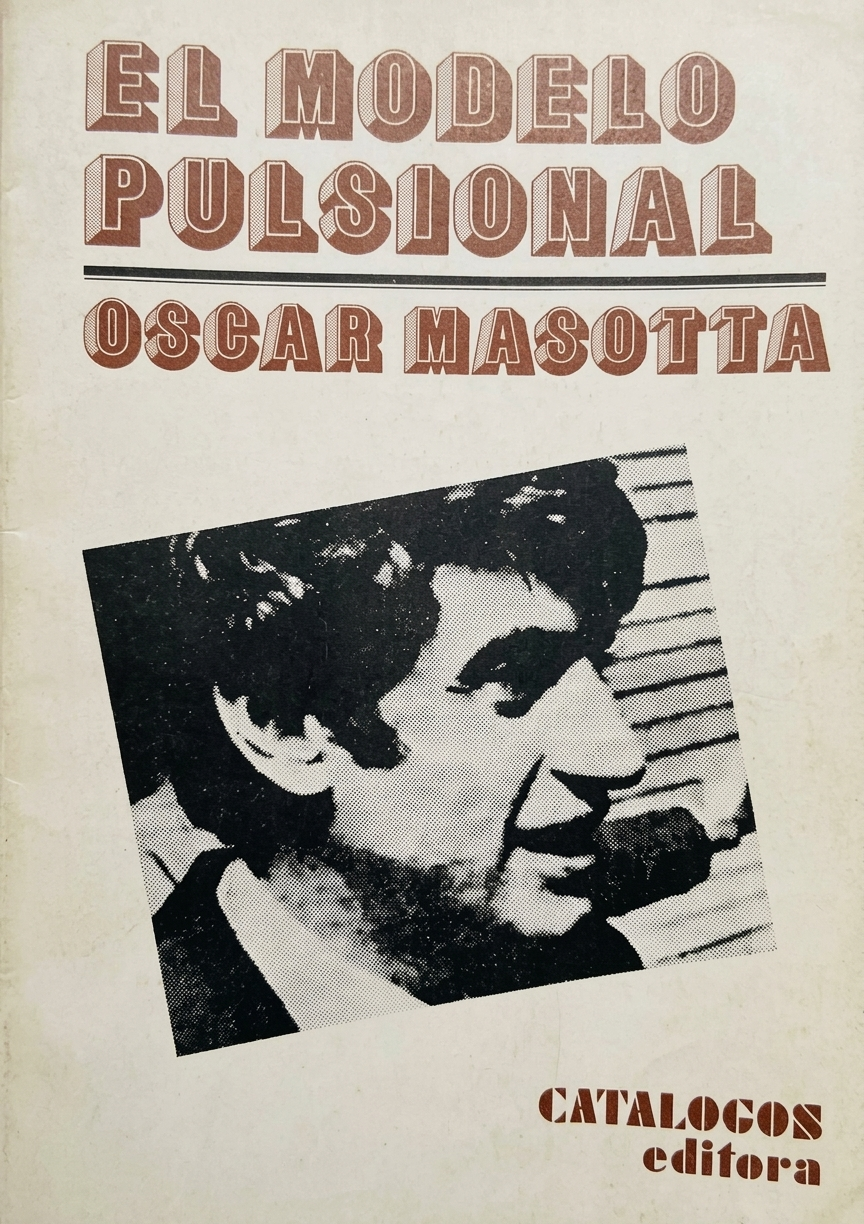
An enigma is a proposition that demands an answer: "a question about desire," according to Oscar Masotta. Hence all knowledge, and even more so knowledge about sexuality and death, ends in an enigma, correlative to the abyss between word and thing. This is what we call the drive, which is Freud's unfinished attempt to overcome the Cartesian split.
But we also have the whole doctrine of the partial drives. Partiality is not a limitation of the drive but precisely its mode of existence. There is never a full satisfaction nor a definitive object; every drive skirts a void and finds only partial satisfactions.
The history of the term itself illustrates this. The German trieb comes from the verb treiben, which refers to impelling, setting in motion, making sprout or driving. It shares a root with drive and with drift. However, when it was translated as "instinct" it contributed to a huge derailment that gave rise to a naturalist reading alien to the Freudian project.
Instinct presupposes a predetermined object and an adaptive purpose. The drive, by contrast, has no natural object, can change its modes of satisfaction indefinitely and depends on the inscription of the body in language.
This difference is not merely terminological: a large part of the criticisms aimed at psychoanalysis, as well as numerous attempts to reduce it to a biological psychology, rest on that confusion.
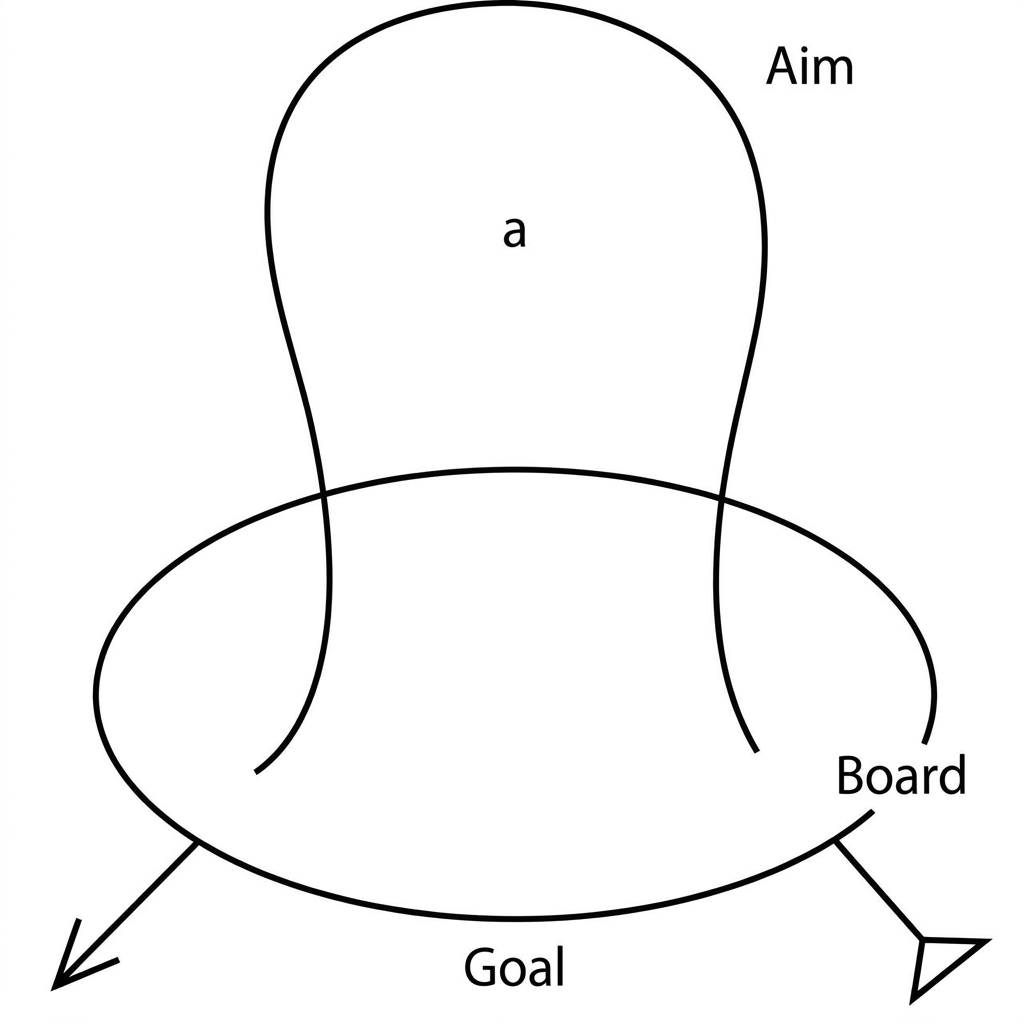
In Instincts and Their Vicissitudes (1915), Freud distinguishes its four fundamental dimensions:
-a source, located in a bodily process;
-a pressure (drang), which expresses the intensity of the demand;
-an aim, which points toward reaching satisfaction through the reduction of tension;
-an object, which is the most contingent element of the series, since it is the circumstantial means for a provisional satisfaction.
From 1920 on, with the introduction of the death drive, the drive model becomes far more radical. It definitively abandons any homeostatic understanding of the psyche; psychical life can no longer be described solely as a search for pleasure: the compulsion to repeat pushes toward painful or (self-)destructive experiences. From then on, Freudian clinical practice stops being organized exclusively around satisfaction and starts to consider as well the jouissance that insists beyond well-being: the beyond the pleasure principle.
If Freud had shown that the drive has no natural object, Lacan will argue that it doesn't really pursue a lost object either. What is decisive is not the object but the drive's circuit around a structural lack. The drive consists precisely in that detour or circuit: it finds satisfaction not by reaching an aim but by repeating the movement that skirts what is impossible to fill.
In Seminar XI, from '64, he reorganizes the partial drives around four privileged objects: the breast, the feces, the gaze and the voice. The last two (the scopic and invocatory drives) acquire a special status because they show that the drive no longer depends solely on biological functions but also on specifically symbolic-imaginary dimensions. The gaze does not coincide with the physiological act of seeing (to gaze is not to see), just as the voice goes beyond the spoken word: both function as objet petit a.
In Three Essays on the Theory of Sexuality (1905), Freud scandalized most of his contemporaries by positing that infantile sexuality is not organized around genitality or reproduction, but as a multiplicity of drives linked to different erogenous zones of the body. The mouth, the anus or the skin can become supports of satisfaction. Human sexuality is therefore born fragmentary and polymorphous. Only later do these partial satisfactions become subordinated (never completely) to genital organization. The Freudian body is not a closed organism but an erogenous geography whose cartography depends on the subject's history.
The Freudian body is not a closed organism but an erogenous geography whose cartography depends on the subject's history.
The neuroses demonstrate the consequences of that organization. In hysteria, for instance, certain bodily regions can acquire a displaced sexual signification, like Dora's famous cough as a substitute for genital excitation.
The paradox again: the symptom reveals that the body of the drive does not coincide with biological anatomy, yet psychical pain becomes physical. It is a body traversed by significations, fixations and displacements. The hysterical body is seized by acceleration, and for that very reason it becomes a model for the treatment of affect by way of the word.
If desire sets something in motion, jouissance explains why that movement insists even when it produces suffering. In Freud both concepts still appear relatively mixed together under the problem of drive satisfaction. It will be Lacan who establishes a more precise distinction. Desire arises from lack without finding an object capable of definitively filling it and, precisely for that reason, it remains open. It displaces, invents, produces new significations and keeps the subject's movement alive. It aims not so much at obtaining an object as at sustaining a distance from it.
Because of all this, careful: the axiom that says desire is extinguished upon reaching "its" object is precisely neurosis.
Jouissance, on the other hand, no longer depends on lack but on repetition. Where desire searches, jouissance insists and stays fixed. While desire moves from object to object, jouissance comes back again and again, even when that repetition turns out to be painful, destructive or mortifying.
Let's recap:
-Freud distinguishes pleasure from drive. For him the drive attains an always partial and provisional satisfaction when it manages to fulfill its aim, which may not be pleasurable. Here we are at the limits of modern speed.
-Lacan radicalizes this idea by showing that the drive doesn't find its satisfaction by reaching an object, but by repeating the circuit that skirts it. The name of that specifically drive-based satisfaction is "jouissance."
Jouissance doesn't designate "intense pleasure" but the paradoxical modality through which the drive satisfies itself. A complex territory where longing, excess, suffering and the very limits of subjective constitution intersect. A relation with impossibility itself.
The push toward jouissance, that postmodern superegoic command, is well portrayed in Charly García's Fanky , which registers the passage from speed to acceleration:
That's why I don't want to stop
I've got no more doubts
I'm not coming down
Let it go up
Getting off is so much like love
Getting off is so different from pain
This whole gloss aims at a disambiguation but above all at a warning: if everything is jouissance we end up in a Lacanoid behaviorism, that is, a hyperjouissemia that destroys the subtleties and self-limitations of the clinical-conceptual apparatus begun by Freud, turning its subversive power into pseudo-academic snobbery.
The desire/jouissance distinction allows us to better understand Deleuze and Guattari's disagreement with psychoanalysis, aimed at their contemporary Lacan; but it also turns out to be especially fruitful for thinking accelerationism.
When they criticize psychoanalysis for reducing desire to lack, their privileged interlocutor remains, to a large extent, a certain Freud and a particular structural reading of desire. Hence their proposal to replace the logic of lack with an ontology of production: desire lacks nothing, it produces reality.
Deleuze and Guattari first, and Nick Land later, worked from the concept of the desiring machine (developed here), which is precisely the name of that immanent productivity.
However, the Lacanian notion of jouissance shifts the problem onto other terrain. What is decisive is no longer whether desire is born of a lack or of a productive power, but explaining why the subject repeats what makes them suffer. Capitalism captures not only desire but the drive structure of jouissance.
In 1972, in Milan, Lacan presents a formalization genuinely ahead of its time, or at least lucidly up to it: the capitalist discourse. We'll start from there to distinguish and articulate the Deleuzian machine and Lacanian jouissance.
In Anti-Oedipus they argue that the unconscious does not represent but produces: "it is not a theater but a factory." Desire stops being lack and becomes machinic production. Desiring-machines are couplings that produce flows, cuts and connections. Nor does Lacan describe a traditional symbolic exchange but rather an apparatus for the production of surplus-jouissance (plus-de-jouir).
While the machine produces desire, the capitalist discourse produces subjects who consume that desire in the form of jouissance. Where Deleuze builds an ontology of desire, Lacan ends up building an economy of jouissance.
This was indeed noted by Benjamin Noys, though to my modest understanding from a somewhat partial and negative reading of the notion of jouissance, but it's still worth taking up on another occasion.
Now, when Land reads Anti-Oedipus he radicalizes this thesis. There is no longer a subject or a lack, only automatic processes of acceleration. There would no longer be a classical Master or anything of the sort. In a sense, capitalism stops being a historical formation and becomes an inhuman intelligence. Curiously, Lacan's capitalist discourse seems to describe the same movement from another angle.
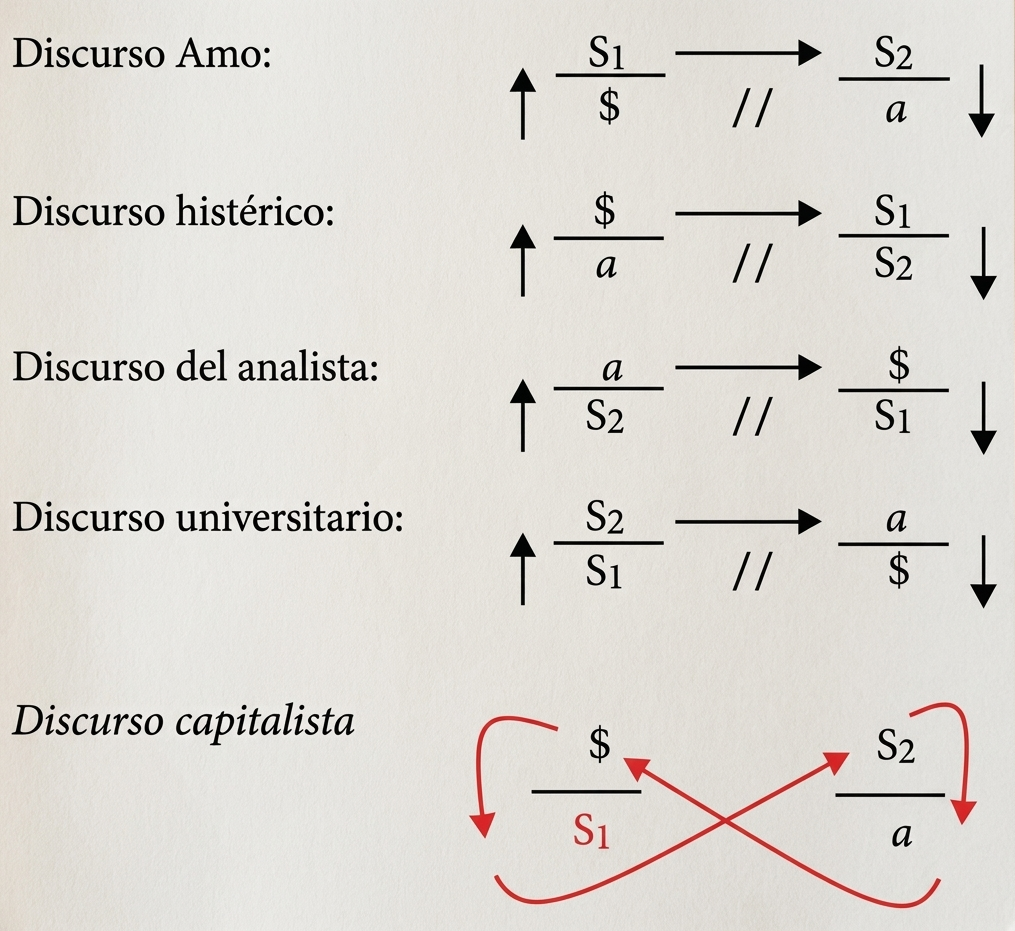
Where every discourse, for example that of the Master (which is the discourse of the unconscious), finds its limit regarding access to truth (the bottom-left place), the capitalist discourse eliminates every point of impossibility, throwing the subject into an immediate (fetishistic) access to the object. The circuit spins on its own, the machine works.
The capitalist discourse eliminates every point of impossibility, throwing the subject into an immediate (fetishistic) access to the object. The circuit spins on its own, the machine works.
Land describes capitalism as a machine without a subject, Lacan as a discourse that rejects castration. Even though it doesn't exist as such, from the Lacanian corpus we would speak of jouissance-machines, the capitalist discourse being entirely machinic given that it:
-transforms inputs into outputs;
-generates objects and excess production;
-accelerates circulation and eliminates stoppages;
-reduces symbolic mediation.
The capitalist discourse shows how the production of the Deleuzian machine is organized through structural positions of the subject, the signifier and jouissance, eliminating any of the detours proper to the social bond. A consummation in which the subject itself ends up functioning as an object of jouissance. Buy, consume, update, like, scroll. Immediacy forces the circuit to repeat indefinitely.
Below, a possible application of the capitalist discourse, where the original letters are replaced by colloquial terms, highlighting the secondary place of the agent, a consumer of itself:
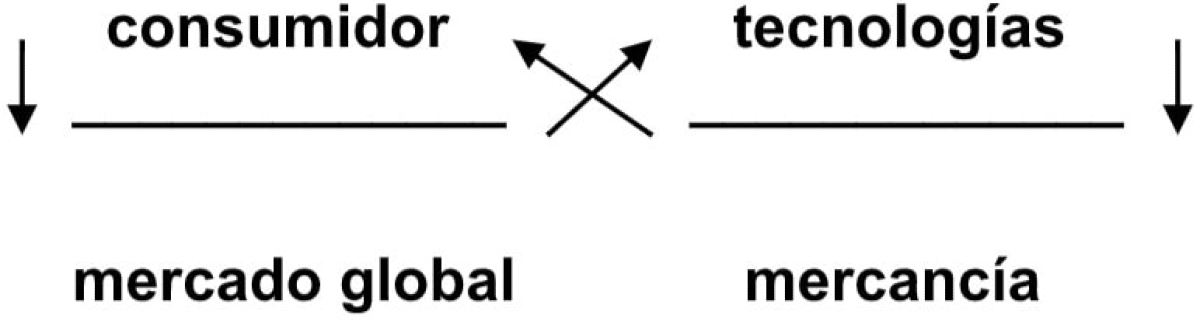
From the worker who sells his labor power (Marx) to the subject who, on top of selling it, puts his jouissance into circulation. It is this subtlety that many Marxists overlook and that, for instance, Peronism knew how to read: the greatness of the Nation, but first the happiness of the people.
Capitalism doesn't only produce commodities for the subject, it produces the subject itself as a commodity and as a source of surplus-jouissance.
Deleuze and Guattari describe something similar when they speak of deterritorialized flows. Capitalism releases flows only to immediately capture them again; it never lets them circulate completely. Acceleration always produces a new capture.
The feedback loops thus turn out to be an analogy for the drive circuit in its first, homeostatic version: positive loops as jouissance and negative ones as the interdiction of knowledge, though bearing in mind that all knowledge eventually implies a satisfaction of the drive, a jouissance of meaning or, in plain terms, intellectual masturbation.
For Deleuze, desiring-machines are still machines of the unconscious. For Land they are autonomous, self-propelled techno-economic processes (AI, the crypto market, algorithms, etc.). Here the philosophical mutation: the machine stops being psychological and becomes cosmological. But it is in that move away from the psy that we can, unexpectedly and paradoxically, take up the human question again by way of the drive.
At the same time we can open a dialogue between Freud, Lacan, Deleuze and Guattari, and Land without reducing any one of them to the others, formulating a thesis that, as far as I know, has not been systematically developed: accelerationism does not accelerate desire but the drive circuit. The drive contains what Land ends up privileging: automatism, repetition, circuit, impersonality, indifference toward the object and a dynamic that can dispense with the conscious subject. The drive as the true metapsychological "engine" of accelerationism, with desire being merely one of its subjective effects.
Did Land, unconsciously, produce an ontology of the drive? The Landian machine as an emancipation of the drive from the psychological subject. Land retroilluminates Freud not because Freud foresaw digital capitalism but because the formal logic of the drive describes the dynamics of contemporary machines better than many cybernetic theories do.
Land retroilluminates Freud not because Freud foresaw digital capitalism but because the formal logic of the drive describes the dynamics of contemporary machines better than many cybernetic theories do.
That is why a critical awareness of the possible uses of the drive is pertinent in order to steer accelerationist political discussion and action. Our human security system, besides drawing on Kantian dikes and on rights, must also include the symbolic treatment of the real that jouissance in the body implies.
By drive we mean an episteme or system of thought, subversive because unsettling, a signifying enigma made flesh. The drive circuit has the power to relieve cognitive rhetoric (whether left- or right-wing) precisely where its sometimes messianic illusion of "feedback" is stripped bare as self-limitation, technical rather than ethical. We're talking about a retrofuturist notion with the capacity to project a post-capitalism with room for singularity and the common, understanding the former less as the human sciences do than as quantum mechanics conceives it.
Widening the battlefield of the drive from within accelerationism allows us to rethink the treatment of complex psychic problems: impulses, addictions, anhedonic states, the traumatic, helplessness and disaffiliation.
What is anxious depression if not the raw subjective expression of accelerationism?
The unconscious is the human "by default" [default]. The Freudian hack consists in a bizarre (brave) poiesis, spiritually embodied, where the neurotic algorithm begins to spit out heartfelt poetry. Hence the relevance of a failingly modern apparatus for fighting techno-esoteric capital.
In a psychoanalysis you can't do many things, only one, present from its very beginnings, prior to but nonexistent before its founding, and which in fact gave it its specificity: the art of affecting reality without denying it. We're talking about operating on the affective in its very materiality, bringing about a work of fantasizing that runs counter to alienation. A subtle intensity that allows you to sit in silence with the ghosts.
To affect reality consists in unraveling its psychic quantities, which are morbid amounts of collapsed data (analog and ethereal) yet utterly devoid of meaning. And I'm not referring to the Internet, AI or that sort of thing, but to the digitized quality of language.
From what is said, seen and heard we make the datum pass through the flesh, making the digit pass through the slip. Out of this crack we attempt an inhabitable abyss of desire. Being able to look at and speak the abyss without having to throw yourself in.
A kind of transmutation, a more or less secular Eucharist. Making the intangible conscious, operating the unconscious within the tangible. Cracked open, we bend reality precisely where the digital makes it unlivable.
The unconscious is founded by breaking the virtuality of repetition and stops being mere neurosis of destiny in order to function as a hyperstition, with the drive as its raw material: acc/drive.
Y a cada colaborador se le paga por su trabajo. Las dos cosas dependen de los suscriptores.